


Pretreatment nutritional status and response to checkpoint inhibitors in lung cancer
- PMID: 32346405
- PMCID: PMC7186851
- DOI: 10.2217/lmt-2020-0008
Pretreatment nutritional status and response to checkpoint inhibitors in lung cancer
Abstract
Background: Checkpoint inhibitors are integral to non-small-cell lung cancer treatment. Existing data suggests that nutritional status may play a role in antitumor immunity.
Materials & methods: This retrospective study of 106 non-small-cell lung cancer patients who started checkpoint inhibitors between 2014 and 2017 at our institution assessed relationship of nutritional parameters to overall survival (OS) and progression-free survival.
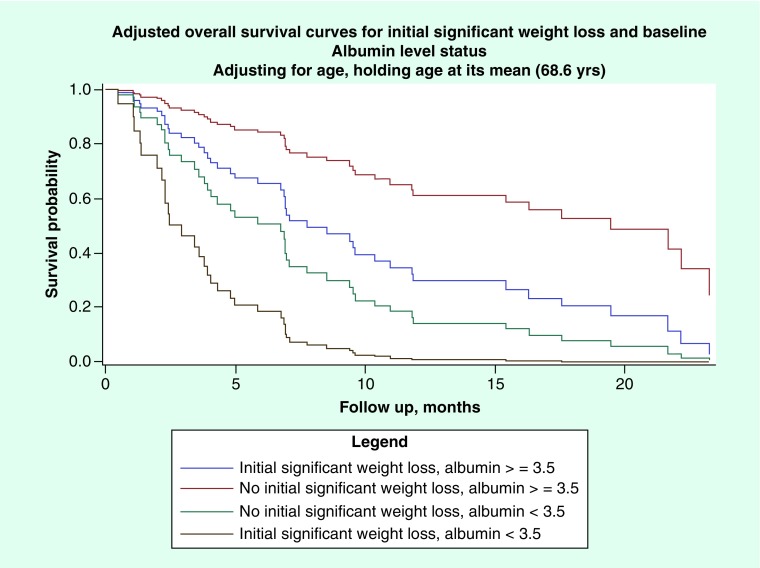
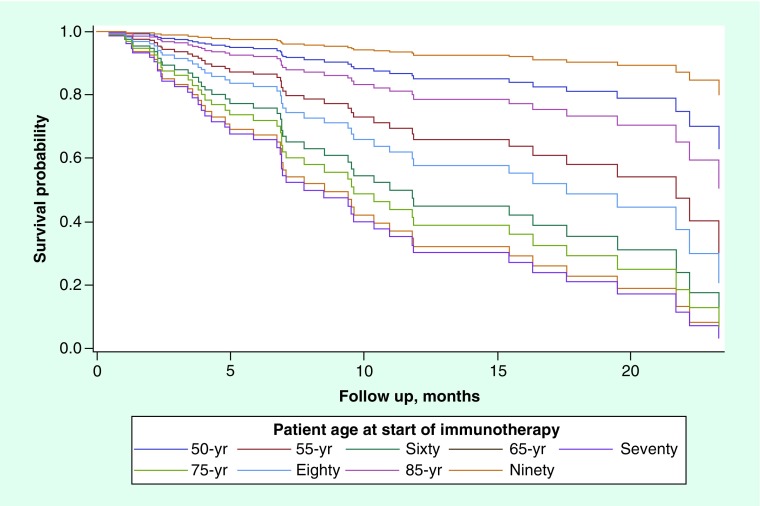
Results: Mean age was 68.7 ± 9.2 years and 59.4% patients were male. On multivariate analysis for OS, hypoalbuminemia and significant weight loss were prognostic at p-values of 0.0005 and 0.0052, respectively. We noted a parabolic association between age and OS (p = 0.026, 0.0025).
Conclusion: In our study, some malnutrition parameters were associated with decreased OS. U-shape relationship between age and OS noted here warrants further evaluation.
Keywords: immunotherapy; malnutrition; non-small-cell lung cancer.
© 2020 Chung-Shien Lee.
Conflict of interest statement
Financial & competing interests disclosure N Seetharamu has served on the advisory boards for Genentech and AstraZeneca in the last year. The authors have no other relevant affiliations or financial involvement with any organization or entity with a financial interest in or financial conflict with the subject matter or materials discussed in the manuscript apart from those disclosed. No writing assistance was utilized in the production of this manuscript.
Figures
References
-
- Bray F, Ferlay J, Soerjomataram I, Siegel RL, Torre LA, Jemal A. Global cancer statistics 2018: GLOBOCAN estimates of incidence and mortality worldwide for 36 cancers in 185 countries. CA Cancer J. Clin. 68(6), 394–424 (2018). - PubMed
-
- Siegel RL, Miller KD, Jemal A. Cancer statistics, 2019. CA Cancer J. Clin. 69(1), 7–34 (2019). - PubMed
LinkOut - more resources
Full Text Sources
