


Comment
doi: 10.1007/s00134-020-06059-6.
Epub 2020 Apr 28.
Facing COVID-19 in the ICU: vascular dysfunction, thrombosis, and dysregulated inflammation
Affiliations
- PMID: 32347323
- PMCID: PMC7186535
- DOI: 10.1007/s00134-020-06059-6
Item in Clipboard
Comment
Facing COVID-19 in the ICU: vascular dysfunction, thrombosis, and dysregulated inflammation
Intensive Care Med.
2020 Jun.
No abstract available
Conflict of interest statement
ML received research funds from the french ministry of health, research support from Shingotec, lecture fees from Baxter and Fresenius and consulting fees from Novartis. The other authors have no conflict of interest.
Figures
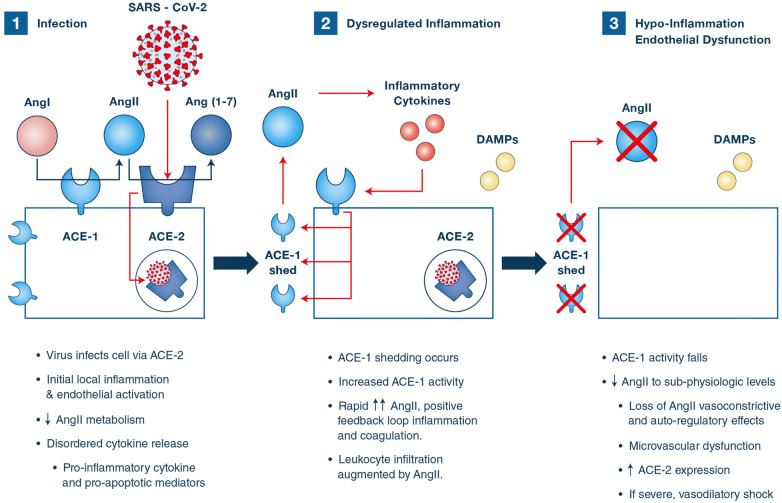
(1) The SARS-CoV-2 virus infects an endothelial cell by binding to ACE-2. Cellular infection initiates localized inflammation, endothelial activation, tissue damage, and disordered cytokine release. Membrane fusion also interrupts AngII metabolism, leading to an increase in AngII and a decrease in Ang (1–7), augmenting inflammation, endothelial activation, and leukocyte and platelet recruitment. (2) Pulmonary endothelial activation leads to the ACE-1 shedding phenomenon, where ACE-1 is rapidly liberated from the cell membrane. This produces an initial rapid rise in AngII, which can induce a positive feedback loop enhancing local inflammation, coagulation, and capillary leak. (3) The transiently increased ACE-1 dissipates, leading to subphysiologic AngII concentrations. Low AngII in this phase leads to vasodilation, worsened capillary leak, and impaired endothelial conductance and autoregulation. Low systemic AngII also upregulates ACE-2, possibly increasing susceptibility to SARS-CoV-2 in remote tissue. ACE, angiotensin-converting enzyme; AngI, angiotensin-I; AngII, angiotensin-II; Ang (1–7), angiotensin (1–7); DAMPs, damage-associated molecular pattern molecules
Comment in
-
Don't lose sight of maintenance fluids' main role: to provide free water!Intensive Care Med. 2020 May;46(5):1074-1076. doi: 10.1007/s00134-020-05989-5. Epub 2020 Mar 11. Intensive Care Med. 2020. PMID: 32162031 No abstract available.
Comment on
-
COVID-19 Does Not Lead to a "Typical" Acute Respiratory Distress Syndrome.Am J Respir Crit Care Med. 2020 May 15;201(10):1299-1300. doi: 10.1164/rccm.202003-0817LE. Am J Respir Crit Care Med. 2020. PMID: 32228035 Free PMC article. No abstract available.
-
COVID-19 pneumonia: different respiratory treatments for different phenotypes?Intensive Care Med. 2020 Jun;46(6):1099-1102. doi: 10.1007/s00134-020-06033-2. Epub 2020 Apr 14. Intensive Care Med. 2020. PMID: 32291463 Free PMC article. No abstract available.
References
-
- Sinha P, Delucchi KL, McAuley DF, O’Kane CM, Matthay MA, Calfee CS. Development and validation of parsimonious algorithms to classify acute respiratory distress syndrome phenotypes: a secondary analysis of randomised controlled trials. Lancet Respir Med. 2020;8(3):247–257. doi: 10.1016/S2213-2600(19)30369-8. - DOI - PMC - PubMed
