. 2020 Apr;128(4):47009.
doi: 10.1289/EHP6422. Epub 2020 Apr 29.

Air Pollutant Exposure and Stove Use Assessment Methods for the Household Air Pollution Intervention Network (HAPIN) Trial

Affiliations

Air Pollutant Exposure and Stove Use Assessment Methods for the Household Air Pollution Intervention Network (HAPIN) Trial

Michael A Johnson et al. Environ Health Perspect. 2020 Apr.

Abstract

Background: High quality personal exposure data is fundamental to understanding the health implications of household energy interventions, interpreting analyses across assigned study arms, and characterizing exposure-response relationships for household air pollution. This paper describes the exposure data collection for the Household Air Pollution Intervention Network (HAPIN), a multicountry randomized controlled trial of liquefied petroleum gas stoves and fuel among 3,200 households in India, Rwanda, Guatemala, and Peru.

Objectives: The primary objectives of the exposure assessment are to estimate the exposure contrast achieved following a clean fuel intervention and to provide data for analyses of exposure-response relationships across a range of personal exposures.

Methods: Exposure measurements are being conducted over the 3-y time frame of the field study. We are measuring fine particulate matter [PM < 2.5μm in aerodynamic diameter (PM2.5)] with the Enhanced Children's MicroPEM™ (RTI International), carbon monoxide (CO) with the USB-EL-CO (Lascar Electronics), and black carbon with the OT21 transmissometer (Magee Scientific) in pregnant women, adult women, and children <1 year of age, primarily via multiple 24-h personal assessments (three, six, and three measurements, respectively) over the course of the 18-month follow-up period using lightweight monitors. For children we are using an indirect measurement approach, combining data from area monitors and locator devices worn by the child. For a subsample (up to 10%) of the study population, we are doubling the frequency of measurements in order to estimate the accuracy of subject-specific typical exposure estimates. In addition, we are conducting ambient air monitoring to help characterize potential contributions of PM2.5 exposure from background concentration. Stove use monitors (Geocene) are being used to assess compliance with the intervention, given that stove stacking (use of traditional stoves in addition to the intervention gas stove) may occur.

Conclusions: The tools and approaches being used for HAPIN to estimate personal exposures build on previous efforts and take advantage of new technologies. In addition to providing key personal exposure data for this study, we hope the application and learnings from our exposure assessment will help inform future efforts to characterize exposure to household air pollution and for other contexts. https://doi.org/10.1289/EHP6422.


Figures
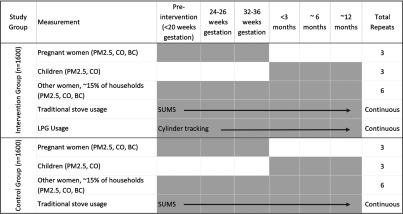
Figure 1 is a tabular representation having 9 columns, listing (1) Study group, (2) Measurement, (3) Pre-intervention (less than 20 weeks gestation), (4) 24 to 26 weeks gestation, (5) 32 to 36 weeks gestation, (6) less than 3 months, (7) approximately 6 months, (8) approximately 12 months, and (9) total repeats. There are two study groups, namely, Intervention group (n equals 1,600) and control group (n equals 1,600). The measurements are for the following: (A) Pregnant women (PM2.5, CO, BC); (B) Children (PM2.5, CO); (C) Other women, approximately 15 percent of households (PM2.5, CO, BC); (D) Traditional stove usage having pre-intervention S U M S; and (E) liquified petroleum gas usage having pre-intervention Cylinder tracking. Within the Intervention group, the measurements for A, B, C, D, and E were 3 total repeats comprising columns 3, 4, and 5; 3 total repeats comprising columns 6, 7, and 8; 6 total repeats comprising columns 3, 4, 5, 6, 7, and 8; continuous total repeats comprising the sums of columns 3 to 8; and continuous total repeats comprising the cylinder tracking of columns 3 to 8, respectively. Within the Control group, the measurements for A, B, C, and D were 3 total repeats comprising columns 3, 4, and 5; 3 total repeats comprising columns 6, 7, and 8; 6 total repeats comprising columns 3, 4, 5, 6, 7, and 8; and continuous total repeats comprising the sums of columns 3 to 8 respectively.
Figure 1.
Exposure assessment timeline including frequency of assessment for intervention and control households. The intervention arm will have gas stoves, whereas the control arm will use traditional biomass stoves. In each country, direct personal measurements will be collected for 800 pregnant women during gestation and an estimated 120 older women, 40–79 years of age, living in the same households. Indirect measurements of personal exposure using a microenvironmental approach will be conducted on 800 infants from birth to 1 year of age. Traditional biomass stove usage will be continuously measured by stove use monitors during the trial, whereas gas usage will be tracked by the number of cylinders used by each household throughout the trial. Note: BC, black carbon; CO, carbon monoxide; LPG, liquid petroleum gas; PM2.5, particulate matter <2.5μm in aerodynamic diameter.
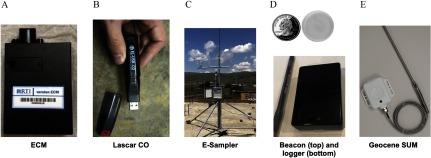
Figure 2 shows real-life photographs of the following: ECM, Lascar CO, E-sampler, Beacon and Beacon logger, and Geocene S U M.
Figure 2.
(A) Enhanced Children’s MicroPEM™ (ECM) developed by RTI International; (B) CO data logger, model EL-USB-300 (Lascar Electronics); (C) E-Sampler (Met One Instruments) installed in the Peru site; Beacon (Model O Roximity Inc.); (D) Beacon Logger (Berkeley Air Monitoring Group); and (E) Geocene stove use monitors (Geocene). [Photo credits: Michael Johnson (A), Ricardo Piedrahita (B), Ajay Pillarisetti (C), and Ricardo Piedrahita (D), and Daniel Wilson (E).]
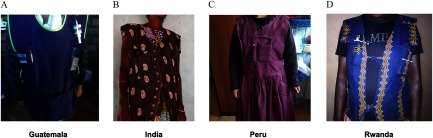
Figure 3 shows photographs of participants from Guatemala, India, Peru, and Rwanda, each wearing a vest or an apron and with their faces not captured in the camera.
Figure 3.
Example photos of participants wearing customized vests and/or aprons with exposure monitoring equipment. (A) Guatemala; (B) India; (C) Peru; and (D) Rwanda. The picture of the sampling garment in Guatemala was taken when a pump and cyclone setup was also being compared with the Enhanced Children’s MicroPEM™ (ECM) during Household Air Pollution Intervention Network (HAPIN)’s formative research phase. [Photo credits: Eric Mollinedo (A), Thangavel Gurusamy (B), Vanessa Burrowes (C), and Ephrem Dusabimana (D)].

References

    1. Adetona O, Reinhardt TE, Domitrovich J, Broyles G, Adetona AM, Kleinman MT, et al. 2016. Review of the health effects of wildland fire smoke on wildland firefighters and the public. Inhal Toxicol 28(3):95–139, PMID: 26915822, 10.3109/08958378.2016.1145771. - DOI - PubMed
    1. Balakrishnan K, Ghosh S, Thangavel G, Sambandam S, Mukhopadhyay K, Puttaswamy N, et al. 2018. Exposures to fine particulate matter (PM2.5) and birthweight in a rural-urban, mother-child cohort in Tamil Nadu, India. Environ Res 161:524–531, PMID: 29227900, 10.1016/j.envres.2017.11.050. - DOI - PubMed
    1. Balakrishnan K, Mehta S, Ghosh S, Johnson MA, Brauer M, Naeher L, et al. 2014. WHO indoor air quality guidelines: household fuel combustion. Review 5: population levels of household air pollution and exposures. http://www.who.int/airpollution/guidelines/household-fuel-combustion/Rev.... [accessed 7 April 2020].
    1. Balakrishnan K, Sambandam S, Ramaswamy P, Mehta S, Smith KR. 2004. Exposure assessment for respirable particulates associated with household fuel use in rural districts of Andhra Pradesh, India. J Expo Sci Environ Epidemiol 14(suppl 1):S14–S25, PMID: 15118741, 10.1038/sj.jea.7500354. - DOI - PubMed
    1. Baumgartner J, Zhang Y, Schauer JJ, Huang W, Wang Y, Ezzati M. 2014. Highway proximity and black carbon from cookstoves as a risk factor for higher blood pressure in rural China. Proc Natl Acad Sci USA 111(36):13229–13234, PMID: 25157159, 10.1073/pnas.1317176111. - DOI - PMC - PubMed

Publication types

MeSH terms