. 2020 Apr 29;15(4):e0224720.
doi: 10.1371/journal.pone.0224720. eCollection 2020.

Ischaemic preconditioning and pharmacological preconditioning with dexmedetomidine in an equine model of small intestinal ischaemia-reperfusion

Affiliations

Ischaemic preconditioning and pharmacological preconditioning with dexmedetomidine in an equine model of small intestinal ischaemia-reperfusion

Kathrin S König et al. PLoS One. .

Abstract

Small intestinal strangulation associated with ischaemia-reperfusion injury (IRI) is common in horses. In laboratory animals IRI can be ameliorated by ischaemic preconditioning (IPC) and pharmacological preconditioning (PPC) with dexmedetomidine. The aim of this study was to determine the effect of PPC with dexmedetomidine or IPC in an equine model of small intestinal ischaemia-reperfusion (IR). In a randomized controlled experimental trial, 15 horses were assigned to three groups: control (C), IPC, and PPC with dexmedetomidine (DEX). All horses were placed under general anaesthesia and 90% jejunal ischaemia was induced for 90 minutes, followed 30 minutes of reperfusion. In group IPC, three short bouts of ischaemia and reperfusion were implemented, and group DEX received a continuous rate infusion of dexmedetomidine prior to the main ischaemia. Jejunal biopsies were collected before ischaemia (P), and at the end of ischaemia (I) and reperfusion (R). Mucosal injury was assessed by the Chiu-Score, inflammatory cells were stained by cytosolic calprotectin. The degree of apoptosis and cell necrosis was assessed by cleaved-caspase-3 and TUNEL. Parametric data were analyzed by two-way ANOVA for repeated measurements followed by Dunnetts t-test. Non parametric data were compared between groups at the different time points by a Kruskal-Wallis-Test and a Wilcoxon-2-Sample-test. The mucosal injury score increased during I in all groups. After reperfusion, IRI further progressed in group C, but not in IPC and DEX. In all groups the number of cleaved caspase-3 and TUNEL positive cells increased from P to I. The number of TUNEL positive cells were lower in group DEX compared to group C after I and R. Infiltration with calprotectin positive cells was less pronounced in group DEX compared to group C, whereas in group IPC more calprotectin positive cells were seen. In conclusion, IPC and DEX exert protective effects in experimental small intestinal ischaemia in horses.


Conflict of interest statement

The authors have declared that no competing interests exist.

Figures

Fig 1
Fig 1. Representative microscopic images of the intestinal mucosa stained with HE, characterized according to a modified Chiu score (Grade 0–5; 0 = normal; 5 = complete loss of villi).
(A) Pre-ischemia sample, grade 0; (B) Ischaemia sample with epithelial separation from the lamina propria over one-third to one-half of the lamina propria, grade 3; (C) Ischaemia sample, with near to complete epithelial separation and cellular debris in the intestinal lumen, grade 4.
Fig 2
Fig 2
Representative microscopic images of the intestinal mucosa after ischaemia with cleaved caspase-3 staining (A) and TUNEL staining (B). The arrows indicate cleaved caspase 3 positive cells or TUNEL-positive cells.
Fig 3
Fig 3. Tukey box and whisker plot of the effect of dexmedetomidine and ischaemic preconditioning on mucosal injury score (modified Chiu score, grade 0–5) in an equine intestinal IR model.
* indicates a significant difference within groups (p < 0.05), # indicates a significant difference compared to the control group at the same time point (p < 0.05); P = pre-ischaemia; I = ischaemia; R = reperfusion. Boxes represent the interquartile range, the horizontal line is the median, the whiskers indicate 1.5 x the interquartile range, open circles represent outliers.
Fig 4
Fig 4
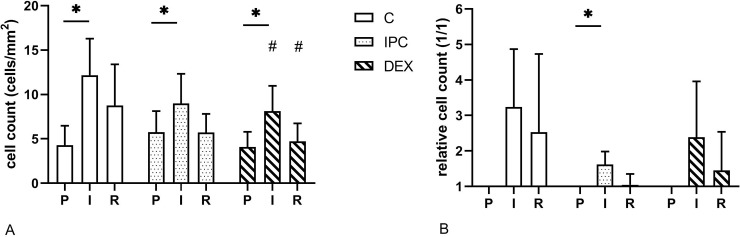
Mean (SD) of the effect of dexmedetomidine and ischaemic preconditioning on absolute (A) and relative (B) number of cleaved caspase 3 positive cells in an equine intestinal IR model. * indicates a significant difference to the pre-ischemia sample within groups (p < 0.05), P = pre-ischaemia; I = ischaemia; R = reperfusion.
Fig 5
Fig 5
Mean (SD) of the effect of dexmedetomidine and ischaemic preconditioning on absolute (A) and relative (B) number of TUNEL positive cells in an equine intestinal IR model. * indicates a significant difference to the pre-ischemia sample within groups (p < 0.05), # indicates a significant difference compared to the control group at the same time point (p < 0.05); P = pre-ischaemia; I = ischaemia; R = reperfusion.

References

    1. Tinker MK, White NA, Lessard P, Thatcher CD, Pelzer KD, et al. (1997) Prospective study of equine colic incidence and mortality. Equine Vet J 29: 448–453. 10.1111/j.2042-3306.1997.tb03157.x - DOI - PubMed
    1. Kaneene JB, Ross WA, Miller R (1997) The Michigan equine monitoring system. II. Frequencies and impact of selected health problems. Prev Vet Med 29: 277–292. 10.1016/s0167-5877(96)01080-x - DOI - PubMed
    1. Mair TS, Smith LJ (2005) Survival and complication rates in 300 horses undergoing surgical treatment of colic. Part 1: Short-term survival following a single laparotomy. Equine Vet J 37: 296–302. 10.2746/0425164054529409 - DOI - PubMed
    1. Tomai F, Crea F, Chiariello L, Gioffre PA (1999) Ischemic preconditioning in humans: models, mediators, and clinical relevance. Circulation 100: 559–563. 10.1161/01.cir.100.5.559 - DOI - PubMed
    1. Cheung MM, Kharbanda RK, Konstantinov IE, Shimizu M, Frndova H, et al. (2006) Randomized controlled trial of the effects of remote ischemic preconditioning on children undergoing cardiac surgery: first clinical application in humans. J Am Coll Cardiol 47: 2277–2282. 10.1016/j.jacc.2006.01.066 - DOI - PubMed

Publication types

MeSH terms

Substances