Review
. 2020 Aug:507:167-173.
doi: 10.1016/j.cca.2020.04.027. Epub 2020 Apr 26.

Hyperinflammation and derangement of renin-angiotensin-aldosterone system in COVID-19: A novel hypothesis for clinically suspected hypercoagulopathy and microvascular immunothrombosis

Affiliations
Review

Hyperinflammation and derangement of renin-angiotensin-aldosterone system in COVID-19: A novel hypothesis for clinically suspected hypercoagulopathy and microvascular immunothrombosis

Brandon Michael Henry et al. Clin Chim Acta. 2020 Aug.

Abstract

Early clinical evidence suggests that severe cases of coronavirus disease 2019 (COVID-19), caused by the severe acute respiratory syndrome coronavirus 2 (SARS-CoV-2), are frequently characterized by hyperinflammation, imbalance of renin-angiotensin-aldosterone system, and a particular form of vasculopathy, thrombotic microangiopathy, and intravascular coagulopathy. In this paper, we present an immunothrombosis model of COVID-19. We discuss the underlying pathogenesis and the interaction between multiple systems, resulting in propagation of immunothrombosis, which through investigation in the coming weeks, may lead to both an improved understanding of COVID-19 pathophysiology and identification of innovative and efficient therapeutic targets to reverse the otherwise unfavorable clinical outcome of many of these patients.

Keywords: COVID-19; Coagulation; Coronavirus; Endothelial dysfunction; Thrombosis.


Figures

Fig. 1
Fig. 1
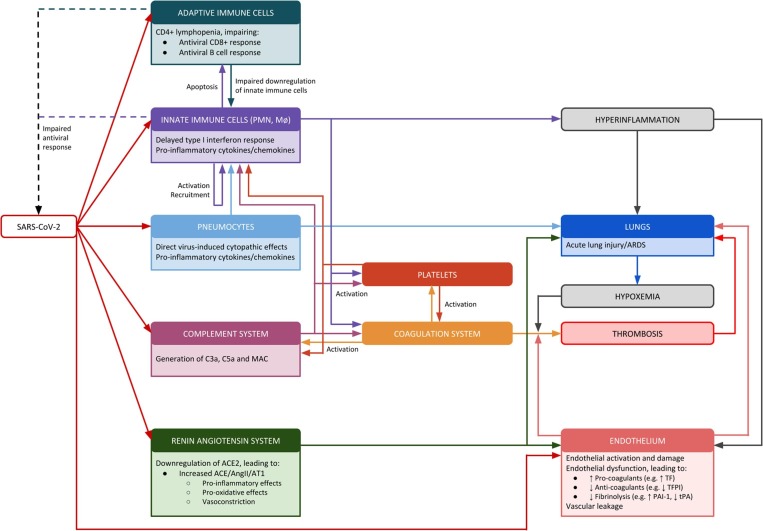
Pathophysiologic Model of Immunothrombisis in COVID-19. SARS-CoV-2 is associated with an impaired antiviral host response, leading to rapid viral replication and a subsequent hyperinflammatory state. The hyperinflammation and virus-induced dysregulation of the renin angiotensin aldosterone system (RAAS) induces acute lung injury, leading to hypoxemia. Together, hyperinflammation, RAAS and hypoxemia induces endothelial dysfunction and a hypercoagulable state leading to widespread immunothrombosis which further propagates organ damage. ACE = angiotensin converting enzyme, ACE2 = angiotensin converting enzyme 2, AngII = angiotensin II, ARDS = acute respiratory distress syndrome, AT1 = angiotensin II receptor type 1, MAC = membrane attack complex, Mø = monocytes/macrophages, PAI-1 = plasminogen activator inhibitor-1, PMN = polymorphonuclear neutrophils, SARS-CoV-2 = severe acute respiratory syndrome coronavirus 2, TF = tissue factor, TFPI = tissue factor pathway inhibitor, tPA = tissue plasminogen activator.
Fig. 2
Fig. 2
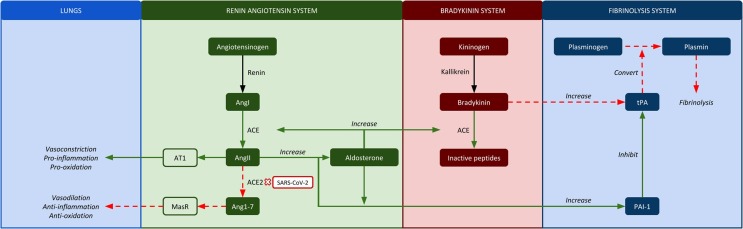
Potential interactions between renin angiotensin system, bradykinin system and fibrinolysis in severe COVID-19. Arrows demonstrate interactions. Italic script depicts the function of the molecule/enzyme in a normal state. The color of the arrows demonstrate how SARS-CoV-2 may influence their function. Green solid arrow means that the process (in italics) is enhanced in COVID-19, while red dashed arrow means that the process (in italics) is suppressed in COVID-19. As an example, in COVID-19 decreased ACE2 increases AngII, which increases aldosterone, which augments ACE expression, causing increased breakdown of bradykinin, thereby preventing the normal bradykinin-mediated increase in tPA). ACE = angiotensin converting enzyme, ACE2 = angiotensin converting enzyme 2, AngI = angiotensin I, AngII = angiotensin II, Ang1-7 = angiotensin 1–7, AT1 = angiotensin II receptor type 1, MasR = Mas receptor, PAI-1 = plasminogen activator inhibitor-1, SARS-CoV-2 = severe acute respiratory syndrome coronavirus 2, tPA = tissue plasminogen activator. (For interpretation of the references to color in this figure legend, the reader is referred to the web version of this article.)

References

    1. Lippi G., Favaloro E.J. D-dimer is associated with severity of coronavirus disease 2019: a pooled analysis. Thromb. Haemost. 2020 doi: 10.1055/s-0040-1709650. - DOI - PMC - PubMed
    1. Henry B.M., de Oliveira M.H.S., Benoit S., Plebani M., Lippi G. Hematologic, biochemical and immune biomarker abnormalities associated with severe illness and mortality in coronavirus disease 2019 (COVID-19): a meta-analysis. Clin. Chem. Lab. Med. (CCLM). 2020;1 doi: 10.1515/cclm-2020-0369. - DOI - PubMed
    1. G. Lippi, M. Plebani, B.M. Henry, Thrombocytopenia is associated with severe coronavirus disease 2019 (COVID-19) infections: A meta-analysis, Clin. Chim. Acta. 506 (2020) 145–148. https://doi.org/10.1016/j.cca.2020.03.022. - PMC - PubMed
    1. Thachil J. The versatile heparin in COVID-19. J. Thromb. Haemost. 2020 doi: 10.1111/jth.14821. - DOI - PMC - PubMed
    1. W. Luo, H. Yu, J. Gou, X. Li, Y. Sun, J. Li, L. Liu, Clinical Pathology of Critical Patient with Novel Coronavirus Pneumonia (COVID-19), (2020). https://www.preprints.org/manuscript/202002.0407/v1 (accessed April 5, 2020).

MeSH terms