Review
. 2020 Apr 29;12(1):43.
doi: 10.1186/s13073-020-00734-5.

Translating insights from neuropsychiatric genetics and genomics for precision psychiatry

Affiliations
Review

Translating insights from neuropsychiatric genetics and genomics for precision psychiatry

Elliott Rees et al. Genome Med. .

Abstract

The primary aim of precision medicine is to tailor healthcare more closely to the needs of individual patients. This requires progress in two areas: the development of more precise treatments and the ability to identify patients or groups of patients in the clinic for whom such treatments are likely to be the most effective. There is widespread optimism that advances in genomics will facilitate both of these endeavors. It can be argued that of all medical specialties psychiatry has most to gain in these respects, given its current reliance on syndromic diagnoses, the minimal foundation of existing mechanistic knowledge, and the substantial heritability of psychiatric phenotypes. Here, we review recent advances in psychiatric genomics and assess the likely impact of these findings on attempts to develop precision psychiatry. Emerging findings indicate a high degree of polygenicity and that genetic risk maps poorly onto the diagnostic categories used in the clinic. The highly polygenic and pleiotropic nature of psychiatric genetics will impact attempts to use genomic data for prediction and risk stratification, and also poses substantial challenges for conventional approaches to gaining biological insights from genetic findings. While there are many challenges to overcome, genomics is building an empirical platform upon which psychiatry can now progress towards better understanding of disease mechanisms, better treatments, and better ways of targeting treatments to the patients most likely to benefit, thus paving the way for precision psychiatry.

Keywords: Genetics; Genomic risk scores; Precision psychiatry; Schizophrenia.


Conflict of interest statement

MO is in receipt of a research grant from Takeda Pharmaceuticals. The remaining author declares that they have no competing interests.

Figures
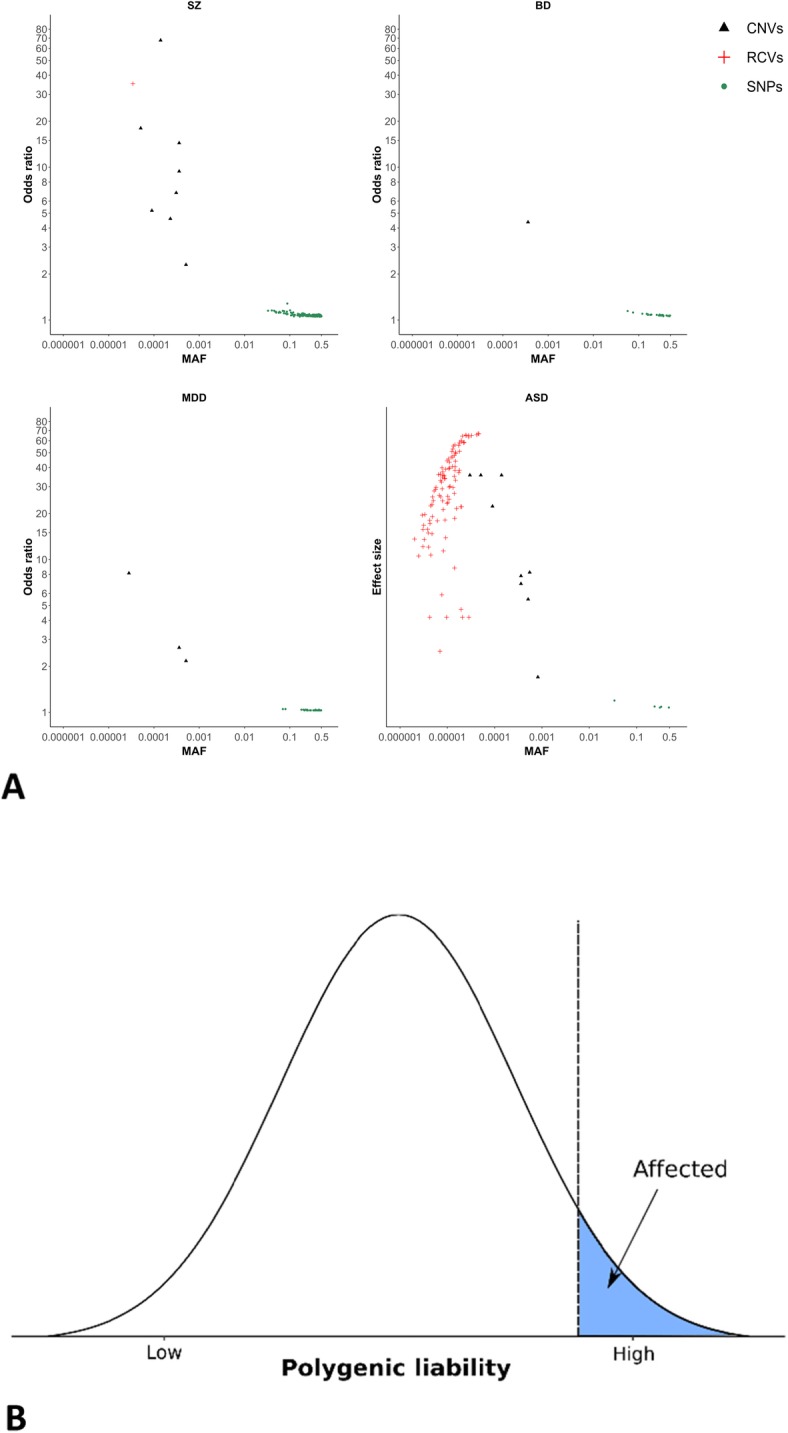
Fig. 1
Fig. 1
a Genetic associations with schizophrenia, bipolar disorder, major depressive disorder, and autism spectrum disorder. Odds ratios (y-axis, −log10, transformed to be > 1) and minor allele frequencies (MAF, x-axis, −log10, transformed to be ≤ 0.5) for single-nucleotide polymorphisms (SNPs), rare coding variants (RCVs), and rare copy number variants (CNVs), which were derived from the studies outlined in Table 2. We note that for ASD, as odds ratios have not been estimated for all classes of mutation, we have plotted the smoothed relative risk for RCVs (as reported in [14]) and odds ratios for CNVs and SNPs on the same scale, labeled as “Effect sizes,” for illustrative purposes. There is a general trend for a negative correlation between odds ratio and MAF, which reflects the degree to which selection removes risk alleles from the population. b Polygenic liability threshold model. For polygenic neuropsychiatric disorders, diverse classes of mutation contribute to liability, with additive models currently providing the best fit to the data [26]
Fig. 2
Fig. 2
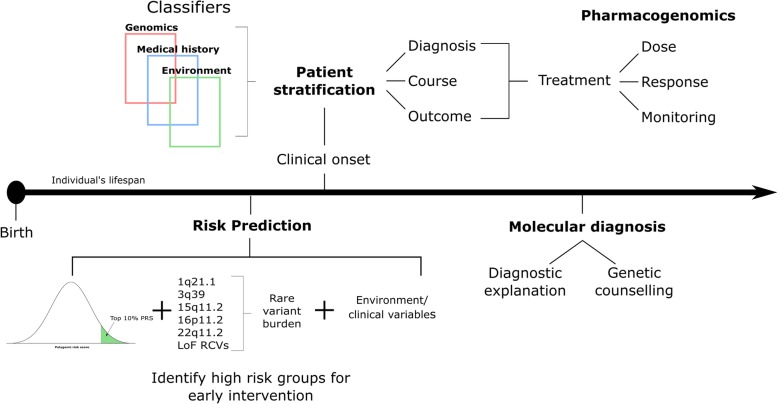
Illustration of what precision psychiatry might look like. With the increasing use of high-throughput genomic technologies in clinical genetics (e.g., the 100 K Genomes Project), it is likely that genomics will eventually have a role in psychiatric healthcare. Quantitative measures of the genetic liability to psychiatric disorders, such as polygenic risk scores, could be combined with additional clinical variables and psycho-social risk factors to help tailor treatment to the individual at several junctures across the lifespan. We briefly highlight here four key areas (risk prediction, patient stratification, pharmacogenomic and molecular diagnostics) where precision psychiatry would directly benefit the management and treatment of patients and provide a general timeline for when they could impact healthcare across an individual’s lifespan (Fig. 2). Risk prediction: Genetic risk scores could help target early intervention strategies towards those at greatest risk for developing a major psychiatric disorder. For example, schizophrenia genomic risk scores could be used to help predict which individuals from phenotypically defined high-risk groups are more likely to develop psychosis. Moreover, individuals who carry a pathogenic copy number variant could receive additional monitoring and/or screening for psychiatric and/or physical comorbidities. Patient stratification: Psychiatric disorders are associated with marked clinical variability in disease course and outcome, both within and across diagnostic categories. Research into biological and environmental exposures associated with this variability will inform stratification of patients into those that could benefit from tailored programs of treatment. Pharmacogenomics: Pharmacogenomic variants are known to influence variation in drug response. Precision psychiatry could therefore impact the way drugs are prescribed, by identifying patients most likely to benefit, predicting the dose required to maximize their therapeutic effects, and identifying patients who require additional monitoring for adverse side effects. Molecular diagnosis: No individual genetic variant is either necessary or sufficient to cause psychiatric disorders; however, the identification of rare, highly penetrant risk mutations, such as 22q11.2 deletions, can help towards providing a diagnostic explanation for the development of a psychiatric disorder. As our knowledge about the penetrance and phenotypic variability associated with rare risk variants improves, their identification among psychiatric patients will inform both genetic counseling and the examination of comorbidities

References

    1. Rees E, Moskvina V, Owen MJ, O’Donovan MC, Kirov G. De novo rates and selection of schizophrenia-associated copy number variants. Biol Psychiatry. 2011;70:1109–1114. doi: 10.1016/j.biopsych.2011.07.011. - DOI - PubMed
    1. Keller MC, Miller G. Resolving the paradox of common, harmful, heritable mental disorders: which evolutionary genetic models work best? Behav Brain Sci. 2006;29:385–404. doi: 10.1017/S0140525X06009095. - DOI - PubMed
    1. Stilo SA, Murray RM. Non-genetic factors in schizophrenia. Curr Psychiatry Rep. 2019;21:100. doi: 10.1007/s11920-019-1091-3. - DOI - PMC - PubMed
    1. Pardiñas AF, Holmans P, Pocklington AJ, Escott-Price V, Ripke S, Carrera N, et al. Common schizophrenia alleles are enriched in mutation-intolerant genes and in regions under strong background selection. Nat Genet. 2018;50:381–389. doi: 10.1038/s41588-018-0059-2. - DOI - PMC - PubMed
    1. Singh T, Kurki MI, Curtis D, Purcell SM, Crooks L, McRae J, et al. Rare loss-of-function variants in SETD1A are associated with schizophrenia and developmental disorders. Nat Neurosci. 2016;19:571–577. doi: 10.1038/nn.4267. - DOI - PMC - PubMed

Publication types