. 2020 Aug;14(8):1982-1993.
doi: 10.1038/s41396-020-0661-z. Epub 2020 Apr 29.

Syntrophic splitting of central carbon metabolism in host cells bearing functionally different symbiotic bacteria

Affiliations

Syntrophic splitting of central carbon metabolism in host cells bearing functionally different symbiotic bacteria

Nana Y D Ankrah et al. ISME J. 2020 Aug.

Abstract

Insects feeding on the nutrient-poor diet of xylem plant sap generally bear two microbial symbionts that are localized to different organs (bacteriomes) and provide complementary sets of essential amino acids (EAAs). Here, we investigate the metabolic basis for the apparent paradox that xylem-feeding insects are under intense selection for metabolic efficiency but incur the cost of maintaining two symbionts for functions mediated by one symbiont in other associations. Using stable isotope analysis of central carbon metabolism and metabolic modeling, we provide evidence that the bacteriomes of the spittlebug Clastoptera proteus display high rates of aerobic glycolysis, with syntrophic splitting of glucose oxidation. Specifically, our data suggest that one bacteriome (containing the bacterium Sulcia, which synthesizes seven EAAs) predominantly processes glucose glycolytically, producing pyruvate and lactate, and the exported pyruvate and lactate is assimilated by the second bacteriome (containing the bacterium Zinderia, which synthesizes three energetically costly EAAs) and channeled through the TCA cycle for energy generation by oxidative phosphorylation. We, furthermore, calculate that this metabolic arrangement supports the high ATP demand in Zinderia bacteriomes for Zinderia-mediated synthesis of energy-intensive EAAs. We predict that metabolite cross-feeding among host cells may be widespread in animal-microbe symbioses utilizing low-nutrient diets.


Conflict of interest statement

The authors declare that they have no conflict of interest.

Figures
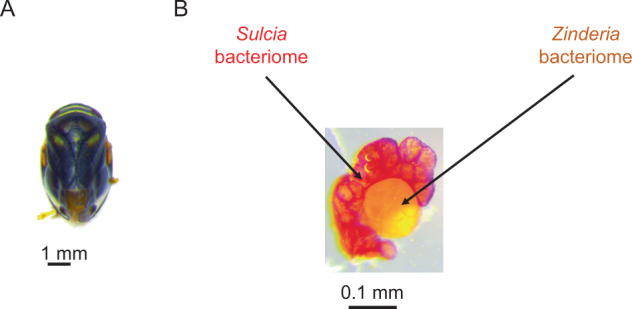
Fig. 1
Fig. 1. Images of insect used in this study and their dissected bacteriomes.
a Adult spittlebug Clastoptera proteus. b Clastoptera bacteriomes showing Sulcia (red) and Zinderia (orange) specific bacteriomes. Each paired bacteriome is readily isolated, and the Sulcia bacteriome and Zinderia bacteriome can then be separated.
Fig. 2
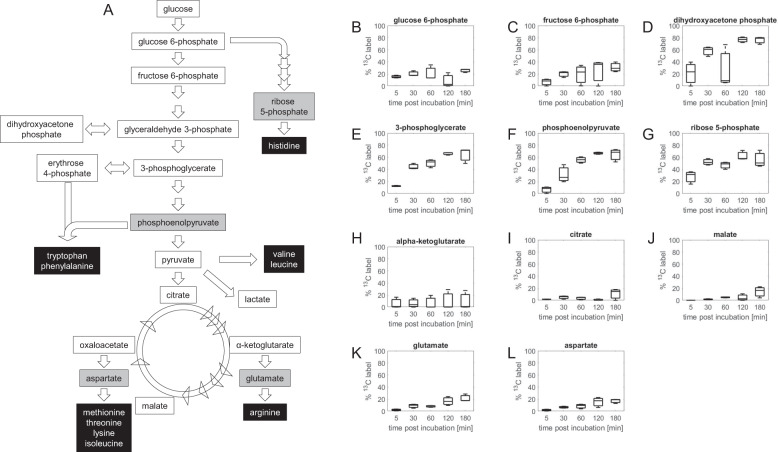
Fig. 2. Glucose-derived 13C incorporation into essential amino acid precursor metabolites.
a Schematic representation of central carbon metabolism. Essential amino acids are shown in black boxes and essential amino acid precursors monitored in this study are shown in gray boxes. Kinetic incorporation of glucose-derived 13C into bf glycolytic, g pentose-phosphate, hj TCA cycle metabolites. Kinetic incorporation of glucose-derived 13C into nonessential amino acid precursors, glutamate (k) and aspartate (l). Box-plots show the percentage of the spittlebug intracellular metabolite pool that has accumulated 13C-labeled fraction.
Fig. 3
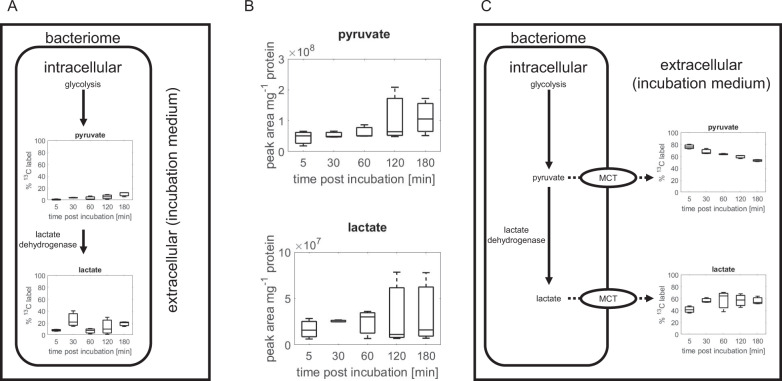
Fig. 3. Comparison of intracellular and extracellular pyruvate and lactate 13C-label incorporation during 3-h incubation.
a Intracellular pyruvate and lactate 13C-label incorporation. b Peak area count of extracellular pyruvate and lactate. c Extracellular pyruvate and lactate 13C-label incorporation. Monocarboxylate transporter (MCT) mediates bi-directional transport of pyruvate and lactate. Box-plots show the percentage of the intracellular metabolite pool that has accumulated 13C-label.
Fig. 4
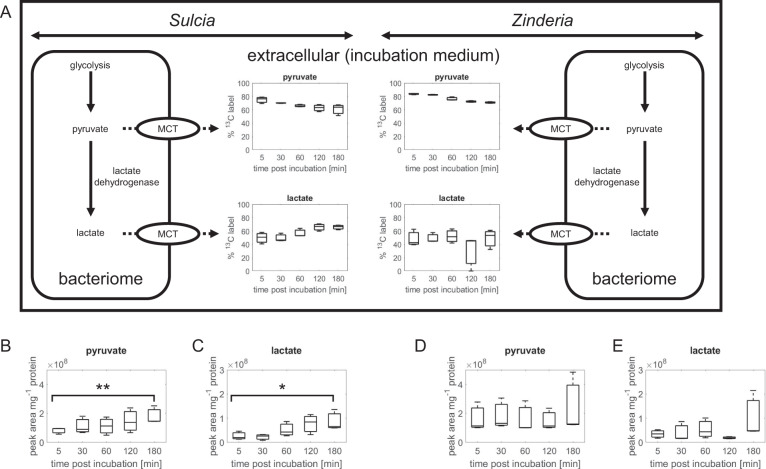
Fig. 4. Comparison of pyruvate and lactate release from Sulcia and Zinderia-spittlebug bacteriomes.
Extracellular pyruvate and lactate, expressed as percentage of 13C-label in Sulcia and Zinderia (a) and expressed as area count, for pyruvate and lactate in Sulcia (b, c) and Zinderia (d, e). Asterisks indicate significant differences between specific timepoints compared with the 5 min timepoint. *p < 0.1; **p < 0.05.
Fig. 5
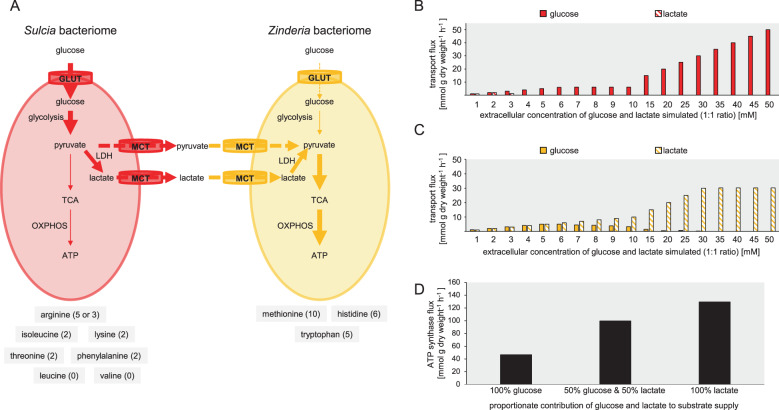
Fig. 5. Metabolic specialization in spittlebug bacteriomes.
a Model for metabolite transfer in bacteriomes. Lactate released as an end product of aerobic glycolysis from Sulcia bacteriomes is imported by Zinderia bacteriomes and oxidized to produce energy. Essential amino acids produced in each bacteriome are listed in gray boxes and energy costs (μmol ATP per μmol amino acid synthesized) for the synthesis of each amino acid are provided in parentheses. Energy costs data obtained from ref. [9]. Reaction fluxes (solid arrows) and transport fluxes (dashed arrows) are shown. Arrow thickness illustrate the magnitude of flux size, thicker arrows represent higher fluxes. GLUT glucose transporter, LDH lactate dehydrogenase, MCT monocarboxylate transporter, TCA tricarboxylic acid, OXPHOS oxidative phosphorylation, ATP adenosine triphosphate. In silico glucose and lactate choice assay for (b) Sulcia bacteriomes and (c) Zinderia bacteriomes. d In silico predictions of ATP synthase flux in Zinderia bacteriomes when provided with glucose, a mixture of glucose and lactate or lactate as carbon sources.

References

    1. Buchner P. Endoymbiosis of animals with plant microorganisms. Chichester, United Kingdom: John Wiley and Sons; 1965.
    1. McFall-Ngai M, Hadfield MG, Bosch TCG, Carey HV, Domazet-Lošo T, Douglas AE, et al. Animals in a bacterial world, a new imperative for the life sciences. Proc Natl Acad Sci USA. 2013;110:3229–36. - PMC - PubMed
    1. Douglas AE. Multiorganismal insects: diversity and function of resident microorganisms. Annu Rev Entomol. 2015;60:17–34. - PMC - PubMed
    1. McCutcheon JP, Moran NA. Extreme genome reduction in symbiotic bacteria. Nat Rev Microbiol. 2012;10:13–26. - PubMed
    1. Mattson WJ., Jr Herbivory in relation to plant nitrogen content. Annu Rev Ecol Syst. 1980;11:119–61.

Publication types