


Pregabalin as a Pain Therapeutic: Beyond Calcium Channels
- PMID: 32351366
- PMCID: PMC7174704
- DOI: 10.3389/fncel.2020.00083
Pregabalin as a Pain Therapeutic: Beyond Calcium Channels
Abstract
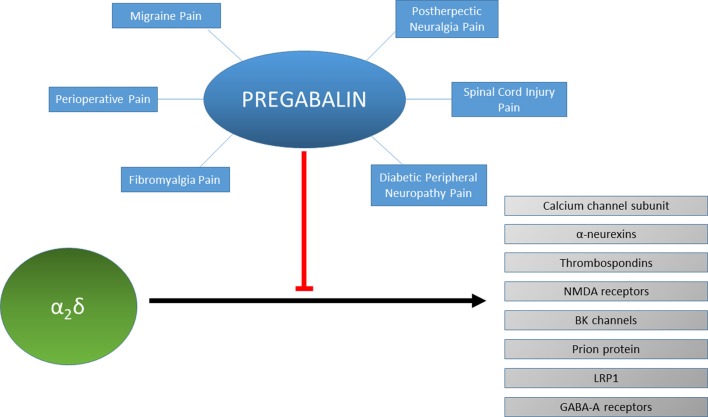
Initially developed to generate new treatments for epilepsy, gabapentin, and pregabalin ("gabapentinoids") were engineered to mimic the action of GABA and to modulate GABA metabolism. Rather than their intended pharmacological action on GABA neurotransmission, instead, they exhibit a high affinity for the α2δ-1 and α2δ-2 subunits of voltage-activated calcium channels, wherein binding of gabapentinoids inhibits cellular calcium influx and attenuates neurotransmission. Despite a lack of activity on GABA levels, gabapentin and pregabalin are effective at suppressing seizures and subsequently approved as a new class of antiepileptic therapy for partial-onset epilepsy. Through the same hypothesized molecular mechanism and by controlling neuronal hyperexcitability, gabapentinoids demonstrate clear efficacy in pain management, which has arguably been their most extensively prescribed application to date. In this review, we focus on pregabalin as a second-generation gabapentinoid widely employed in the treatment of a variety of pain conditions. We also discuss the wider functional roles of α2δ subunits and the contributions that pregabalin might play in affecting physiological and pathophysiological processes.
Keywords: calcium channel; chronic pain; hyperexcitability; pregabalin (PGB); therapeutic targets.
Copyright © 2020 Alles, Cain and Snutch.
Figures
References
-
- Alles S. R. A., Bandet M. V., Eppler K., Noh M.-C., Winship I. R., Baker G., et al. . (2017). Acute anti-allodynic action of gabapentin in dorsal horn and primary somatosensory cortex: correlation of behavioural and physiological data. Neuropharmacology 113, 576–590. 10.1016/j.neuropharm.2016.11.011 - DOI - PubMed
Publication types
LinkOut - more resources
Full Text Sources
Other Literature Sources
