


Effect of Moderate-Intensity Aerobic Exercise on Hepatic Fat Content and Visceral Lipids in Hepatic Patients with Diabesity: A Single-Blinded Randomised Controlled Trial
- PMID: 32351591
- PMCID: PMC7171632
- DOI: 10.1155/2020/1923575
Effect of Moderate-Intensity Aerobic Exercise on Hepatic Fat Content and Visceral Lipids in Hepatic Patients with Diabesity: A Single-Blinded Randomised Controlled Trial
Retraction in
-
Retracted: Effect of Moderate-Intensity Aerobic Exercise on Hepatic Fat Content and Visceral Lipids in Hepatic Patients with Diabesity: A Single-Blinded Randomised Controlled Trial.Evid Based Complement Alternat Med. 2023 Oct 10;2023:9829387. doi: 10.1155/2023/9829387. eCollection 2023. Evid Based Complement Alternat Med. 2023. PMID: 37854275 Free PMC article.
Abstract
Objective: Limited studies have assessed the effect of moderate-intensity continuous aerobic exercise on hepatic fat content and visceral lipids in hepatic patients with diabesity. This study was designed to evaluate hepatic fat content and visceral lipids following moderate-intensity continuous aerobic exercise in hepatic patients with diabesity.
Design: A single-blinded randomised controlled trial.
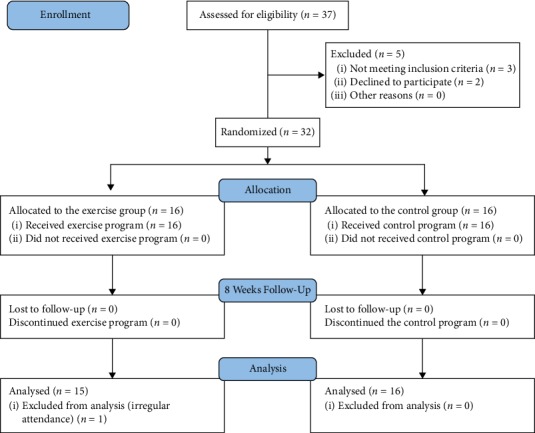
Methods: Thirty-one diabetic obese patients with nonalcoholic fatty liver disease were recruited into this study. The patients were randomly classified into exercise and control groups, fifteen patients in the exercise group and sixteen patients in the control group. The exercise group received an 8-week moderate-intensity continuous aerobic exercise program with standard medical treatment, while the control group received standard medical treatment without any exercise program. Hepatic fat content and visceral lipids were assessed before and after intervention at the end of the study.
Results: Baseline and clinical characteristics showed a nonsignificant difference between the two groups (p > 0.05). At the end of the intervention, the aerobic exercise showed significant improvements (serum triglycerides and low-density lipoproteins (LDLs), p ≤ 0.002, total cholesterol, p=0.004, visceral fats, p=0.016, glycated hemoglobin (HbA1C), p=0.022, high-density lipoproteins (HDLs), p=0.038, alanine transaminases (AL), p=0.044, intrahepatic triglyceride and HOMA-IR, p=0.046, and body mass index (BMI), p=0.047), while the control group showed a nonsignificant difference (p > 0.05). The postintervention analysis showed significant differences in favor of the aerobic exercise group (p < 0.05).
Conclusions: Moderate-intensity continuous aerobic exercise reduces the hepatic fat content and visceral lipids in hepatic patients with diabesity. Recommendations should be prescribed for encouraging moderate-intensity aerobic exercise training, particularly hepatic patients with diabesity.
Copyright © 2020 Walid Kamal Abdelbasset et al.
Conflict of interest statement
The authors declare no conflicts of interest.
Figures

References
-
- Kalra S. Diabesity. Journal of the Pakistan Medical Association. 2013;63(4):532–534. - PubMed
Publication types
LinkOut - more resources
Full Text Sources
