


COVID-19 and the 5G Conspiracy Theory: Social Network Analysis of Twitter Data
- PMID: 32352383
- PMCID: PMC7205032
- DOI: 10.2196/19458
COVID-19 and the 5G Conspiracy Theory: Social Network Analysis of Twitter Data
Abstract
Background: Since the beginning of December 2019, the coronavirus disease (COVID-19) has spread rapidly around the world, which has led to increased discussions across online platforms. These conversations have also included various conspiracies shared by social media users. Amongst them, a popular theory has linked 5G to the spread of COVID-19, leading to misinformation and the burning of 5G towers in the United Kingdom. The understanding of the drivers of fake news and quick policies oriented to isolate and rebate misinformation are keys to combating it.
Objective: The aim of this study is to develop an understanding of the drivers of the 5G COVID-19 conspiracy theory and strategies to deal with such misinformation.
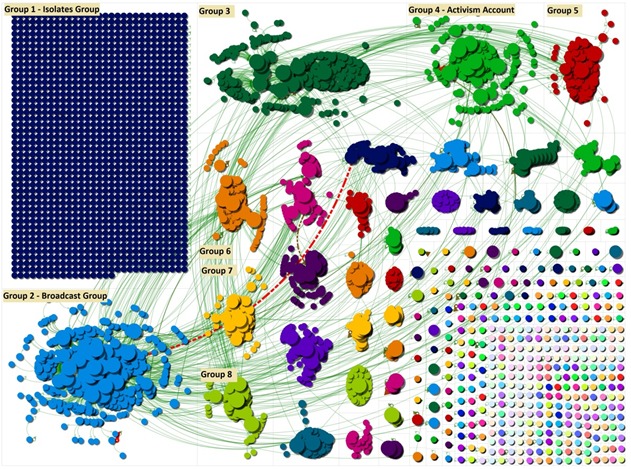
Methods: This paper performs a social network analysis and content analysis of Twitter data from a 7-day period (Friday, March 27, 2020, to Saturday, April 4, 2020) in which the #5GCoronavirus hashtag was trending on Twitter in the United Kingdom. Influential users were analyzed through social network graph clusters. The size of the nodes were ranked by their betweenness centrality score, and the graph's vertices were grouped by cluster using the Clauset-Newman-Moore algorithm. The topics and web sources used were also examined.
Results: Social network analysis identified that the two largest network structures consisted of an isolates group and a broadcast group. The analysis also revealed that there was a lack of an authority figure who was actively combating such misinformation. Content analysis revealed that, of 233 sample tweets, 34.8% (n=81) contained views that 5G and COVID-19 were linked, 32.2% (n=75) denounced the conspiracy theory, and 33.0% (n=77) were general tweets not expressing any personal views or opinions. Thus, 65.2% (n=152) of tweets derived from nonconspiracy theory supporters, which suggests that, although the topic attracted high volume, only a handful of users genuinely believed the conspiracy. This paper also shows that fake news websites were the most popular web source shared by users; although, YouTube videos were also shared. The study also identified an account whose sole aim was to spread the conspiracy theory on Twitter.
Conclusions: The combination of quick and targeted interventions oriented to delegitimize the sources of fake information is key to reducing their impact. Those users voicing their views against the conspiracy theory, link baiting, or sharing humorous tweets inadvertently raised the profile of the topic, suggesting that policymakers should insist in the efforts of isolating opinions that are based on fake news. Many social media platforms provide users with the ability to report inappropriate content, which should be used. This study is the first to analyze the 5G conspiracy theory in the context of COVID-19 on Twitter offering practical guidance to health authorities in how, in the context of a pandemic, rumors may be combated in the future.
Keywords: 5G; COVID-19; coronavirus; fake news; misinformation; pandemic; public health; social media; social network analysis; twitter.
©Wasim Ahmed, Josep Vidal-Alaball, Joseph Downing, Francesc López Seguí. Originally published in the Journal of Medical Internet Research (http://www.jmir.org), 06.05.2020.
Conflict of interest statement
Conflicts of Interest: None declared.
Figures
References
-
- Jolly G. Middle East respiratory syndrome coronavirus (MERS-CoV) TIJPH. 2016 Dec 31;4(4):351–376. doi: 10.21522/tijph.2013.04.04.art033. - DOI
-
- Smith RD. Responding to global infectious disease outbreaks: lessons from SARS on the role of risk perception, communication and management. Soc Sci Med. 2006 Dec;63(12):3113–23. doi: 10.1016/j.socscimed.2006.08.004. http://europepmc.org/abstract/MED/16978751 - DOI - PMC - PubMed
-
- World Health Organization. [2020-04-15]. Middle East respiratory syndrome coronavirus (MERS-CoV) https://www.who.int/emergencies/mers-cov/en/
-
- Sohrabi C, Alsafi Z, O'Neill N, Khan M, Kerwan A, Al-Jabir A, Iosifidis C, Agha R. World Health Organization declares global emergency: a review of the 2019 novel coronavirus (COVID-19) Int J Surg. 2020 Apr;76:71–76. doi: 10.1016/j.ijsu.2020.02.034. http://europepmc.org/abstract/MED/32112977 - DOI - PMC - PubMed
-
- Wu F, Zhao S, Yu B, Chen Y, Wang W, Song Z, Hu Y, Tao Z, Tian J, Pei Y, Yuan M, Zhang Y, Dai F, Liu Y, Wang Q, Zheng J, Xu L, Holmes EC, Zhang Y. A new coronavirus associated with human respiratory disease in China. Nature. 2020 Mar;579(7798):265–269. doi: 10.1038/s41586-020-2008-3. http://europepmc.org/abstract/MED/32015508 - DOI - PMC - PubMed
MeSH terms
LinkOut - more resources
Full Text Sources
Medical
Miscellaneous
