


Preliminary Incidence and Trends of Infections with Pathogens Transmitted Commonly Through Food - Foodborne Diseases Active Surveillance Network, 10 U.S. Sites, 2016-2019
- PMID: 32352955
- PMCID: PMC7206985
- DOI: 10.15585/mmwr.mm6917a1
Preliminary Incidence and Trends of Infections with Pathogens Transmitted Commonly Through Food - Foodborne Diseases Active Surveillance Network, 10 U.S. Sites, 2016-2019
Abstract
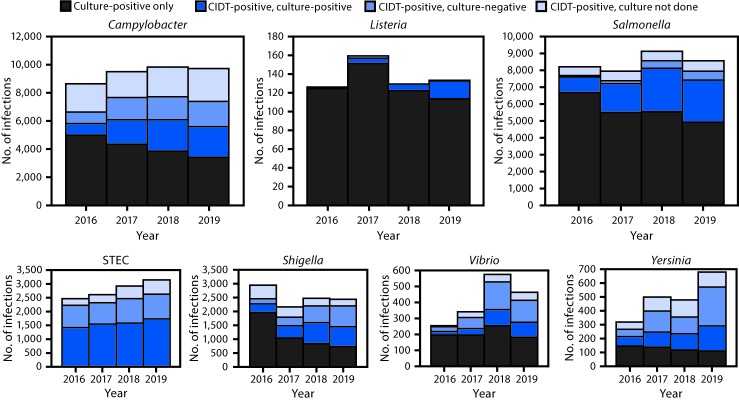
To evaluate progress toward prevention of enteric illnesses, the Foodborne Diseases Active Surveillance Network (FoodNet) of CDC's Emerging Infections Program monitors the incidence of laboratory-diagnosed infections caused by eight pathogens transmitted commonly through food at 10 U.S. sites.* This report summarizes preliminary 2019 data and describes changes in incidence compared with that during 2016-2018. The incidence of enteric infections caused by these eight pathogens reported by FoodNet sites in 2019 continued to increase or remained unchanged, indicating progress in controlling major foodborne pathogens in the United States has stalled. Campylobacter and Salmonella caused the largest proportion of illnesses; trends in incidence varied by Salmonella serotype. Widespread adoption of whole genome sequencing (WGS) of bacteria has improved the ability to identify outbreaks, emerging strains, and sources of pathogens. To maximize the potential of WGS to link illnesses to particular sources, testing of isolates by clinical and public health laboratories is needed. Reductions in Salmonella serotype Typhimurium suggest that targeted interventions (e.g., vaccinating chickens and other food animals) might decrease human infections. Reducing contamination during food production, processing, and preparation will require more widespread implementation of known prevention measures and of new strategies that target particular pathogens and serotypes.
Conflict of interest statement
All authors have completed and submitted the International Committee of Medical Journal Editors form for disclosure of potential conflicts of interest. No potential conflicts of interest were disclosed.
Figures
References
-
- Kimura AC, Reddy V, Marcus R, et al. ; Emerging Infections Program FoodNet Working Group. Chicken consumption is a newly identified risk factor for sporadic Salmonella enterica serotype Enteritidis infections in the United States: a case-control study in FoodNet sites. Clin Infect Dis 2004;38(Suppl 3):S244–52. 10.1086/381576 - DOI - PubMed
-
- The National Antimicrobial Resistance Monitoring System. NARMS integrated report, 2016–2017. Laurel, MD: US Department of Health and Human Services, Food and Drug Administration; 2019. https://www.fda.gov/animal-veterinary/national-antimicrobial-resistance-....
MeSH terms
LinkOut - more resources
Full Text Sources
Medical
