


Medication treatment for opioid use disorder in expectant mothers (MOMs): Design considerations for a pragmatic randomized trial comparing extended-release and daily buprenorphine formulations
- PMID: 32353544
- PMCID: PMC7184985
- DOI: 10.1016/j.cct.2020.106014
Medication treatment for opioid use disorder in expectant mothers (MOMs): Design considerations for a pragmatic randomized trial comparing extended-release and daily buprenorphine formulations
Abstract
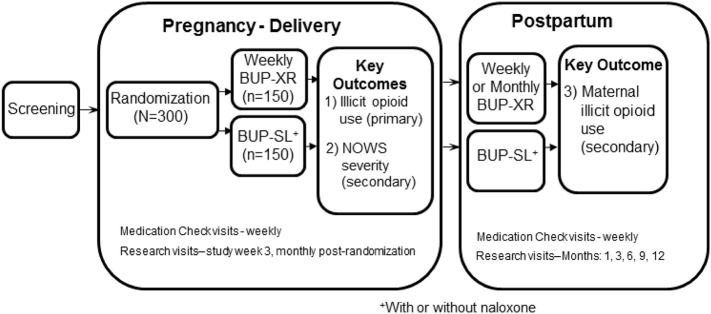
Opioid use disorder (OUD) in pregnant women has increased significantly in recent years. Maintaining these women on sublingual (SL) buprenorphine (BUP) is an evidence-based practice but BUP-SL is associated with several disadvantages that an extended-release (XR) BUP formulation could eliminate. The National Drug Abuse Treatment Clinical Trials Network (CTN) is conducting an intent-to-treat, two-arm, open-label, pragmatic randomized controlled trial, Medication treatment for Opioid-dependent expectant Mothers (MOMs), to compare mother and infant outcomes of pregnant women with OUD treated with BUP-XR, relative to BUP-SL. A second aim is to determine the relative economic value of utilizing BUP-XR. Approximately 300 pregnant women with an estimated gestational age (EGA) of 6-30 weeks, recruited from 12 sites, will be randomized in a 1:1 ratio to BUP-XR or BUP-SL, balancing on site, EGA, and BUP-SL status (taking/not taking) at the time of randomization. Participants will be provided with study medication and attend weekly medication visits through 12 months postpartum. Participants will be invited to participate in two sub-studies to evaluate the: 1) mechanisms by which BUP-XR may improve mother and infant outcomes; and 2) effects of prenatal exposure to BUP-XR versus BUP-SL on infant neurodevelopment. This paper describes the key design decisions for the main trial made during protocol development. This Investigational New Drug (IND) trial uniquely uses pragmatic features where feasible in order to maximize external validity, hence increasing the potential to inform clinical practice guidelines and address multiple knowledge gaps for treatment of this patient population.
Keywords: Buprenorphine; Extended-release; Infant; Neurodevelopment; Opioid; Pregnant.
Copyright © 2020 Elsevier Inc. All rights reserved.
Conflict of interest statement
Declaration of Competing Interest Dr. Lofwall reported receiving research funding from Braeburn Pharmaceuticals, Inc., consulting fees from Braeburn Pharmaceuticals, Inc. and Titan, and honorarium/travel expenses from Camurus. Dr. Murphy reports having consulted for Sandoz Inc. for work unrelated to the investigation reported here. Dr. Wexelblatt reported receiving consulting fees from Braeburn Pharmaceuticals, Inc. All other authors have no potential conflicts of interest to report.
References
-
- Hayes M.J., Brown M.S. Epidemic of prescription opiate abuse and neonatal abstinence. JAMA. 2012;307(18):1974–1975. - PubMed
-
- Maeda A., Bateman B.T., Clancy C.R., Creanga A.A., Leffert L.R. Opioid abuse and dependence during pregnancy temporal trends and obstetrical outcomes. Anesthesiology. 2014;121(6):1158–1165. - PubMed
-
- Patrick S.W., Schiff D.M. U.S.E. committee on substance, prevention, a public health response to opioid use in pregnancy. Pediatrics. 2017;139(3) - PubMed
-
- Patrick S.W., Schumacher R.E., Benneyworth B.D., Krans E.E., McAllister J.M., Davis M.M. Neonatal abstinence syndrome and associated health care expenditures: United States, 2000-2009. Jama. 2012;307(18):1934–1940. - PubMed
Publication types
MeSH terms
Substances
Grants and funding
- K12 DA043490/DA/NIDA NIH HHS/United States
- HHSN271201400028C/DA/NIDA NIH HHS/United States
- UG1 DA015815/DA/NIDA NIH HHS/United States
- UG1 DA049468/DA/NIDA NIH HHS/United States
- UG1 DA013720/DA/NIDA NIH HHS/United States
- UG1 DA049444/DA/NIDA NIH HHS/United States
- UG1 DA013714/DA/NIDA NIH HHS/United States
- UG1 DA013727/DA/NIDA NIH HHS/United States
- UG1 DA049436/DA/NIDA NIH HHS/United States
- UG1 DA015831/DA/NIDA NIH HHS/United States
- U10 DA013732/DA/NIDA NIH HHS/United States
- HHSN271201500065C/DA/NIDA NIH HHS/United States
- UG1 DA040317/DA/NIDA NIH HHS/United States
