Review
. 2020 Jan 1:2020:baaa028.
doi: 10.1093/database/baaa028.

Community curation in PomBase: enabling fission yeast experts to provide detailed, standardized, sharable annotation from research publications

Affiliations
Review

Community curation in PomBase: enabling fission yeast experts to provide detailed, standardized, sharable annotation from research publications

Antonia Lock et al. Database (Oxford). .

Abstract

Maximizing the impact and value of scientific research requires efficient knowledge distribution, which increasingly depends on the integration of standardized published data into online databases. To make data integration more comprehensive and efficient for fission yeast research, PomBase has pioneered a community curation effort that engages publication authors directly in FAIR-sharing of data representing detailed biological knowledge from hypothesis-driven experiments. Canto, an intuitive online curation tool that enables biologists to describe their detailed functional data using shared ontologies, forms the core of PomBase's system. With 8 years' experience, and as the author response rate reaches 50%, we review community curation progress and the insights we have gained from the project. We highlight incentives and nudges we deploy to maximize participation, and summarize project outcomes, which include increased knowledge integration and dissemination as well as the unanticipated added value arising from co-curation by publication authors and professional curators.


Figures

Figure 1
Figure 1
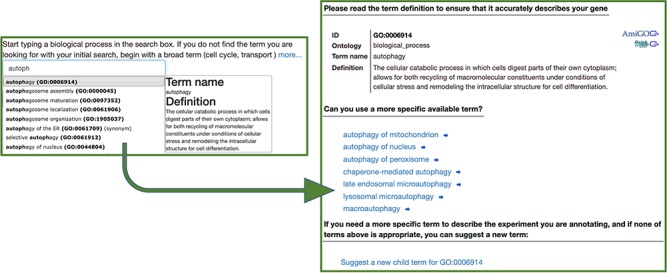
The Canto annotation tool. A user-friendly step-by-step annotation workflow guides new users through finding ontology terms and completing annotations.
Figure 2
Figure 2
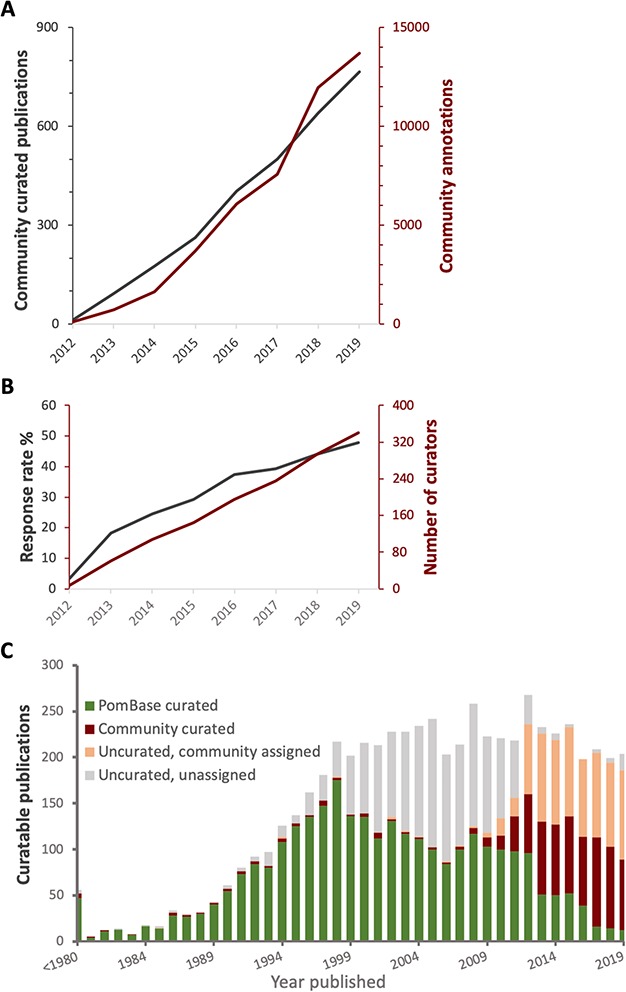
Curation statistics. A. Cumulative numbers of publications curated (grey) and annotations added (red) bythe community over time. B. Cumulative number of new participants (red) and invitation response rate (grey) over time. C. The proportion of curatable fission yeast literature curated by PomBase staff and community, or as yet uncurated, by year published. Uncurated publications are subdivided into ‘uncurated community’ (invitation sent, no response) and ‘uncurated unassigned’ (no invitation sent—we do not send invitations for publications predating 2012).
Figure 3
Figure 3
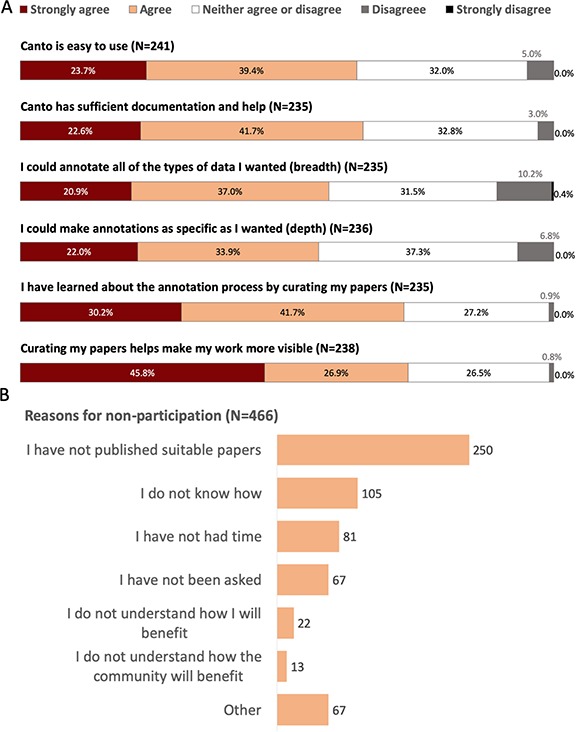
Community perception of Canto curation from 2019 PomBase user survey. A. Responses to questions evaluating Canto usability. Note: 30% of respondents (189/632) reported having used Canto. B. Reasons given for not participating in community curation. Free text responses from respondents selecting ‘other’ indicate that many intend to participate in the future, or found that their papers had already been curated by other lab members.
Figure 4
Figure 4
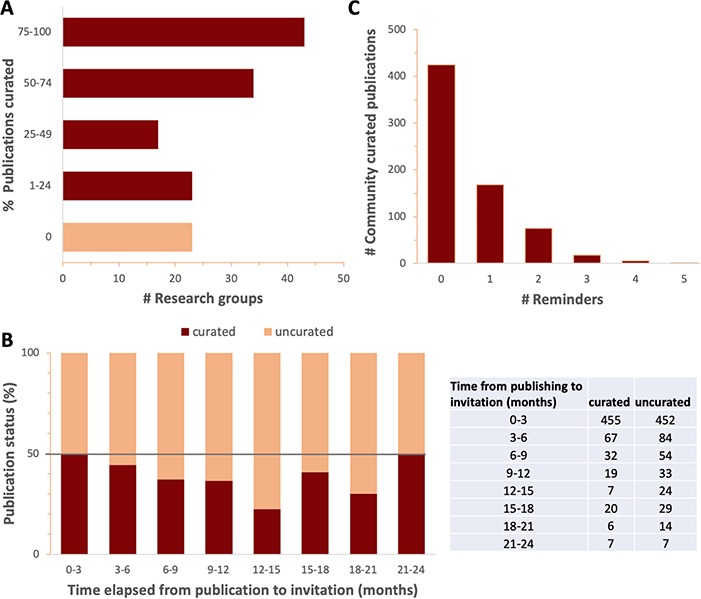
Response to curation invitations. A. Percent of publications curated per research group for all groups that have received four or more curation invitations. Research groups with fewer than 4 relevant publications were omitted to focus on research groups dedicated to fission yeast. B. Percent (graph) and number (table) of curated and uncurated publications as a function of the time elapsed between PubMed indexing and the date that the first invitation to curate was sent, in 3-month intervals. The increase in response rate seen in later time intervals could either reflect the increased number of reminders received, or simply be an artefact of the smaller sample sizes. C. The number of community curated publications versus the number of reminders.

References

    1. Arighi N.C., Balakrishnan R., Cherry J.M. et al. (2018) Biocuration: distilling data into knowledge. PLoS Biol., 16, 8 e2002846. - PMC - PubMed
    1. Wilkinson M.D., Dumontier M., Aalbersberg I.J. et al. (2016) The FAIR Guiding Principles for scientific data management and stewardship. Sci. Data, 3, 160018. - PMC - PubMed
    1. Howe D., Costanzo M., Fey P. et al. (2008) Big data: the future of biocuration. Nature, 455, 47–50. - PMC - PubMed
    1. Attrill H., Gaudet P., Huntley R.P. et al. (2019) Annotation of gene product function from high-throughput studies using the Gene Ontology. Database (Oxford), 2019, 8. - PMC - PubMed
    1. Wood V., Lock A., Harris M.A. et al. (2019) Hidden in plain sight: what remains to be discovered in the eukaryotic proteome? Open Biol., 9, 180241. - PMC - PubMed

Publication types