Review
. 2020 Apr 28;9(5):560.
doi: 10.3390/plants9050560.

Physiological and Molecular Mechanism Involved in Cold Stress Tolerance in Plants

Affiliations
Review

Physiological and Molecular Mechanism Involved in Cold Stress Tolerance in Plants

Faujiah Nurhasanah Ritonga et al. Plants (Basel). .

Abstract

Previous studies have reported that low temperature (LT) constrains plant growth and restricts productivity in temperate regions. However, the underlying mechanisms are complex and not well understood. Over the past ten years, research on the process of adaptation and tolerance of plants during cold stress has been carried out. In molecular terms, researchers prioritize research into the field of the ICE-CBF-COR signaling pathway which is believed to be the important key to the cold acclimation process. Inducer of CBF Expression (ICE) is a pioneer of cold acclimation and plays a central role in C-repeat binding (CBF) cold induction. CBFs activate the expression of COR genes via binding to cis-elements in the promoter of COR genes. An ICE-CBF-COR signaling pathway activates the appropriate expression of downstream genes, which encodes osmoregulation substances. In this review, we summarize the recent progress of cold stress tolerance in plants from molecular and physiological perspectives and other factors, such as hormones, light, and circadian clock. Understanding the process of cold stress tolerance and the genes involved in the signaling network for cold stress is essential for improving plants, especially crops.

Keywords: ICE-CBF-COR; chilling; cold acclimation; freezing; low temperature; tolerance.


Conflict of interest statement

The authors declare no conflict of interest.

Figures
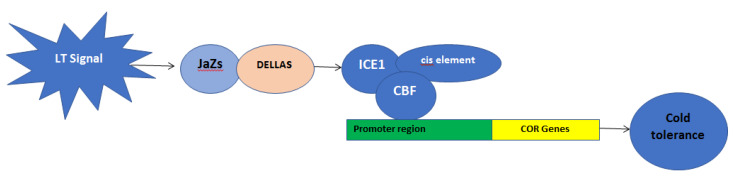
Figure 1
Figure 1
ICE-CBF-COR pathways in plants tolerance to cold stress. The expression of CBFs is mainly mediated by DELLA signaling and induced by ICE1. DELLAs contribute to the cold induction of CBF genes through interaction with JaZs signaling. CBFs activate the expression of COR genes via binding to cis-elements in the promoter of COR genes and result in the enhancement of cold tolerance in plants.
Figure 2
Figure 2
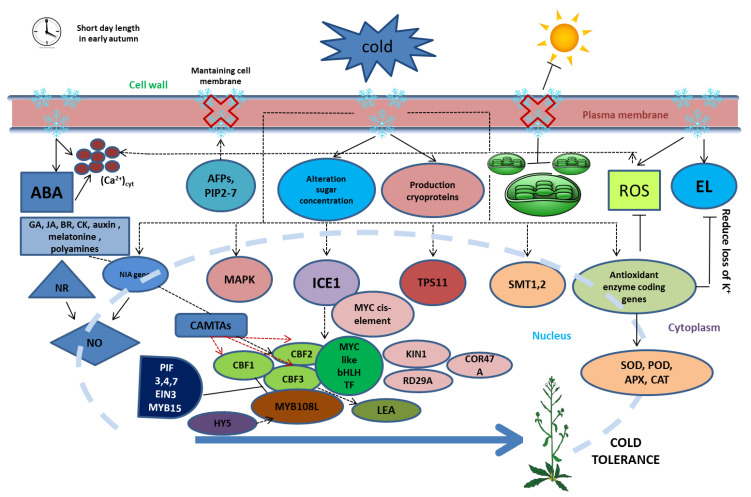
The mechanism of cold tolerance in plants. A short day in early autumn represents the first initiation of cold stress. AFPs and PIP2-7 slow ice crystal formation to maintain cell membranes and reduce membrane injury. However, low temperature (LT) still causes some changes in membrane structure, sugar concentration, and production in cry proteins. LT initiates the increase of ABA, EL, (Ca2+)cyt, and ROS accumulation but decreases chloroplast number. LT induces the expression of some genes, such as NIA, MAPK, TPS11, SMT1,2, ICE1 and antioxidant enzyme coding genes. Antioxidant enzyme coding genes reduce the EL and increase the activity of the antioxidant enzymes in cold stress plants. Meanwhile, NIA genes and NR initiate NO as a result of LT. ICE1, CAMTAs, NIA, and hormones induce the expression of CBFs, which bind to CRT/DRE cis-elements to enhance cold tolerance. ICE1-CBFs induce expression of cold-responsive genes, such as KIN1, RD29A, COR47A, and LEA, during cold stress.

References

    1. Mboup M., Fischer I., Lainer H., Stephan W. Trans-species polymorphism and allele-specific expression in the cbf gene family of wild tomatoes. Mol. Biol. Evol. 2012;29:3641–3652. doi: 10.1093/molbev/mss176. - DOI - PubMed
    1. Theocharis A., Clément C., Barka E.A. Physiological and molecular changes in plants grown at low temperatures. Planta. 2012;235:1091–1105. doi: 10.1007/s00425-012-1641-y. - DOI - PubMed
    1. Zhou M., Chen H., Wei D., Ma H., Lin J. Arabidopsis I3 and DELLAs positively regulate each other in response to low temperature. Sci. Rep. 2017;7:1–13. doi: 10.1038/srep39819. - DOI - PMC - PubMed
    1. Mickelbart M.V., Hasegawa P.M., Bailey-Serres J. Genetic mechanisms of abiotic stress tolerance that translate to crop yield stability. Nat. Rev. Genet. 2015;16:237–251. doi: 10.1038/nrg3901. - DOI - PubMed
    1. Guo X., Zhang L., Zhu J., Liu H., Wang A. Cloning and characterization of SiDHN, a novel dehydrin gene from Saussurea involucrata Kar. et Kir. that enhances cold and drought tolerance in tobacco. Plant Sci. 2017;256:160–169. doi: 10.1016/j.plantsci.2016.12.007. - DOI - PubMed

LinkOut - more resources