Review
. 2020 Apr 28;12(5):1248.
doi: 10.3390/nu12051248.

Vitamin D's Effect on Immune Function

Affiliations
Review

Vitamin D's Effect on Immune Function

Pieter-Jan Martens et al. Nutrients. .

Abstract

Ever since its discovery by Windhaus, the importance of the active metabolite of vitamin D (1,25-dihydroxyvitamin D3; 1,25-(OH)2D3) has been ever expanding. In this review, the attention is shifted towards the importance of the extra-skeletal effects of vitamin D, with special emphasis on the immune system. The first hint of the significant role of vitamin D on the immune system was made by the discovery of the presence of the vitamin D receptor on almost all cells of the immune system. In vitro, the overwhelming effect of supra-physiological doses of vitamin D on the individual components of the immune system is very clear. Despite these promising pre-clinical results, the translation of the in vitro observations to solid clinical effects has mostly failed. Nevertheless, the evidence of a link between vitamin D deficiency and adverse outcomes is overwhelming and clearly points towards avoidance of vitamin D deficiency especially in early life.

Keywords: 1,25-(OH)2D3; Vitamin D; autoimmune disease; immune system; infectious disease; multiple sclerosis; rheumatoid arthritis; type 1 diabetes.


Conflict of interest statement

The authors declare no conflict of interest.

Figures
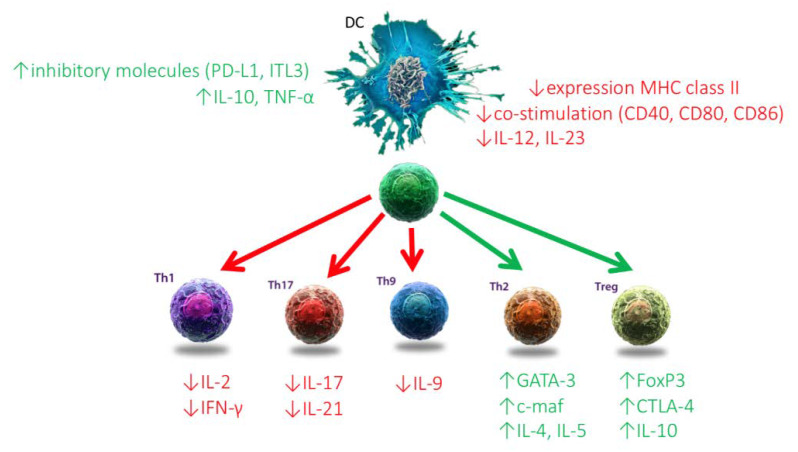
Figure 1
Figure 1
Immunomodulatory actions of active vitamin D (1,25-dihydroxyvitamin D3; 1,25-(OH)2D3). Both the direct as the indirect effects on T-lymphocytes are shown as 1,25-(OH)2D3 exerts its effect through direct binding on both the vitamin D receptor of the antigen-presenting cell (APC), in this case the dendritic cell (DC), and the T-lymphocytes directly. The effect of 1,25-(OH)2D3 on the APC is both an upregulation of the direct inhibition of the APC, as well as a downregulation of its antigen presentation function. The direct effect of 1,25-(OH)2D3 on the T-lymphocytes is a change towards a more tolerogenic state with an induction of Thelper-2 (Th2)-lymphocytes and regulatory T-lymphocytes (Tregs; depicted in green text), together with a downregulation of the pro-inflammatory Thelper-1 (Th1)-lymphocytes, Thelper-17 (Th17)-lymphocytes, and Thelper-9 (Th9)-lymphocytes (depicted in red text). Other abbreviations: IL: interleukin; IFN-γ: interferon-γ; TNF-α: tumor necrosis factor-α; ILT-3: immunoglobulin-like transcript-3; GATA-3: GATA binding protein-3; FoxP3: forkhead box P3, CTLA-4: cytotoxic T lymphocyte associated protein-4.

References

    1. Bouillon R., Carmeliet G., Verlinden L., van Etten E., Verstuyf A., Luderer H.F., Lieben L., Mathieu C., Demay M. Vitamin D and human health: Lessons from vitamin D receptor null mice. Endocr. Rev. 2008;29:726–776. doi: 10.1210/er.2008-0004. - DOI - PMC - PubMed
    1. Holick M.F. Vitamin D deficiency. N. Engl. J. Med. 2007;357:266–281. doi: 10.1056/NEJMra070553. - DOI - PubMed
    1. Colotta F., Jansson B., Bonelli F. Modulation of inflammatory and immune responses by vitamin D. J. Autoimmun. 2017;85:78–97. doi: 10.1016/j.jaut.2017.07.007. - DOI - PubMed
    1. Prietl B., Treiber G., Pieber T.R., Amrein K. Vitamin D and immune function. Nutrients. 2013;5:2502–2521. doi: 10.3390/nu5072502. - DOI - PMC - PubMed
    1. Dusso A.S., Brown A.J., Slatopolsky E. Vitamin D. Am. J. Physiol. Renal Physiol. 2005;289:F8–F28. doi: 10.1152/ajprenal.00336.2004. - DOI - PubMed

MeSH terms
