


Triglyceride-Rich Lipoprotein Cholesterol, Small Dense LDL Cholesterol, and Incident Cardiovascular Disease
- PMID: 32354380
- PMCID: PMC8064770
- DOI: 10.1016/j.jacc.2020.02.059
Triglyceride-Rich Lipoprotein Cholesterol, Small Dense LDL Cholesterol, and Incident Cardiovascular Disease
Abstract
Background: Elevated triglyceride-rich lipoprotein (TRL) and small-dense low-density lipoprotein (sdLDL) particles are hallmarks of atherogenic dyslipidemia, and their cholesterol content is hypothesized to drive atherosclerotic risk. Prospective epidemiological data pertaining to cholesterol content of TRLs and sdLDL in primary prevention populations are mostly limited to coronary heart disease.
Objectives: The purpose of this study was to prospectively evaluate whether triglyceride-rich lipoprotein cholesterol (TRL-C) and small-dense low-density lipoprotein cholesterol (sdLDL-C) concentrations associate with composite and individual incident cardiovascular disease (CVD) outcomes including myocardial infarction (MI), ischemic stroke (IS), and peripheral artery disease (PAD).
Methods: In a prospective case-cohort study within the Women's Health Study, TRL-C and sdLDL-C (mg/dl) were directly measured in baseline blood specimens of case subjects (n = 480) and the reference subcohort (n = 496). Risk associations were evaluated for total CVD (MI, IS, PAD, and CVD death), coronary and cerebrovascular disease (MI, IS, CVD death), and individual outcomes (MI, IS, and PAD). Models were adjusted for traditional risk factors, low-density lipoprotein cholesterol, and high-sensitivity C-reactive protein.
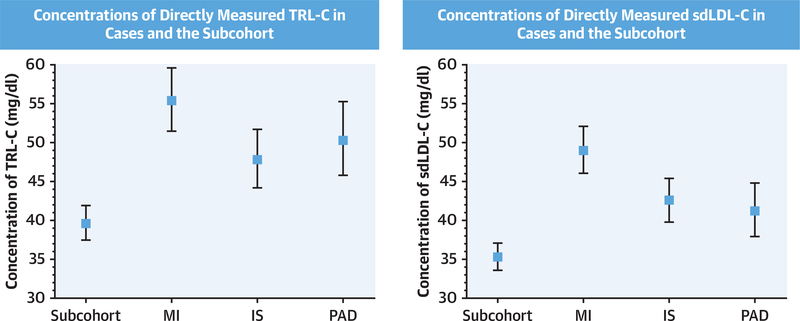
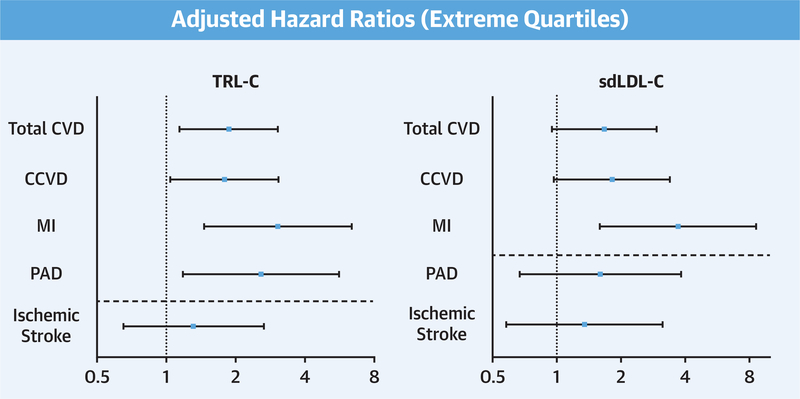
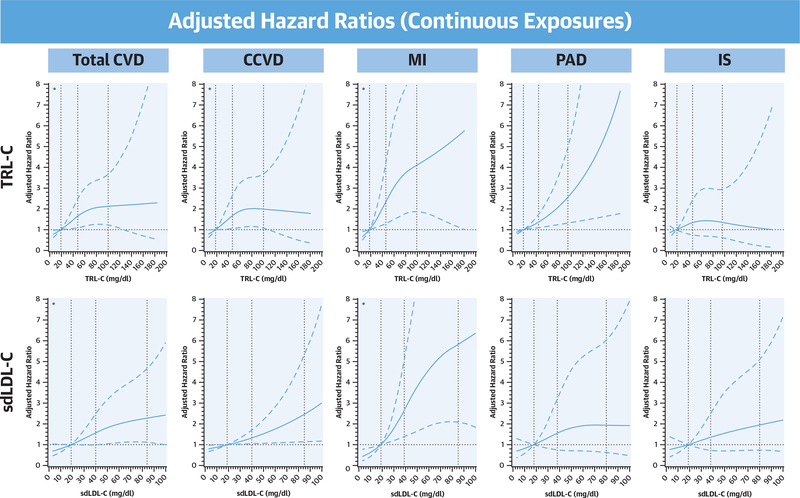
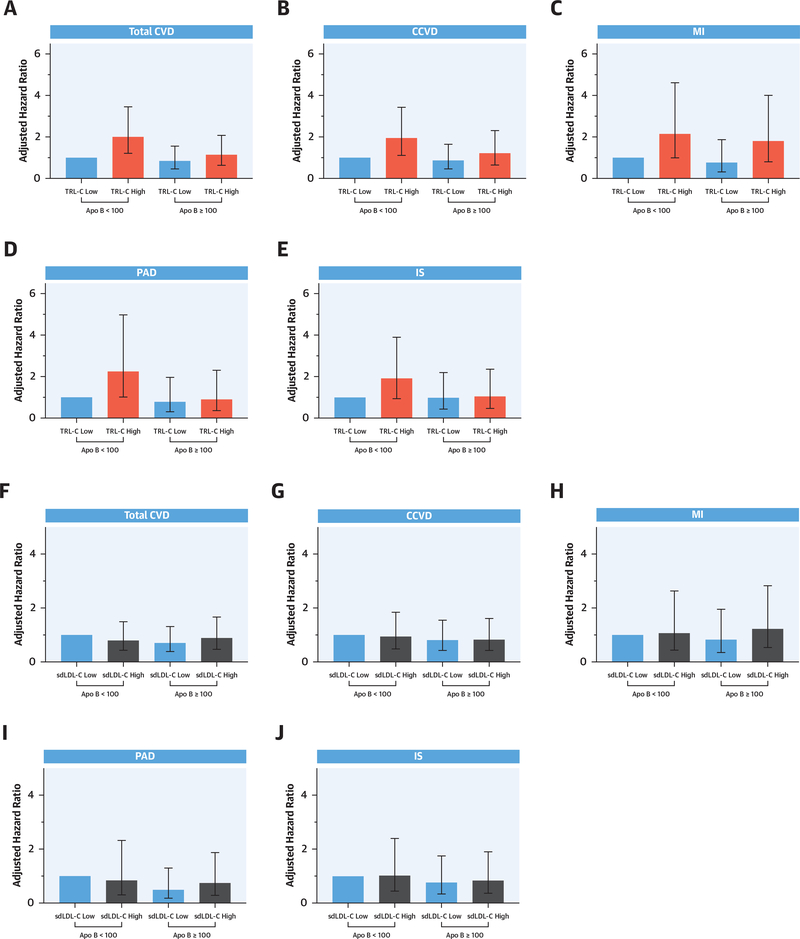
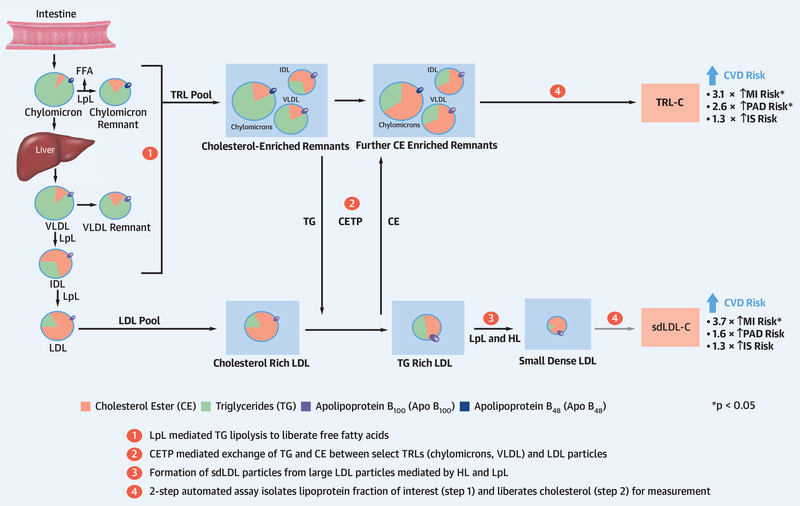
Results: The risk of both composite outcomes significantly increased across quartiles of TRL-C and sdLDL-C. TRL-C was significantly associated with MI and PAD (MI hazard ratio [HR]Q4: 3.05 [95% confidence interval (CI): 1.46 to 6.39]; ptrend = 0.002; PAD HRQ4: 2.58 [95% CI: 1.18 to 5.63]; ptrend = 0.019), whereas sdLDL-C was significantly associated with MI alone (HRQ4: 3.71 [95% CI: 1.59 to 8.63]; ptrend < 0.001). Both markers weakly associated with IS. Association patterns were similar for continuous exposures and, for TRL-C, among subjects with low atherogenic particle concentrations (apolipoprotein B <100 mg/dl).
Conclusions: TRL-C strongly associates with future MI and PAD events, whereas sdLDL-C strongly associates with MI alone. These findings signal that the cholesterol content of TRLs and sdLDL influence atherogenesis independently of low-density lipoprotein cholesterol, and high sensitivity C-reactive protein, with potentially different potency across vascular beds. (Women's Health Study; NCT00000479).
Keywords: atherogenesis; biomarkers; dyslipidemia; epidemiology; primary prevention; vascular disease.
Copyright © 2020 American College of Cardiology Foundation. Published by Elsevier Inc. All rights reserved.
Figures
Comment in
-
Atherogenic Dyslipoproteinemia and Management of ASCVD: Will New Indices Untie the Gordian Knot?J Am Coll Cardiol. 2020 May 5;75(17):2136-2139. doi: 10.1016/j.jacc.2020.03.032. J Am Coll Cardiol. 2020. PMID: 32354381 No abstract available.
References
-
- Grundy SM, Stone NJ, Bailey AL, et al. 2018 AHA/ACC/AACVPR/AAPA/ABC/ACPM/ADA/AGS/APhA/ASPC/NLA/PCNA Guideline on the management of blood cholesterol: a report of the American College of Cardiology/American Heart Association Task Force on Clinical Practice Guidelines [published correction in J Am Coll Cardiol 2019;73:3237-41]. J Am Coll Cardiol 2019;73: e285–350. - PubMed
-
- Fruchart JC, Sacks FM, Hermans MP, et al. The Residual Risk Reduction Initiative: a call to action to reduce residual vascular risk in dyslipidaemic patient. Diab Vasc Dis Res 2008;5: 319–35. - PubMed
-
- Xiao C, Dash S, Morgantini C, Hegele RA, Lewis GF. Pharmacological targeting of the atherogenic dyslipidemia complex: the next frontier in CVD prevention beyond lowering LDL Ccholesterol. Diabetes 2016; 65:1767–78. - PubMed
-
- Otvos JD, Jeyarajah EJ, Cromwell WC. Measurement issues related to lipoprotein heterogeneity. Am J Cardiol 2002;90:22i–9i. - PubMed
Publication types
MeSH terms
Substances
Associated data
Grants and funding
LinkOut - more resources
Full Text Sources
Medical
Research Materials
