. 2020 Apr 30;10(1):7351.
doi: 10.1038/s41598-020-64123-z.

J-CKD-DB: a nationwide multicentre electronic health record-based chronic kidney disease database in Japan

Affiliations

J-CKD-DB: a nationwide multicentre electronic health record-based chronic kidney disease database in Japan

Naoki Nakagawa et al. Sci Rep. .

Abstract

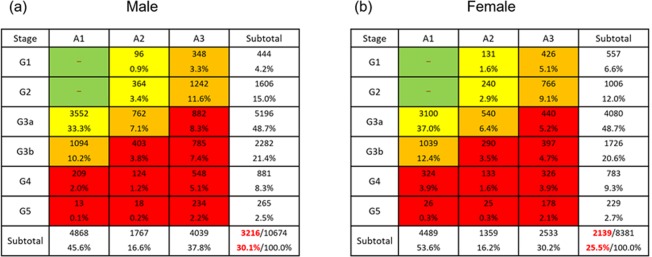
The Japan Chronic Kidney Disease (CKD) Database (J-CKD-DB) is a large-scale, nation-wide registry based on electronic health record (EHR) data from participating university hospitals. Using a standardized exchangeable information storage, the J-CKD-DB succeeded to efficiently collect clinical data of CKD patients across hospitals despite their different EHR systems. CKD was defined as dipstick proteinuria ≥1+ and/or estimated glomerular filtration rate <60 mL/min/1.73 m2 base on both out- and inpatient laboratory data. As an initial analysis, we analyzed 39,121 CKD outpatients (median age was 71 years, 54.7% were men, median eGFR was 51.3 mL/min/1.73 m2) and observed that the number of patients with a CKD stage G1, G2, G3a, G3b, G4 and G5 were 1,001 (2.6%), 2,612 (6.7%), 23,333 (59.6%), 8,357 (21.4%), 2,710 (6.9%) and 1,108 (2.8%), respectively. According to the KDIGO risk classification, there were 30.1% and 25.5% of male and female patients with CKD at very high-risk, respectively. As the information from every clinical encounter from those participating hospitals will be continuously updated with an anonymized patient ID, the J-CKD-DB will be a dynamic registry of Japanese CKD patients by expanding and linking with other existing databases and a platform for a number of cross-sectional and prospective analyses to answer important clinical questions in CKD care.


Conflict of interest statement

The authors declare no competing interests.

Figures
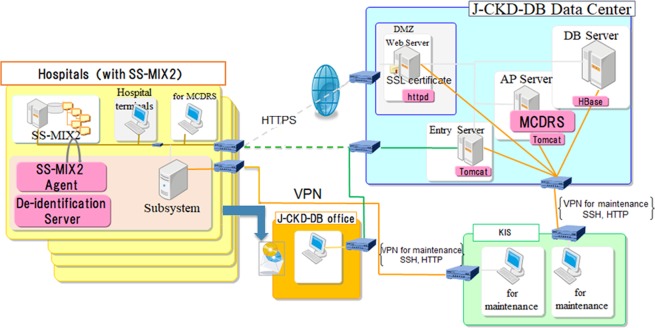
Figure 1
Figure 1
Overview of the Japan Chronic Kidney Disease Database (J-CKD-DB) System. The SS-MIX2 (Standardized Structured Medical Information eXchange) leveraged recent progress made in healthcare information standards in Japan, including code standardization regarding laboratory data items and prescription data. The university hospitals participating in J-CKD-DB (left boxes) needed to have electronic health record systems that incorporated SS-MIX2 storage and a template-based structured-data entry function that could transfer the entered data to the SS-MIX2 storage. All data elements are extracted semi-automatically using SS-MIX2 storage and send to J-CKD-DB data centre through HTTPS (upper right box). MCDRS (Multi-purpose Clinical Data Repository System), a software system developed at the University of Tokyo, is adopted for designing and collecting the data elements. The administrative office of J-CKD-DB project is in Kawasaki Medical School (lower middle box). J-CKD-DB is maintained, and data cleaning is carried out at the office (lower right box). AP, application; DB, database; DMZ, demilitarized zone; HTTPS, hypertext transfer protocol secure; SSH, secure shell; SSL, secure sockets layer; VPN, virtual private network.
Figure 2
Figure 2
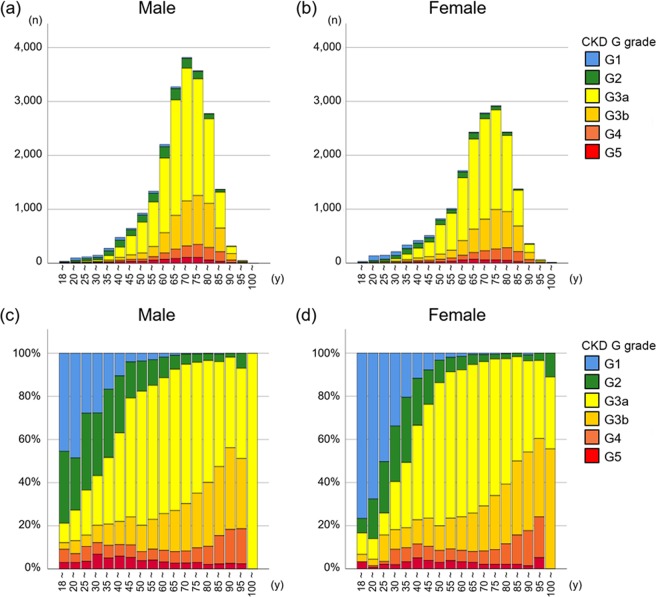
Age distribution (a,b) and proportion (c,d) of CKD G stage by sex in the J-CKD-DB according to the KDIGO criteria.
Figure 3
Figure 3
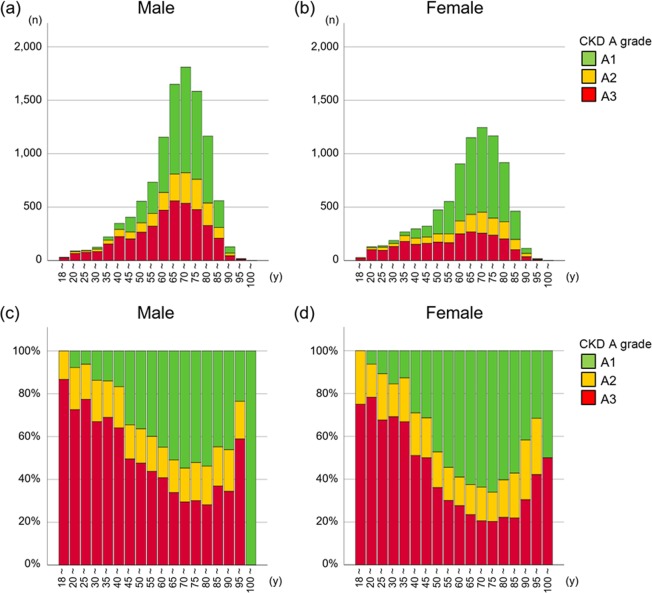
Age distribution (a,b) and proportion (c,d) of CKD A stage by sex in the J-CKD-DB according to the KDIGO criteria.
Figure 4
Figure 4
The KDIGO risk classification by age and sex in the J-CKD-DB. According to the KDIGO risk classification, very high-risk (red zone) cases accounted for 30.1% and 25.5% of all cases of male (a) and female (b) patients, respectively.
Figure 5
Figure 5
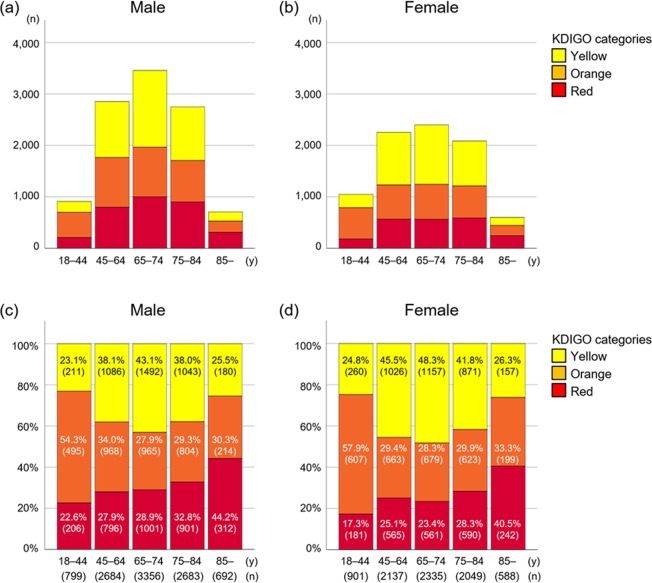
Age distribution (a,b) and proportion (c,d) of patients by KDIGO risk categories in the J-CKD-DB. The highest proportion of very high-risk (red zone) cases in both sexes is among patients over 85 years of age (c,d).
Figure 6
Figure 6
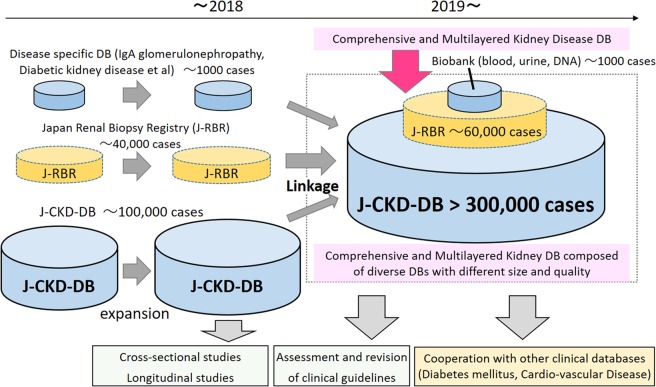
The plan for the J-CKD-DB project. The J-CKD-DB (bottom layer) will be integrated into other databases including J-RBR/J-KDR (Japan Renal Biopsy Registry and Japan Kidney Disease Registry) (middle layer). It is also planning to connect J-CKD-DB to biological samples and genomic information after informed consent (top layer) and establishing a multi-layered database that will comprise the J-RBR. Numbers are number of patients/measurements.

References

    1. Matsushita K, et al. Cohort profile: the chronic kidney disease prognosis consortium. Int. J. Epidemiol. 2013;42:1660–1668. doi: 10.1093/ije/dys173. - DOI - PubMed
    1. Levin A, et al. Global kidney health 2017 and beyond: a roadmap for closing gaps in care, research, and policy. Lancet. 2017;390:1888–1917. doi: 10.1016/S0140-6736(17)30788-2. - DOI - PubMed
    1. Fukui A, Yokoo T, Nangaku M, Kashihara N. New measures against chronic kidney diseases in Japan since 2018. Clin. Exp. Nephrol. 2019;23:1263–1271. doi: 10.1007/s10157-019-01786-7. - DOI - PMC - PubMed
    1. Imai E, et al. Prevalence of chronic kidney disease in the Japanese general population. Clin. Exp. Nephrol. 2009;13:621–630. doi: 10.1007/s10157-009-0199-x. - DOI - PubMed
    1. Nagata M, et al. Trends in the prevalence of chronic kidney disease and its risk factors in a general Japanese population: the Hisayama Study. Nephrol. Dial. Transplant. 2010;25:2557–2564. doi: 10.1093/ndt/gfq062. - DOI - PubMed

Publication types