Review
. 2020 Apr 26;21(9):3067.
doi: 10.3390/ijms21093067.

Cannabidiol and Other Non-Psychoactive Cannabinoids for Prevention and Treatment of Gastrointestinal Disorders: Useful Nutraceuticals?

Affiliations
Review

Cannabidiol and Other Non-Psychoactive Cannabinoids for Prevention and Treatment of Gastrointestinal Disorders: Useful Nutraceuticals?

Vicente Martínez et al. Int J Mol Sci. .

Abstract

Cannabis sativa is an aromatic annual flowering plant with several botanical varieties, used for different purposes, like the production of fibers, the production of oil from the seeds, and especially for recreational or medical purposes. Phytocannabinoids (terpenophenolic compounds derived from the plant), include the well-known psychoactive cannabinoid Δ9-tetrahydrocannabinol, and many non-psychoactive cannabinoids, like cannabidiol. The endocannabinoid system (ECS) comprises of endocannabinoid ligands, enzymes for synthesis and degradation of such ligands, and receptors. This system is widely distributed in the gastrointestinal tract, where phytocannabinoids exert potent effects, particularly under pathological (i.e., inflammatory) conditions. Herein, we will first look at the hemp plant as a possible source of new functional food ingredients and nutraceuticals that might be eventually useful to treat or even prevent gastrointestinal conditions. Subsequently, we will briefly describe the ECS and the general pharmacology of phytocannabinoids. Finally, we will revise the available data showing that non-psychoactive phytocannabinoids, particularly cannabidiol, may be useful to treat different disorders and diseases of the gastrointestinal tract. With the increasing interest in the development of functional foods for a healthy life, the non-psychoactive phytocannabinoids are hoped to find a place as nutraceuticals and food ingredients also for a healthy gastrointestinal tract function.

Keywords: cannabidiol; cannabinoids; gastrointestinal; inflammatory bowel disease; irritable bowel syndrome; non-psychoactive cannabinoids; nutraceutical; psychoactive cannabinoids; visceral pain.


Conflict of interest statement

The authors declare no conflict of interest.

Figures

Figure 1
Figure 1
Morphological differences among varieties of Cannabis sativa species, image from John M. McPartland. Cannabis and Cannabinoid Research. Dec 2018.203-212. http://doi.org/10.1089/can.2018.0039.
Figure 2
Figure 2
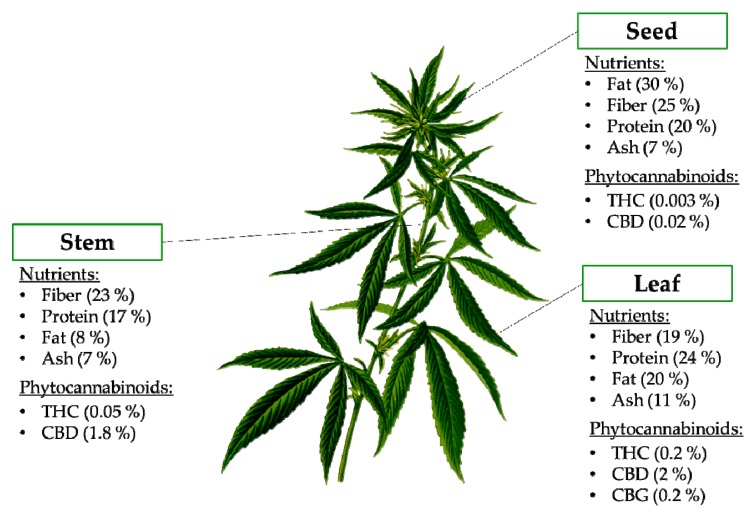
Nutritional composition and phytocannabinoids present in the different anatomic parts of the hemp plant. Abbreviations: CBD, cannabidiol; CBG, cannabigerol; THC, Δ9-tetrahydrocannabinol.
Figure 3
Figure 3
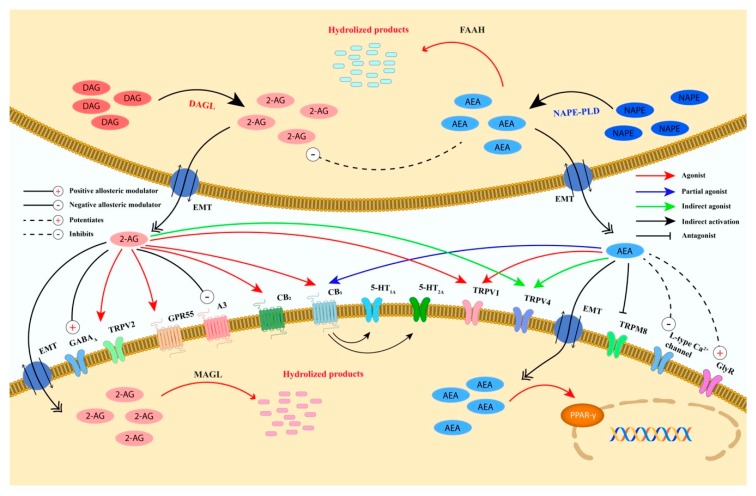
Schematic representation of the biosynthesis, degradation, and receptors’ binding of AEA and 2-AG. Anandamide and 2-AG are postsynaptically biosynthesized from the membrane’s phospholipids and degraded with different pathways and enzymes. AEA is mainly synthesized from NAPE by NAPE-PLD, whereas 2-AG is biosynthesized from DAG by DAGL-α and DAGL-β. The degradation of AEA is catalyzed by FAAH that is mainly expressed postsynaptically. 2-AG is degraded by MAGL that is expressed presynaptically and by two hydrolases named ABHD6 and ABHD12, expressed postsynaptically. Furthermore, AEA and 2-AG catabolism might also occur by the activity of other enzymes (e.g., NAAA, COX-2, and several LOX isoenzymes). AEA and 2-AG retrogradely activate presynaptic CB1. AEA is almost inactive on CB2, whereas 2-AG acts as a full agonist. In addition, AEA, directly or indirectly, also modulates the receptors/channels CB1, CB2, TRPV1 (at postsynaptic and presynaptic level), TRPV4, TRPM8, PPARγ, 5-HT1A, 5HT2A, L-type Ca2+channel, GlyR and negatively regulates 2-AG biosynthesis. 2-AG, directly or indirectly, modulates the receptors/channels TRPV1, TRPV2, TRPV4, GPR55, A3 adenosine, GABAA, 5-HT1A, and 5HT2A. The activation of CB1 by 2-AG suppresses either GABA or glutamate release. Abbreviations: ABDH6/12, αβ-hydrolase domain 6/12; AEA, anandamide; 2-AG, 2-arachidonoylglycerol; CB1, cannabinoid receptor 1; CB2, cannabinoid receptor 2; COX-2, cyclooxygenase-2; DAG, diacylglycerol; DAGL-α and DAGL-β, diacylglycerol lipase-α and β isoforms; EMT, endocannabinoid membrane transporter; FAAH, fatty acid amide hydrolase; GABA, γ-aminobutyric acid; GABAA, γ-aminobutyric acid type A receptor; GlyR, glycine receptor; GPR55, G protein-coupled receptor 55; 5-HT1A, 5-hydroxytryptamine 1A receptor; 5-HT2A, 5-hydroxytryptamine 2A receptor; LOX, lipoxygenase; MAGL, monoacylglycerol lipase; NAAA, N-acylethanolamine hydrolyzing acid amidase; NAPE-PLD, N-acyl-phosphatidylethanolamine-specific phospholipase D; PPARγ, peroxisome proliferator-activated receptor type-γ; TRPM8, transient receptor potential cation channel subfamily M member 8; TRPV2, transient receptor potential cation channel subfamily V member 2; TRPV4, transient receptor potential cation channel subfamily V member 4; TRPV1, transient receptor potential vanilloid type-1 channel.

References

    1. Gao X., Liu J., Li L., Liu W., Sun M. A brief review of nutraceutical ingredients in gastrointestinal disorders: Evidence and suggestions. Int. J. Mol. Sci. 2020;21:1822. doi: 10.3390/ijms21051822. - DOI - PMC - PubMed
    1. Larussa T., Imeneo M., Luzza F. Potential role of nutraceutical compounds in inflammatory bowel disease. World J. Gastroenterol. 2017;23:2483–2492. doi: 10.3748/wjg.v23.i14.2483. - DOI - PMC - PubMed
    1. Larussa T., Rossi M., Suraci E., Marasco R., Imeneo M., Abenavoli L., Luzza F. Use of complementary and alternative medicine by patients with irritable bowel syndrome according to the roma IV criteria: A single-center italian survey. Medicina. 2019;55:46. doi: 10.3390/medicina55020046. - DOI - PMC - PubMed
    1. McPartland J.M. Cannabis Systematics at the Levels of Family, Genus, and Species. Cannabis Cannabinoid Res. 2018;3:203–212. doi: 10.1089/can.2018.0039. - DOI - PMC - PubMed
    1. Morales P., Hurst D.P., Reggio P.H. Molecular Targets of the Phytocannabinoids: A Complex Picture. In: Kinghorn A.D., Falk H., Gibbons S., Kobayashi J., editors. Phytocannabinoids. Unraveling the Complex Chemistry and Pharmacology of Cannabis sativa. Volume 103. Springer International Publishing; Cham, Switzerland: 2017. pp. 103–131.

LinkOut - more resources