Review
. 2020 Jul;31(5):454-470.
doi: 10.1111/pai.13271. Epub 2020 Jun 5.

The first, holistic immunological model of COVID-19: Implications for prevention, diagnosis, and public health measures

Affiliations
Review

The first, holistic immunological model of COVID-19: Implications for prevention, diagnosis, and public health measures

Paolo Maria Matricardi et al. Pediatr Allergy Immunol. 2020 Jul.

Abstract

The natural history of COVID-19 caused by SARS-CoV-2 is extremely variable, ranging from asymptomatic or mild infection, mainly in children, to multi-organ failure, eventually fatal, mainly in the eldest. We propose here the first model explaining how the outcome of first, crucial 10-15 days after infection, depends on the balance between the cumulative dose of viral exposure and the efficacy of the local innate immune response (natural IgA and IgM antibodies, mannose-binding lectin). If SARS-CoV-2 runs the blockade of this innate immunity and spreads from the upper airways to the alveoli in the early phases of the infections, it can replicate with no local resistance, causing pneumonia and releasing high amounts of antigens. The delayed and strong adaptive immune response (high-affinity IgM and IgG antibodies) that follows, causes severe inflammation and triggers mediator cascades (complement, coagulation, and cytokine storm), leading to complications often requiring intensive therapy and being, in some patients, fatal. Low-moderate physical activity can still be recommended. However, extreme physical activity and oral breathing with hyperventilation during the incubation days and early stages of COVID-19 facilitates re-inhalation and early direct penetration of high numbers of own virus particles in the lower airways and the alveoli, without impacting on the airway's mucosae covered by neutralizing antibodies ("viral auto-inhalation" phenomenon). This allows the virus to bypass the efficient immune barrier of the upper airway mucosa in already infected, young, and otherwise healthy athletes. In conclusion, whether the virus or the adaptive immune response reaches the lungs first is a crucial factor deciding the fate of the patient. This "quantitative and time-/sequence-dependent" model has several implications for prevention, diagnosis, and therapy of COVID-19 at all ages.

Keywords: COVID-19; SARS-CoV-2; antibodies; glycans; immunoglobulin M; pneumonia; prediction; protection.


Conflict of interest statement

The text contains the personal opinion of the Authors, not of their institutions: Charité Universitaetsmedizin Berlin, Germany (PMM), and Istituto Superiore di Sanità, Rome, Italy (RN). All authors declare no conflict of interest.

Figures
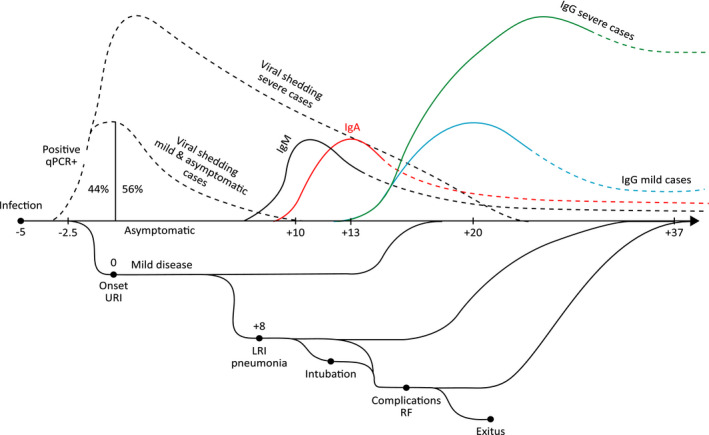
Figure 1
Figure 1
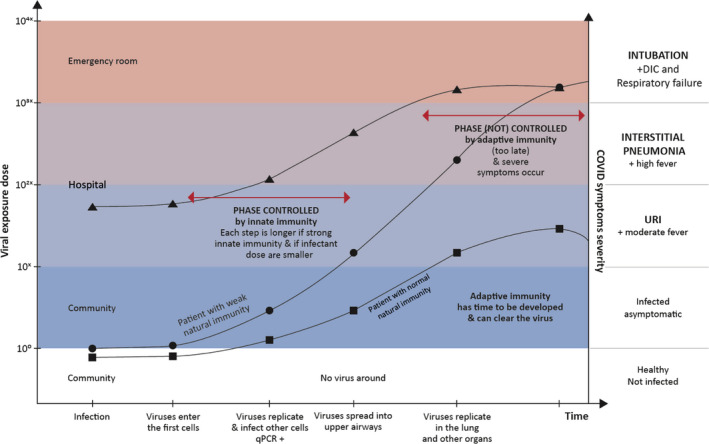
Different COVID‐19 clinical courses and trajectories of adaptive immune response and viral shedding. Quantitative polymerase chain reaction (qPCR); disseminated intravascular coagulation (DIC); upper respiratory airway infection (URI); lower respiratory airways infection (LRI); respiratory failure (RF)
Figure 2
Figure 2
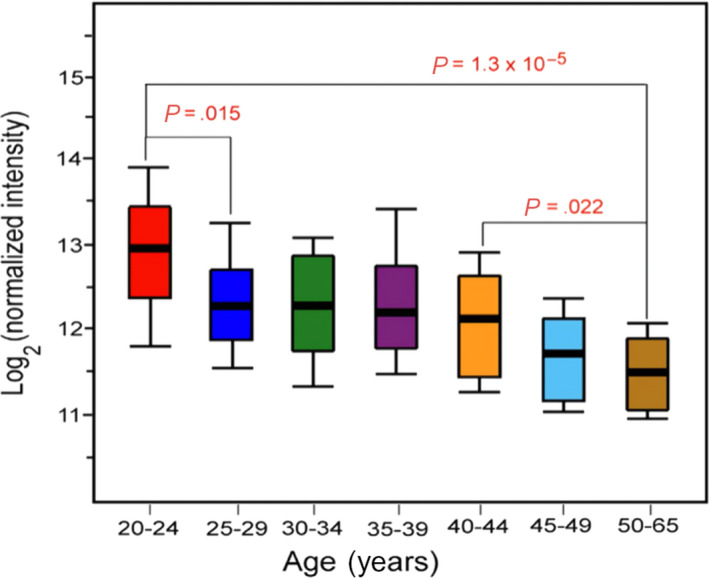
Variations in anti‐glycan IgG and IgM antibody signals with age. [Reprinted unmodified from, https://www.nature.com/articles/srep19509 which is available under the Creative Commons License 4.0.]
Figure 3
Figure 3
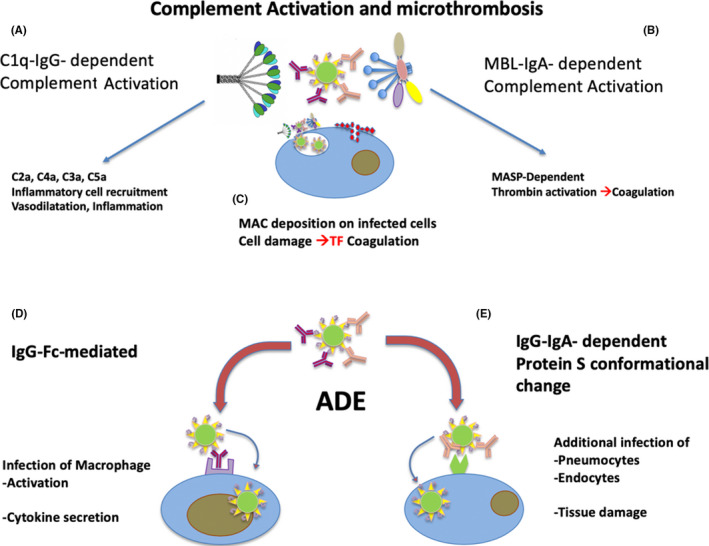
Mediator cascades causing complications during pneumonia in COVID‐19 patients. The classical pathway of complement can be activated by immunocomplexes formed by SARS‐CoV‐2 and specific IgG or IgM (A). Complement activation causes the release of pro‐inflammatory, vasoactive, and chemoattractant components that increase local inflammation. The lectin pathway of complement may be activated by virus‐IgA immunocomplexes, through MBL binding to both viral N‐glycan and IgA (B). Activation of MBL‐associated MASP may cause thrombin activation and triggering of coagulation. Both classic and lectin pathways of complement activation on the external membrane of infected cells releasing viruses may cause deposition of late complement factor and formation of the membrane attack complex (MAC) causing cell damage (C) and release of cellular components. Non‐neutralizing specific IgG and IgA binding the virus may concur to increased infection and inflammation as a consequence of antibody‐dependent enhancement (ADE) of infectivity. Ig with low affinity or non‐neutralizing effect may cause infection and activation of macrophages via Fc receptors (D). In addition, Ig binding the S protein of SARS‐CoV‐2 may cause its conformational changes making more efficacious the binding to the ACE‐2 receptor and the viral fusion with the cell membrane (D)
Figure 4
Figure 4
Evolution of COVID‐19 in relation to the cumulative dose of exposure and the natural immune response. Evolution of COVID‐19 in dependence of cumulative exposure dose to the virus, efficacy of natural immunity, and protective adaptive immune response. The lines represent the disease evolution of index patients, whose profile is presented in the main text; squares: young patient; circles: old patient; triangles: young doctor exposed to massive doses of virus. Quantitative polymerase chain reaction (qPCR); disseminated intravascular coagulation (DIC); upper respiratory airways infection (URI)
Figure 5
Figure 5
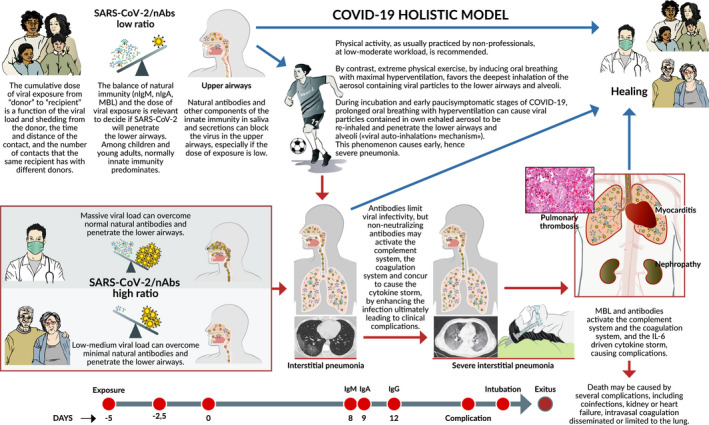
A “quantitative and time‐/sequence‐dependent” model COVID‐19.—The natural history of COVID‐19 caused by SARS‐CoV‐2 is extremely variable, ranging from asymptomatic infection, to pneumonia, and to complications eventually fatal. We propose here the first model, explaining how the outcome of first, crucial 10‐15 d after infection, hangs on the balance between the cumulative dose of viral exposure and the efficacy of the local innate immune response (natural IgA and IgM antibodies, MBL). If SARS‐CoV‐2 overcomes this first‐line immune barrier and rapidly spreads from the upper airways to the alveoli, then it can replicate with no resistance into the lungs, before a strong adaptive immune defense is established. When high‐affinity IgM and IgG antibodies are produced, the consequent severe inflammation damages the lungs and triggers mediator cascades (complement, coagulation, and cytokine storm) leading to complications that may be fatal. Strenuous exercise and high flow air in the incubation days and early stages of COVID‐19 facilitate direct penetration of the viral particles, acquired from the aerosol exhaled by other infected atletes or re‐inhaled together with the athlete's own infected aerosol (viral auto‐inhalation hypothesis), to the lower airways and the alveoli, without impacting on the airway mucosae covered by neutralizing antibodies. This allows the virus to bypass the efficient immune barriers of young and healthy athletes. In conclusion, whether the virus or the adaptive immune response reaches the lungs first is a crucial factor deciding the destiny of the patient

Comment in

  • Comment on Matricardi PM et al.
    Mirijello A, D'Errico MM, La Marca A, Piscitelli P, De Cosmo S. Mirijello A, et al. Pediatr Allergy Immunol. 2020 Nov;31(8):997. doi: 10.1111/pai.13277. Epub 2020 Jun 12. Pediatr Allergy Immunol. 2020. PMID: 32418306 Free PMC article. No abstract available.

References

    1. Zhu N, Zhang D, Wang W, et al. A novel coronavirus from patients with pneumonia in China, 2019. N Engl J Med. 2020;382:727‐733. - PMC - PubMed
    1. Corman VM, Landt O, Kaiser M, et al. Detection of 2019 novel coronavirus (2019‐nCoV) by real‐time RT‐PCR. Euro Surveill. 2020;25(3):2000045. - PMC - PubMed
    1. Drosten C, Günther S, Preiser W, et al. Identification of a novel coronavirus in patients with severe acute respiratory syndrome. N Engl J Med. 2003;348:1967‐1976. - PubMed
    1. Gorbalenya AE, Baker SC, Baric RS, et al. The species Severe acute respiratory syndrome‐related coronavirus: classifying 2019‐nCoV and naming it SARS‐CoV‐2. Nat Microbiol. 2020;5:536‐544. 10.1101/2020.02.07.937862 - DOI - PMC - PubMed
    1. Heymann D, Shindo N. COVID‐19: what is next for public health? Lancet. 2020;395:542‐545. - PMC - PubMed

Publication types

MeSH terms