


Resilience in adolescence: Prospective Self moderates the association of early life adversity with externalizing problems
- PMID: 32361462
- PMCID: PMC7269197
- DOI: 10.1016/j.adolescence.2020.04.004
Resilience in adolescence: Prospective Self moderates the association of early life adversity with externalizing problems
Abstract
Introduction: Early life adversity (ELA) can result in negative behavioral outcomes, including internalizing and externalizing problems. Evidence suggests that adolescence is a critical developmental period for processing ELA. Identity formation, which is crucial to this developmental period, may moderate the effect between ELA and these problems. One potential moderating variable associated with identity formation is the latent construct Prospective Self, comprised of future-oriented attitudes and behaviors.
Methods: Participants are from the first wave of an ongoing longitudinal study designed to characterize behavioral and cognitive correlates of risk behavior trajectories. A community sample of 10th and 12th grade adolescents (N = 2017, 55% female) were recruited from nine public school districts across eight Southeastern Michigan counties in the United States. Data were collected in schools during school hours or after school via self-report, computer-administered surveys. Structural equation modeling was utilized to assess Prospective Self as a latent construct and to evaluate the relationship between ELA, internalizing and externalizing problems, and Prospective Self.
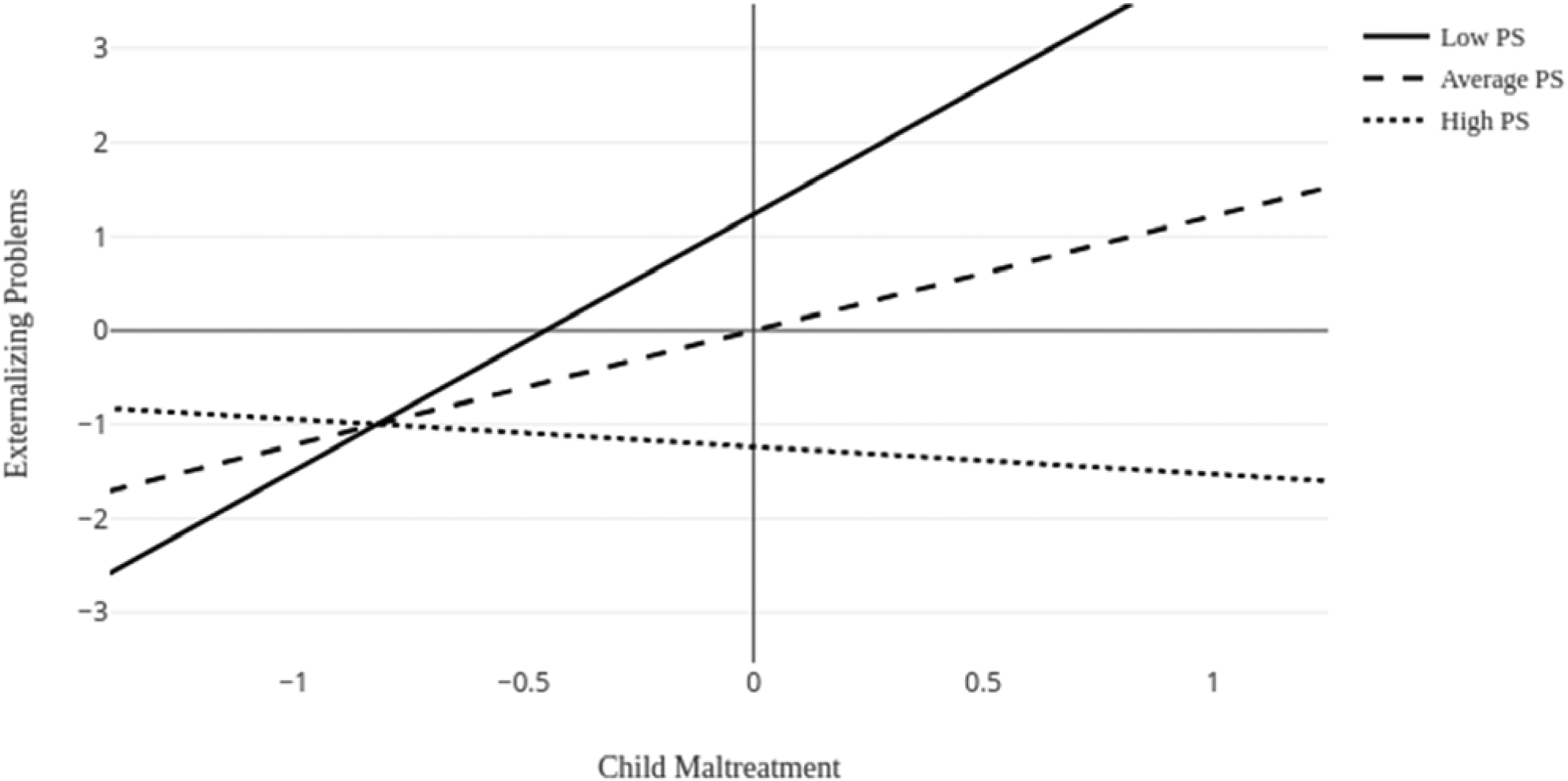
Results: Preliminary findings indicated a satisfactory fit for the construct Prospective Self. The predicted negative associations between Prospective Self and internalizing and externalizing problems were found and evidence of moderation was observed for externalizing problems, such that the effects of ELA (i.e., childhood maltreatment) on externalizing problems were lower for individuals with higher levels of Prospective Self.
Conclusions: These results indicate that Prospective Self may play a role in supporting resilience against externalizing problems associated with ELA among adolescents.
Keywords: Adolescence; Adolescent health; Adverse childhood experiences; Early life adversity; Internalizing and externalizing problems; Self-concept.
Copyright © 2020 The Foundation for Professionals in Services for Adolescents. Published by Elsevier Ltd. All rights reserved.
Conflict of interest statement
Declaration of competing interest The authors declare that they have no conflict of interest.
Figures



References
-
- Achenbach TM (2013). DSM Guide for the ASEBA. Burlington, VT: University of Vermont, Research Center for Children, Youth, & Families.
-
- Achenbach TM, & Rescorla LA (2001). The Manual for the ASEBA School-Age Forms & Profiles. Burlington, VT: University of Vermont, Research Center for Children, Youth, and Families.
-
- Asparouhov T, & Muthen B (2019). Latent variable interactions using maximum-likelihood and Bayesian estimation for single- and two-level models. Mplus Web Notes: No. 23 Retrieved May 3, 2019 from: http://www.statmodel.com/examples/webnotes/webnote%2023.pdf
Publication types
MeSH terms
Grants and funding
LinkOut - more resources
Full Text Sources
Medical
