


Impact of HPV vaccination on cervical screening performance: a population-based cohort study
- PMID: 32362659
- PMCID: PMC7341799
- DOI: 10.1038/s41416-020-0850-6
Impact of HPV vaccination on cervical screening performance: a population-based cohort study
Abstract
Background: Human papillomavirus (HPV) vaccination is predicted to lower the positive predictive value (PPV) of cytology.
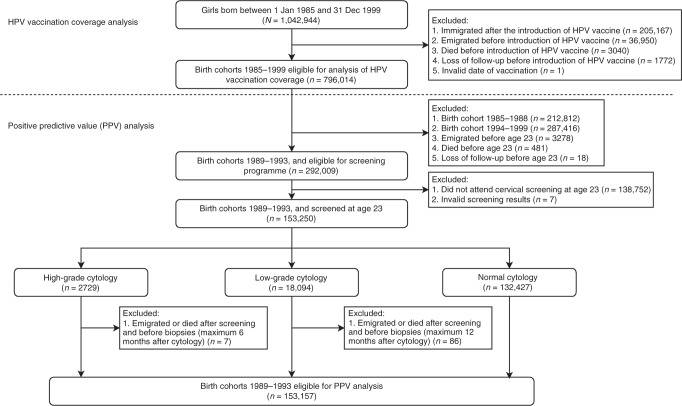
Methods: We included 153,250 girls born between 1989 and 1993, resident in Sweden since the introduction of HPV vaccines (October 2006) and attending cervical screening at age 23 years. We assessed their first cytology and following histopathological diagnosis using Swedish National Cervical Screening Registry (NKCx). By linkage with the national Swedish HPV vaccination registry, we determined PPV of abnormal cytology for cervical intraepithelial neoplasia grade 2 or worse (CIN2+) and the differences with 95% confidence intervals (CIs) according to vaccination status.
Results: The PPV of high-grade cytology for CIN2+ was 69.9% (95% CI, 67.9-71.9), 64.9% (95% CI, 59.8-69.8) and 57.4% (95% CI, 50.9-63.7) among women unvaccinated, initiating vaccination at age 17-22 years and initiating vaccination before age 17 years, corresponding to reduction in PPV by 8% (95% CI, 0-15%) and 17% (95% CI, 7-26%) in vaccinated groups after adjustment for birth cohort, respectively.
Conclusion: The PPV of cytology for CIN2+ decreased among vaccinated women, and the decrease was stronger for girls vaccinated at younger ages. A switch from cytology to HPV testing might potentially improve the screening performance.
Conflict of interest statement
J.D. is formerly recipient of grants on HPV vaccine research from Merck/SPMSD, and grants to his employer (Karolinska University Hospital) from Roche and Genomica; M.L. has received grants for his HPV vaccination studies from Merck & Co., Inc. and GSK Biologicals through his employers T.H.L. and Tampere University; the other authors have no conflict of interest to declare; no financial relationships with any organisations that might have an interest in the submitted work in the previous three years; no other relationships or activities that could appear to have influenced the submitted work.
Figures
References
-
- Immunization, W. Vaccines and Biologicals Database. http://www.who.int/entity/immunization/monitoring_surveillance/VaccineIn... (2019). Accessed 5 December 2019.
