. 2020 Apr 20;5(1):52-67.
doi: 10.20411/pai.v5i1.372. eCollection 2020.

Effectiveness of Ultraviolet-C Light and a High-Level Disinfection Cabinet for Decontamination of N95 Respirators

Affiliations

Effectiveness of Ultraviolet-C Light and a High-Level Disinfection Cabinet for Decontamination of N95 Respirators

Jennifer L Cadnum et al. Pathog Immun. .

Abstract

Background: Shortages of personal protective equipment (PPE) including N95 respirators are an urgent concern in the setting of the global COVID-19 pandemic. Decontamination of PPE could be useful to maintain adequate supplies, but there is uncertainty regarding the efficacy of decontamination technologies.

Methods: A modification of the American Society for Testing and Materials standard quantitative carrier disk test method (ASTM E-2197-11) was used to examine the effectiveness of 3 methods, including ultraviolet-C (UV-C) light, a high-level disinfection cabinet that generates aerosolized peracetic acid and hydrogen peroxide, and dry heat at 70°C for 30 minutes. We assessed the decontamination of 3 commercial N95 respirators inoculated with methicillin-resistant Staphylococcus aureus (MRSA) and bacteriophages MS2 and Phi6; the latter is an enveloped RNA virus used as a surrogate for coronaviruses. Three and 6 log10 reductions on respirators were considered effective for decontamination and disinfection, respectively.

Results: UV-C administered as a 1-minute cycle in a UV-C box or a 30-minute cycle by a room decontamination device reduced contamination but did not meet criteria for decontamination of the viruses from all sites on the N95s. The high-level disinfection cabinet was effective for decontamination of the N95s and achieved disinfection with an extended 31-minute cycle. Dry heat at 70°C for 30 minutes was not effective for decontamination of the bacteriophages.

Conclusions: UV-C could be useful to reduce contamination on N95 respirators. However, the UV-C technologies studied did not meet pre-established criteria for decontamination under the test conditions used. The high-level disinfection cabinet was more effective and met criteria for disinfection with an extended cycle.

Keywords: N95 respirator; SARS-CoV-2; Ultraviolet-C; decontamination; peracetic acid.


Conflict of interest statement

Curtis J. Donskey has received research grants from Clorox, Merck, Pfizer, and PDI. He also serves as an associate editor for Pathogens and Immunity. All other authors report no conflicts of interest relevant to this article.

Figures
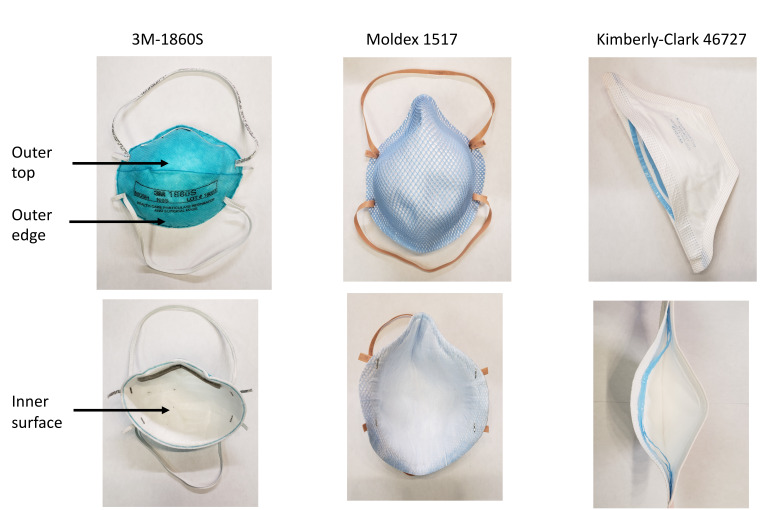
Figure 1.
Figure 1.
Pictures of the 3 N95 respirators evaluated in the study and areas where the test organisms were applied.
Figure 2.
Figure 2.
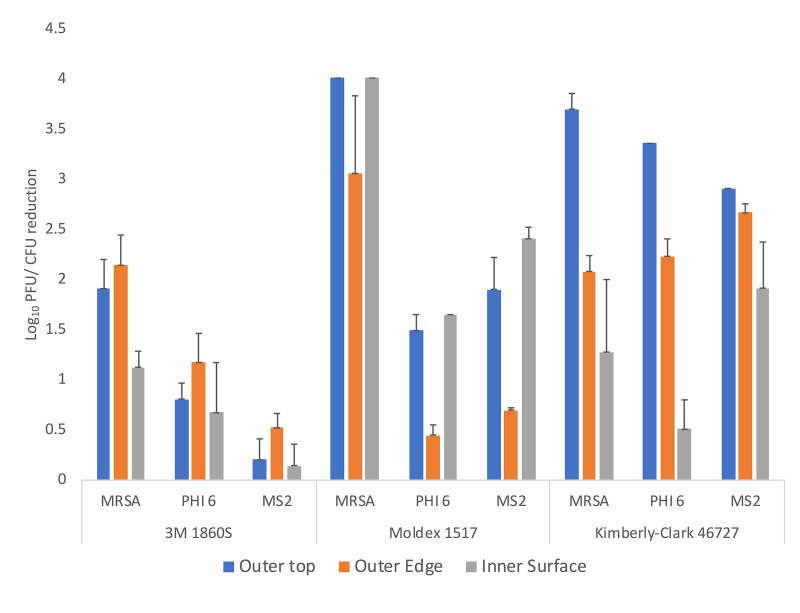
Efficacy of ultraviolet-C (UV-C) light for decontamination of methicillin-resistant Staphylococcus aureus (MRSA), bacteriophage MS2, and bacteriophage Phi6 on 3 different N95 respirators (3M 1860S, Moldex 1517, and Kimberly-Clark 46727). Aliquots of 10 μL containing 106 colony-forming units (CFU) or plaque-forming units (PFU) of the test organisms in the simulated mucus suspension were spread to cover an area of 1 cm2 on 3 different areas on the respirator surface (top exterior, edge exterior, and interior) as shown in Figure 1. The respirators were exposed to a 60-second cycle of UV-C inside a UV-C box. Error bars indicate standard error.
Figure 3.
Figure 3.
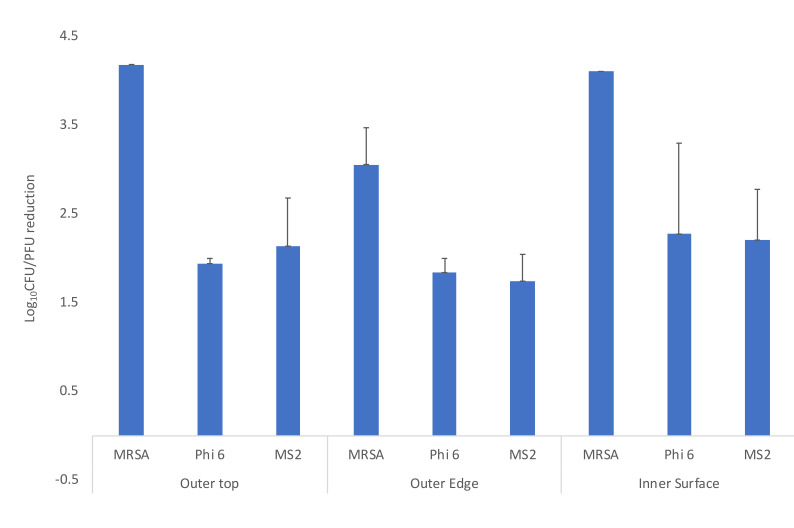
Efficacy of ultraviolet (UV) light delivered by low-pressure mercury decontamination device for decontamination of methicillin-resistant Staphylococcus aureus (MRSA), bacteriophage MS2, and bacteriophage Phi6 on Moldex 1517 N95 respirators. 10-μL aliquots containing 10>6 colony-forming units (CFU) or plaque-forming units (PFU) of the test organisms in the simulated mucous suspension were spread to cover an area of 1-cm2 on 3 different areas on the respirator surface (top exterior, edge exterior, and interior) as shown in Figure 1. The respirator was exposed to a 15-minute cycle of UV at 3 feet from the bulbs then turned for another 15-minute cycle on the opposite side. Error bars indicate standard error.
Figure 4.
Figure 4.
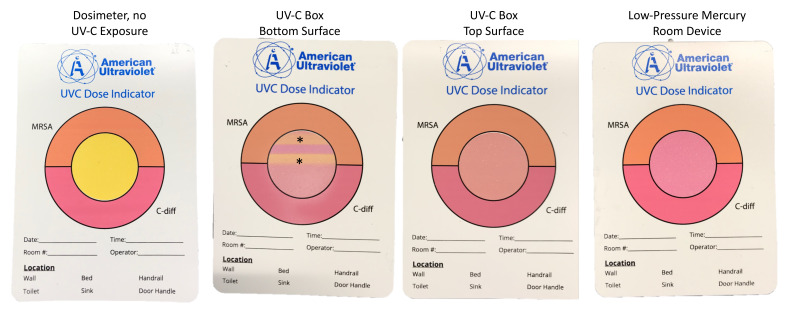
Pictures showing colorimetric indicators placed adjacent to respirators during ultraviolet-C cycles.
Figure 5.
Figure 5.
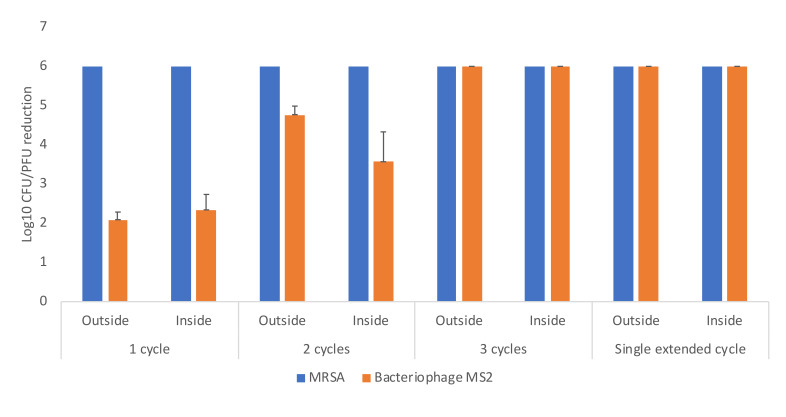
Efficacy of a multi-purpose high-level disinfection cabinet for decontamination or disinfection of methicillin-resistant Staphylococcus aureus (MRSA) and bacteriophage MS2 on N95 respirators. 10-μL aliquots containing 106 colony-forming units (CFU) or plaque-forming units (PFU) of the test organisms in the simulated mucous suspension were spread to cover an area of 1-cm2 on 3 different areas on the respirator surface (top exterior, edge exterior, and interior) as shown in Figure 1. The respirator was exposed to 1, 2, or 3 22-minute treatment cycles or a single extended cycle of 31 minutes. Error bars indicate standard error.

References

    1. Tomas ME, Kundrapu S, Thota P, Sunkesula VC, Cadnum JL, Mana TS, Jencson A, O'Donnell M, Zabarsky TF, Hecker MT, Ray AJ, Wilson BM, Donskey CJ. Contamination of the skin and clothing of healthcare personnel during removal of personal protective equipment. JAMA Intern Med 2015;175:1904–10. doi: 10.1001/jamainternmed.2015.4535. - DOI - PubMed
    1. Ranney ML, Griffeth V, Jha AK. Critical Supply Shortages - The Need for Ventilators and Personal Protective Equipment during the Covid-19 Pandemic. N Engl J Med 2020. March 25. doi: 10.1056/NEJMp2006141. - DOI - PubMed
    1. https://www.cdc.gov/niosh/topics/hcwcontrols/recommendedguidanceextuse.html.
    1. Lore MB, Heimbuch BK, Brown TL, Wander JD, Hinrichs SH. Effectiveness of Three Decontamination Treatments against Influenza Virus Applied to Filtering Facepiece Respirators. Ann Occupat Hyg 2012;56:92–101. 10.1093/annhyg/mer054 - DOI - PubMed
    1. Viscusi DJ, Bergman MS, Eimer BC, Shafter RS. Evaluation of Five Decontamination Methods for Filtering Facepiece Respirators. Ann Occup Hyg 2009;53:815–827. 10.1093/annhyg/mep070 - DOI - PMC - PubMed

LinkOut - more resources