


Patient and clinician experience of a serious illness conversation guide in oncology: A descriptive analysis
- PMID: 32363775
- PMCID: PMC7333843
- DOI: 10.1002/cam4.3102
Patient and clinician experience of a serious illness conversation guide in oncology: A descriptive analysis
Abstract
Background/objective: Oncology guidelines recommend earlier communication with patients about prognosis and goals-of-care in serious illness. However, current evidence leaves gaps in our understanding of the experience of these conversations. This analysis evaluates the patient and clinician experience of a conversation using a Serious Illness Conversation Guide (SICG).
Design/setting: Secondary analysis from a cluster-randomized clinical trial in a northeastern cancer center.
Participants: Physicians, advanced practice clinicians, and patients with advanced cancer who received the intervention.
Intervention: SICG, clinician training, systems-changes.
Main outcomes and measures: The patient questionnaire assessed perceptions of the conversation and impact on anxiety, hopefulness, peacefulness, sense of control over medical decisions, closeness with their clinician, and behaviors. The clinician questionnaire assessed feasibility, acceptability, and impact on satisfaction in their role.
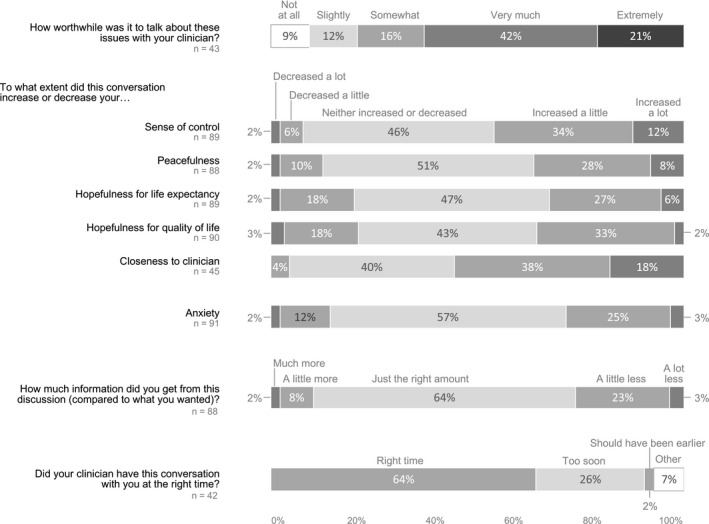
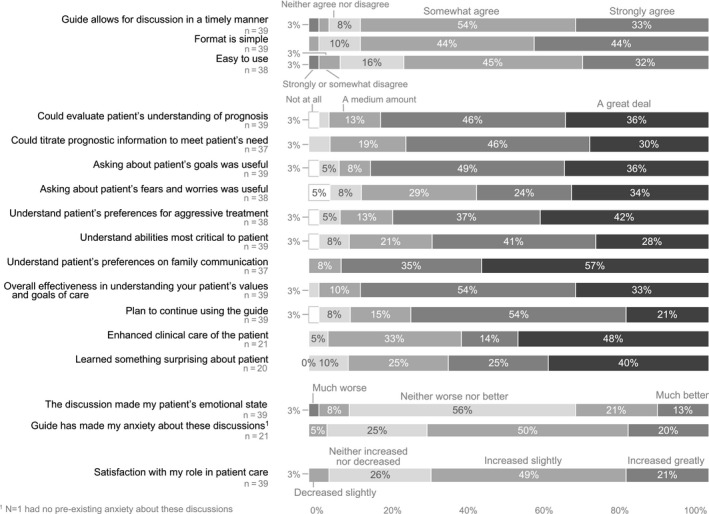
Results: We enrolled 54 clinicians and 163 patients; 41 clinicians and 118 patients had a SICG discussion. Most patients described the conversation as worthwhile (79%) and reported no change or improvement in their sense of peacefulness, hopefulness, and anxiety (on average 79%); 56% reported feeling closer with their clinician. Qualitative patient data described positive behavior changes, including enhanced planning for future care and increased focus on personal priorities. Nearly 90% of clinicians agreed that the SICG facilitated timely, effective conversations, and 70% reported increased satisfaction in their role.
Conclusion: Conversations using a SICG were feasible, acceptable, and were associated with positive experiences for both patients and clinicians in oncology in ways that align with national recommendations for serious illness communication. This trial is registered at ClinicalTrials.gov: NCT01786811 https://clinicaltrials.gov/ct2/show/NCT01786811.
Keywords: advance care planning; advanced cancer; clinician experience; goals of care communication; palliative care; patient experience; prognostic communication; serious illness communication.
© 2020 The Authors. Cancer Medicine published by John Wiley & Sons Ltd.
Conflict of interest statement
Dr Block receives compensation as Palliative Care Editor from Up to Date.
Figures
References
-
- Curtis JR, Downey L, Back AL, et al. Effect of a patient and clinician communication‐priming intervention on patient‐reported goals‐of‐care discussions between patients with serious illness and clinicians: a randomized clinical trial. JAMA Intern Med. 2018;178:930‐940. 10.1001/jamainternmed.2018.2317. - DOI - PMC - PubMed
Publication types
MeSH terms
Associated data
LinkOut - more resources
Full Text Sources
Medical
