


Postmortem examination of COVID-19 patients reveals diffuse alveolar damage with severe capillary congestion and variegated findings in lungs and other organs suggesting vascular dysfunction
- PMID: 32364264
- PMCID: PMC7496150
- DOI: 10.1111/his.14134
Postmortem examination of COVID-19 patients reveals diffuse alveolar damage with severe capillary congestion and variegated findings in lungs and other organs suggesting vascular dysfunction
Abstract
Aims: Coronavirus disease 2019 (COVID-19), caused by severe acute respiratory syndrome coronavirus 2 (SARS-CoV-2), has rapidly evolved into a sweeping pandemic. Its major manifestation is in the respiratory tract, and the general extent of organ involvement and the microscopic changes in the lungs remain insufficiently characterised. Autopsies are essential to elucidate COVID-19-associated organ alterations.
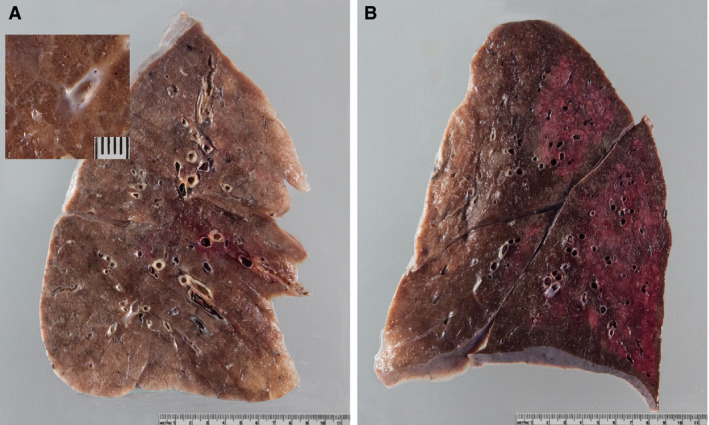
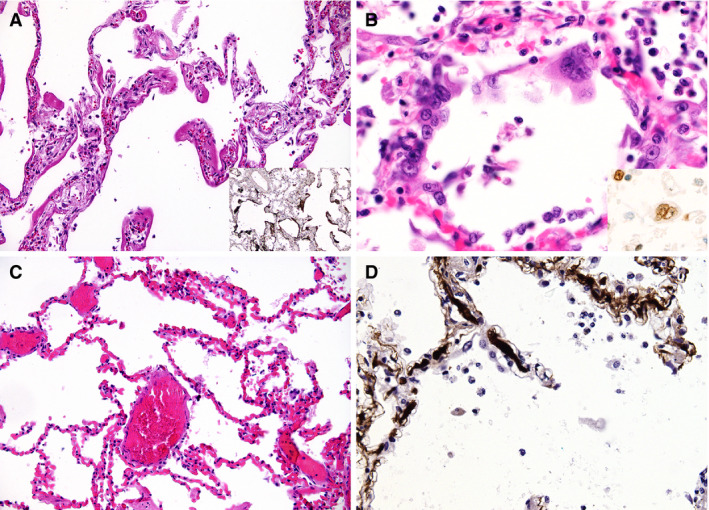
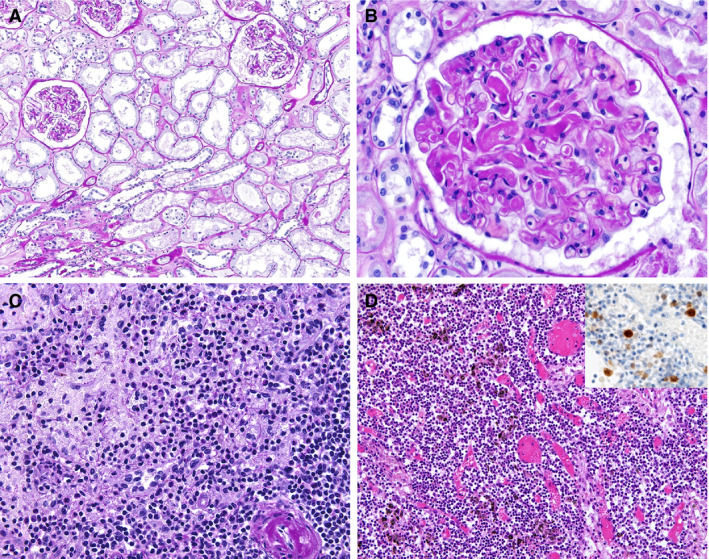
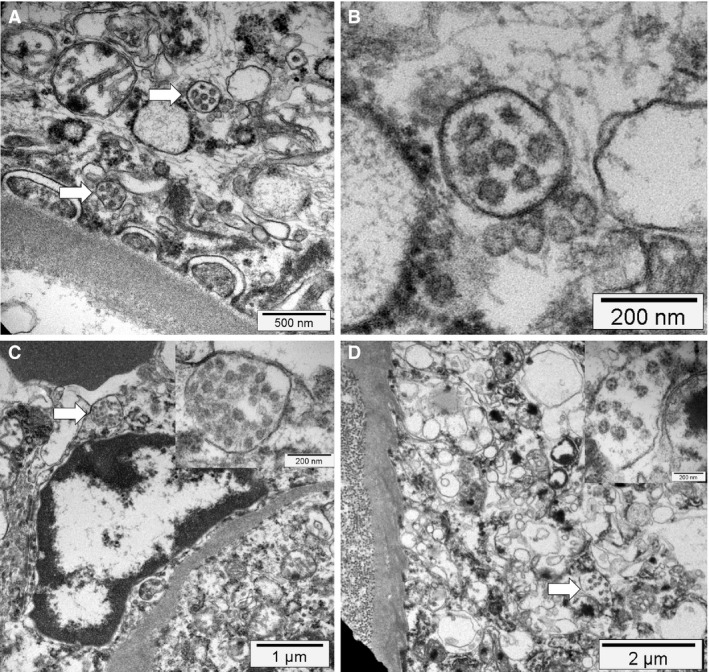
Methods and results: This article reports the autopsy findings of 21 COVID-19 patients hospitalised at the University Hospital Basel and at the Cantonal Hospital Baselland, Switzerland. An in-corpore technique was performed to ensure optimal staff safety. The primary cause of death was respiratory failure with exudative diffuse alveolar damage and massive capillary congestion, often accompanied by microthrombi despite anticoagulation. Ten cases showed superimposed bronchopneumonia. Further findings included pulmonary embolism (n = 4), alveolar haemorrhage (n = 3), and vasculitis (n = 1). Pathologies in other organ systems were predominantly attributable to shock; three patients showed signs of generalised and five of pulmonary thrombotic microangiopathy. Six patients were diagnosed with senile cardiac amyloidosis upon autopsy. Most patients suffered from one or more comorbidities (hypertension, obesity, cardiovascular diseases, and diabetes mellitus). Additionally, there was an overall predominance of males and individuals with blood group A (81% and 65%, respectively). All relevant histological slides are linked as open-source scans in supplementary files.
Conclusions: This study provides an overview of postmortem findings in COVID-19 cases, implying that hypertensive, elderly, obese, male individuals with severe cardiovascular comorbidities as well as those with blood group A may have a lower threshold of tolerance for COVID-19. This provides a pathophysiological explanation for higher mortality rates among these patients.
Keywords: COVID-19; SARS-CoV-2; autopsy; cardiovascular; kidney; lung; senile amyloidosis.
© 2020 The Authors. Histopathology published by John Wiley & Sons Ltd.
Conflict of interest statement
All authors declare that they have no conflicting interests.
Figures
Comment in
-
COVID-19 related lung pathology: old patterns in new clothing?Histopathology. 2020 Aug;77(2):169-172. doi: 10.1111/his.14162. Histopathology. 2020. PMID: 32881045 Free PMC article. No abstract available.
-
Pediatric coronavirus (COVID-19) death in a child with cyclic neutropenia.Pediatr Blood Cancer. 2021 Oct;68(10):e29171. doi: 10.1002/pbc.29171. Epub 2021 Jun 1. Pediatr Blood Cancer. 2021. PMID: 34060701 Free PMC article. No abstract available.
References
-
- Mortensen ML, Ray CG, Payne CM et al Coronaviruslike particles in human gastrointestinal disease. Epidemiologic, clinical, and laboratory observations. Am. J. Dis. Child. 1985; 139; 928–934. - PubMed
-
- Drosten C, Gunther S, Preiser W et al Identification of a novel coronavirus in patients with severe acute respiratory syndrome. N. Engl. J. Med. 2003; 348; 1967–1976. - PubMed
-
- Zaki AM, van Boheemen S, Bestebroer TM, Osterhaus AD, Fouchier RA. Isolation of a novel coronavirus from a man with pneumonia in Saudi Arabia. N. Engl. J. Med. 2012; 367; 1814–1820. - PubMed
MeSH terms
LinkOut - more resources
Full Text Sources
Other Literature Sources
Medical
Miscellaneous
