


Replacing CAR-T cell resistance with persistence by changing a single residue
- PMID: 32364534
- PMCID: PMC7260020
- DOI: 10.1172/JCI136872
Replacing CAR-T cell resistance with persistence by changing a single residue
Abstract
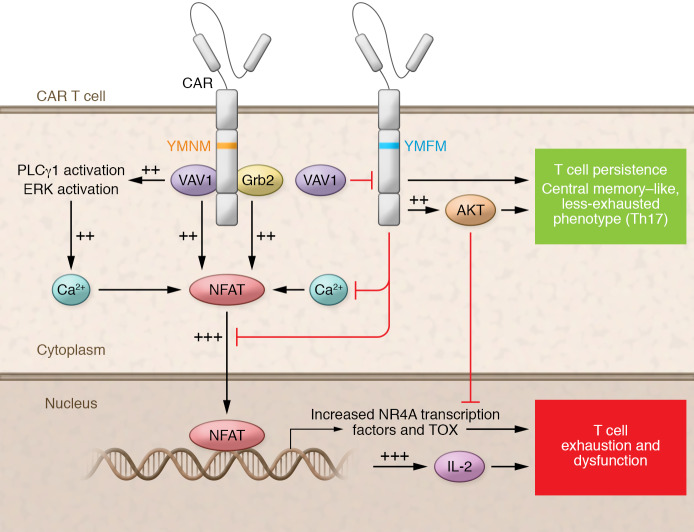
Sustained persistence of chimeric antigen receptor T (CAR-T) cells is a key characteristic associated with long-term remission in patients with hematologic malignancies. Attempts to uncover mechanisms that enhance persistence and thus functionality will have a substantial impact in broadening application of CAR-T cell therapy, especially for solid tumors. In this issue of the JCI, Guedan et al. describe a promising strategy to limit T cell exhaustion and improve persistence by changing a single amino acid in the costimulatory domain of CD28. The authors demonstrated that this single amino acid substitution in CD28-based mesothelin CAR-T cells results in improved persistence and functionality in a xenograft model of pancreatic cancer. Furthermore, reciprocal alteration of the same residue in inducible costimulator-containing (ICOS-containing) CAR-T cells resulted in limited antitumor activity and persistence. These findings suggest that simple alterations in the costimulatory domain may enhance CAR-T cell persistence, warranting future evaluation in other CD28-costimulatory CARs in an effort to improve durable antitumor effects.
Conflict of interest statement
Figures
Comment on
-
Single residue in CD28-costimulated CAR-T cells limits long-term persistence and antitumor durability.J Clin Invest. 2020 Jun 1;130(6):3087-3097. doi: 10.1172/JCI133215. J Clin Invest. 2020. PMID: 32069268 Free PMC article.
