Review
. 2020 Nov 23;59(48):21304-21359.
doi: 10.1002/anie.202003755. Epub 2020 Aug 26.

Sulfonate N-Heterocyclic Carbene-Copper Complexes: Uniquely Effective Catalysts for Enantioselective Synthesis of C-C, C-B, C-H, and C-Si Bonds

Affiliations
Review

Sulfonate N-Heterocyclic Carbene-Copper Complexes: Uniquely Effective Catalysts for Enantioselective Synthesis of C-C, C-B, C-H, and C-Si Bonds

Amir H Hoveyda et al. Angew Chem Int Ed Engl. .

Abstract

A copper-based complex that contains a sulfonate N-heterocyclic carbene ligand was first reported 15 years ago. Since then, these organometallic entities have proven to be uniquely effective in catalyzing an assortment of enantioselective transformations, including allylic substitutions, conjugate additions, proto-boryl additions to alkenes, boryl and silyl substitutions, hydride-allyl additions to alkenyl boronates, and additions of boron-containing allyl moieties to N-H ketimines. In this review article, we detail the shortcomings in the state-of-the-art that fueled the development of this air stable ligand class, members of which can be prepared on multigram scale. For each reaction type, when relevant, the prior art at the time of the advance involving sulfonate NHC-Cu catalysts and/or subsequent key developments are briefly analyzed, and the relevance of the advance to efficient and enantioselective total or formal synthesis of biologically active molecules is underscored. Mechanistic analysis of the structural attributes of sulfonate NHC-Cu catalysts that are responsible for their ability to facilitate transformations with high efficiency as well as regio- and enantioselectivity are detailed. This review contains several formerly undisclosed methodological advances and mechanistic analyses, the latter of which constitute a revision of previously reported proposals.

Keywords: NHC ligands; allylic substitutions; conjugate additions; copper; enantioselective catalysis.


Figures
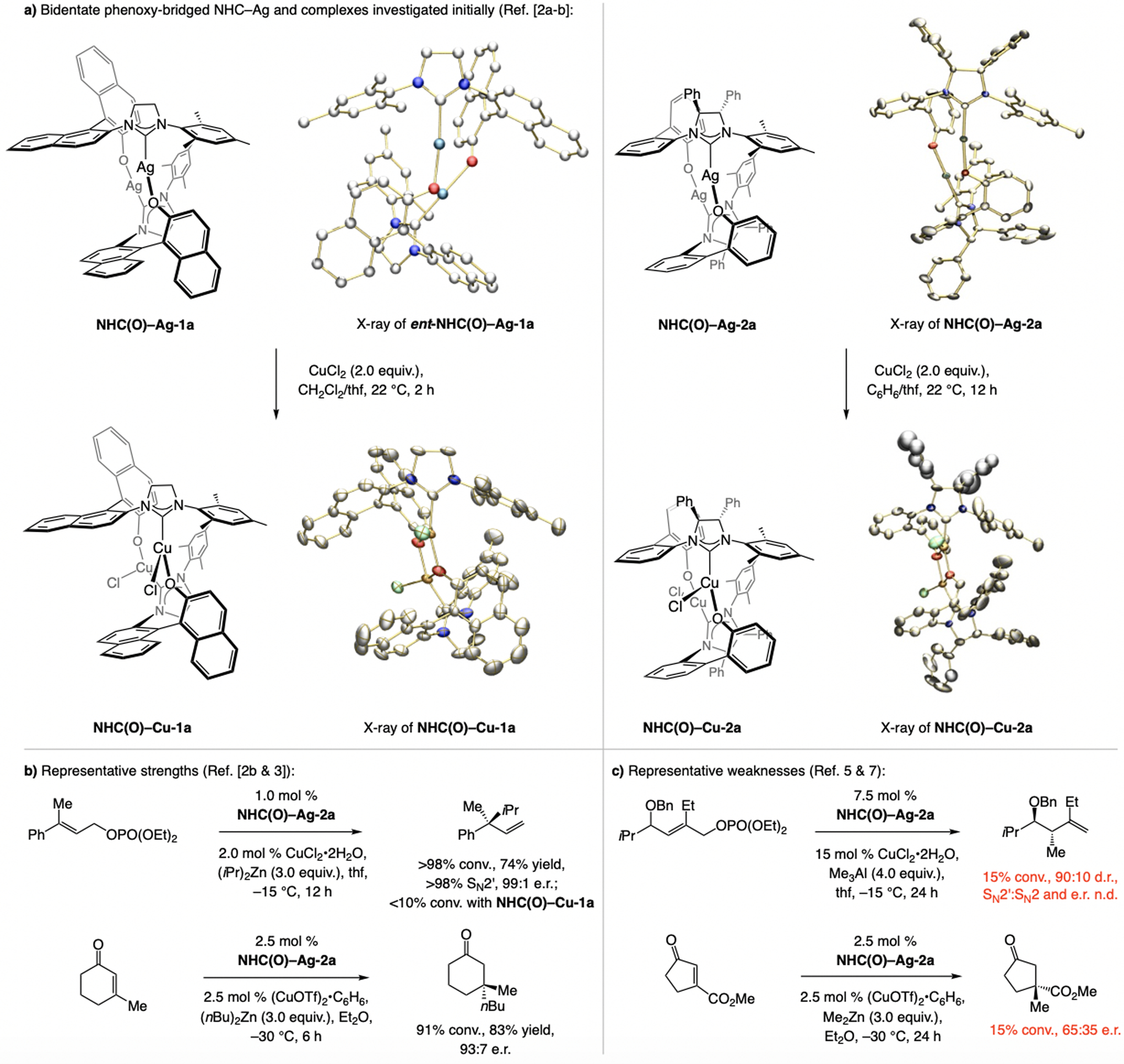
Scheme 1.
Scheme 1.
First- and second-generation aryloxy Ag- and Cu-based N-heterocyclic carbene (NHC) complexes used in enantioselective allylic substitutions and conjugate additions. n.d. = not determined.
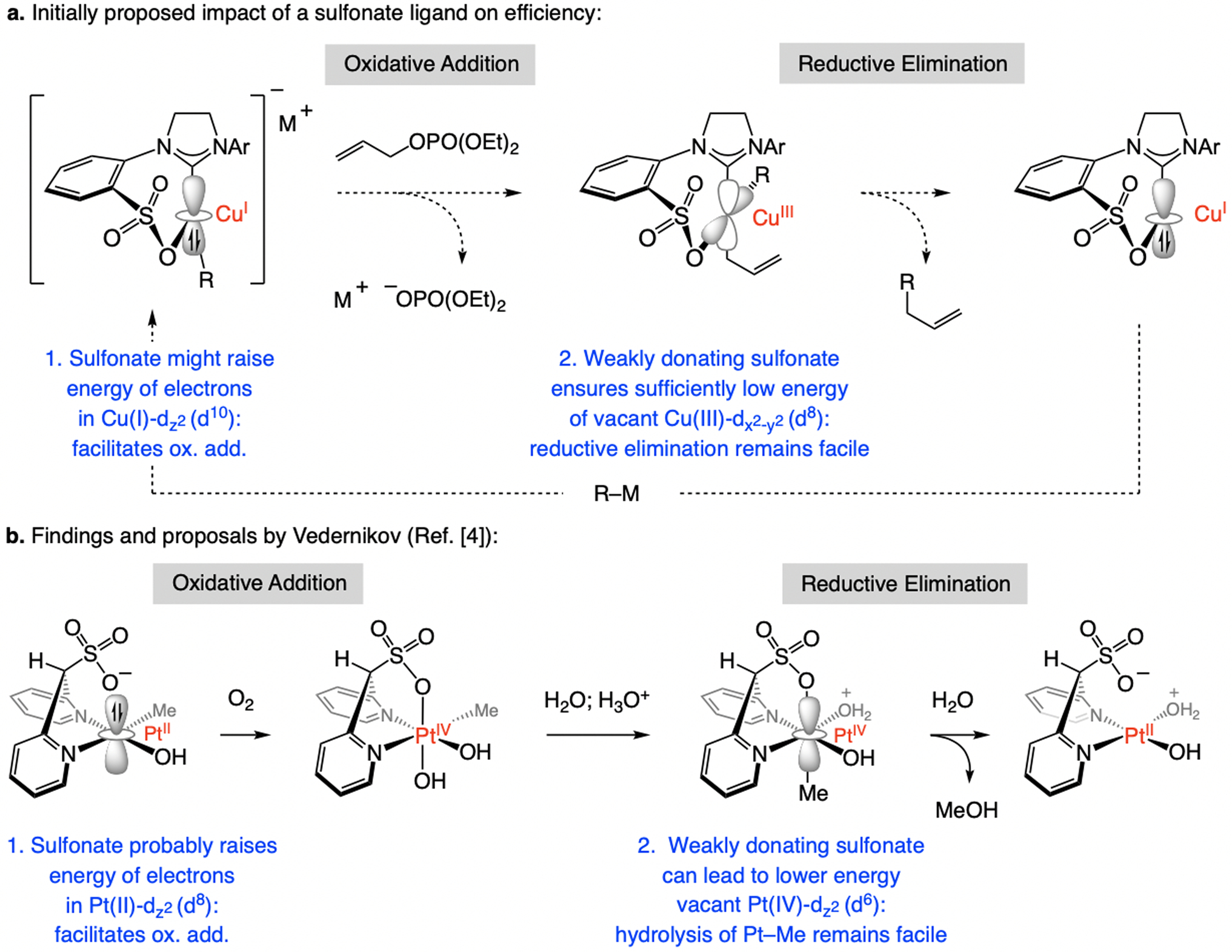
Scheme 2.
Scheme 2.
Regarding the influence of a sulfonate NHC ligand on oxidative addition and reductive elimination steps.
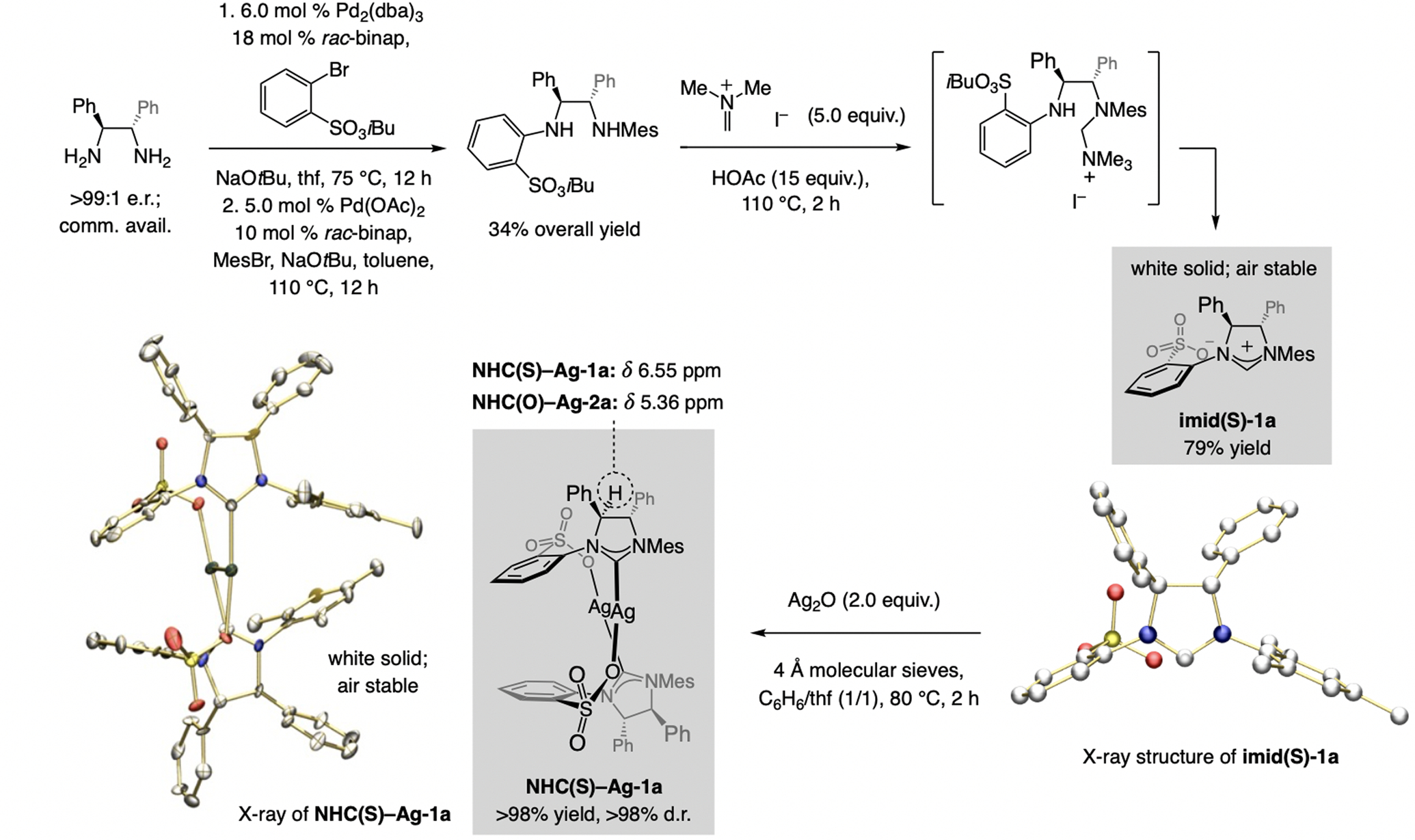
Scheme 3.
Scheme 3.
Preparation of a sulfonate imidazolinium salt and the derived NHC–Ag complex.
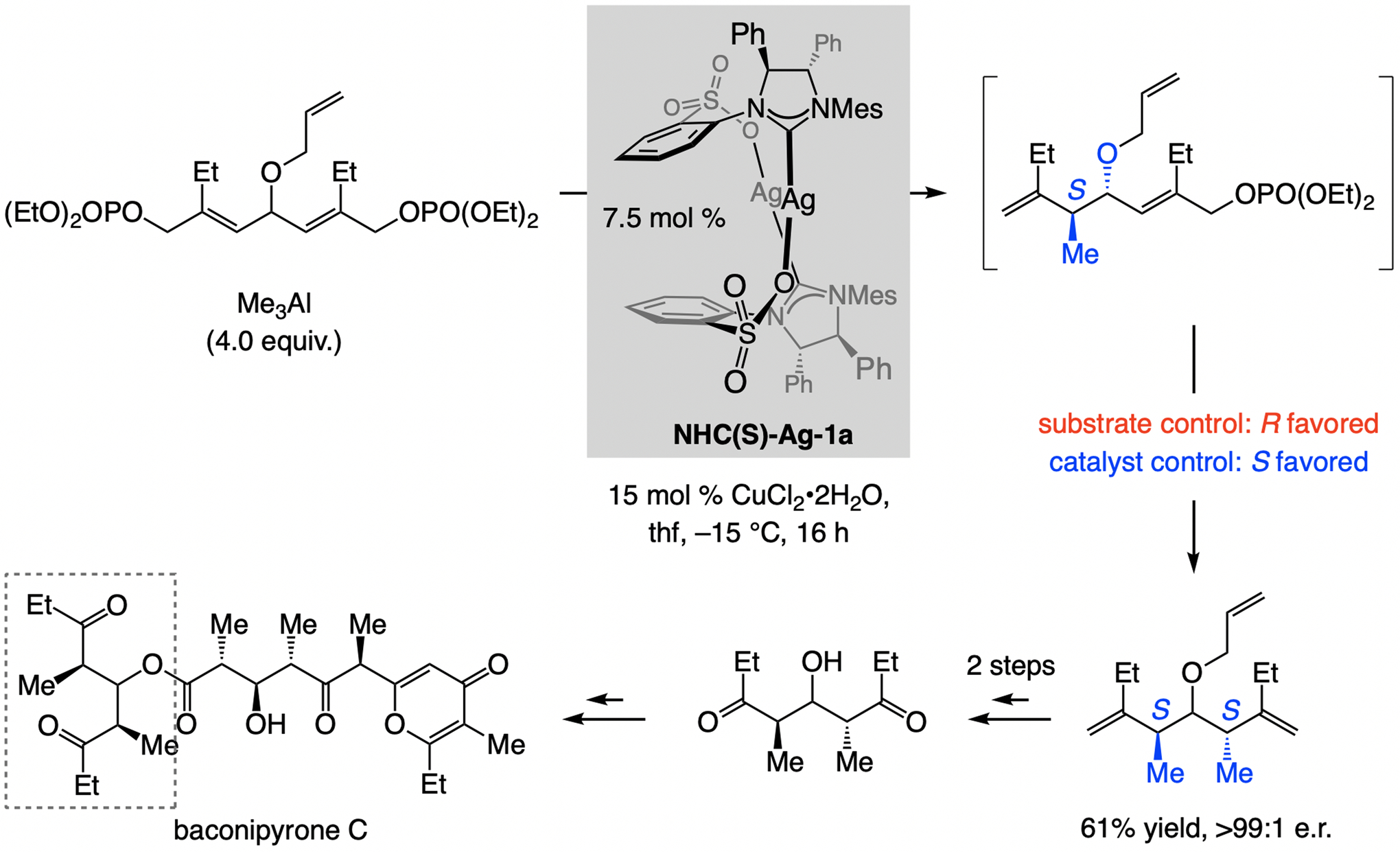
Scheme 4.
Scheme 4.
Tandem EAS with Me3Al in a total synthesis of natural product baconipyrone C.
Scheme 5.
Scheme 5.
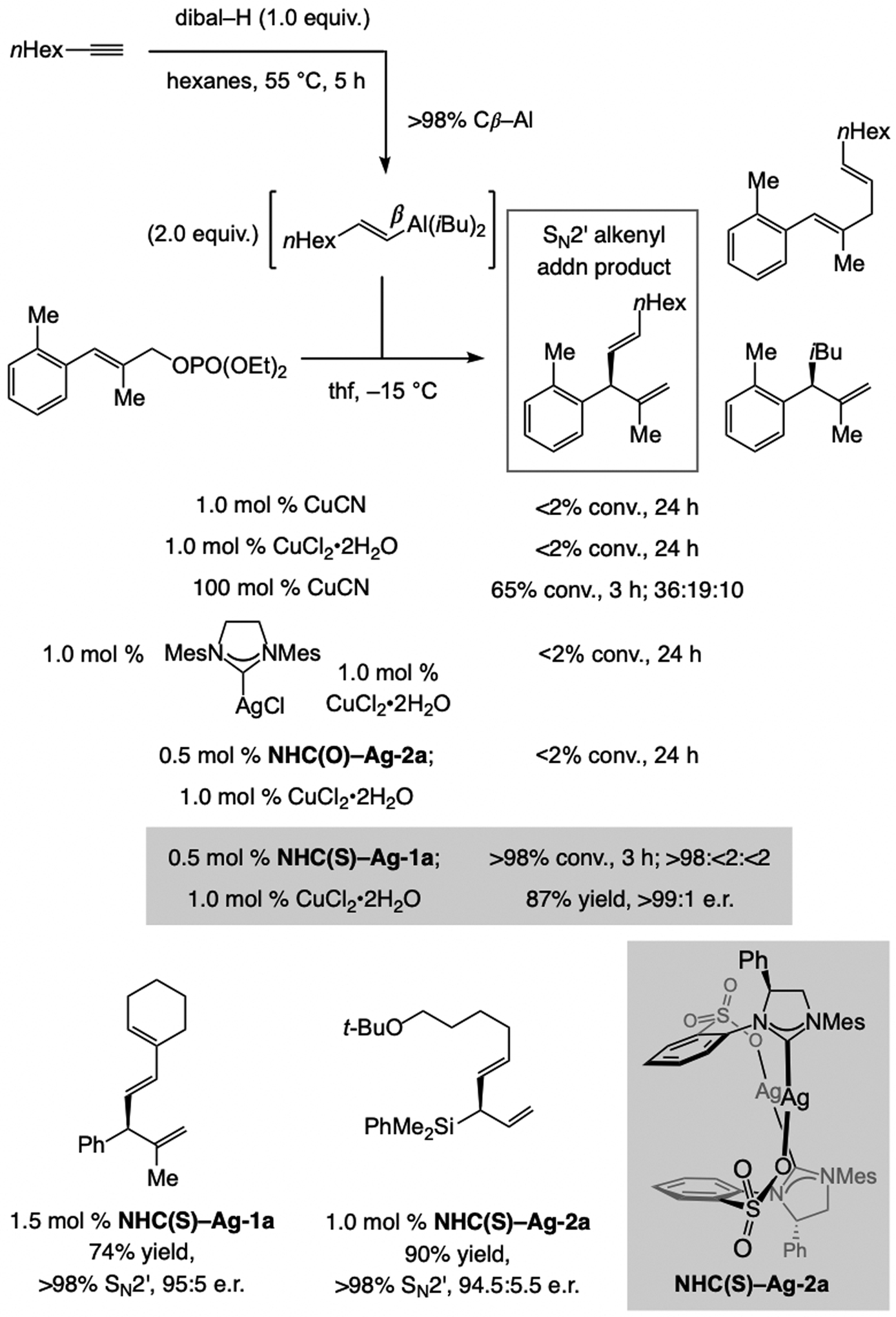
Regio- and stereoselective Al–H addition to an alkyl-substituted terminal alkyne may be followed by a regio- and enantioselective allylic substitution of the in situ generated alkenyl–Al compound (see Scheme 36 for mechanistic analysis).
Scheme 6.
Scheme 6.
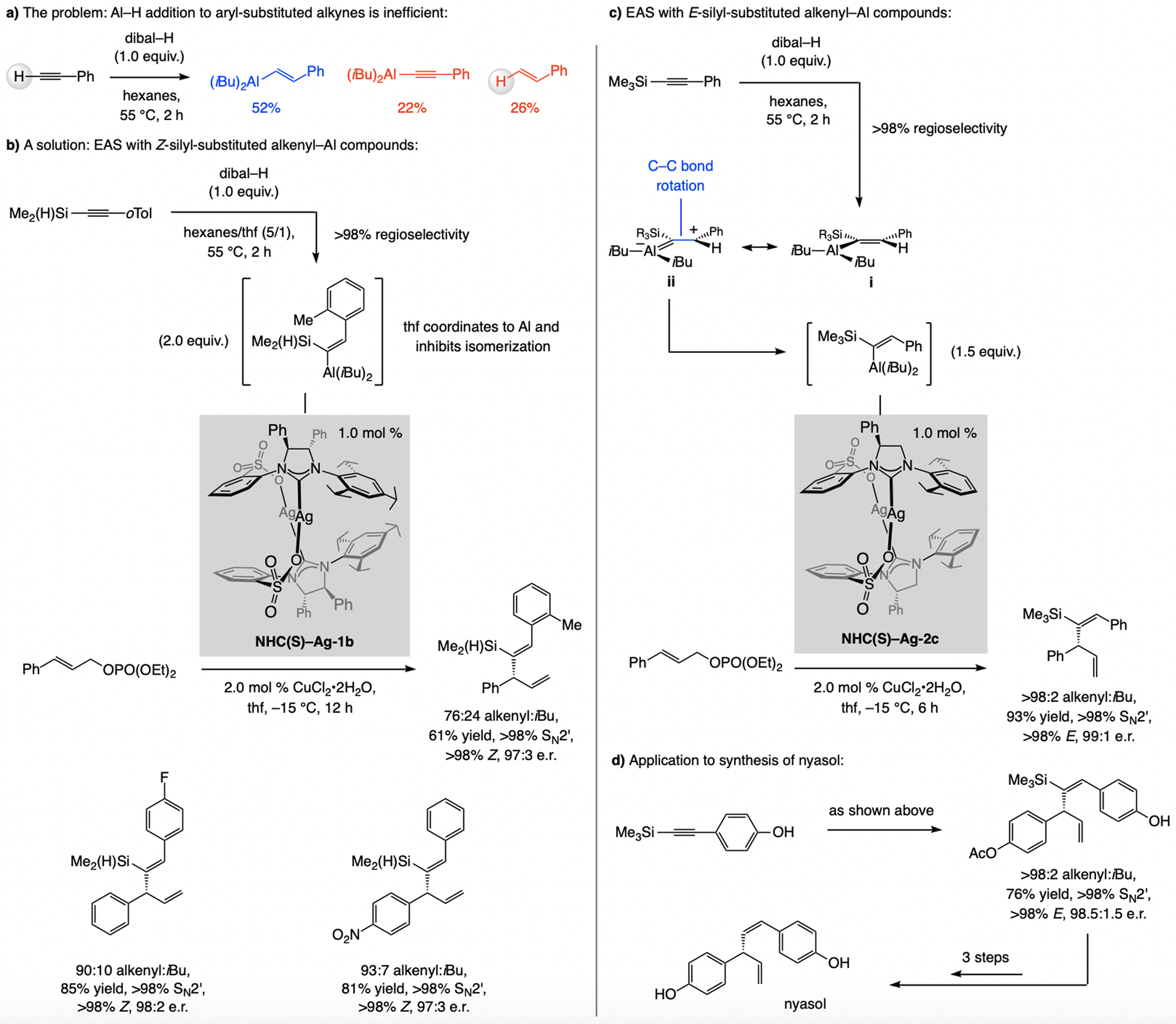
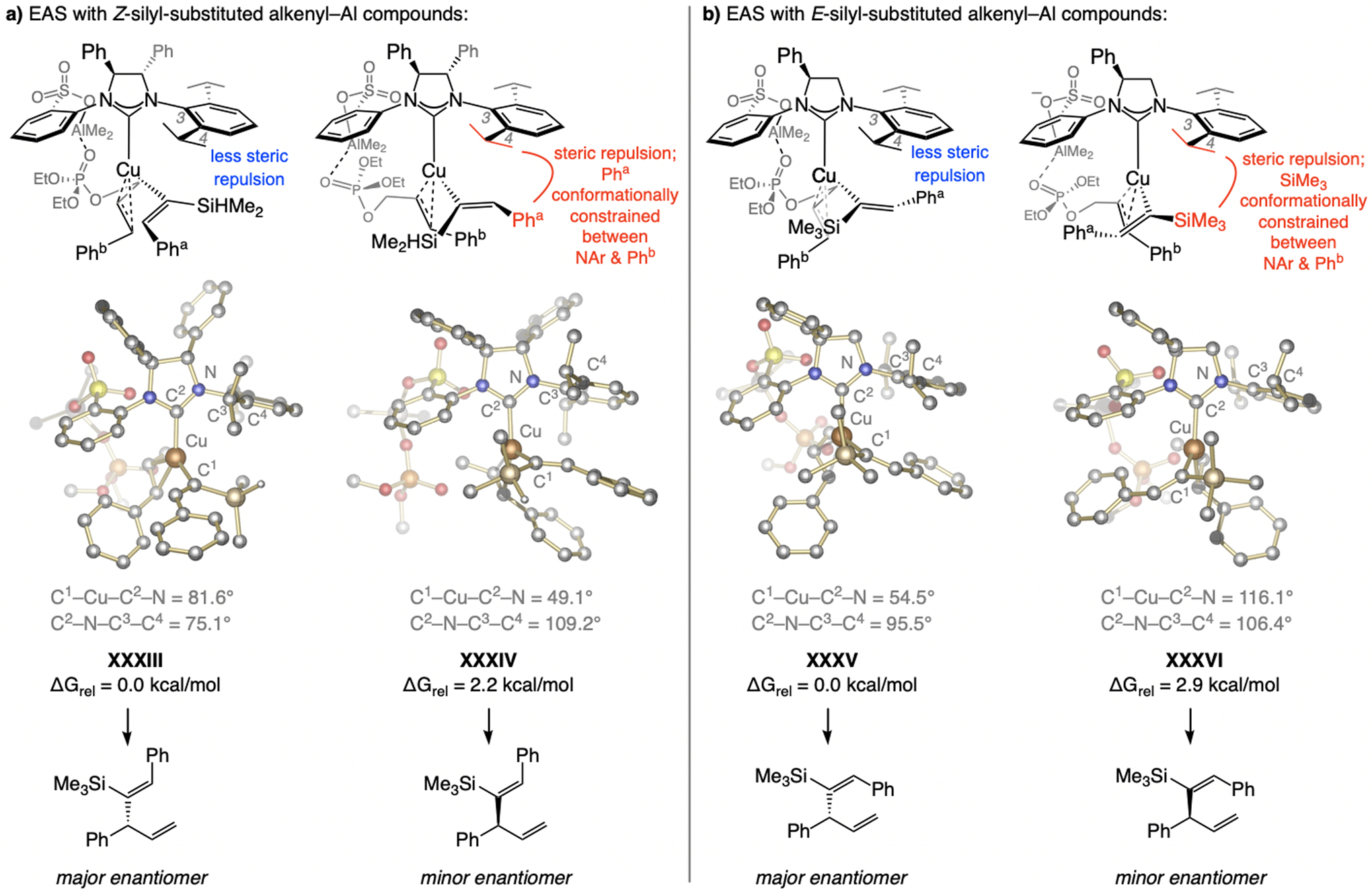
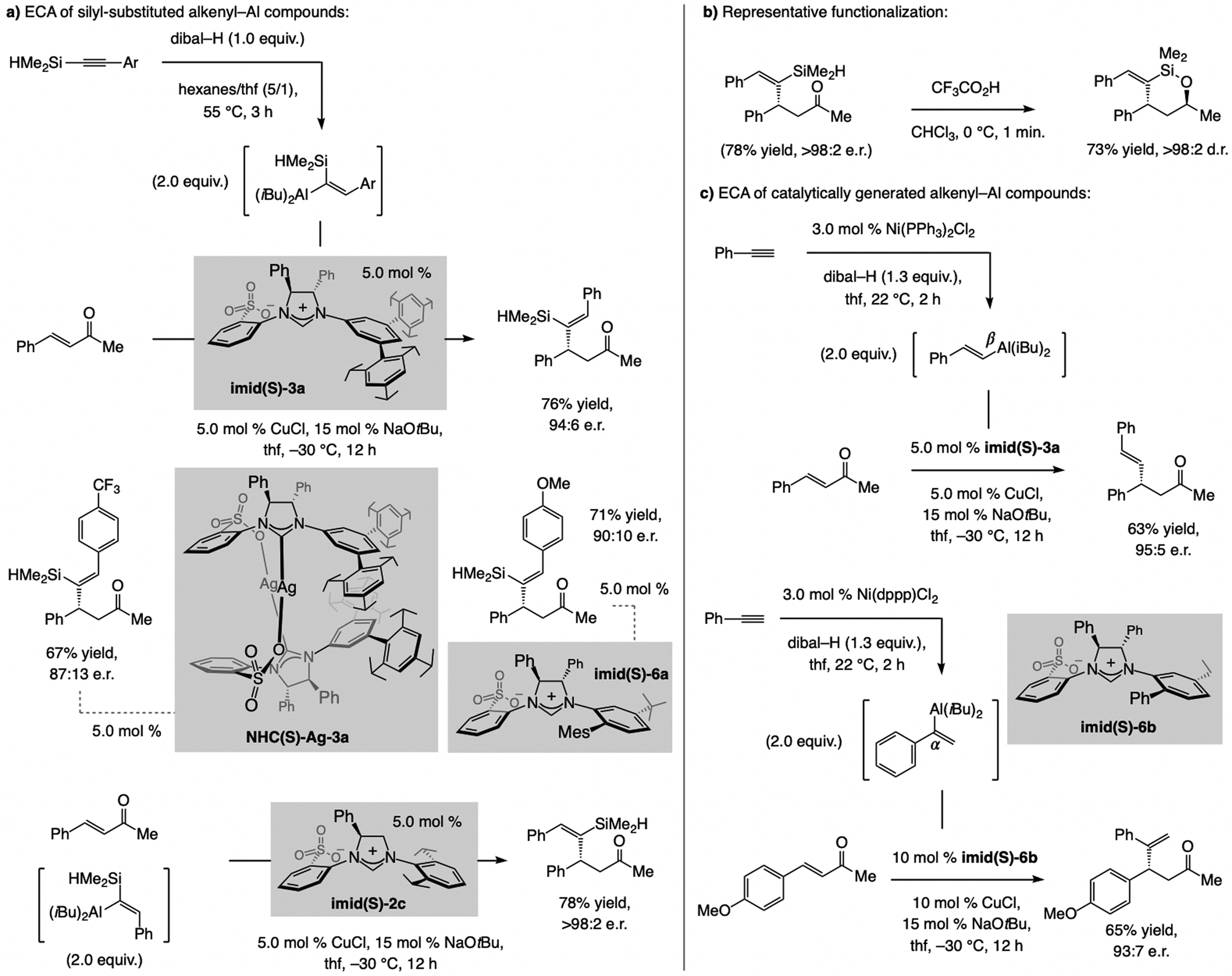
Regio- and E-selective Al–H additions to silyl-substituted aryl alkynes may be used to form (Z)- or (E)-β-alkenyl–Al compounds, applicable to catalytic EAS (see Scheme 37 for mechanistic analysis).
Scheme 7.
Scheme 7.
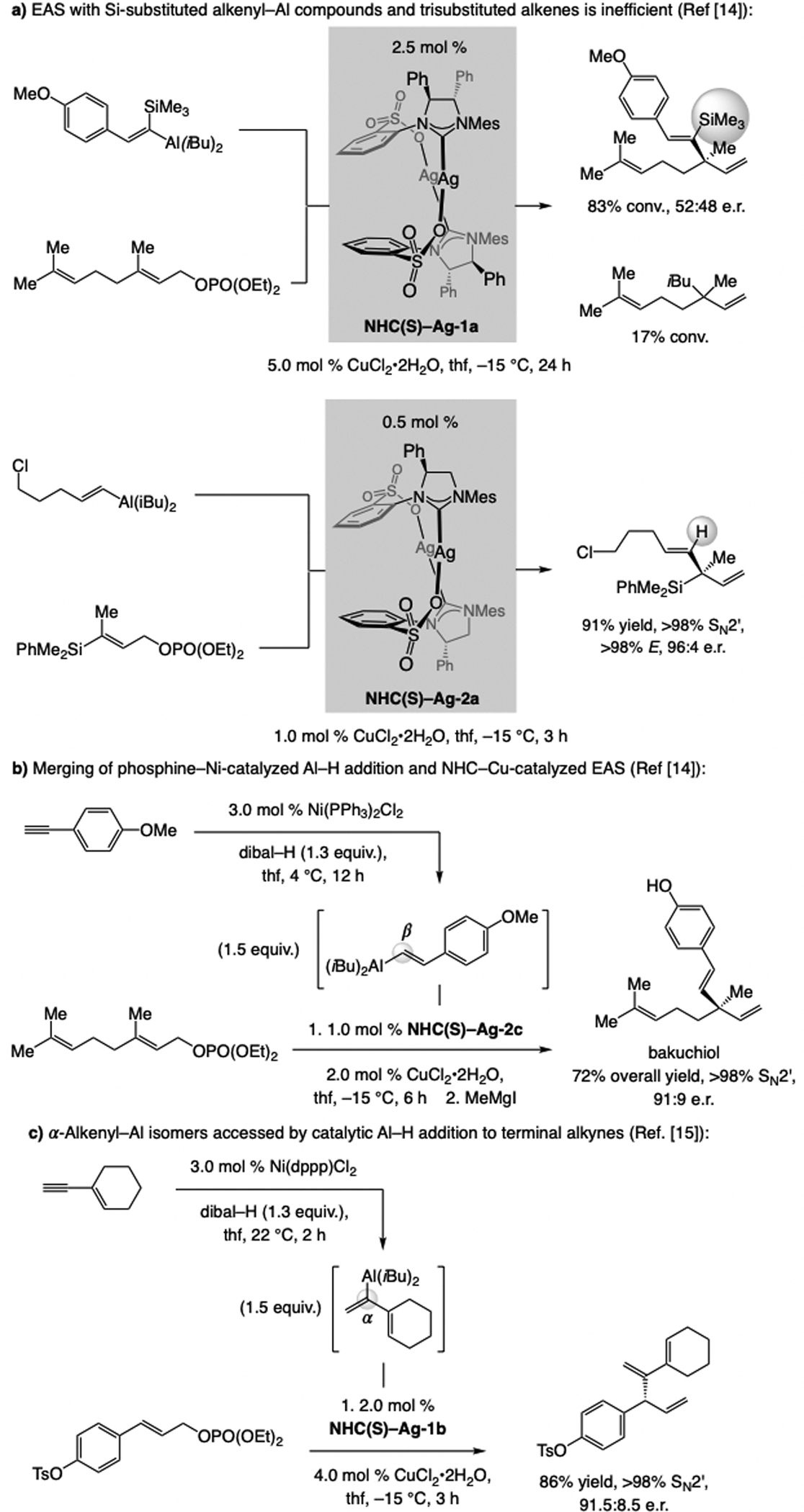
Ni-catalyzed Al–H additions to monosubstituted alkynes to generate Z- or E-alkenyl–Al compounds, and subsequent EAS.
Scheme 8.
Scheme 8.
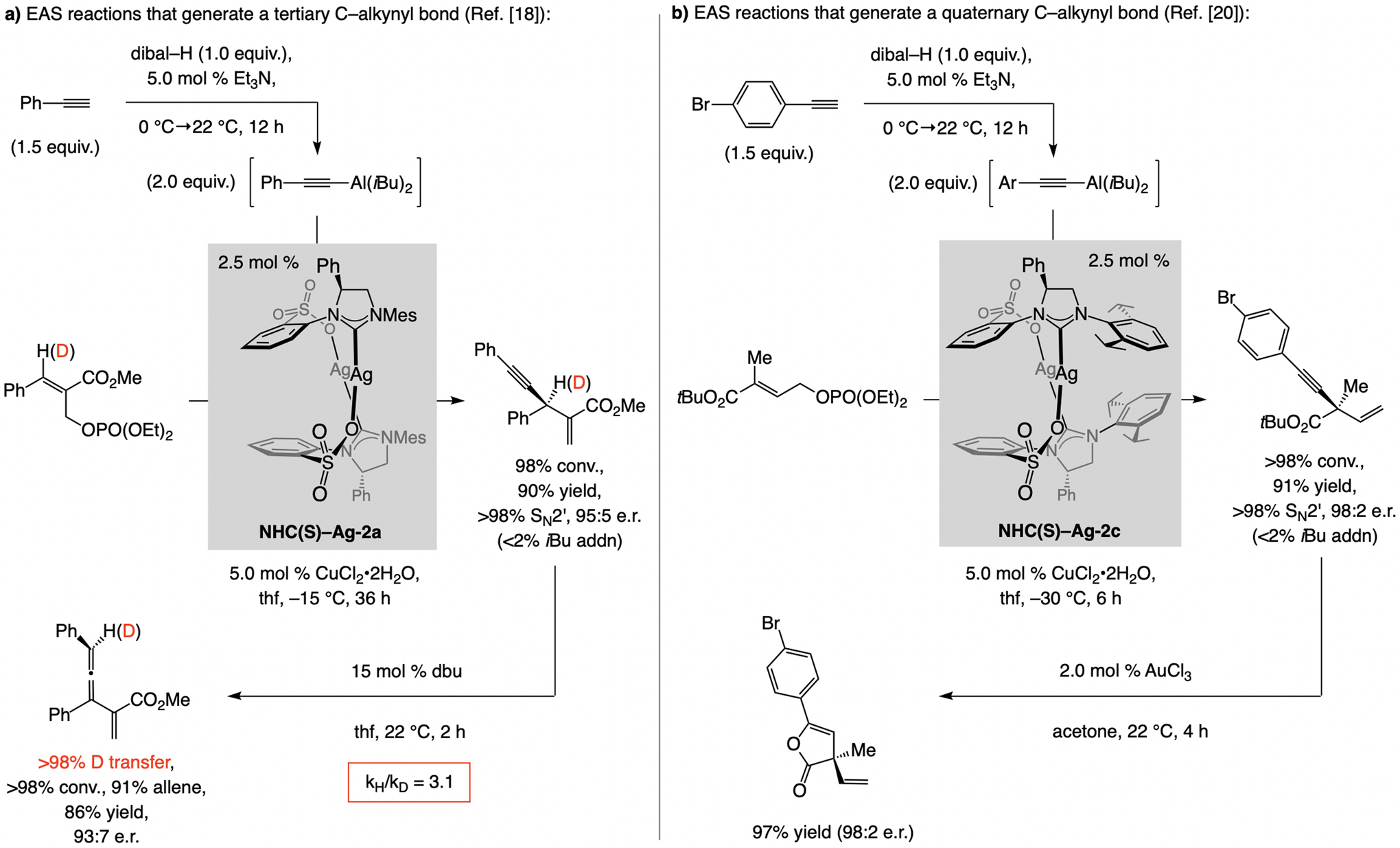
With 5.0 mol % Et3N, reaction of a terminal alkyne with dibal–H affords only the alkynyl–Al compound, which may be used for catalytic EAS.
Scheme 9.
Scheme 9.
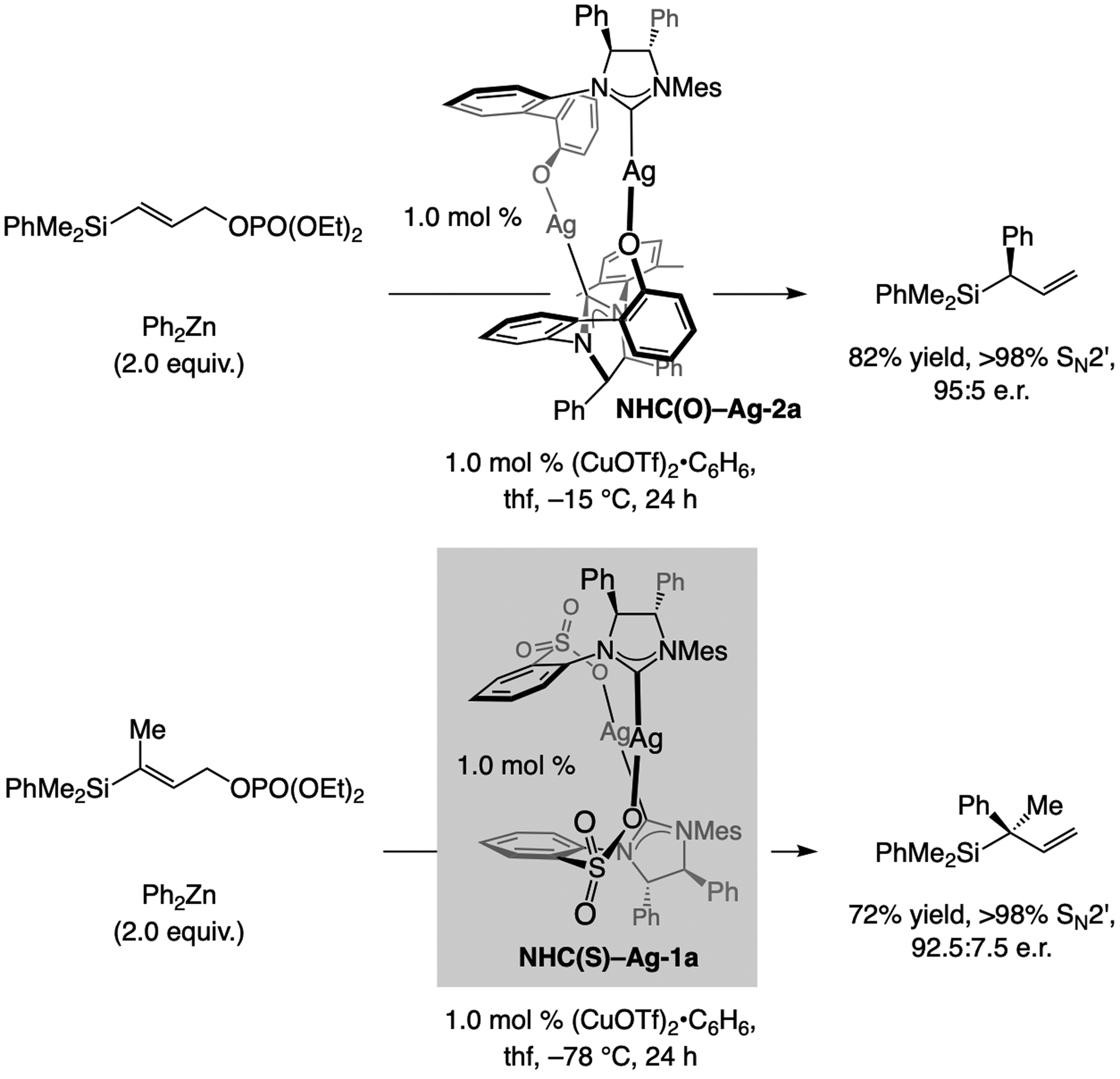
A sulfonate NHC–Cu catalyst is found to be optimal for generating a silyl-substituted quaternary carbon stereogenic center.
Scheme 10.
Scheme 10.
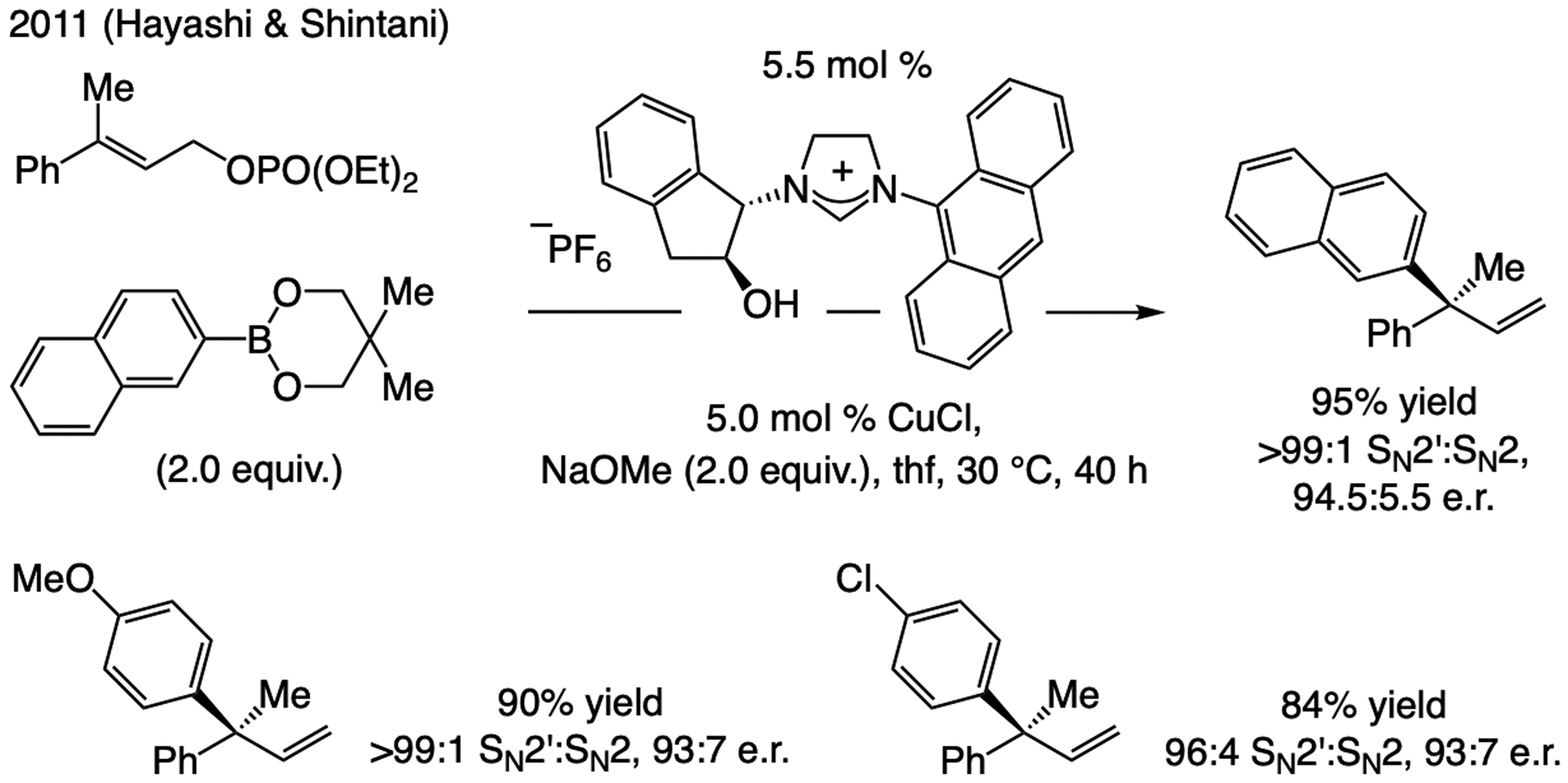
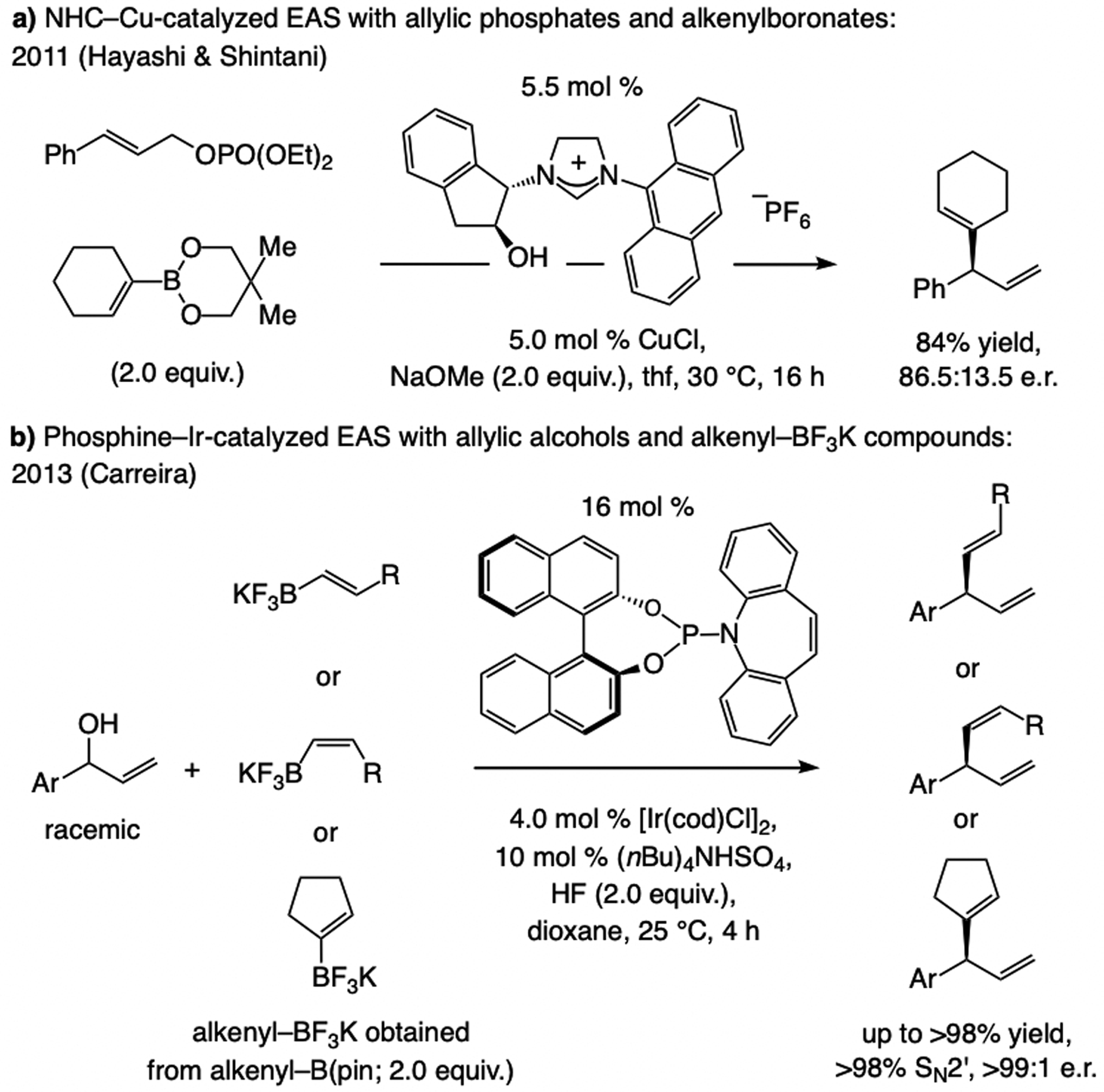
An early example of EAS with an organoboron compound.
Scheme 11.
Scheme 11.
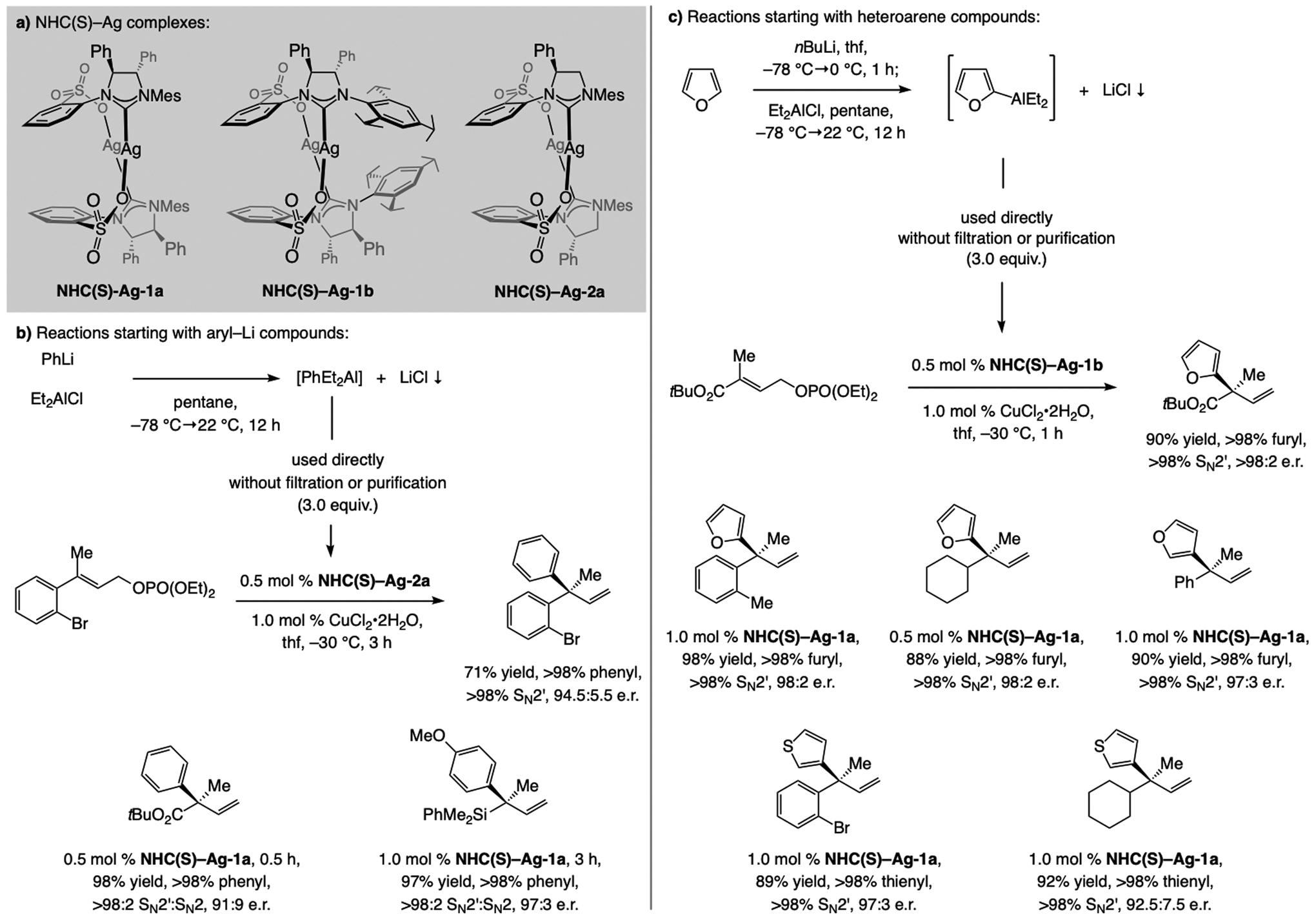
EAS with aryl–Al and heteroaryl–Al compounds, prepared in situ from the corresponding organolithium compounds.
Scheme 12.
Scheme 12.
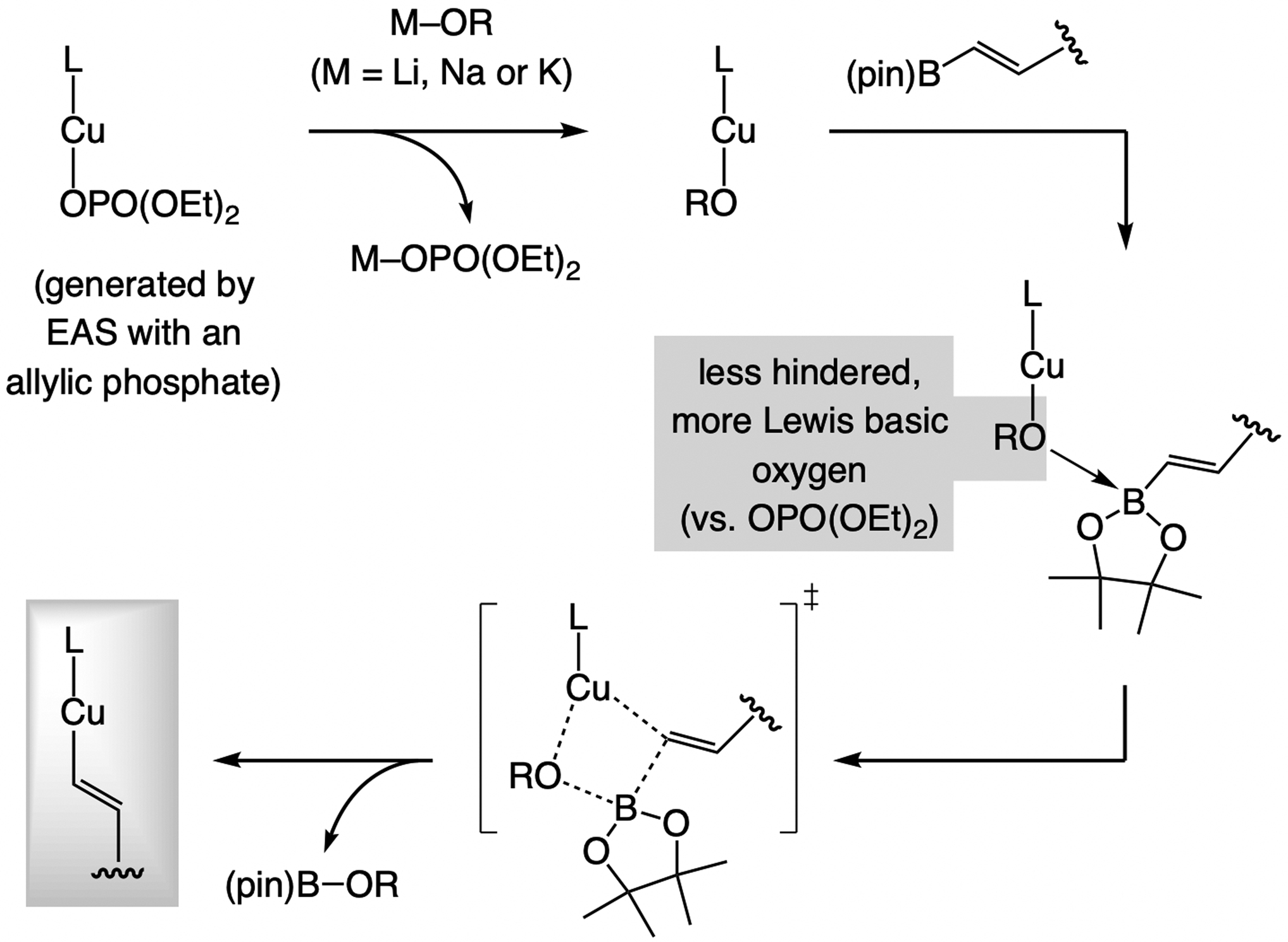
The role of a metal–alkoxide in Cu/B exchange and the formation of an alkenyl–B(pin) compound.
Scheme 13.
Scheme 13.
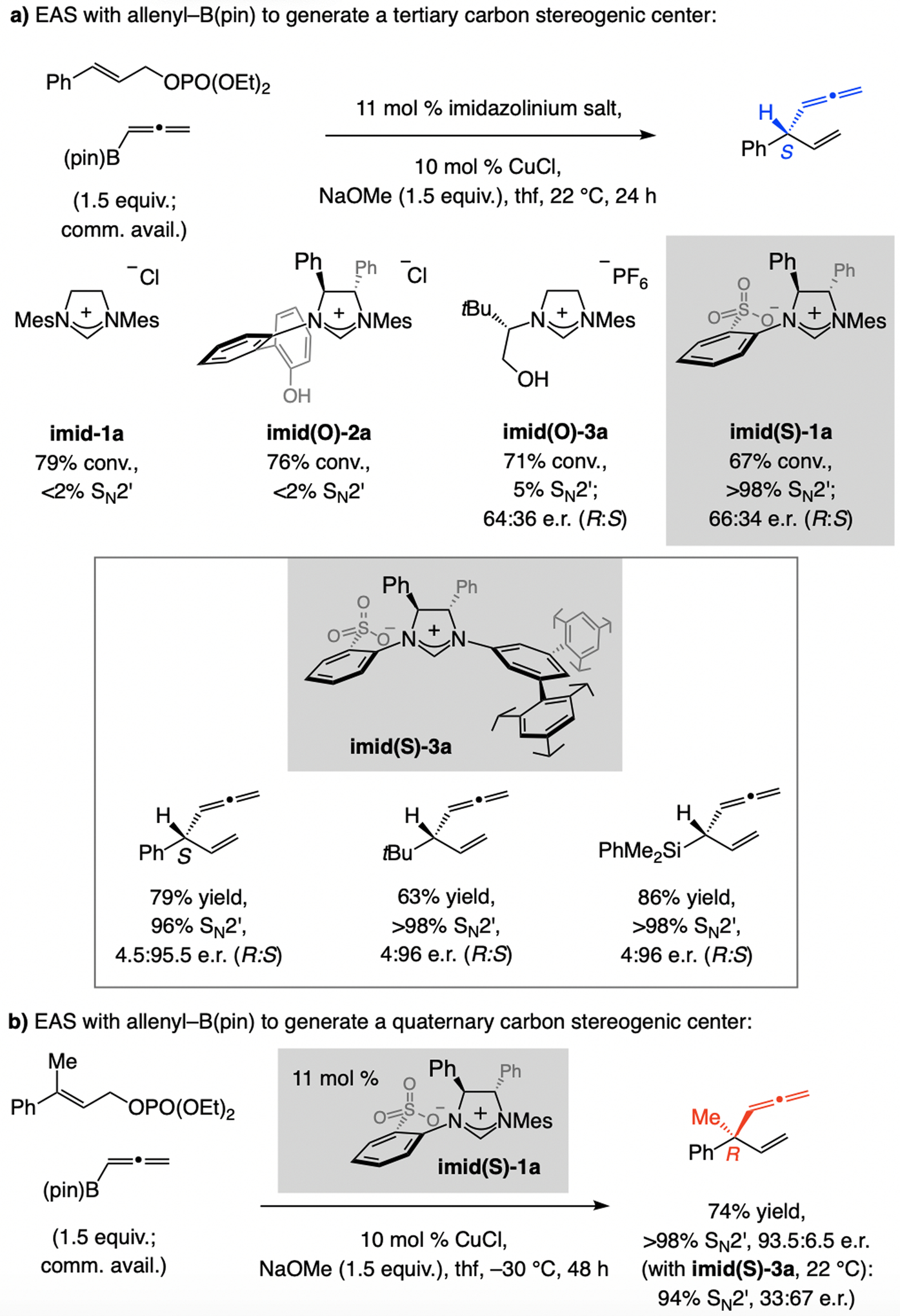
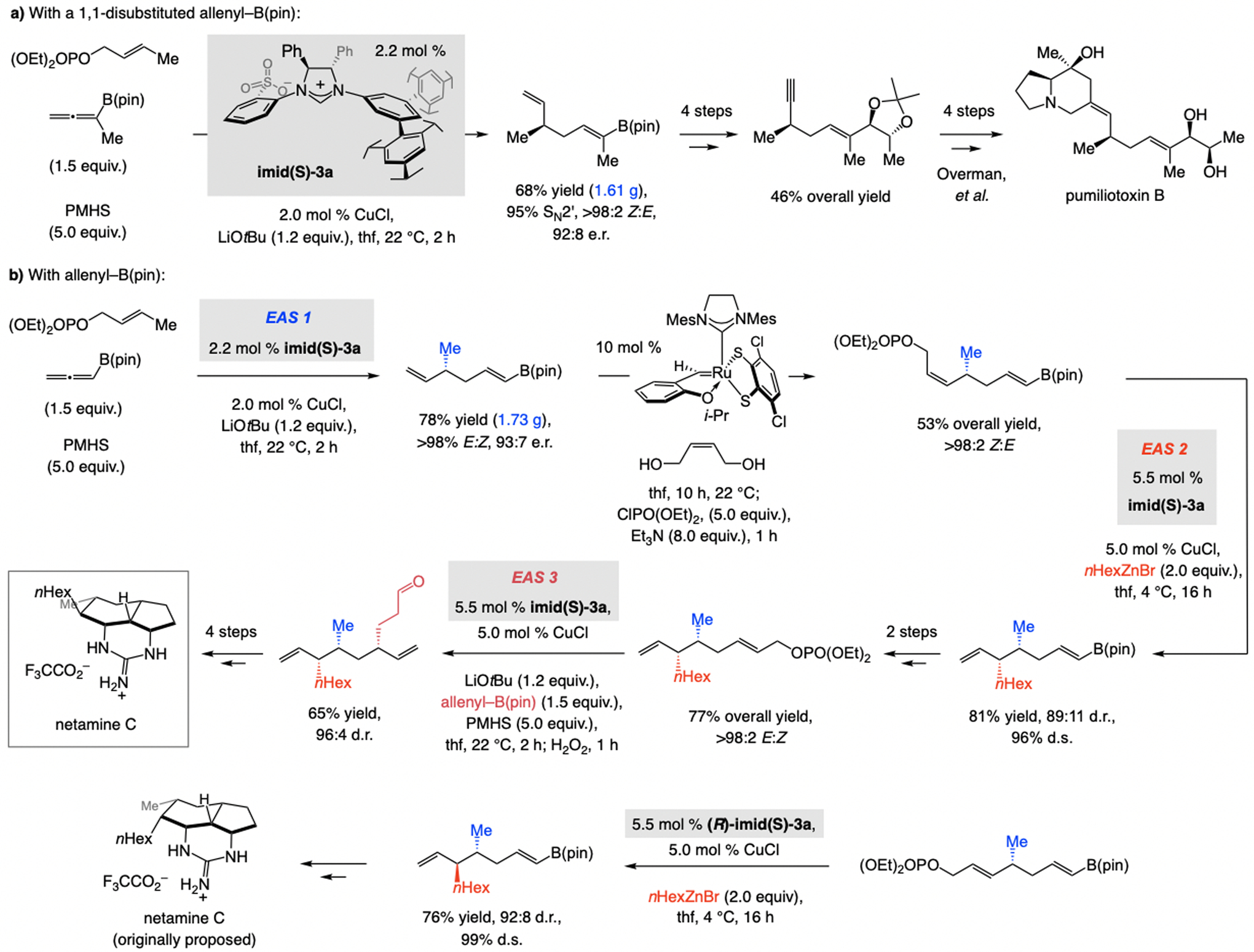
EAS with allenyl–B(pin), affording products that might contain a tertiary or a quaternary carbon stereogenic center (see Schemes 32 for mechanistic analysis).
Scheme 14.
Scheme 14.
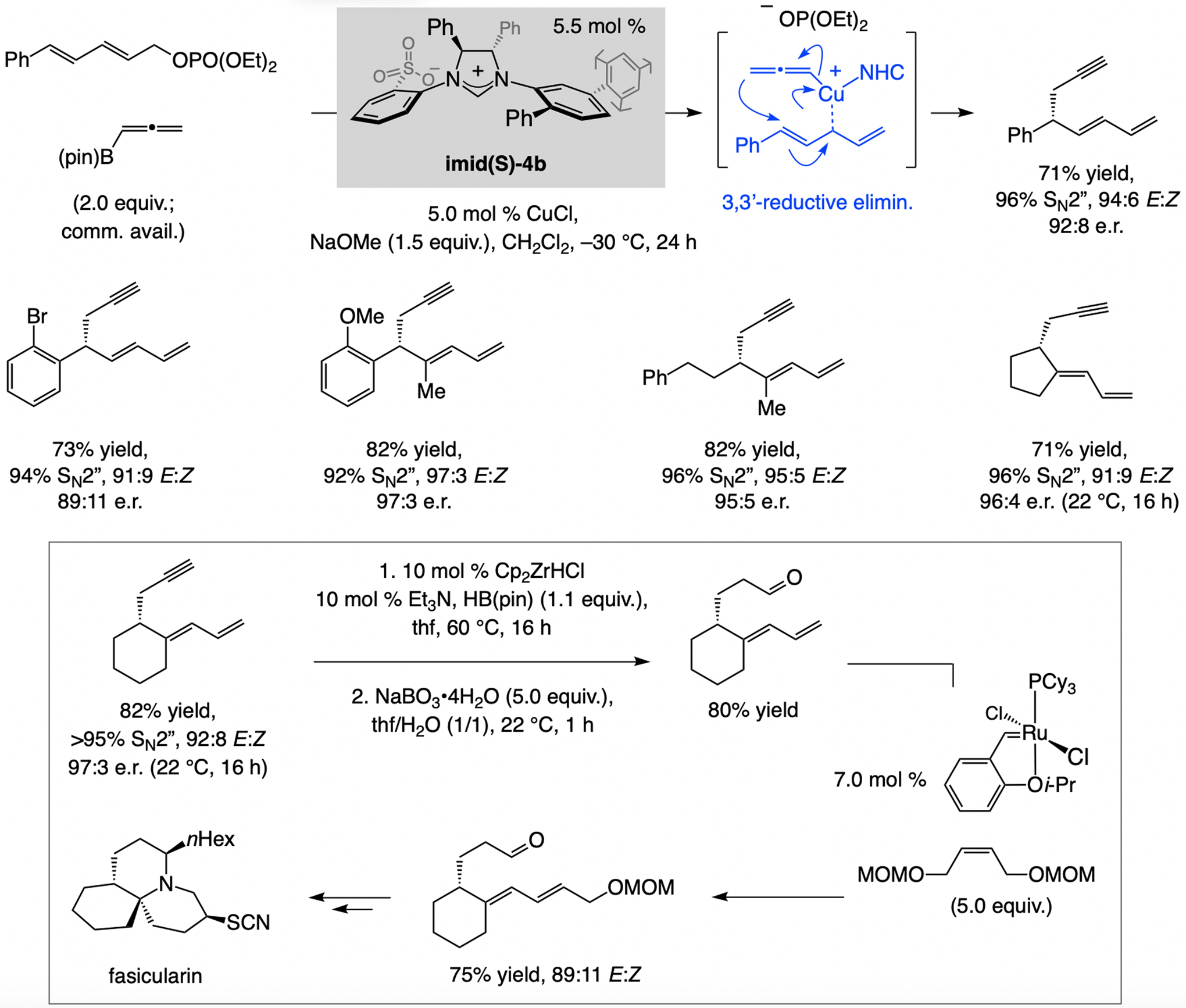
Enantioselective SN2” substitution with allenyl–B(pin) (see Scheme 33 for mechanistic analysis).
Scheme 15.
Scheme 15.
EAS with different acceptor molecules and different alkenyl boronates.
Scheme 16.
Scheme 16.
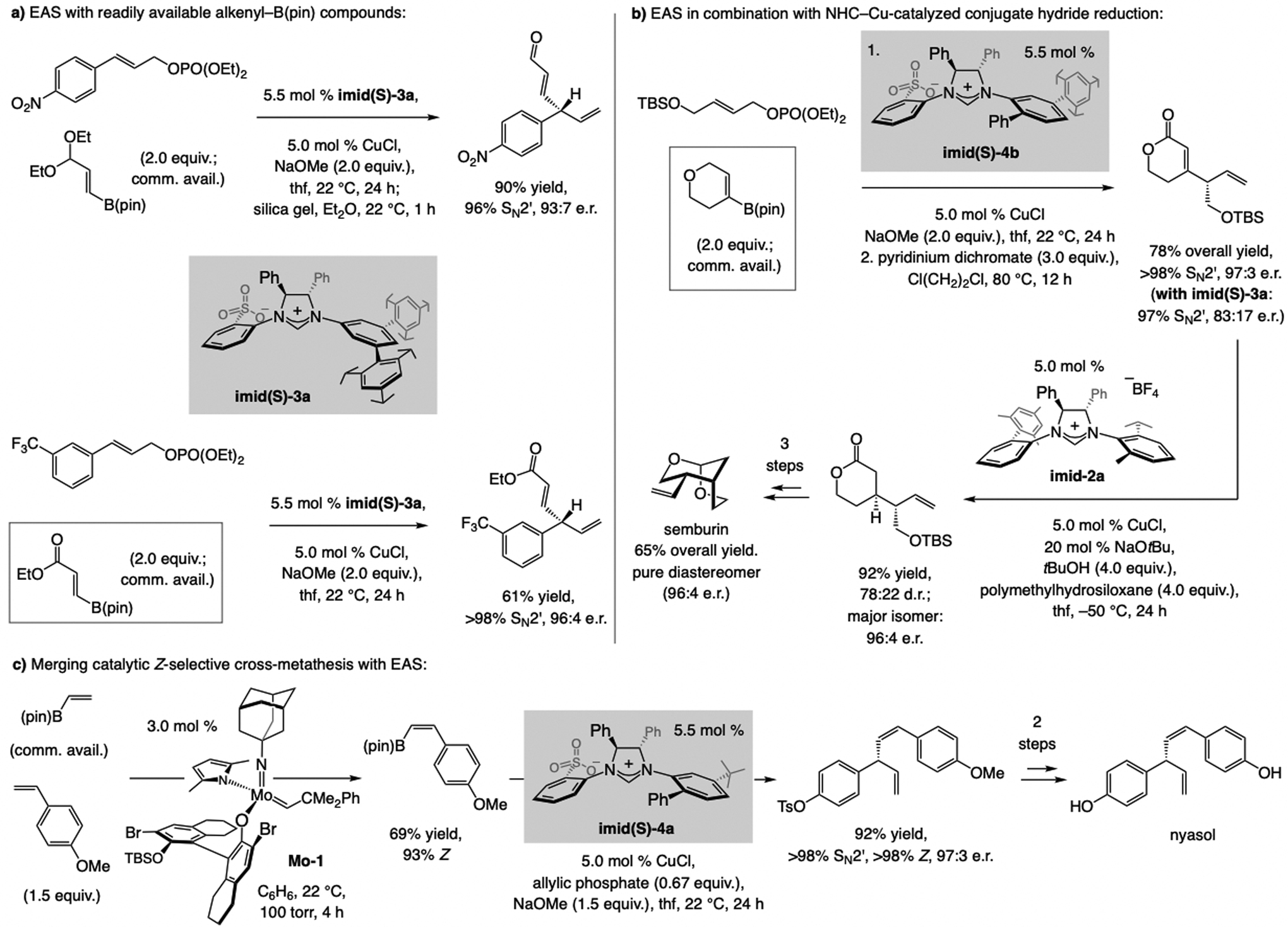
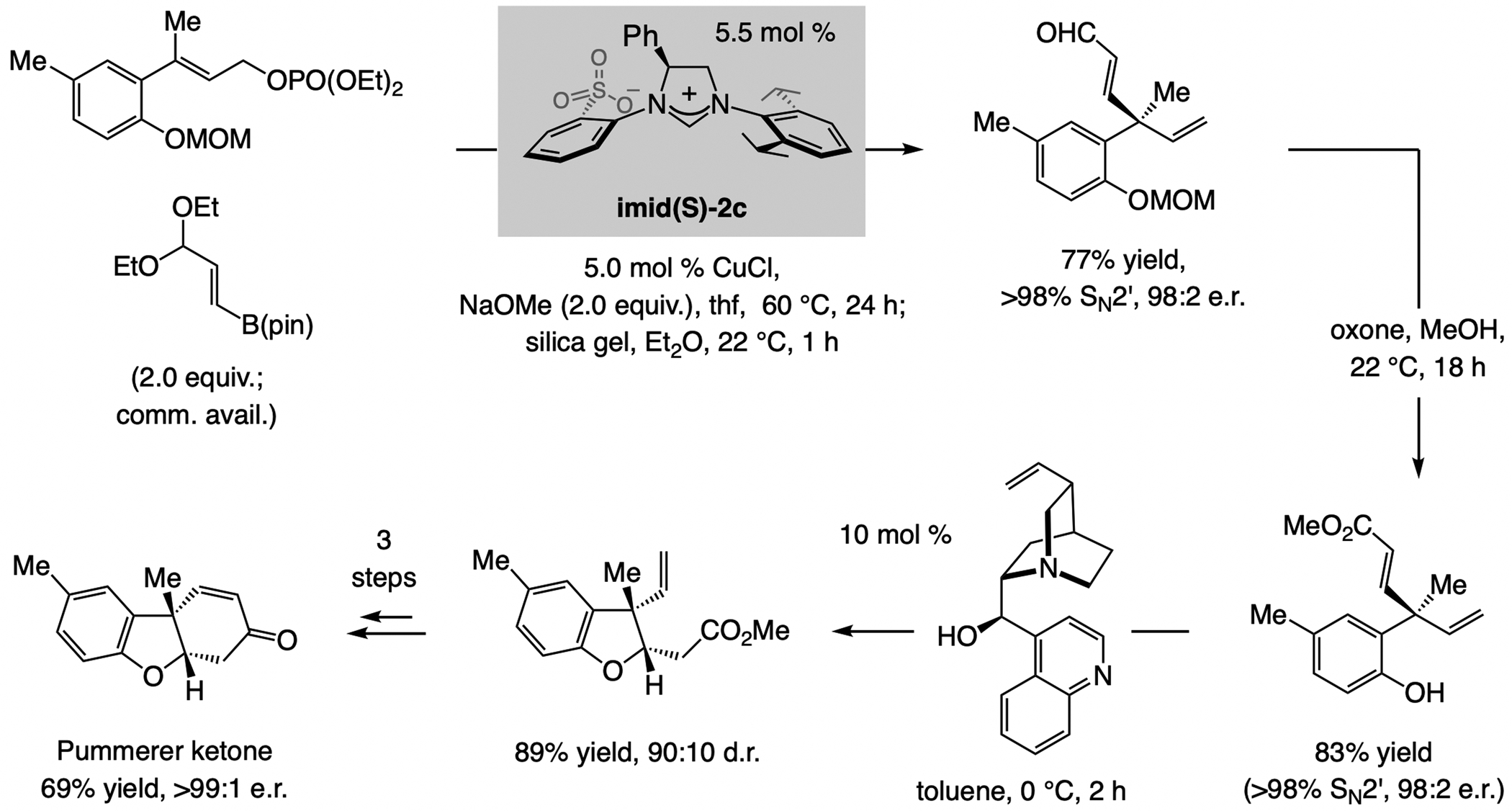
EAS with readily accessible alkenyl–B(pin) compounds. Enantiomerically enriched products that contain an aldehyde, a carboxylic ester, or a Z-alkenyl group can thus be readily synthesized.
Scheme 17.
Scheme 17.
EAS with an alkenyl–B(pin) reagent and generates a quaternary carbon stereogenic center.
Scheme 18.
Scheme 18.
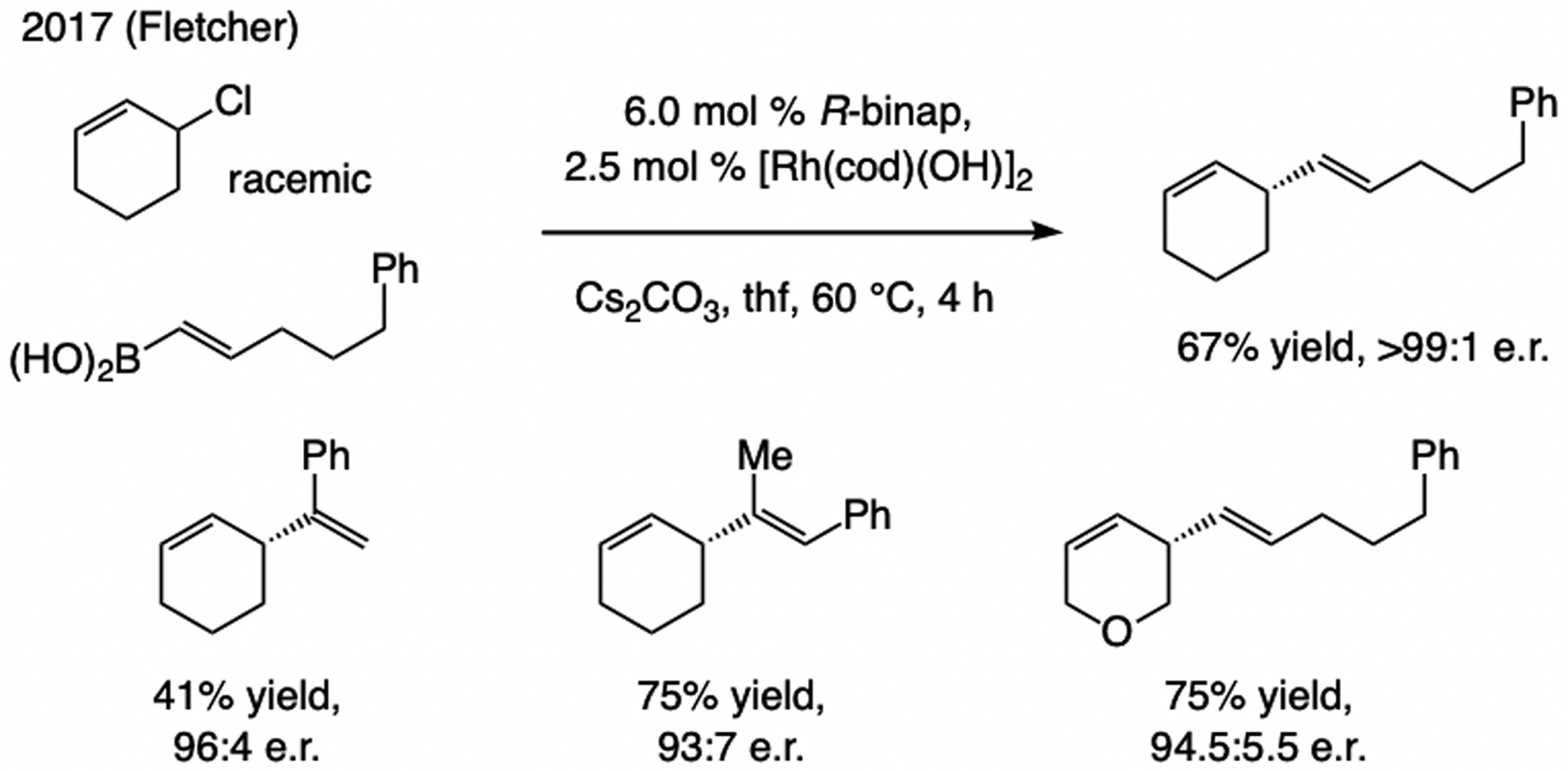
A bis-phosphine–Rh complex promotes EAS with racemic cyclic allylic chlorides and alkenyl–boronic acids.
Scheme 19.
Scheme 19.
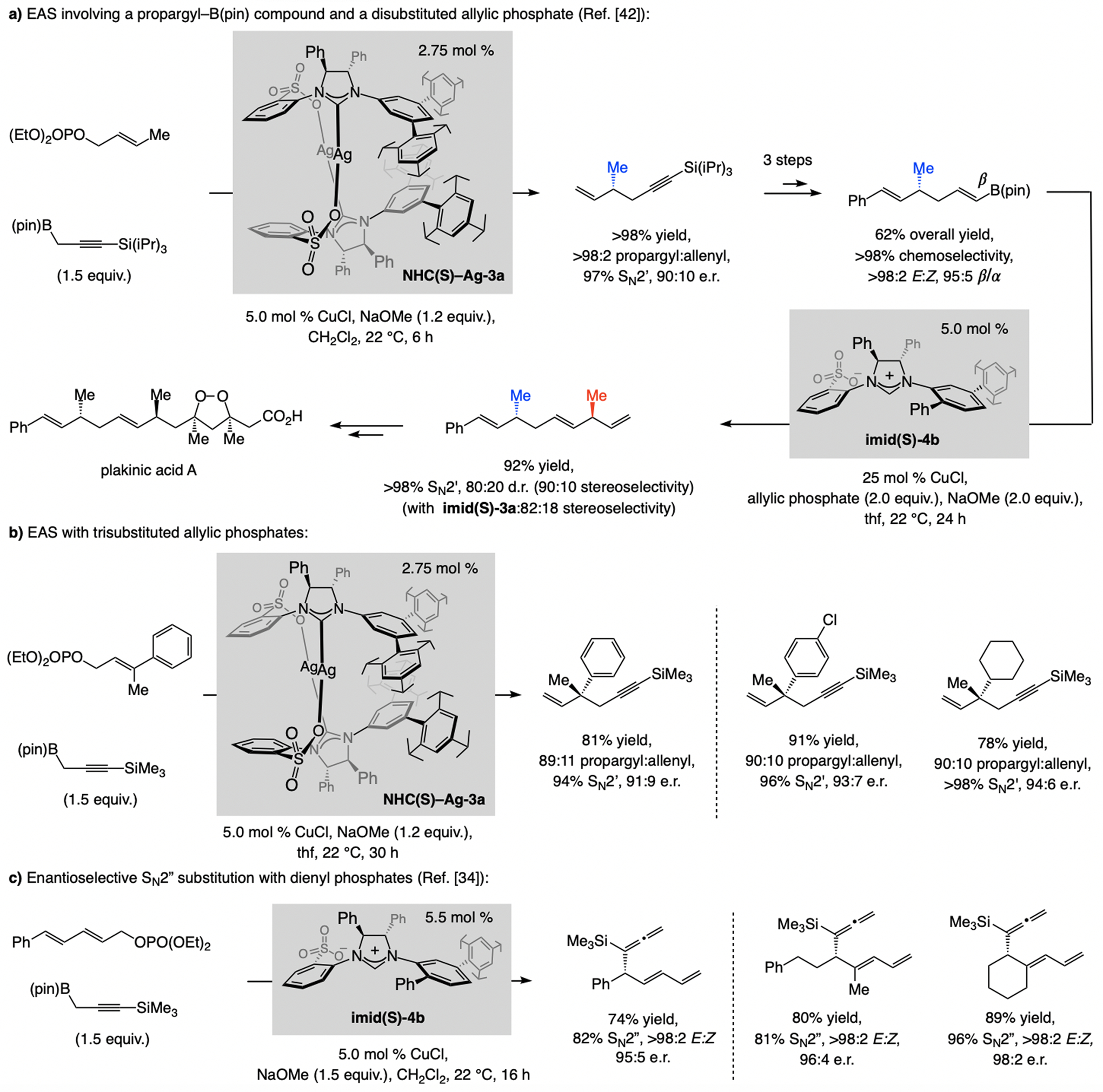
EAS and enantioselective SN2” substitution reactions involving a propargyl–B(pin) compound may be used to generate tertiary or quaternary carbon stereogenic centers.
Scheme 20.
Scheme 20.
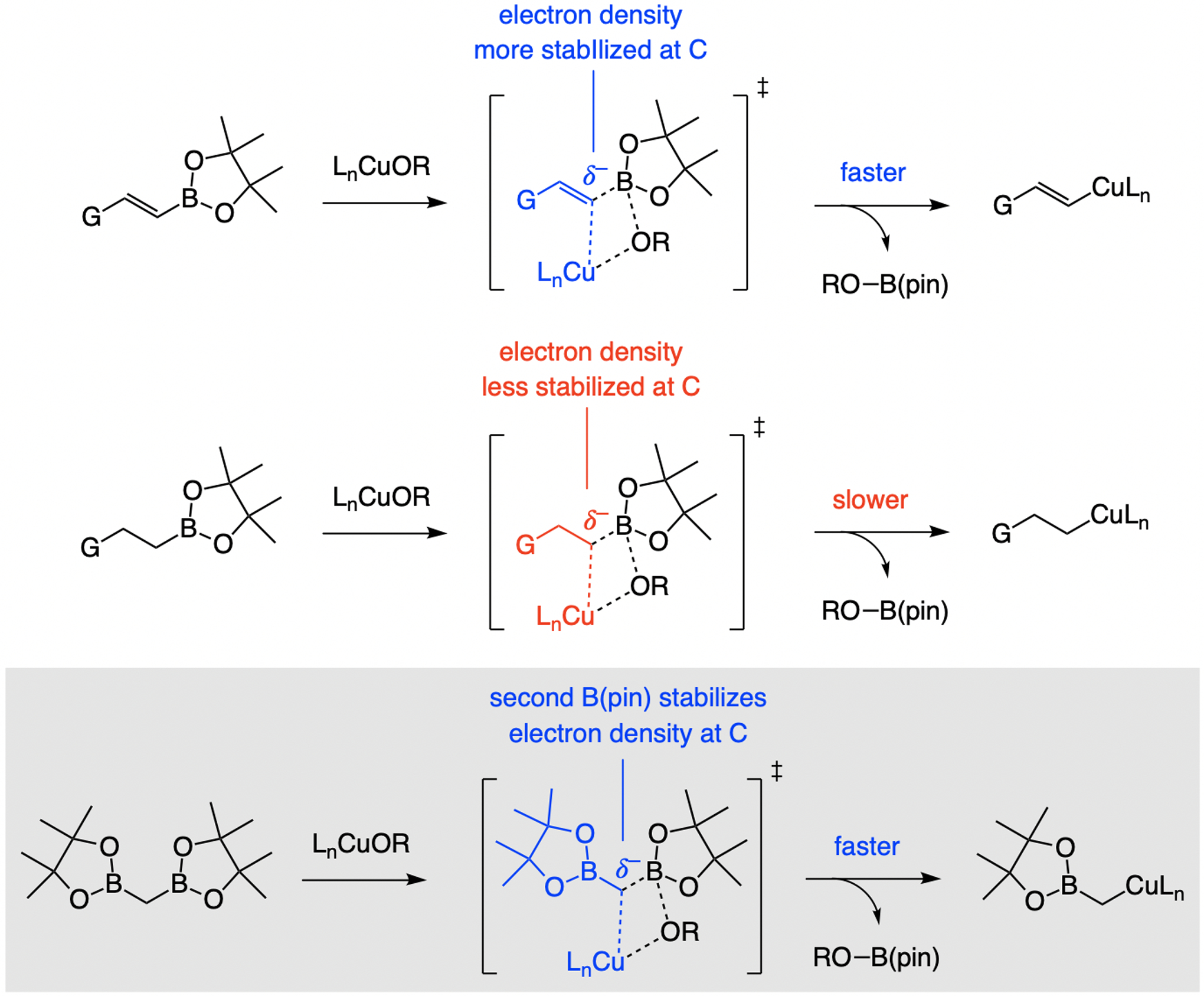
Rate of Cu/B exchange is impacted by how well the developing charge at the carbon center can be stabilized.
Scheme 21.
Scheme 21.
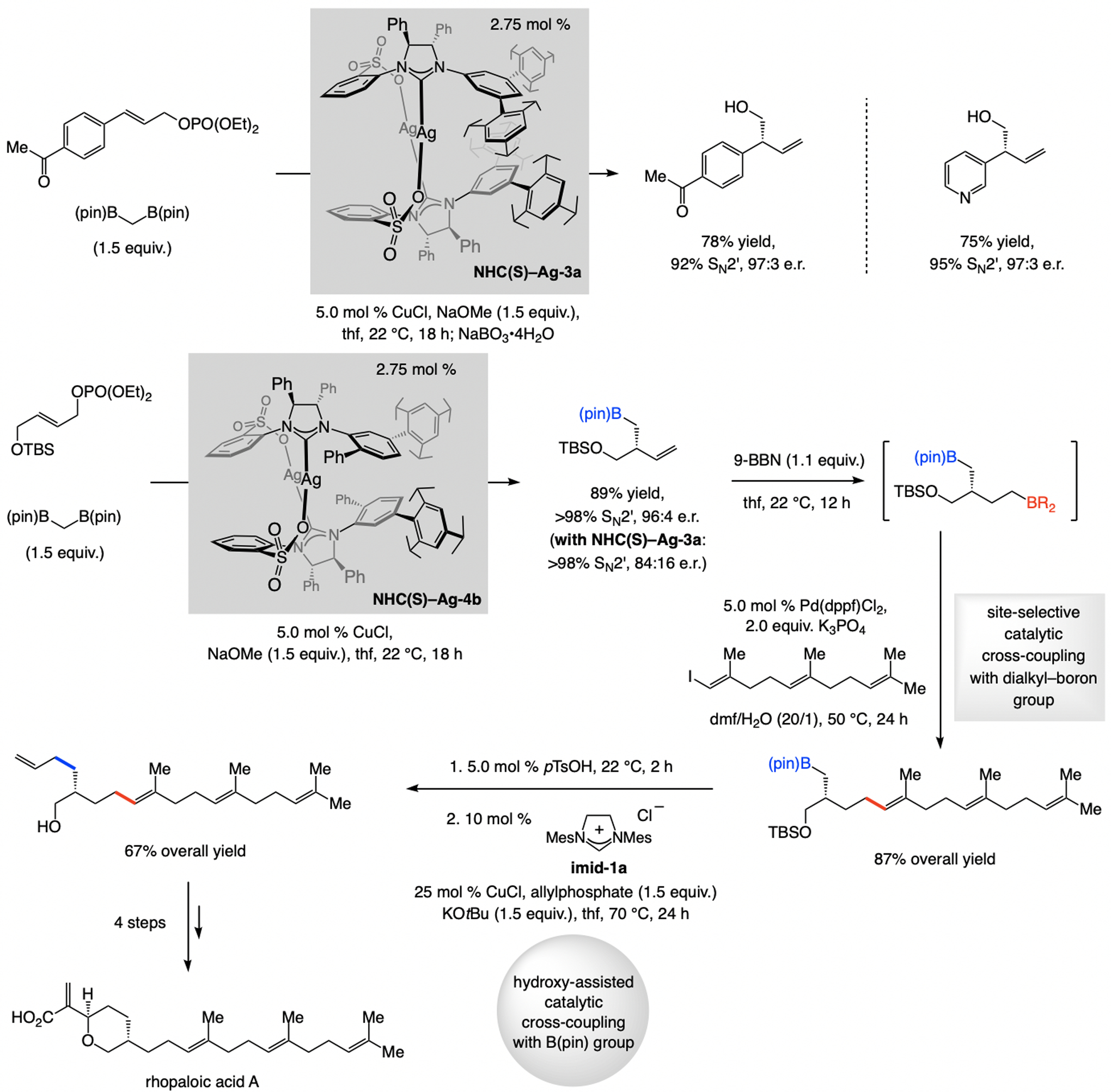
EAS with bis[(pinacolato)boryl]methane furnish enantiomerically enriched alkyl–B(pin)-containing terminal alkenes (see Scheme 34 for mechanistic analysis).
Scheme 22.
Scheme 22.
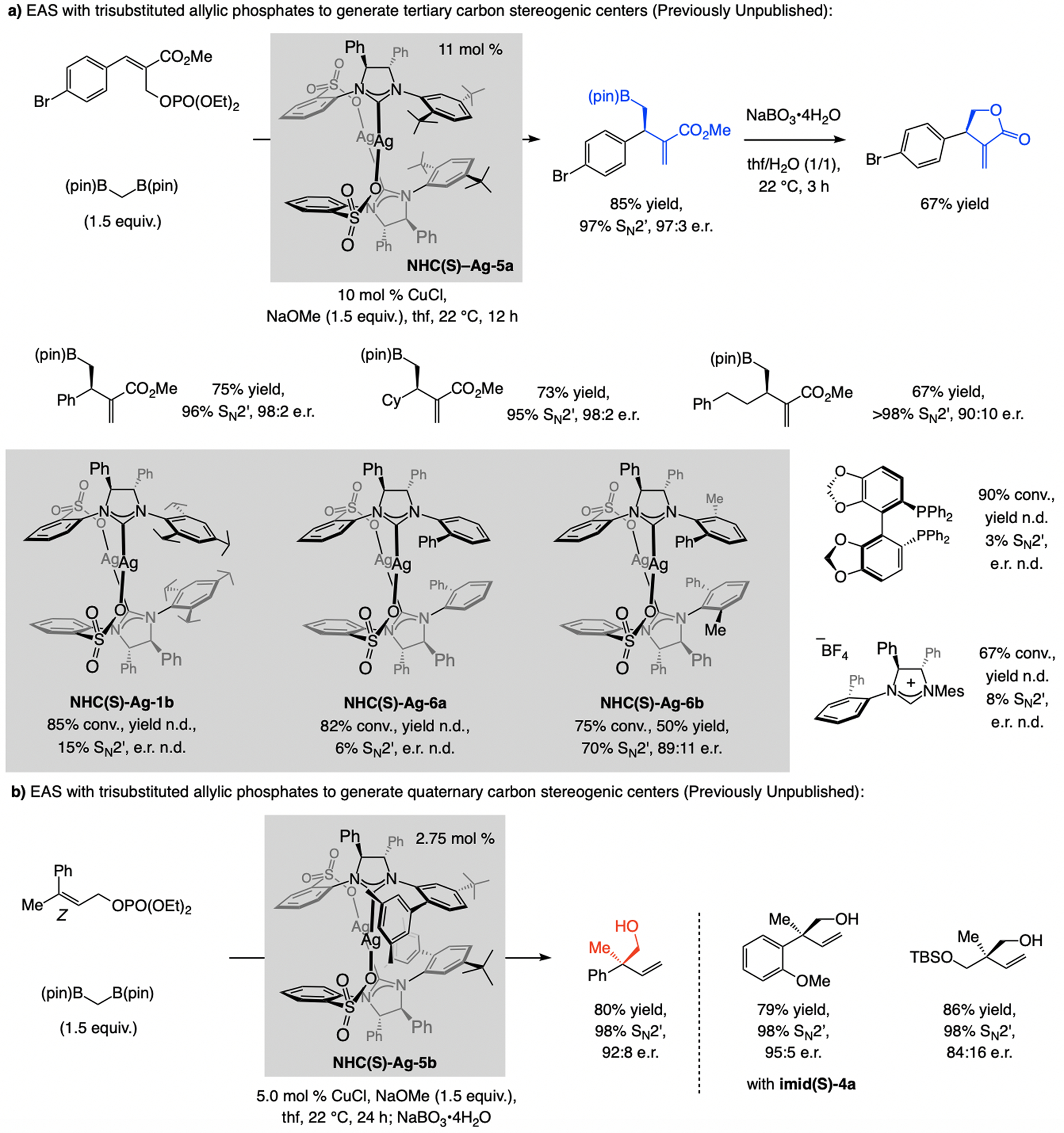
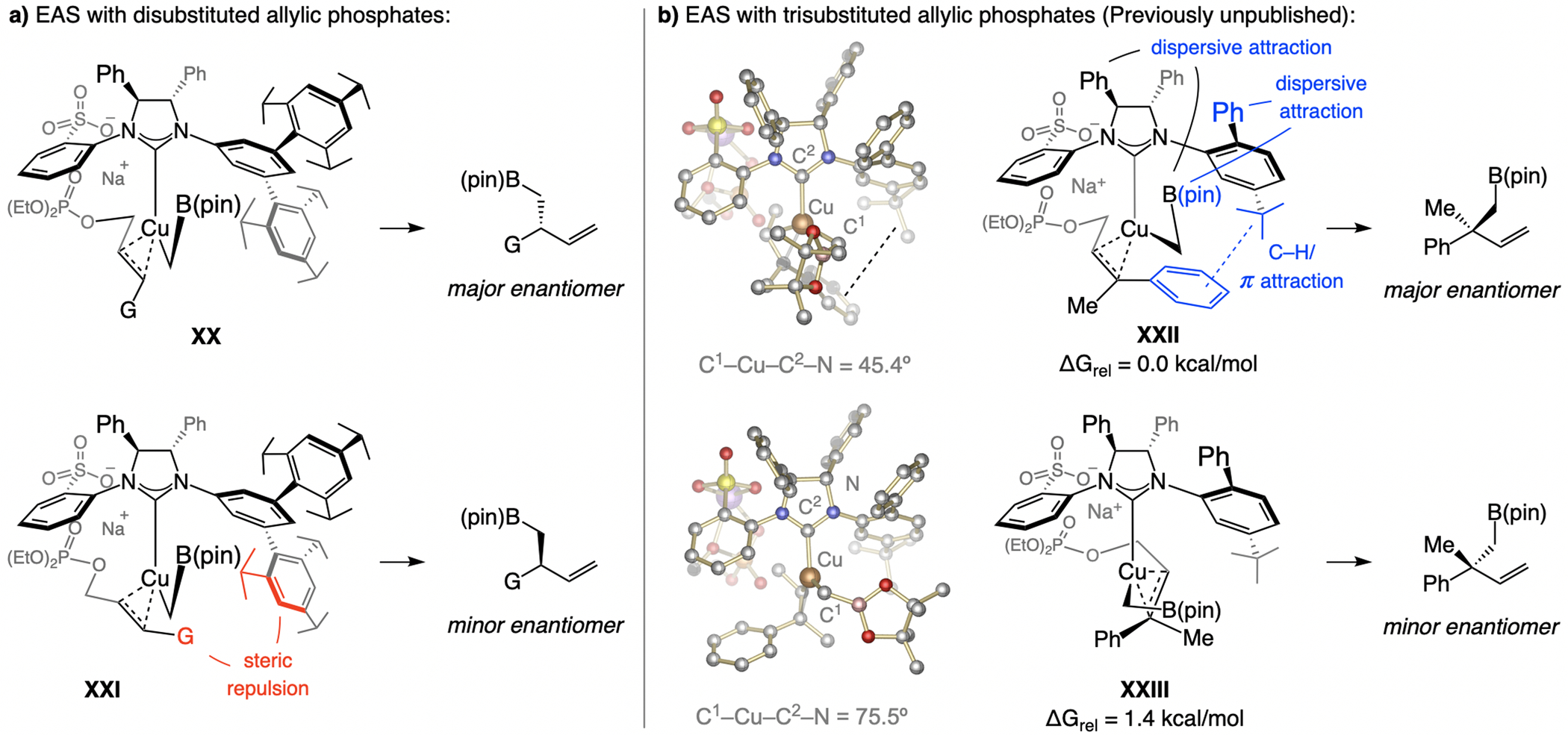
EAS with bis[(pinacolato)boryl]methane and trisubstituted allylic phosphates (see Scheme 34 for mechanistic analysis). Previously unpublished results: reactions performed under N2 atm.; conv. and SN2’ selectivity (±2%) determined by analysis of the 1H NMR spectra of unpurified product mixtures; yields (±5%) correspond to purified products. See the Supporting Information for details. n.d. = not determined.
Scheme 23.
Scheme 23.
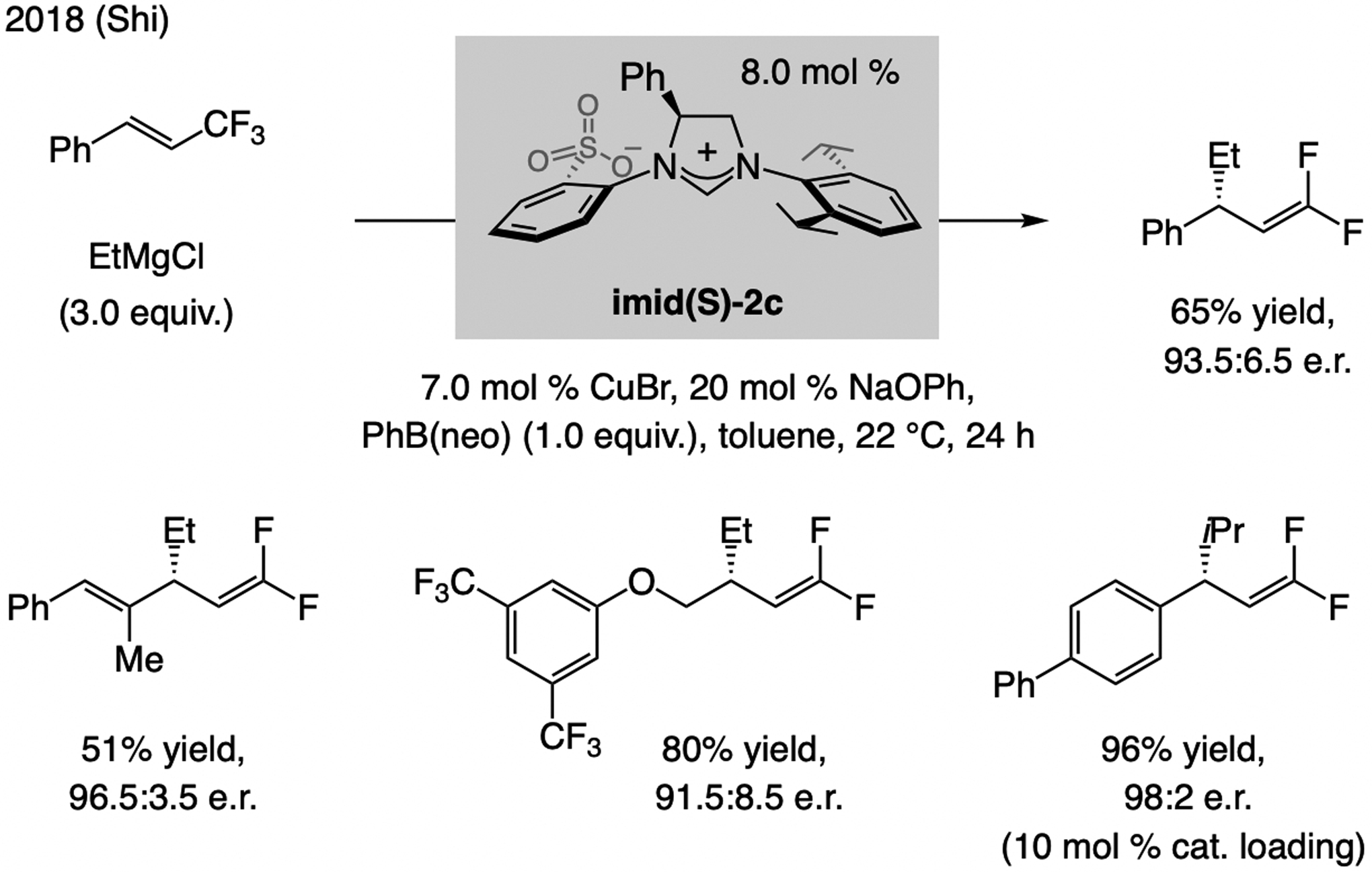
EAS with F3C-substituted alkenes and alkyl–MgCl compounds.
Scheme 24.
Scheme 24.
Regio- and enantioselective Cu–H addition to an aryl or boronate-substituted alkene followed by allylic substitution.
Scheme 25.
Scheme 25.
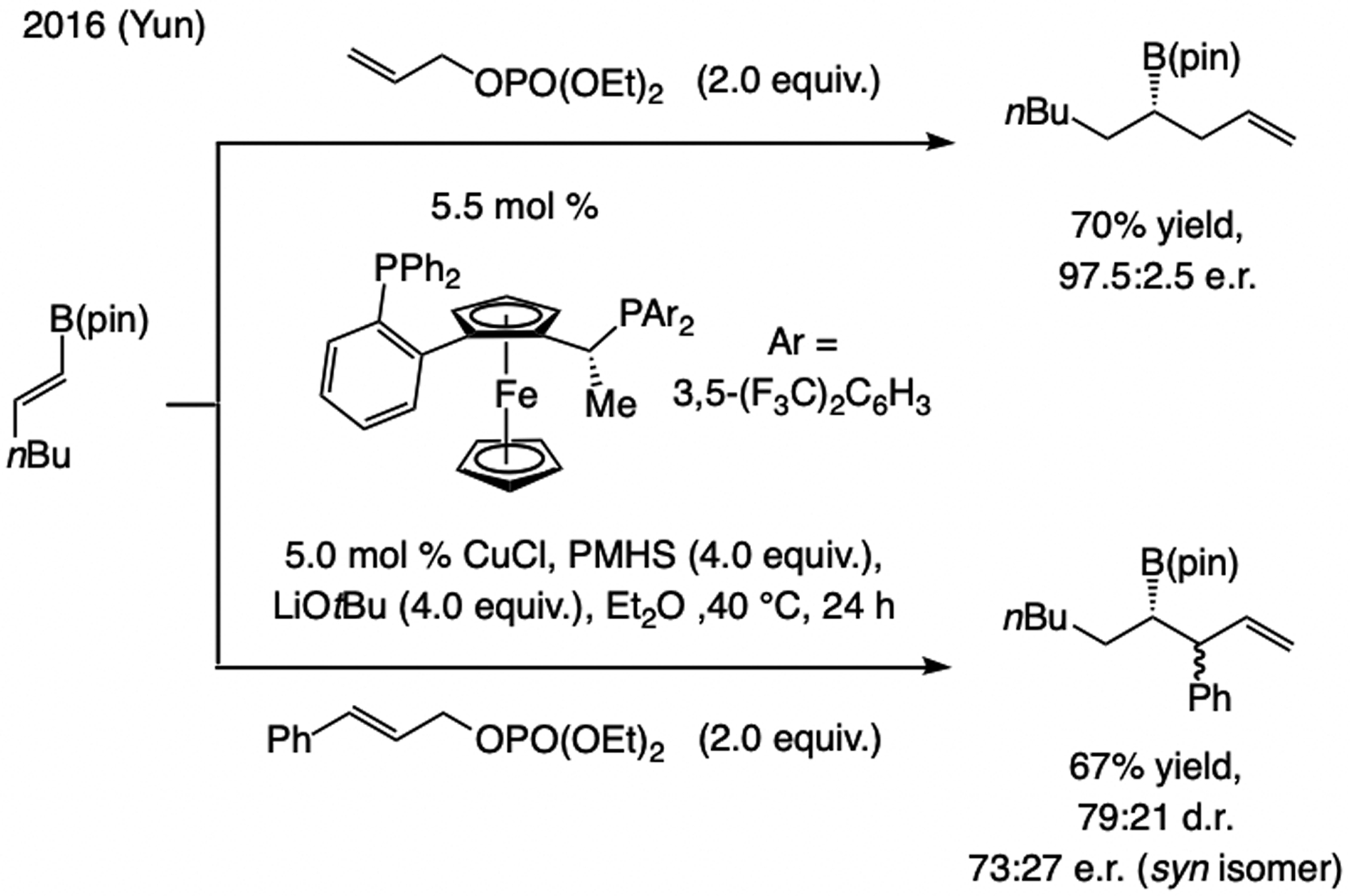
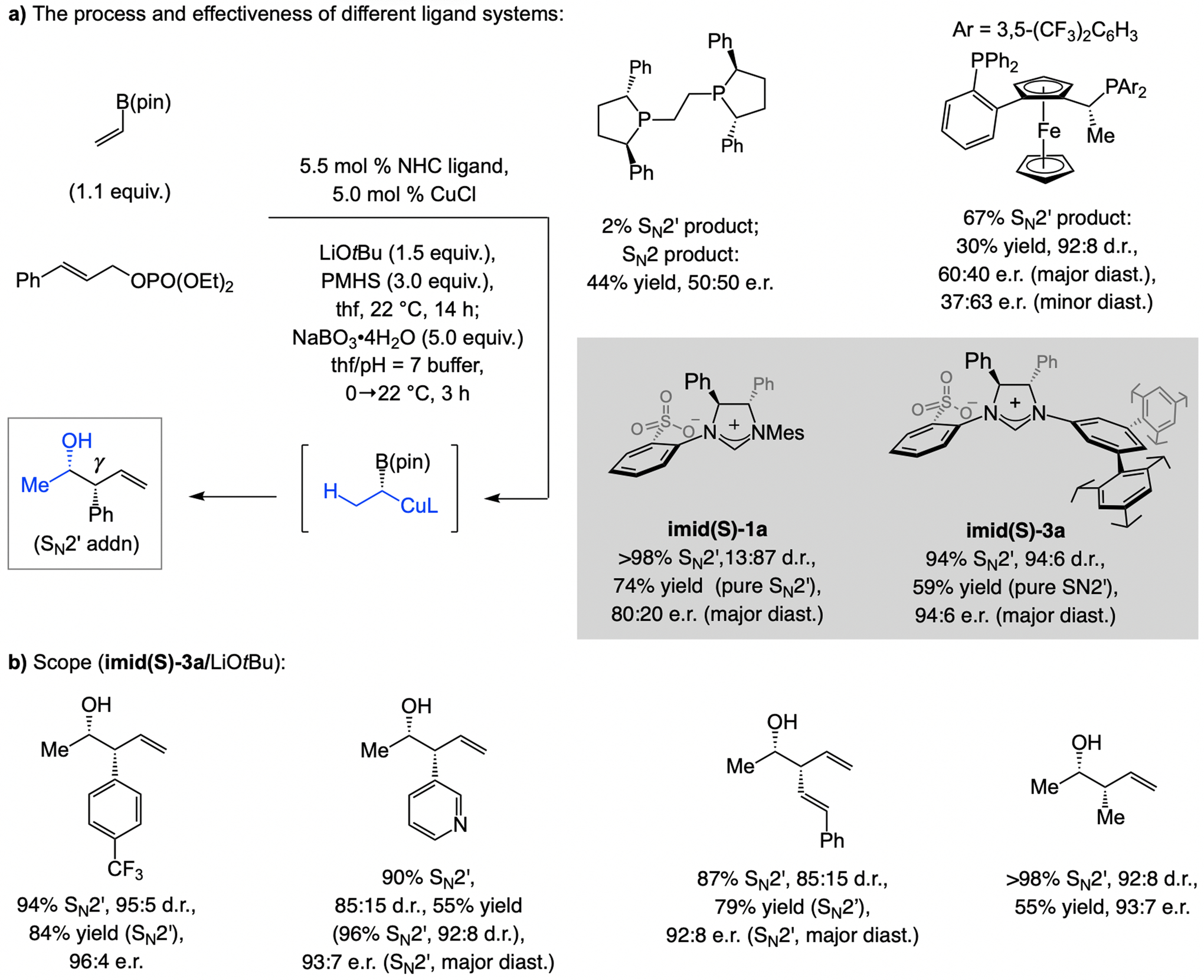
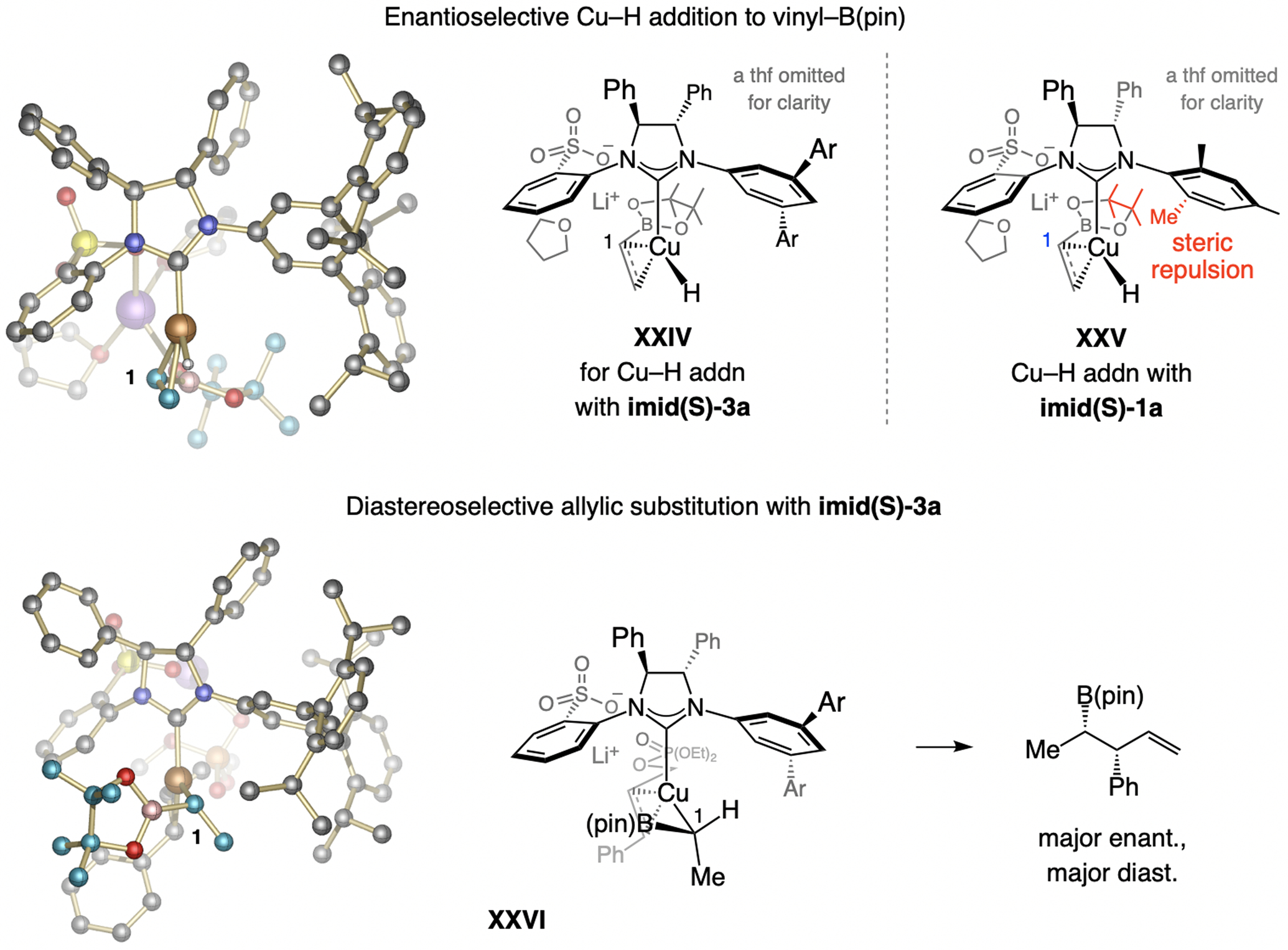
Sulfonate NHC–Cu catalysts promote multicomponent enantioselective Cu–H addition to vinyl–B(pin)/SN2’-selective and diastereoselective allylic substitution. See Scheme 35 for mechanistic analysis.
Scheme 26.
Scheme 26.
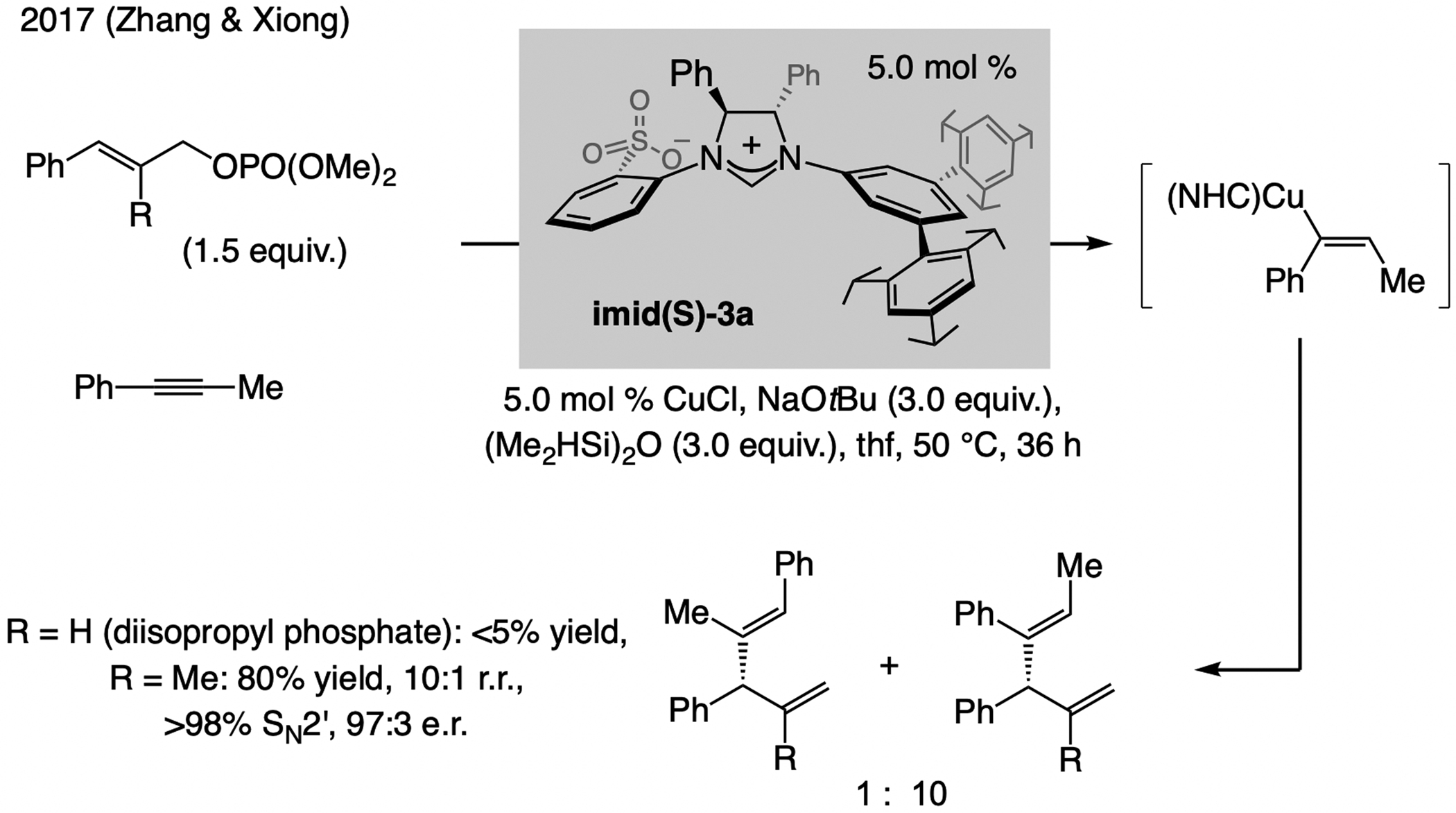
Multicomponent EAS beginning with a regioselective Cu–H addition to an alkyne. r.r. = regioisomeric ratio.
Scheme 27.
Scheme 27.
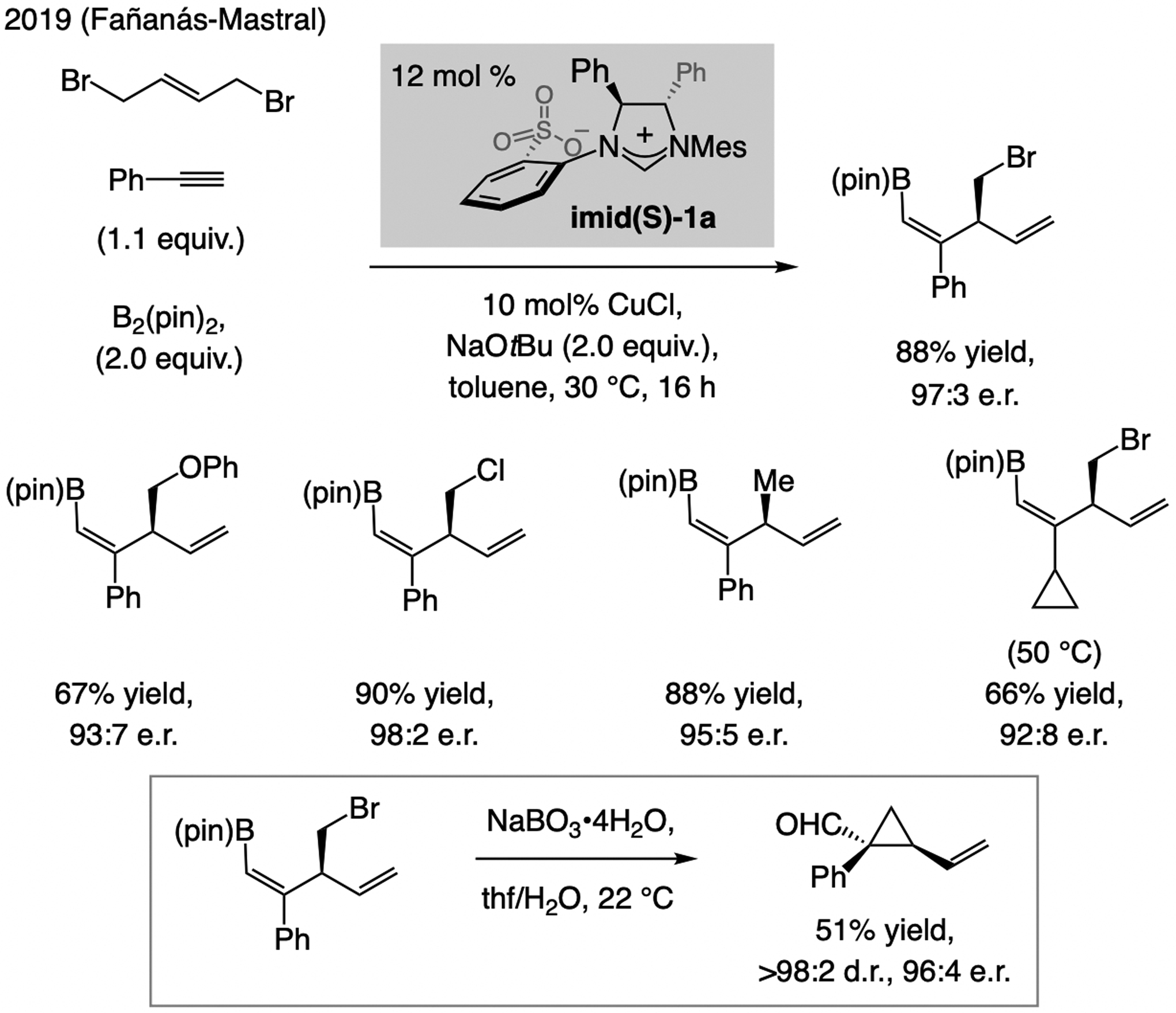
Sulfonate NHC–Cu catalysts promote multicomponent processes involving a Cu-B(pin) addition to alkynes. See Scheme 36 for mechanistic analysis.
Scheme 28.
Scheme 28.
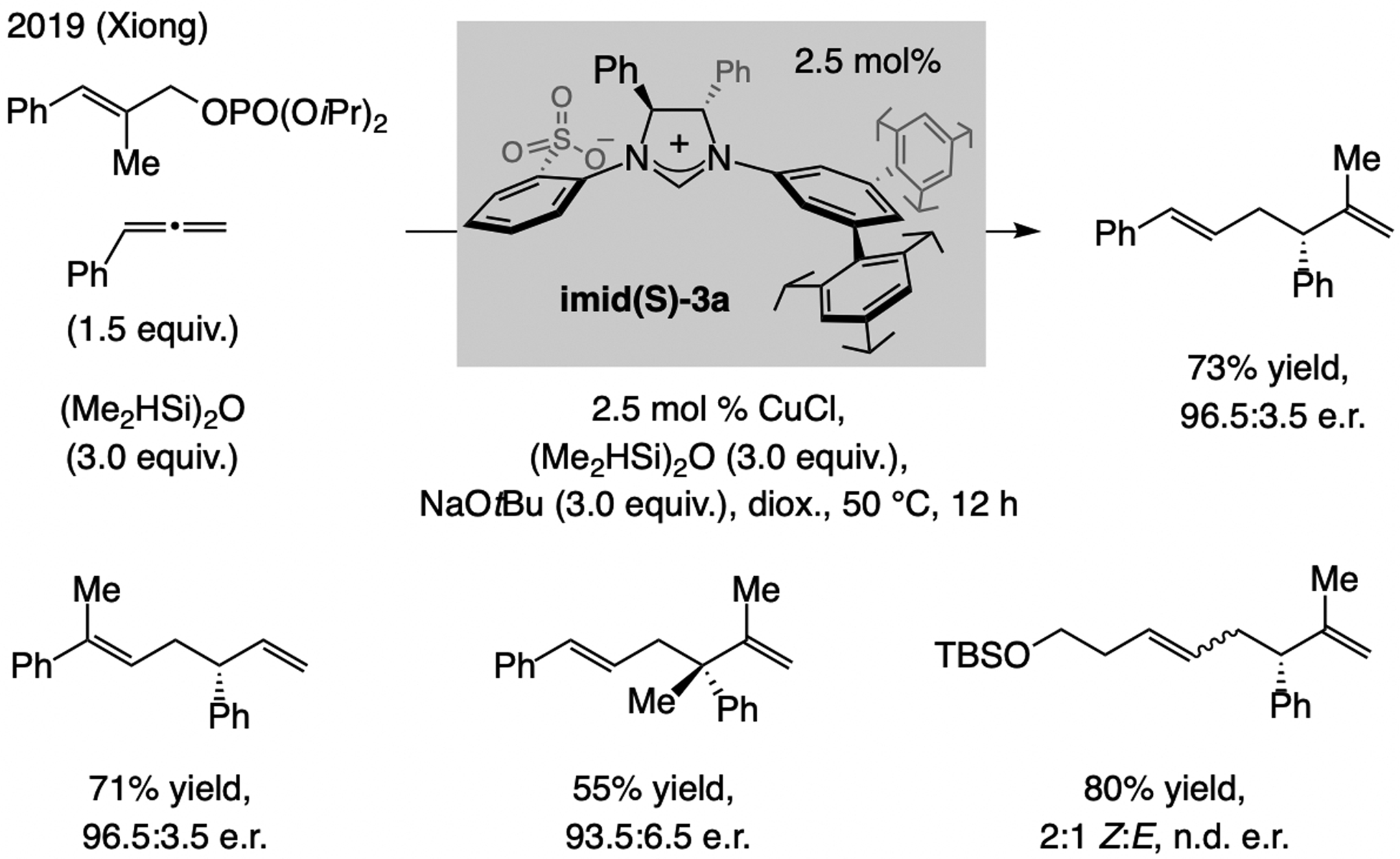
Multicomponent EAS involving Cu-H addition to an allene. n.d. = not determined.
Scheme 29.
Scheme 29.
Multicomponent EAS commencing with Cu–H addition to boryl-substituted allenes (vs. the more common Cu/B exchange) and applications to complex molecule synthesis. d.s. = diastereospecificity.
Scheme 30.
Scheme 30.
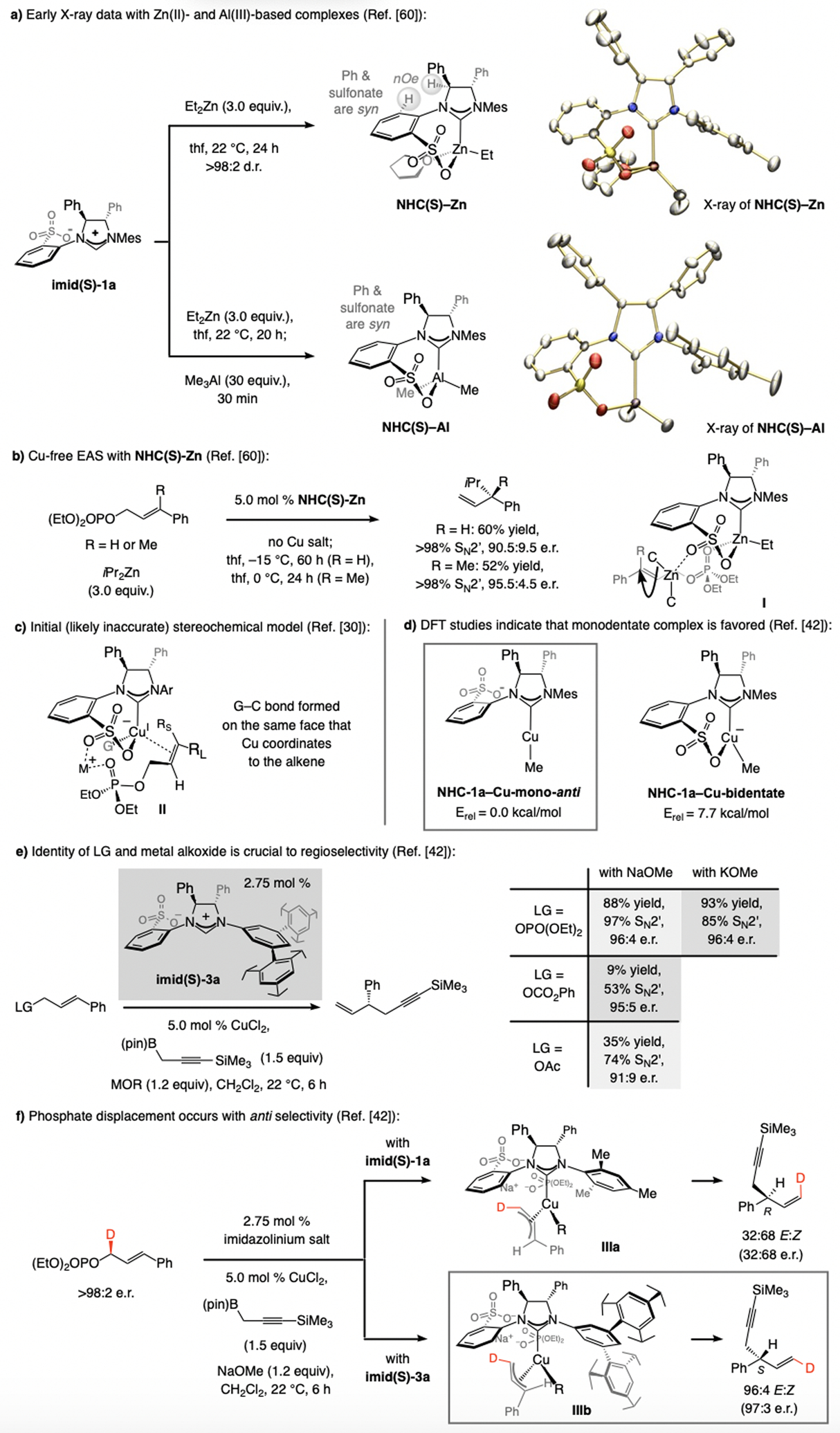
X-ray structures of Zn(II)- and Al(III)-based complexes, the initial stereochemical model, results of DFT studies at the ω-B97XD/Def2-TZVPPTHF(SMD)//ω-B97XD/Def2-SVP level), and key experimental data. LG = leaving group.
Scheme 31.
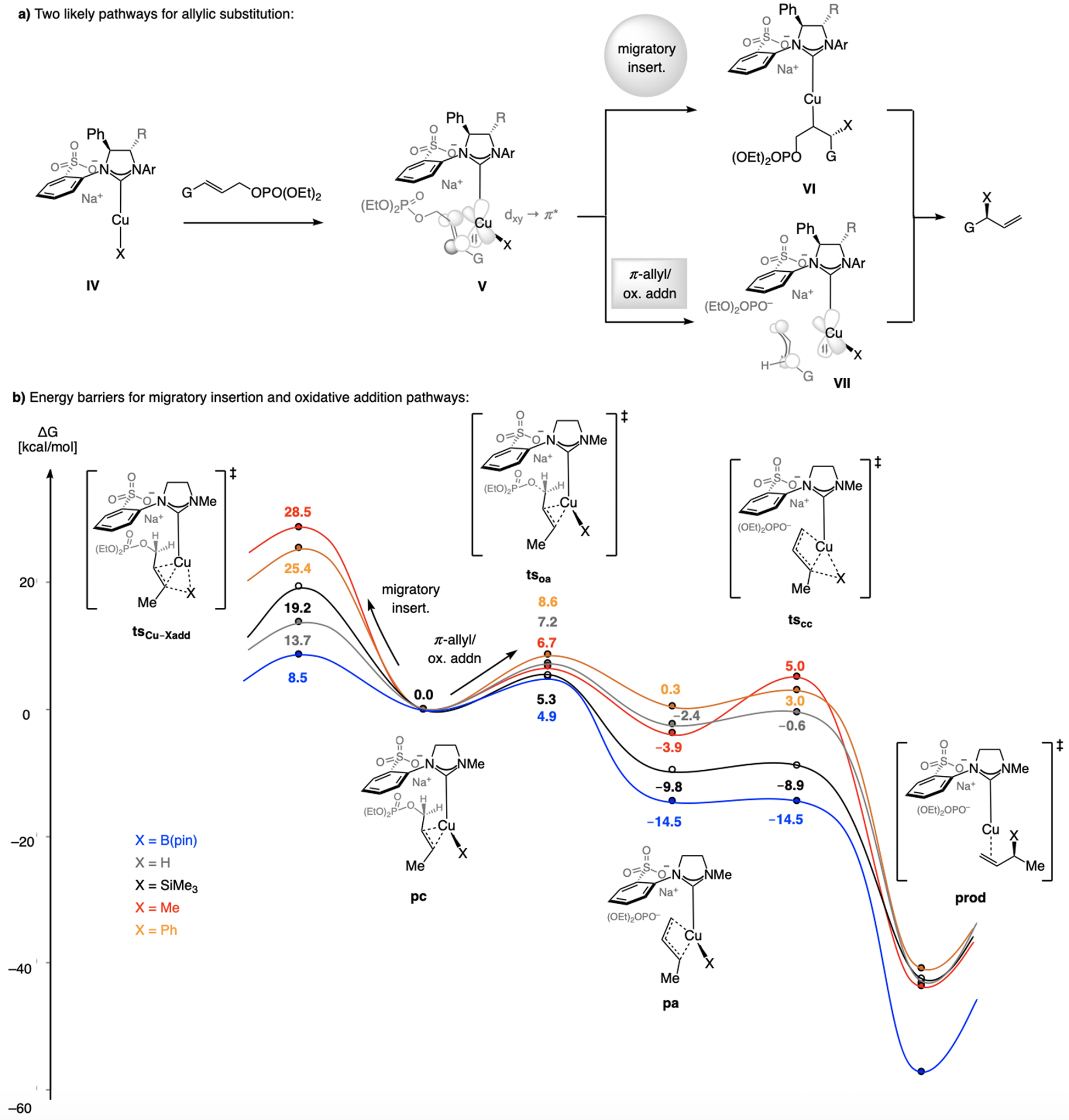
Scheme 31.
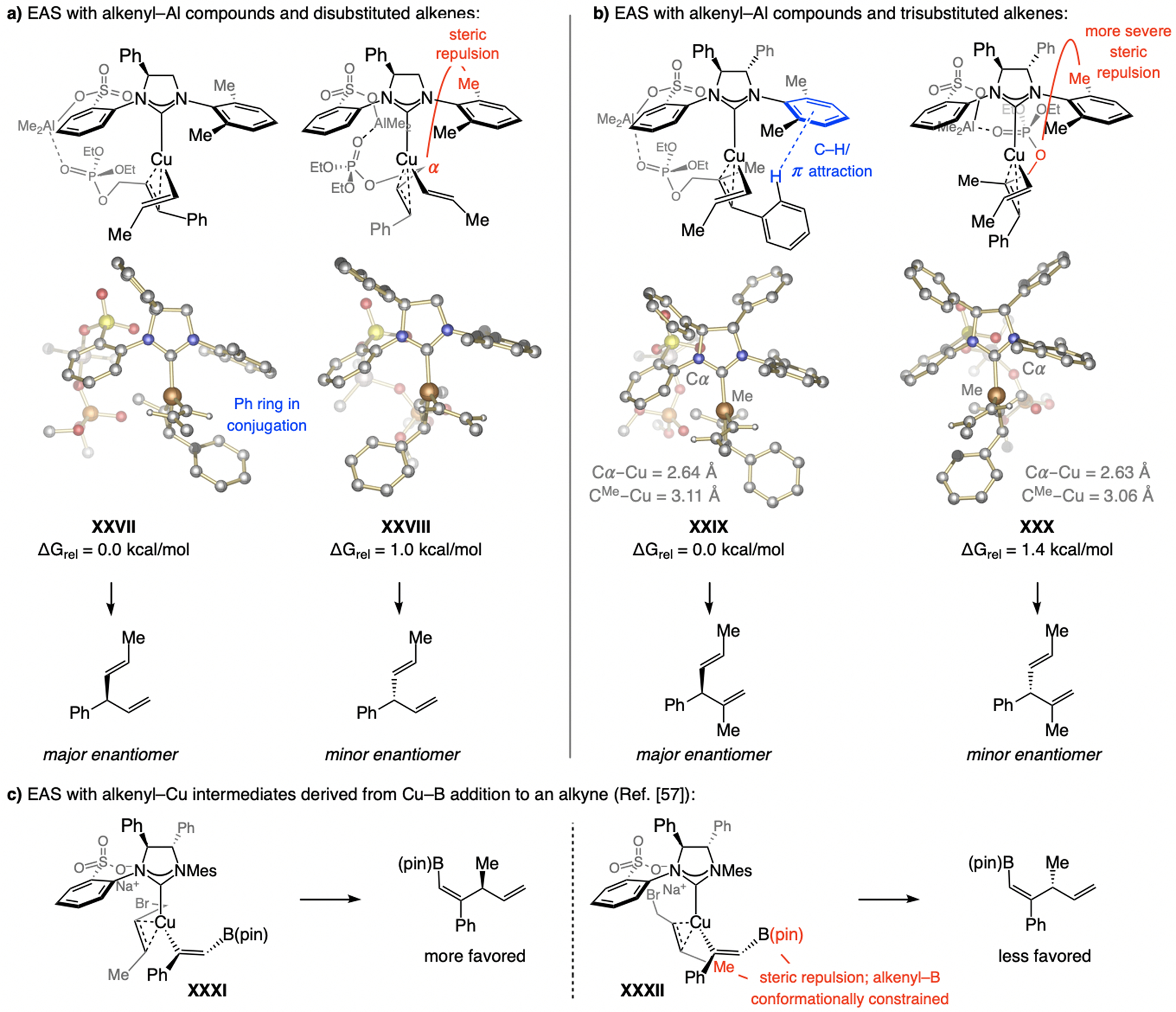
Evaluation of two EAS pathways [M06/def2-TZVPP//M06L/def2-SVP level of theory in CH2Cl2 (SMD solvation model)]; C-O bond constrained in tsCu-Xadd to 1.50 Å to circumvent C–O bond rupture. Previously unpublished analysis; see the Supporting Information for details. ts = transition state; pc = p complex; oa = oxidative addition; pa = π-allyl complex; cc = Cu complex; prod = final product.
Scheme 32.
Scheme 32.
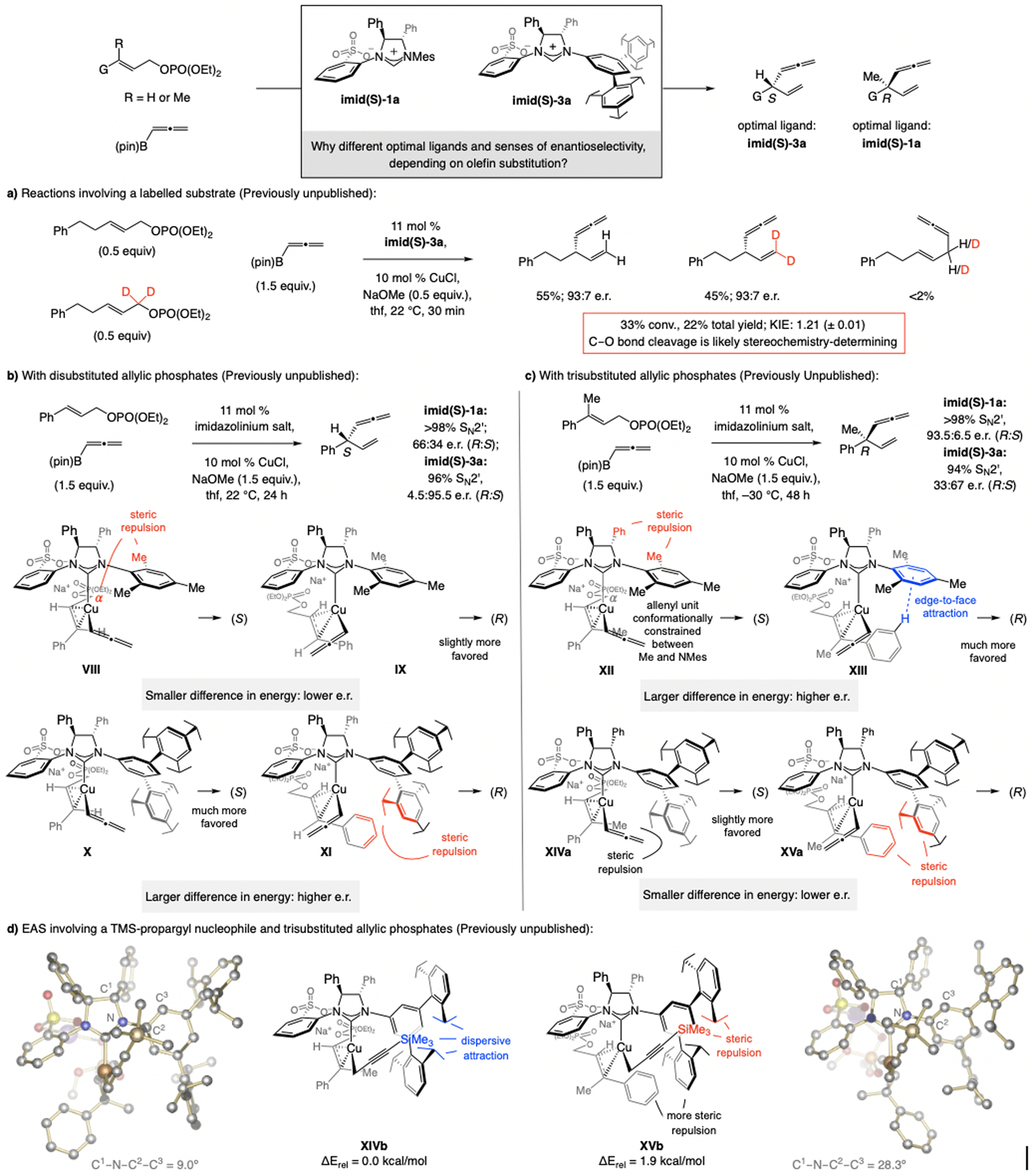
The stereochemistry-determining step and origin of selectivity in EAS with allenyl–B(pin) (see Schemes 13 and 19 for methodology). Reactions performed under N2 atm.; conv. (±2%) determined by analysis of the 1H NMR spectra of the unpurified product mixtures; yields (±5%) are for purified products. Previously unpublished KIE data and DFT analysis; see the Supporting Information for details.
Scheme 33.
Scheme 33.
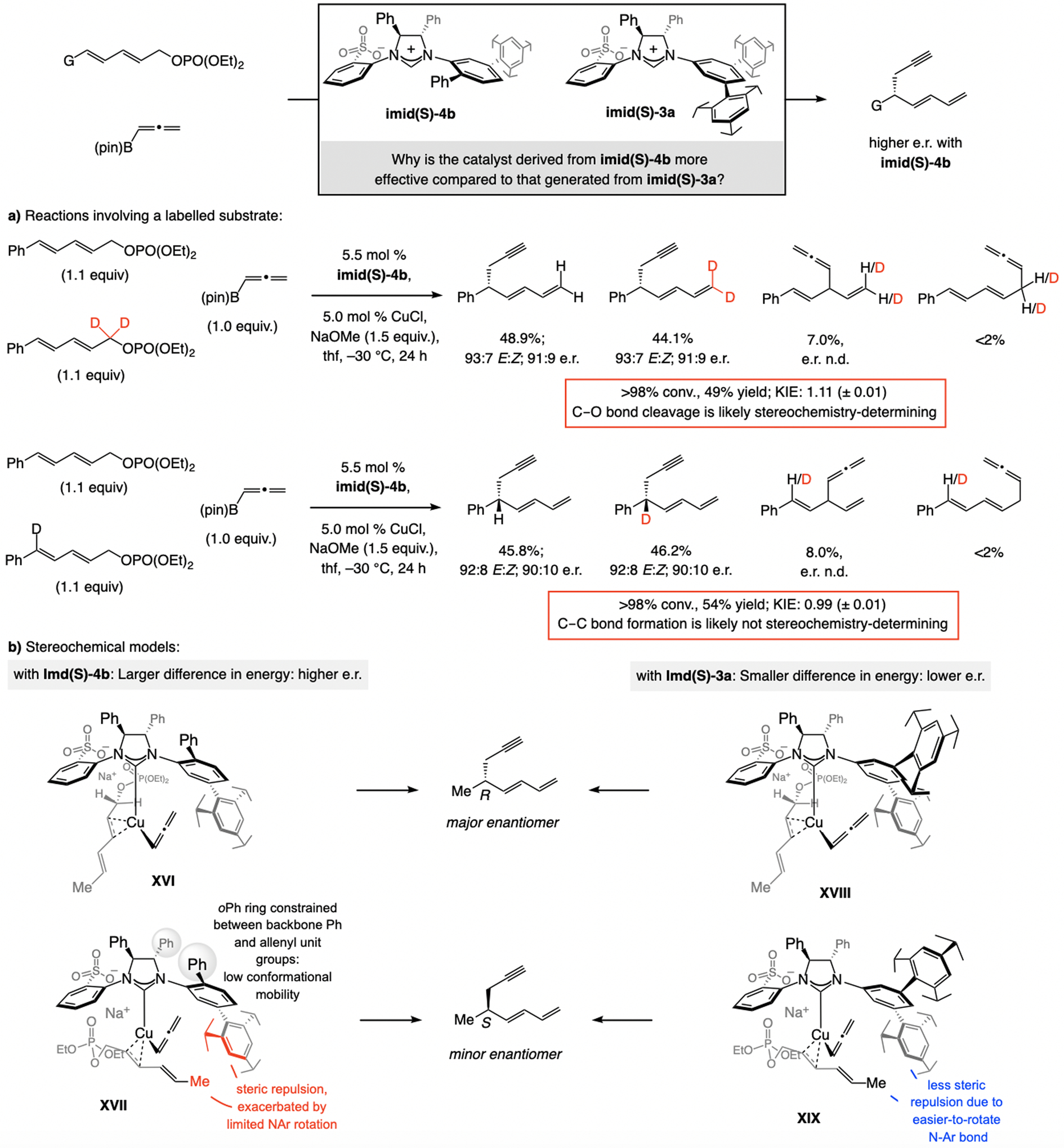
Additional support for C–O bond cleavage being stereochemistry-determining and related stereochemical models (see Scheme 14 for methodology). DFT at the MN15/Def2-TZVPP//M06L/Def2-SVP level. n.d. = not determined.
Scheme 34.
Scheme 34.
High enantioselectivity in some transformations is due to a combination of sulfonate bridging and dispersive attraction (see Schemes 21–22 for methodology). DFT at the M06L/Def2-TZVPP//M06L/Def2-SVP level. Previously unpublished mechanistic analysis; see the Supporting Information for details of the DFT studies.
Scheme 35.
Scheme 35.
The sulfonate moiety is likely responsible for the high d.r. and e.r. in Cu–H-catalyzed multicomponent EAS reactions (see Scheme 25 for methodology). DFT at the M06L/Def2-TZVPP//M06L/Def2-SVP level.
Scheme 36.
Scheme 36.
Rationale for EAS of alkenyl moieties derived from Cu/Al exchange or formed by Cu–B addition to an alkyne (see Schemes 5 and 27 for methodology). DFT at the M06L/Def2-TZVPP//M06L/Def2-SVP level. Previously unpublished analyses; see the Supporting Information for details.
Scheme 37.
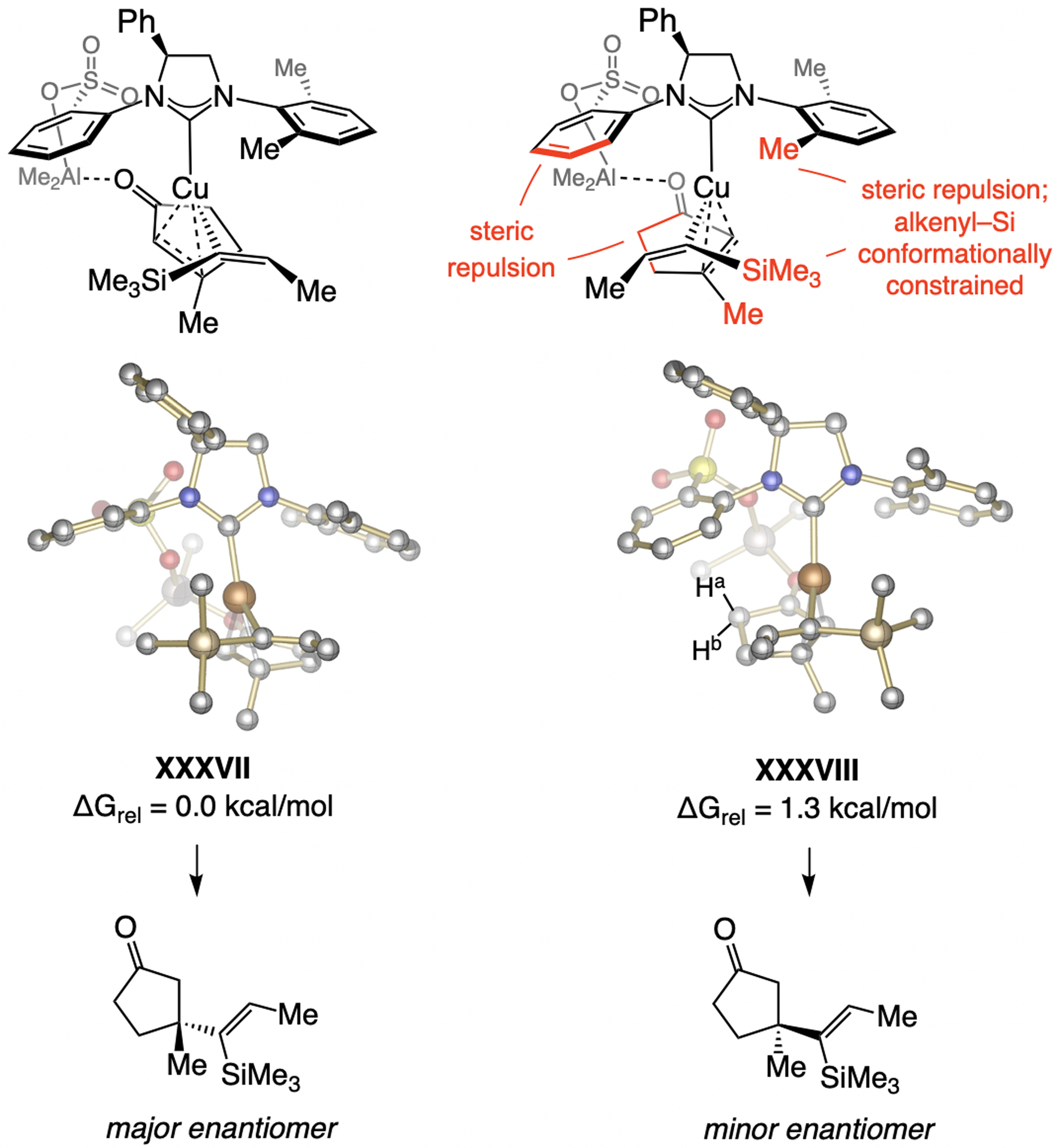
Scheme 37.
Rationale for EAS with silyl-substituted alkenyl–Al compounds (see Scheme 6 for methodology). DFT at the M06L/Def2-TZVPP//M06L/Def2-SVP level. Previously unpublished analyses; see the Supporting Information for details of the DFT studies.
Scheme 38.
Scheme 38.
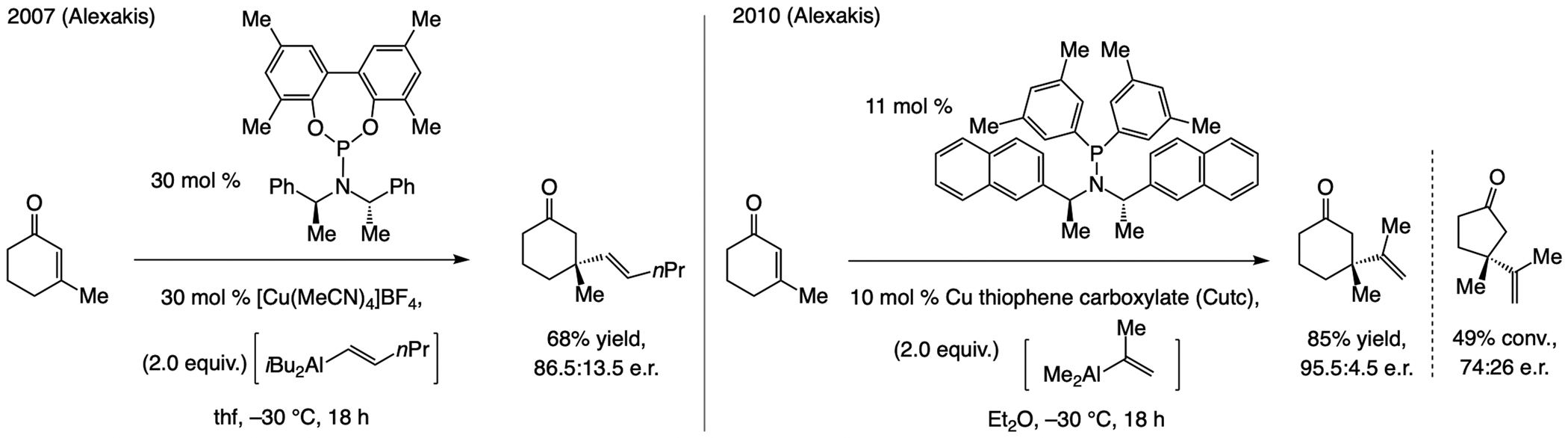
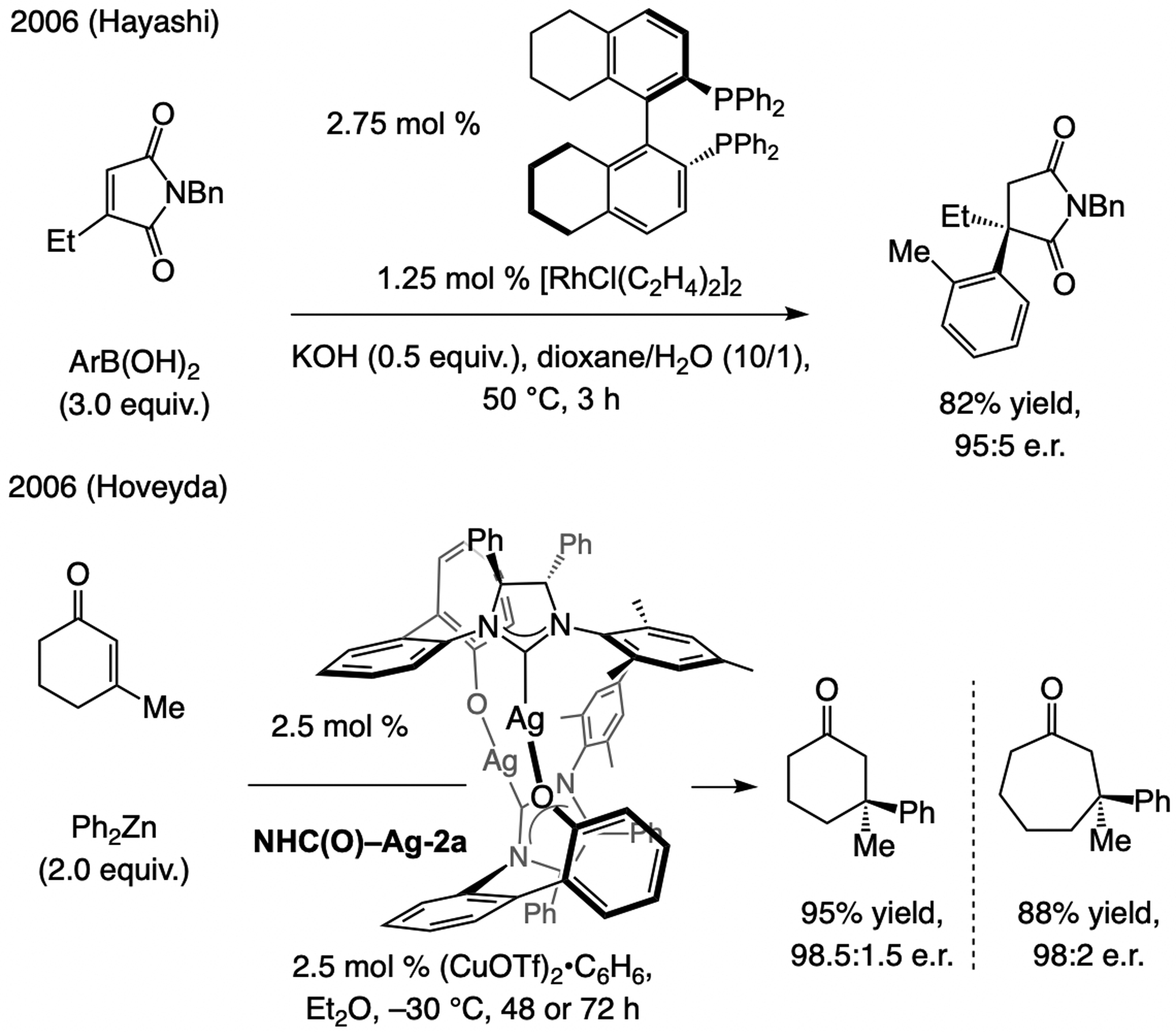
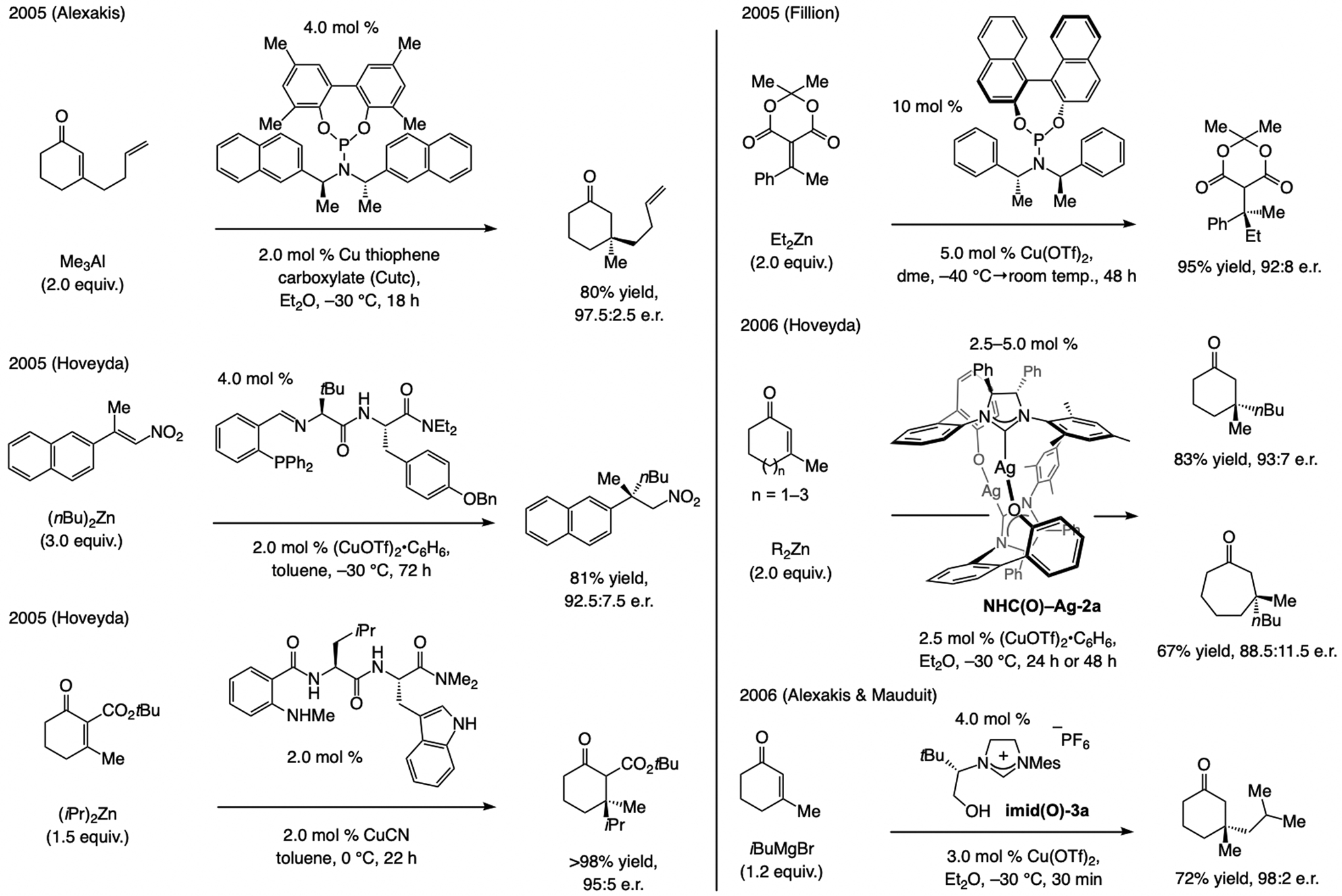
The state-of-the-art in catalytic ECA reactions that generate a quaternary carbon stereogenic center, circa 2006. tc = thiophene-2-carboxylate.
Scheme 39.
Scheme 39.
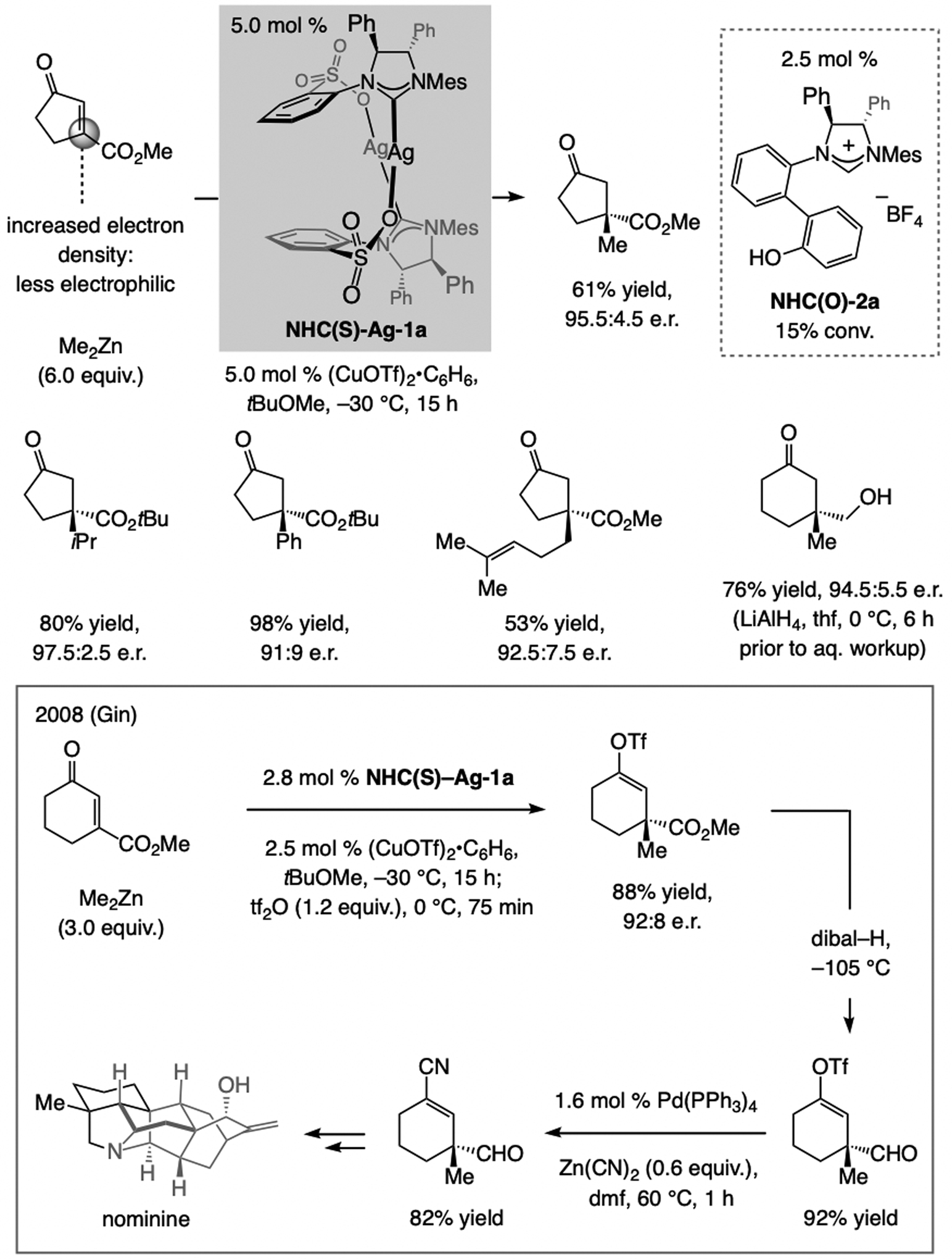
ECA of (alkyl)2Zn reagents to cyclic β-carboxylic enones and application to total synthesis of nominine by Gin et al.
Scheme 40.
Scheme 40.
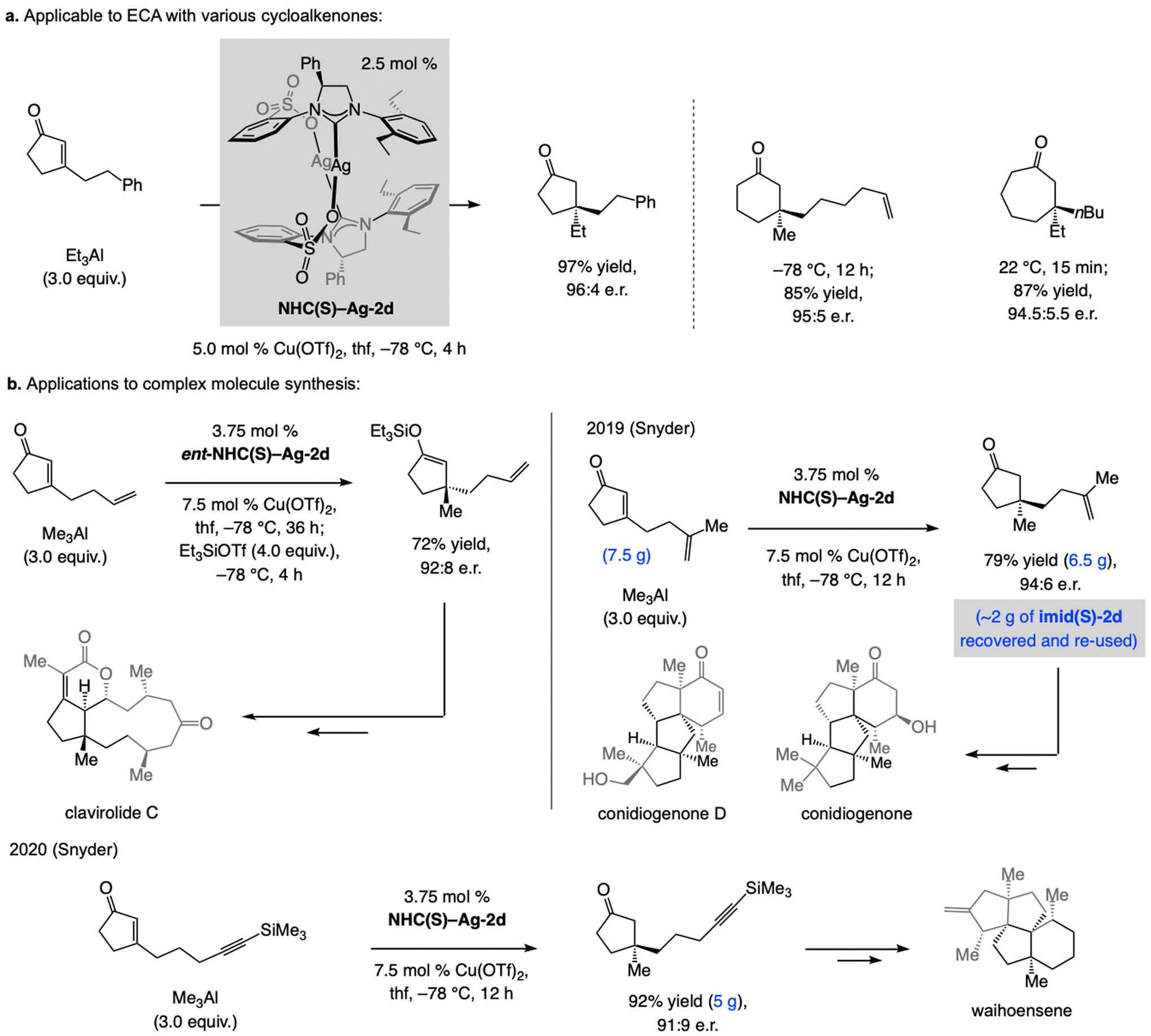
ECA with β-substituted cyclic enones and (alkyl)3Al reagents and applications to total synthesis of structurally complex bioactive natural products.
Scheme 41.
Scheme 41.
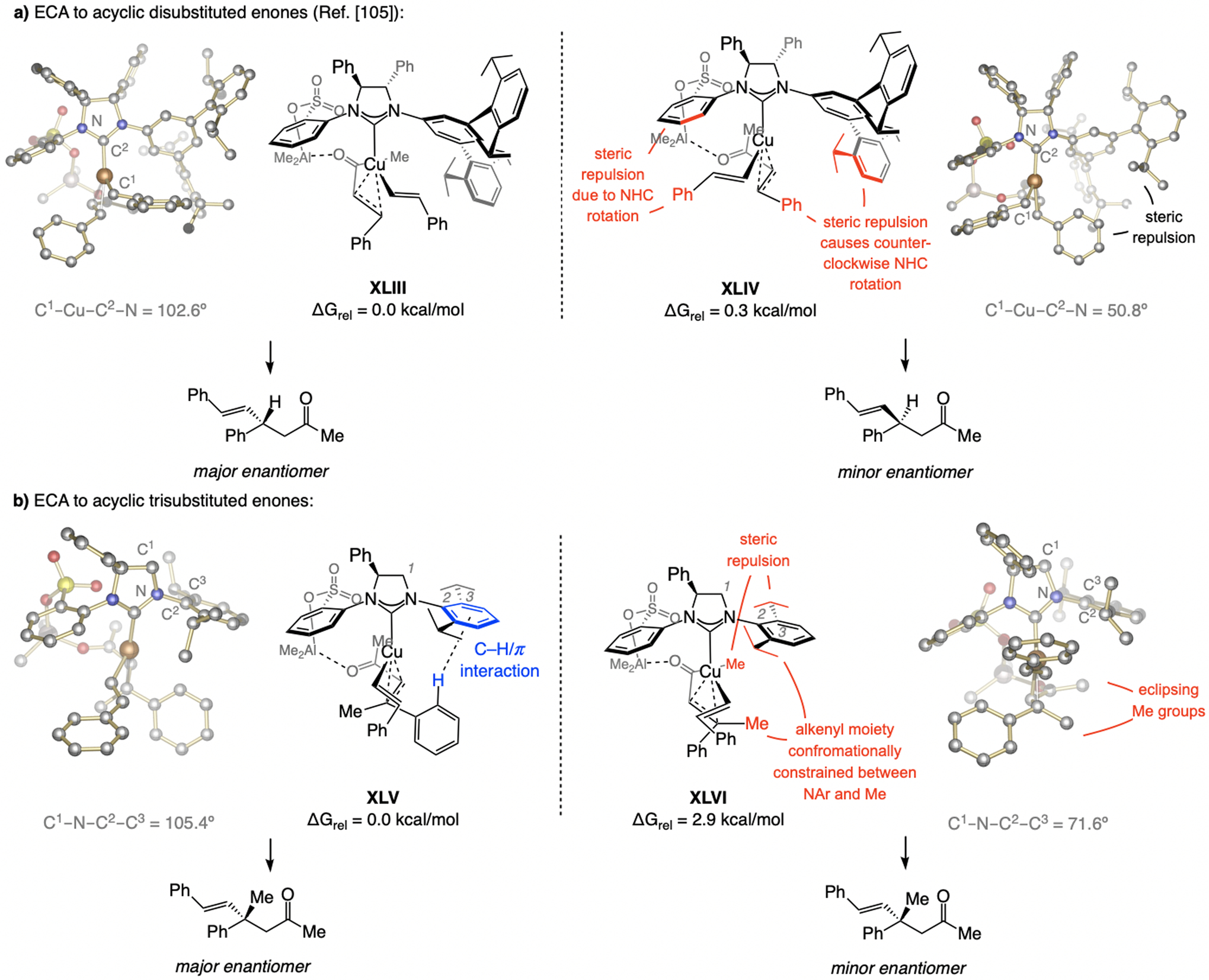
ECA of (alkyl)3Al compounds to acyclic trisubstituted enones.
Scheme 42.
Scheme 42.
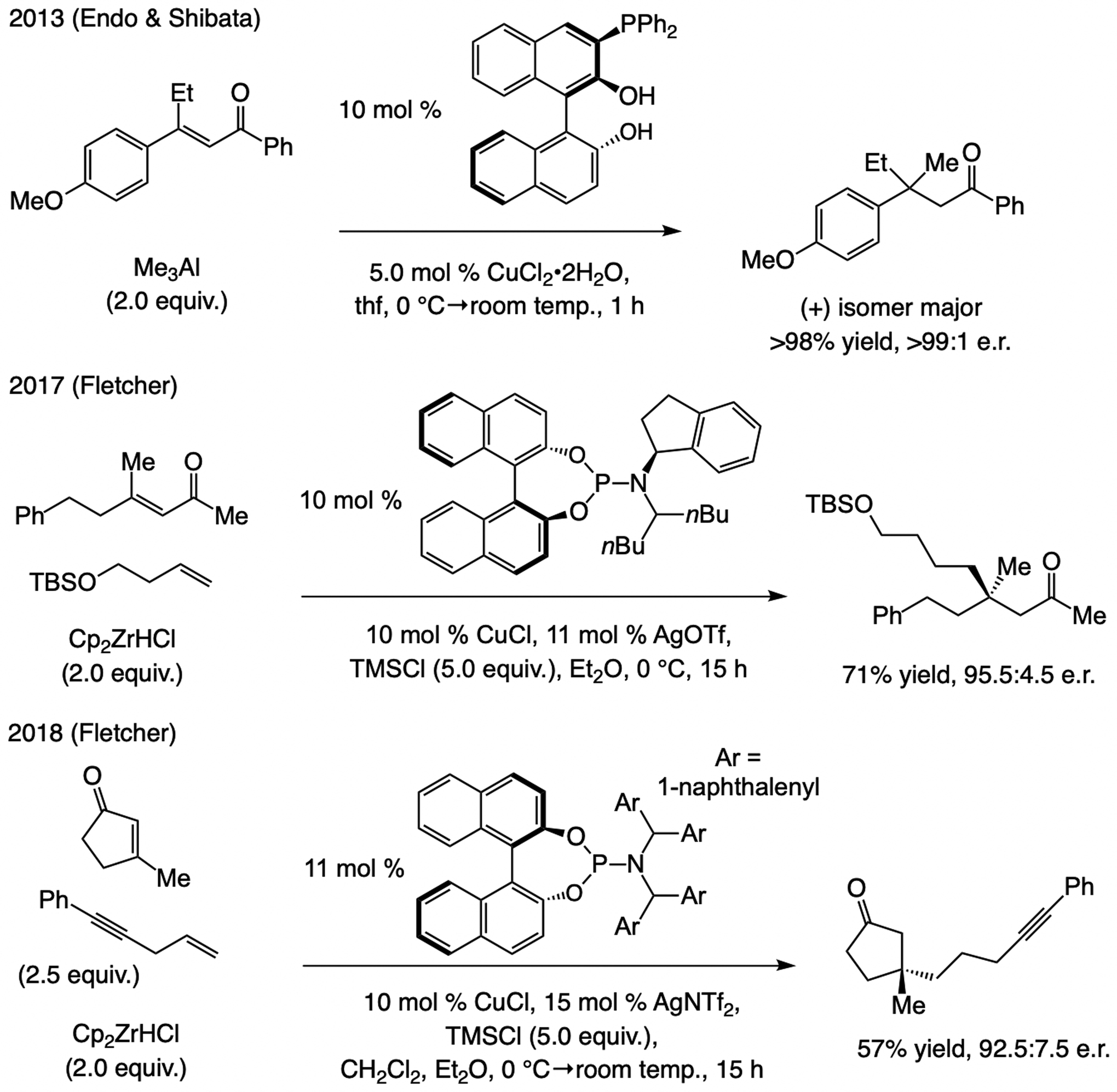
ECA of (alkyl)3Al and alkyl–zirconocene compounds to trisubstituted enones.
Scheme 43.
Scheme 43.
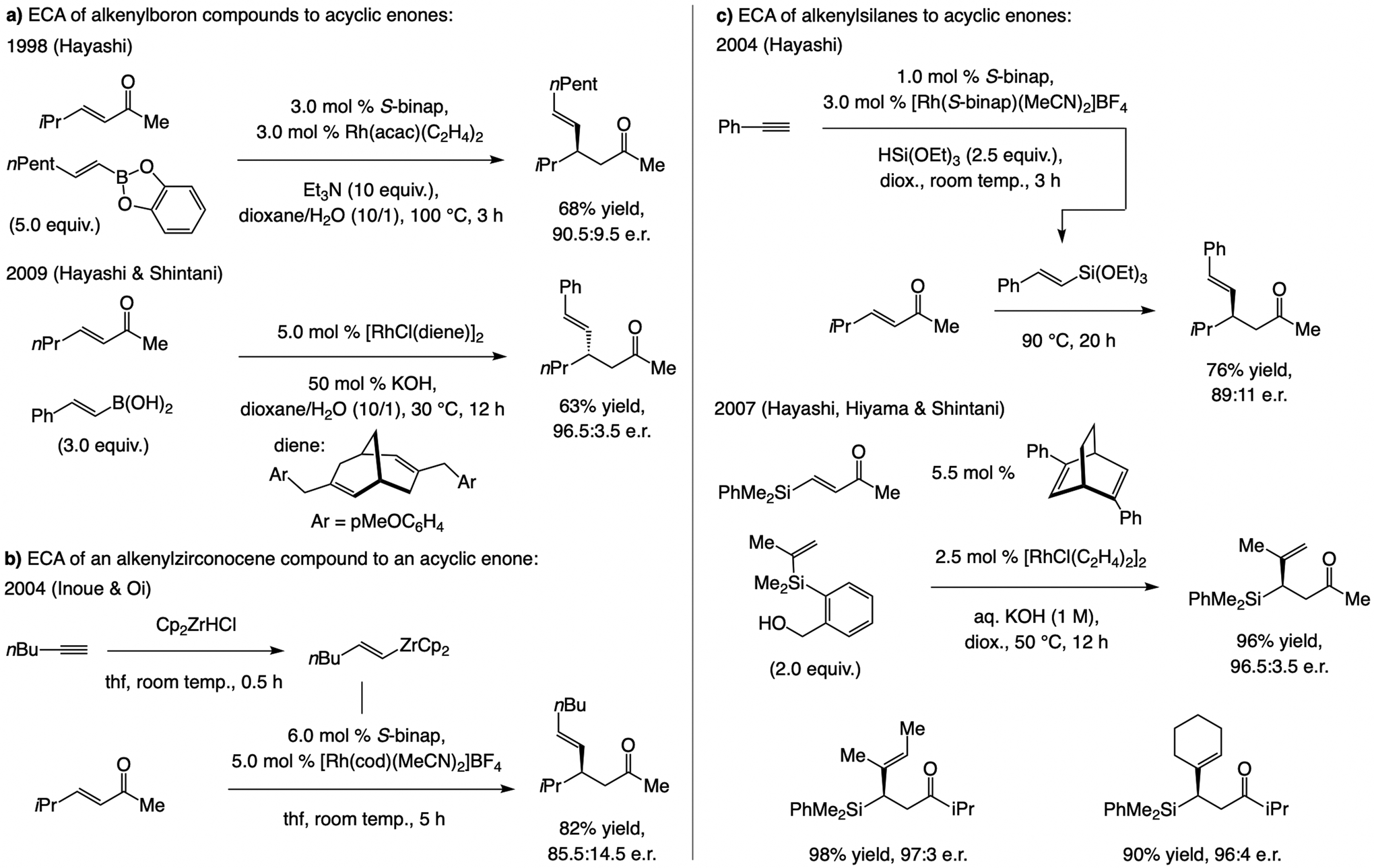
ECA with alkenylboronate, alkenylzirconocene, and alkenylsilane compounds and Rh-based complexes.
Scheme 44.
Scheme 44.
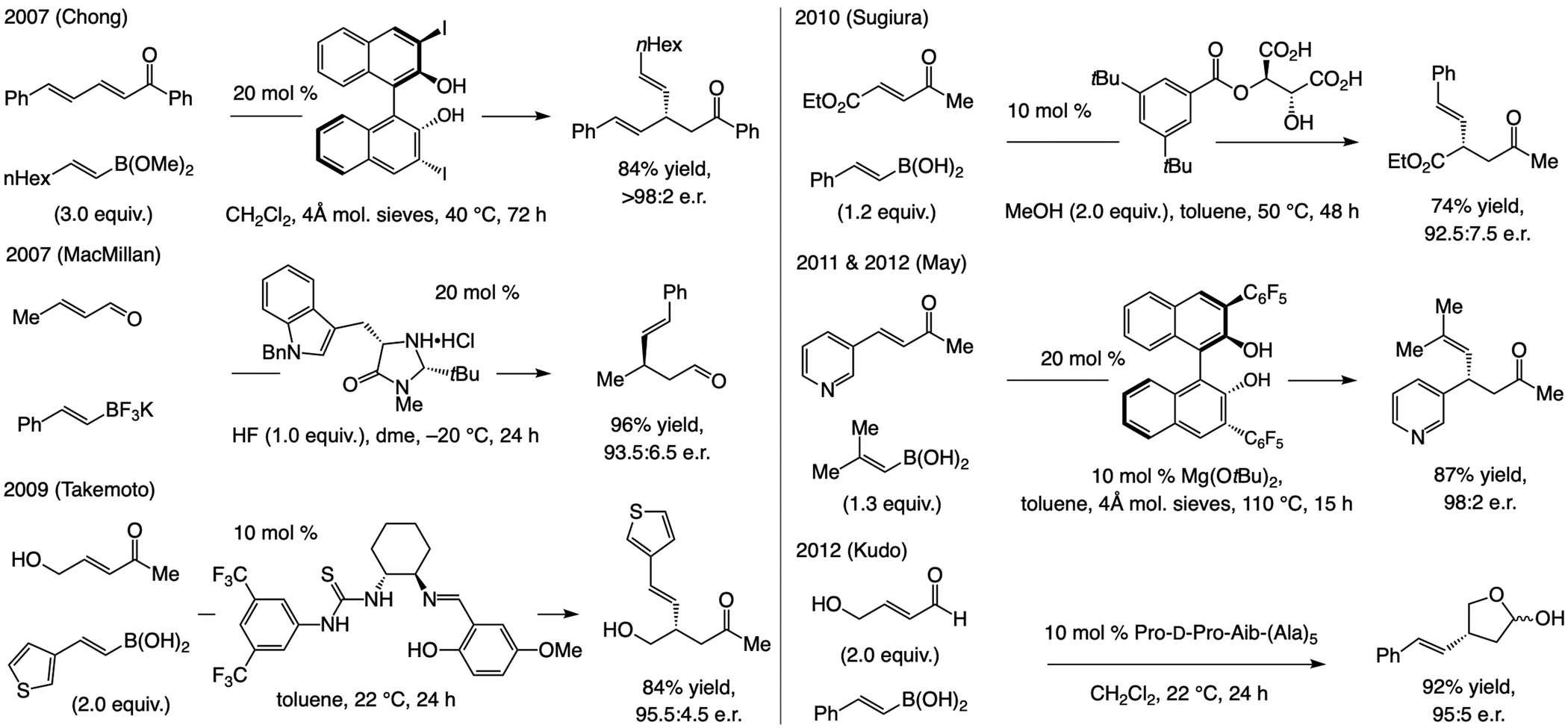
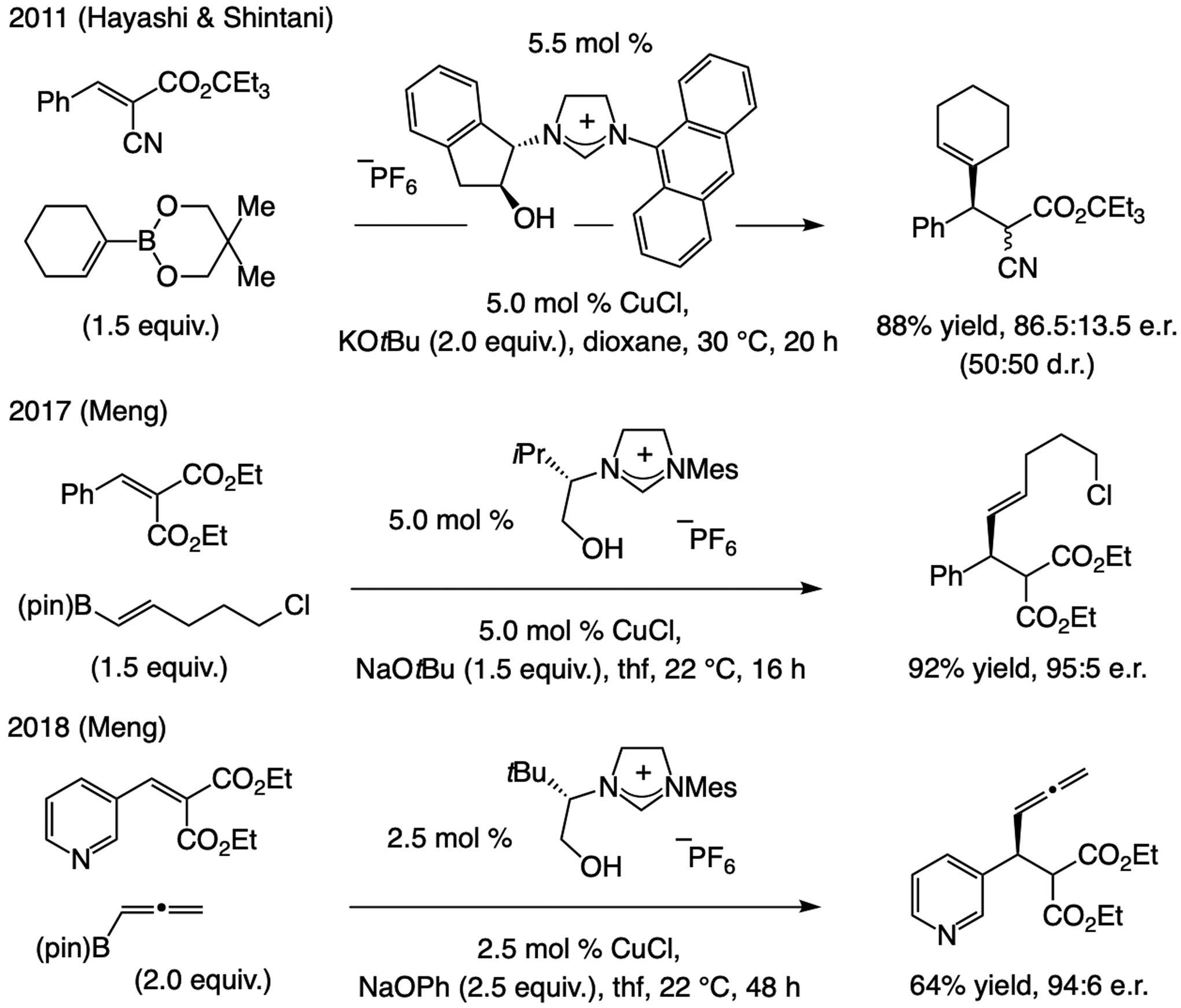
Organic molecules have been used to catalyze ECA of alkenylboron compounds to acyclic enones.
Scheme 45.
Scheme 45.
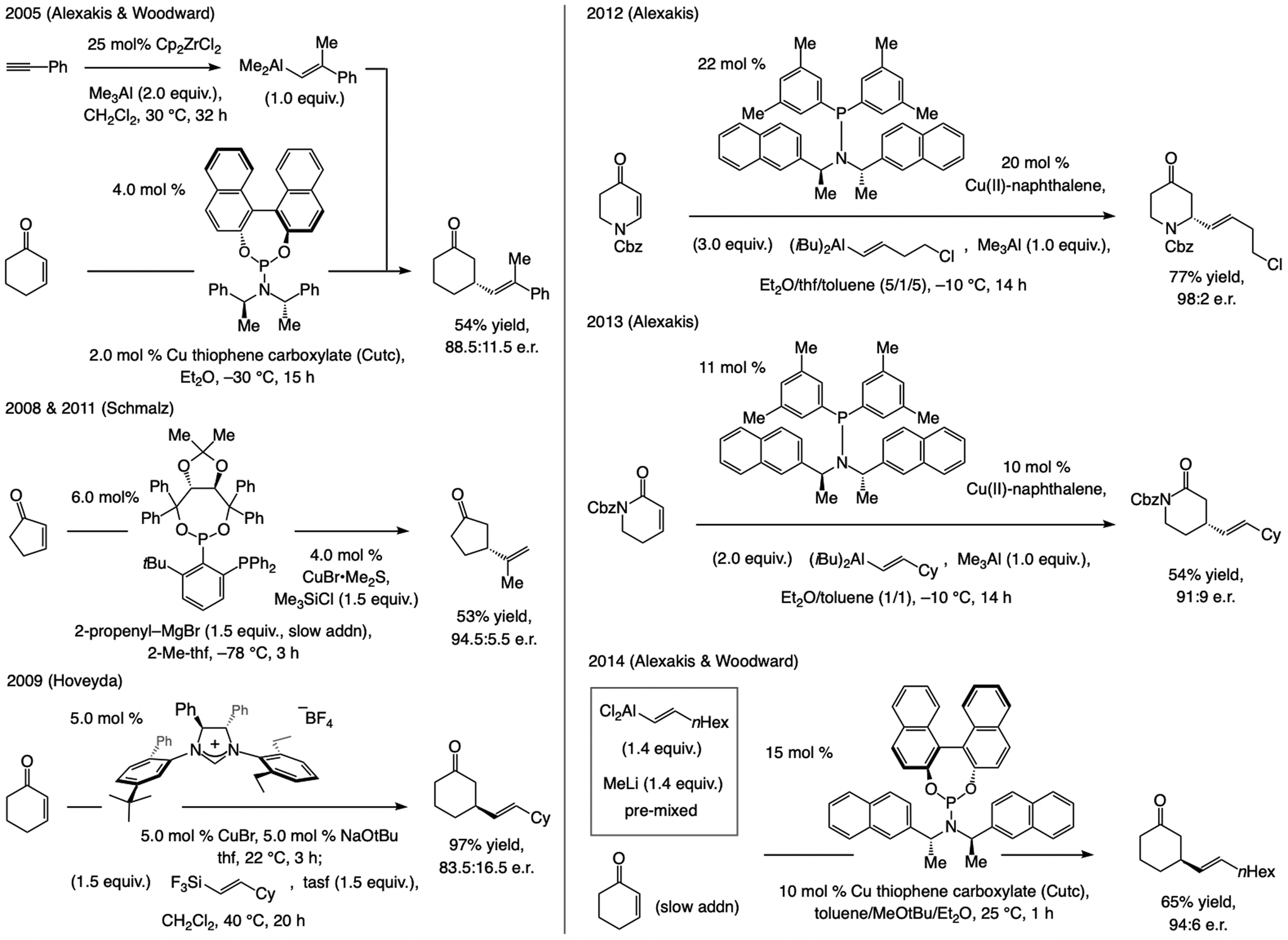
ECA of an alkenyl group with Cu-based catalysts have largely involved cyclic enones. Abbreviation: tasf = tris(dimethylamino)sulfonium difluorotrimethylsilicate.
Scheme 46.
Scheme 46.
ECA of an alkenyl unit to an acyclic α,β-unsaturated carbonyl.
Scheme 47.
Scheme 47.
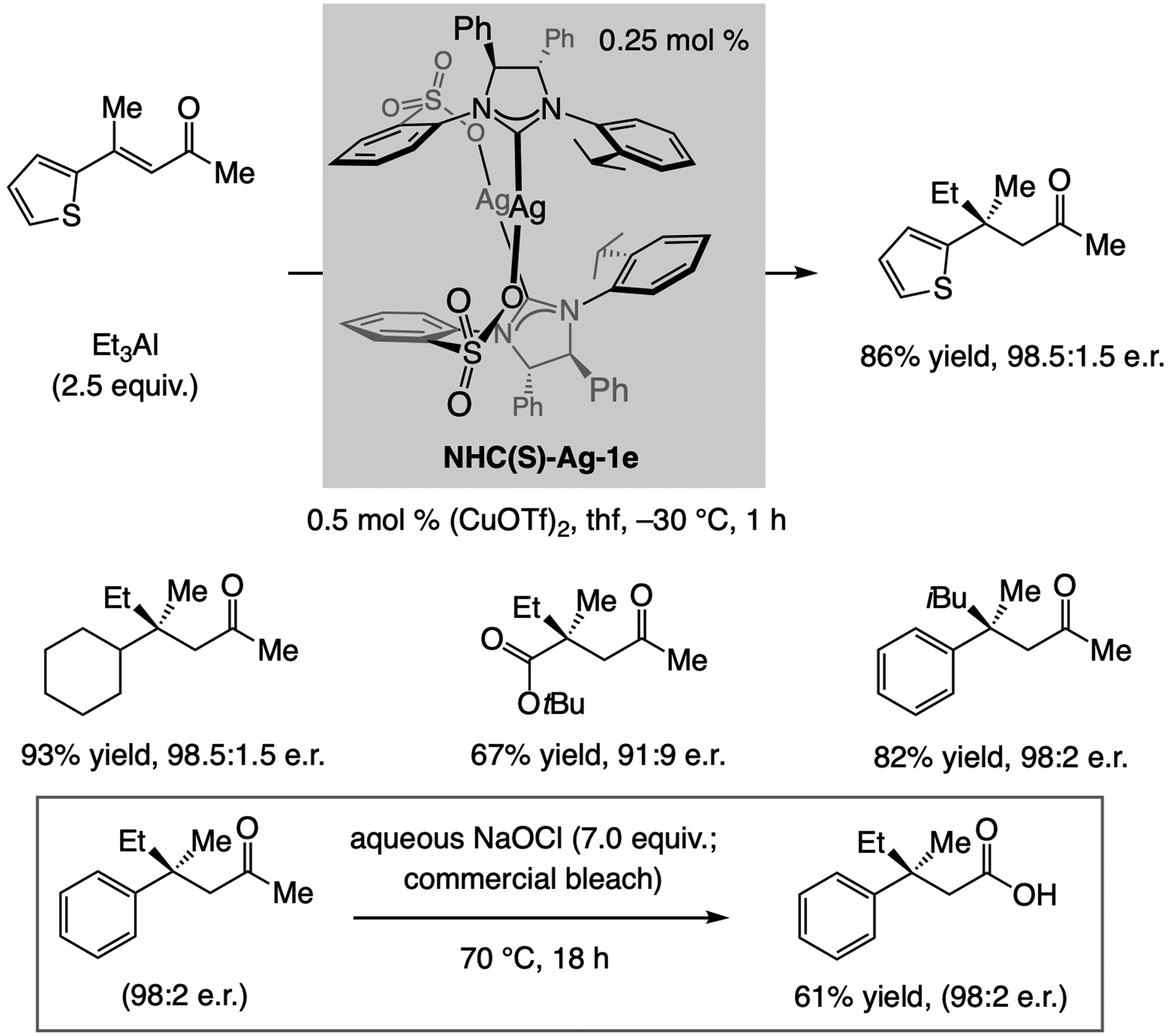
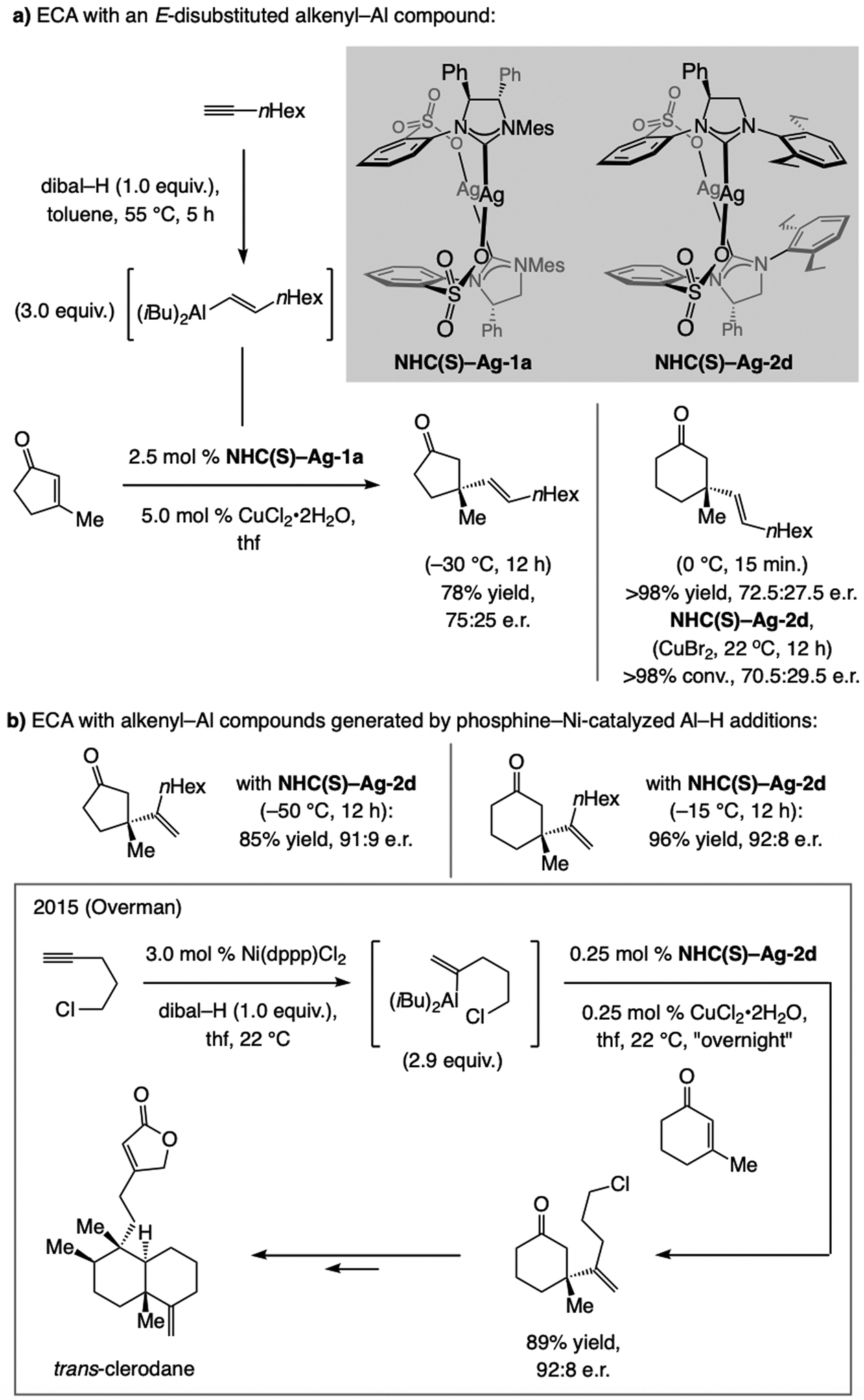
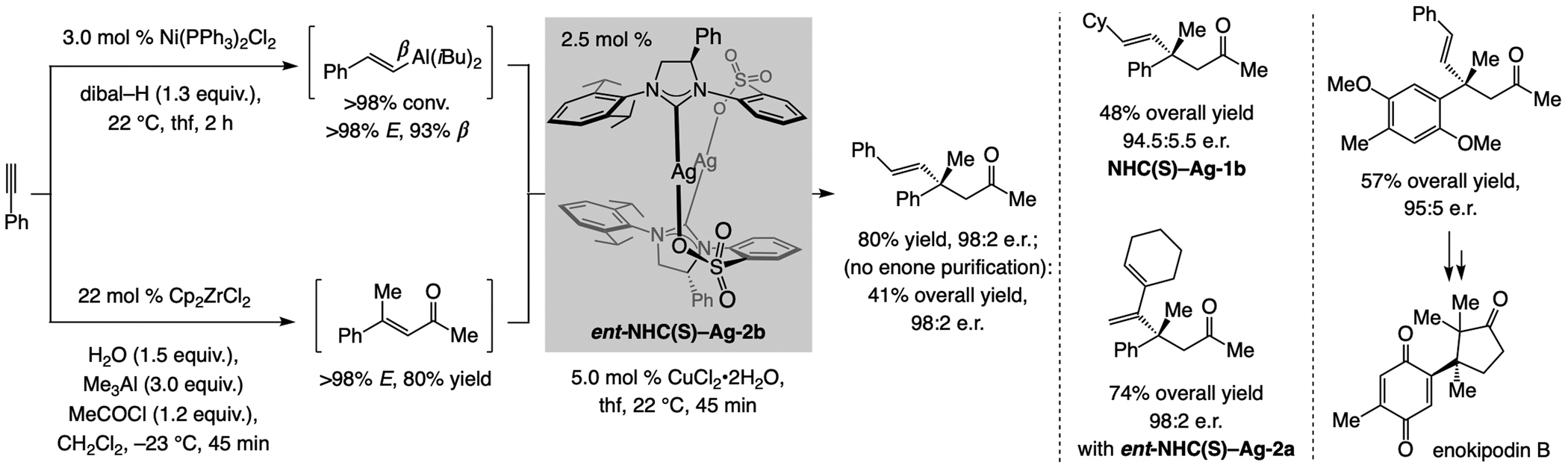
ECA of alkenyl–Al compounds to acyclic enones. Depending on the substrate, a different sulfonate-containing NHC–Cu catalyst might prove to be optimal (see Scheme 61 for mechanistic analysis).
Scheme 48.
Scheme 48.
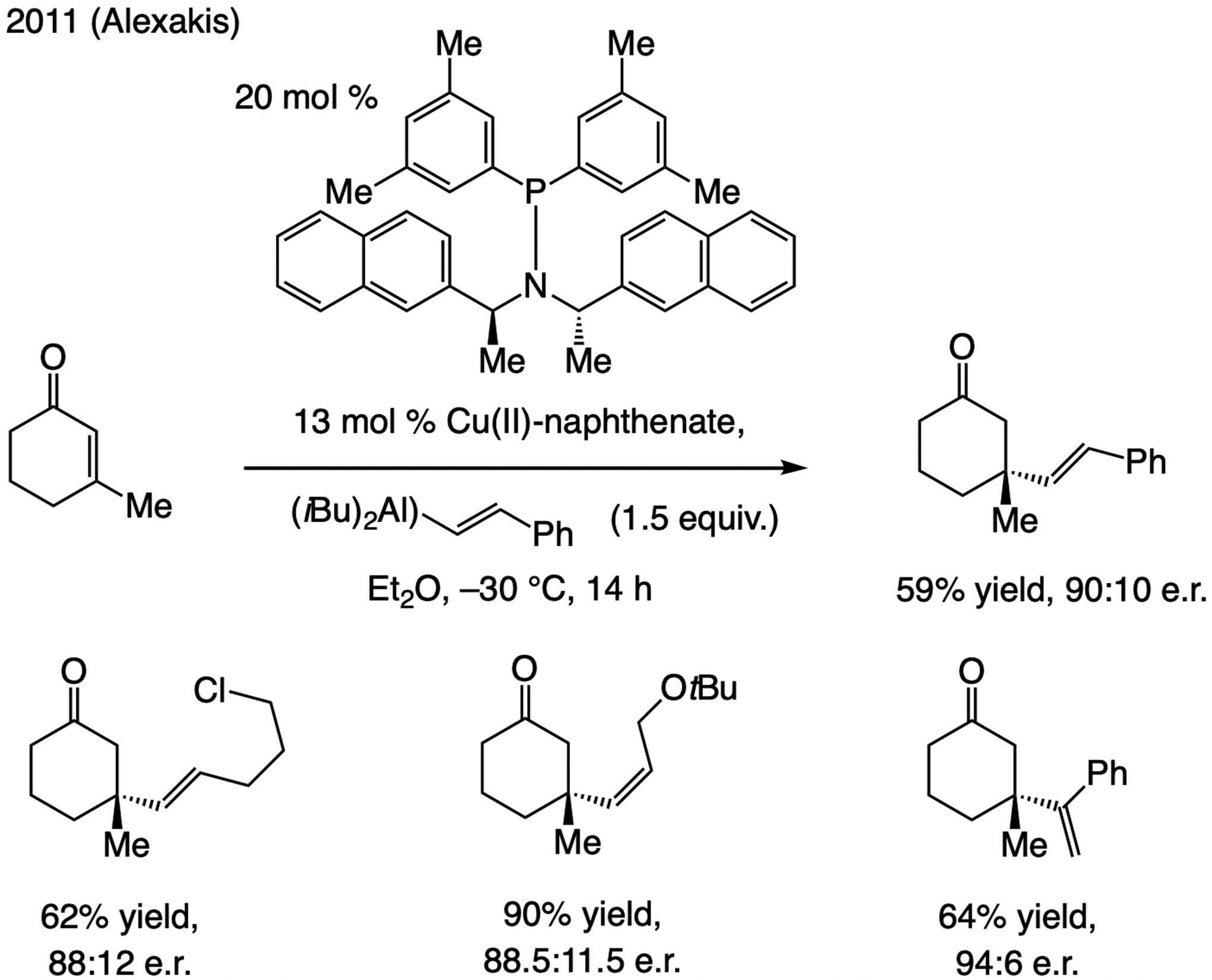
The state-of-the-art in ECA of alkenyl units to enones, circa 2010.
Scheme 49.
Scheme 49.
ECA of alkenyl–Al compounds with sulfonate NHC–Cu catalysts and application to total synthesis of trans-clerodane by Overman et al.
Scheme 50.
Scheme 50.
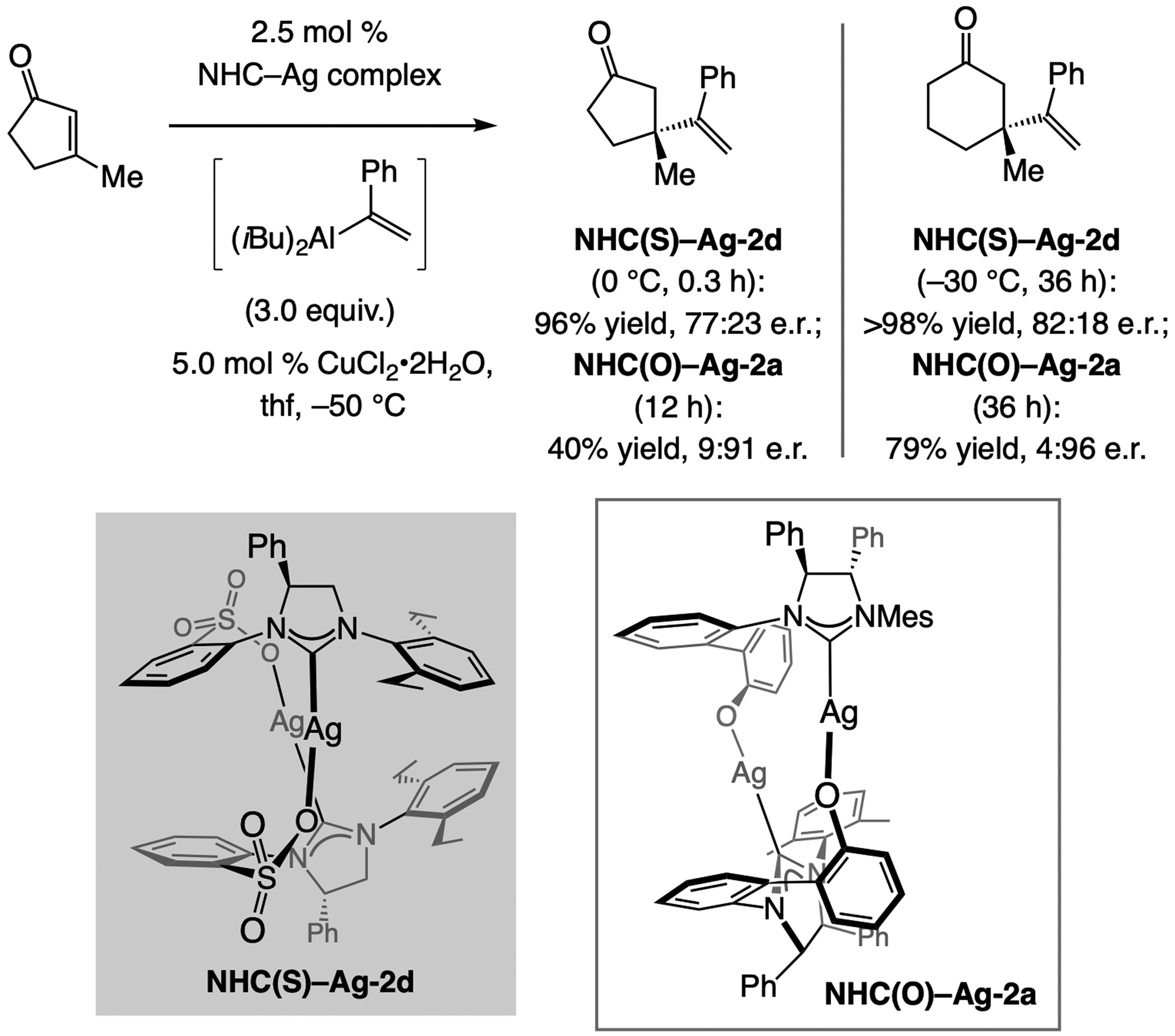
ECA of a 1-phenyl-substituted alkenyl–Al compound. Reactions performed under N2 atm.; conv. (±2%) determined by analysis of the 1H NMR spectra of the unpurified product mixtures; yields (±2%) correspond to purified products, and enantioselectivity determined by GC analysis. Previously unpublished results; see the Supporting Information for details.
Scheme 51.
Scheme 51.
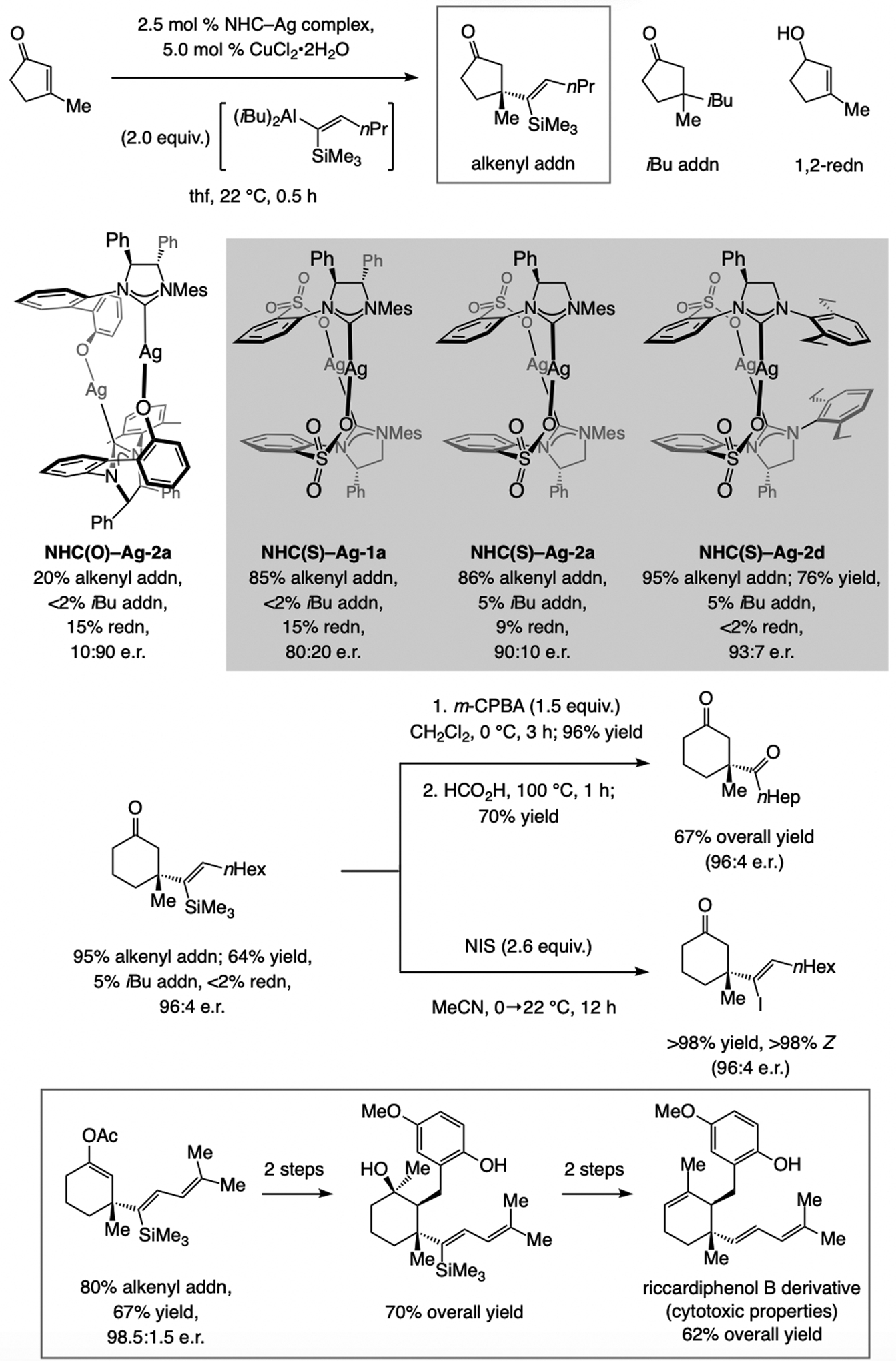
ECA of silyl-substituted alkenyl–Al compounds to β-substituted cyclic enones (for mechanistic analysis, see Scheme 59). NIS = N-iodosuccinimide.
Scheme 52.
Scheme 52.
ECA of alkenyl–Al compounds to acyclic trisubstituted enones proceeds with the opposite enantioselectivity compared to disubstituted substrates (Scheme 47). See Scheme 61 for mechanistic analysis.
Scheme 53.
Scheme 53.
ECA of alkenyl–Al compounds to β-substituted cyclohexenones with aminophosphinite–Cu complexes.
Scheme 54.
Scheme 54.
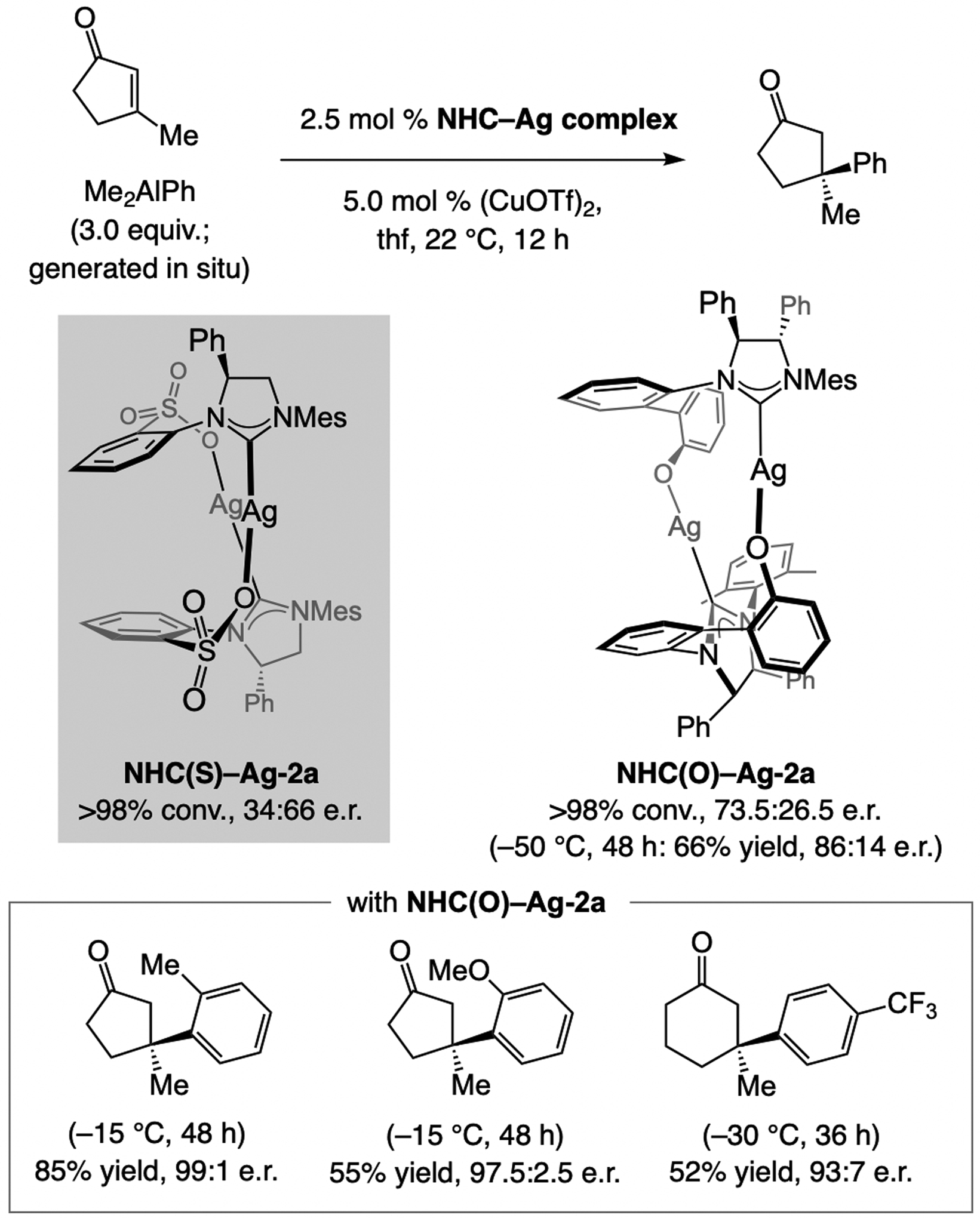
The first examples of ECA of an aryl moiety to cyclic β-substituted enones.
Scheme 55.
Scheme 55.
ECA of di(alkyl)aryl–Al compounds to β-substituted cyclic enones is more enantioselective with a phenoxy NHC ligand (for mechanistic analysis, see Scheme 60).
Scheme 56.
Scheme 56.
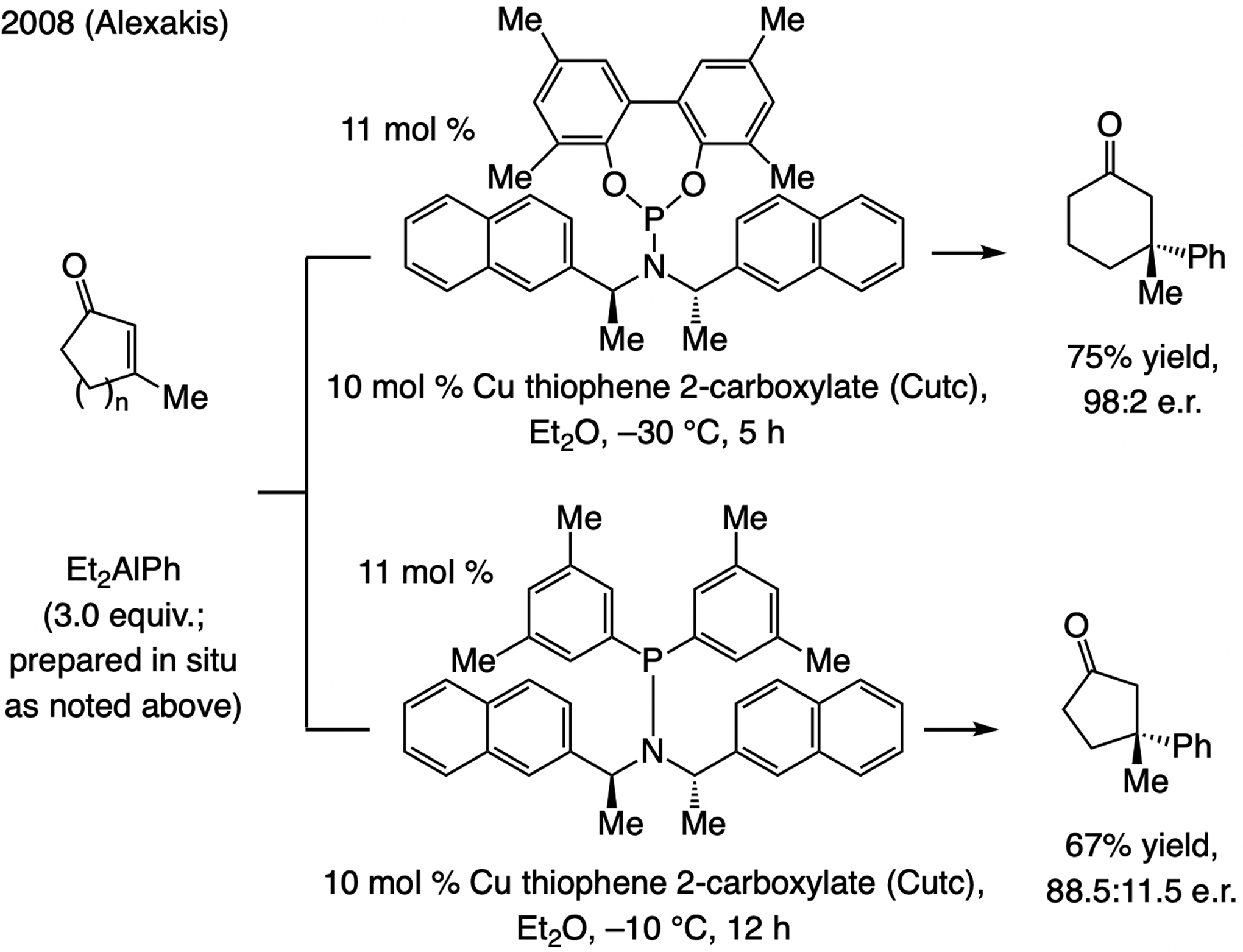
Phosphoramidite–Cu-catalyzed ECA of aryl moieties to β-substituted cyclic enones, including cyclopentenones.
Scheme 57.
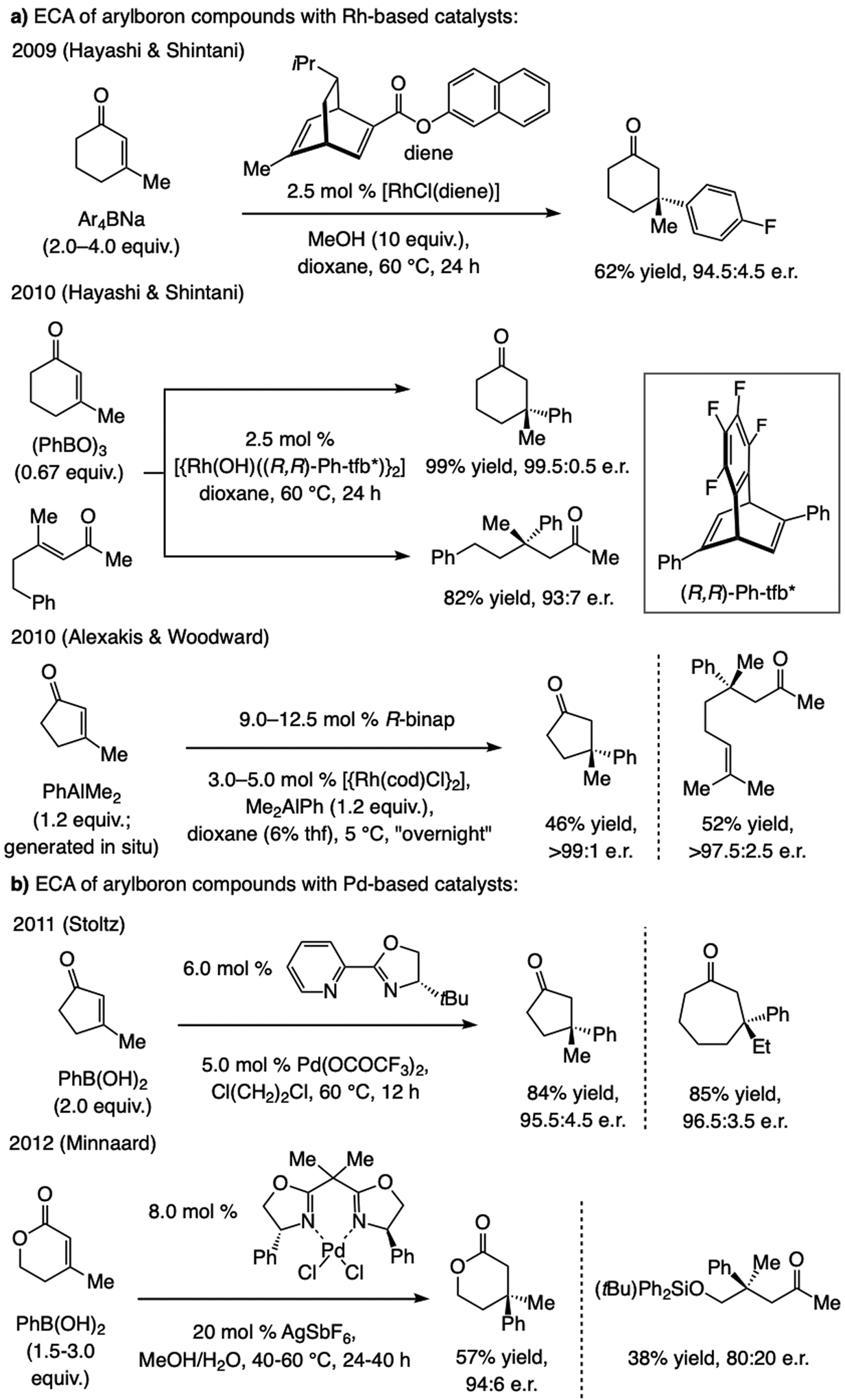
Scheme 57.
ECA of organoboron compounds to β-substituted enones catalyzed by Rh- or Pd-based catalysts.
Scheme 58.
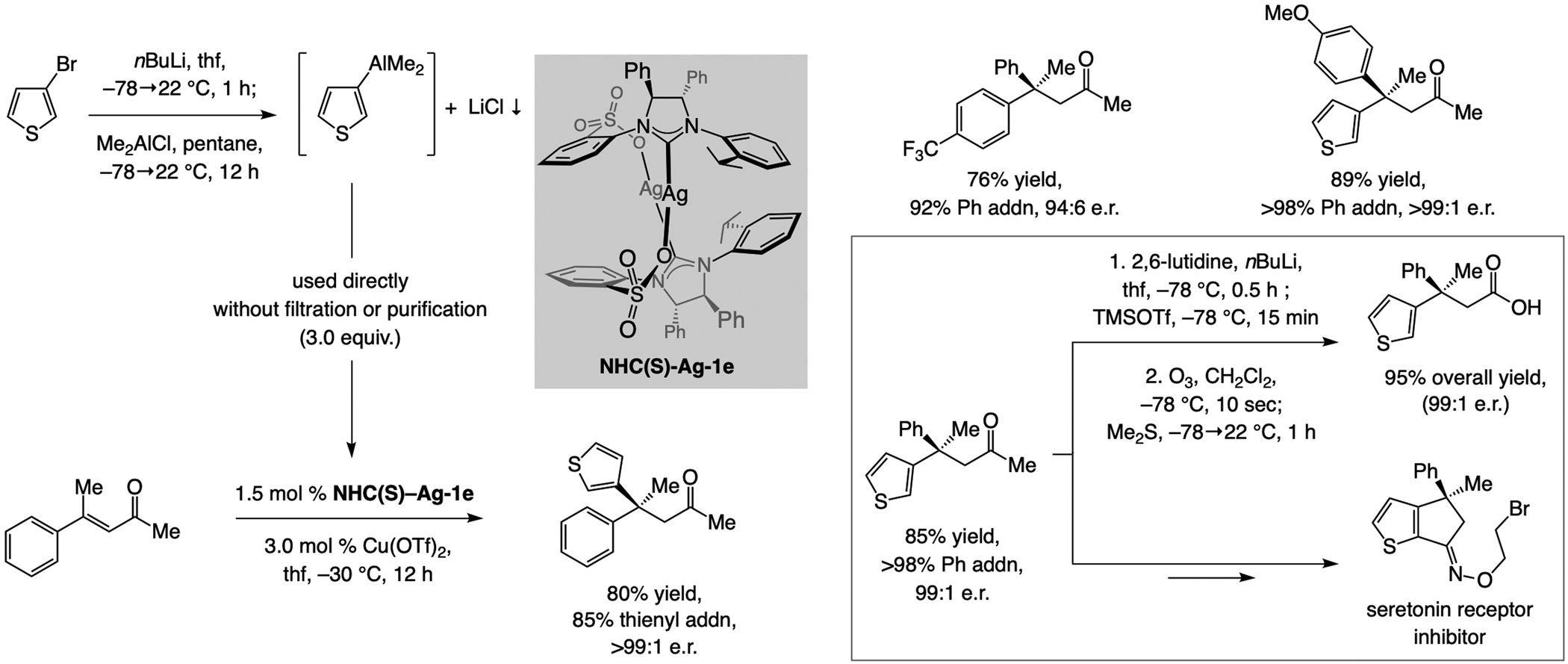
Scheme 58.
ECA of aryl- and heteroaryl–Al compounds to acyclic trisubstituted enones.
Scheme 59.
Scheme 59.
Rationale for high e.r. in ECA with silyl-substituted alkenyl–Al compounds (see Scheme 51 for methodology). DFT at the M06L/Def2-TZVPP//M06L/Def2-SVP level. Previously unpublished analysis; see the Supporting Information for details of the DFT studies.
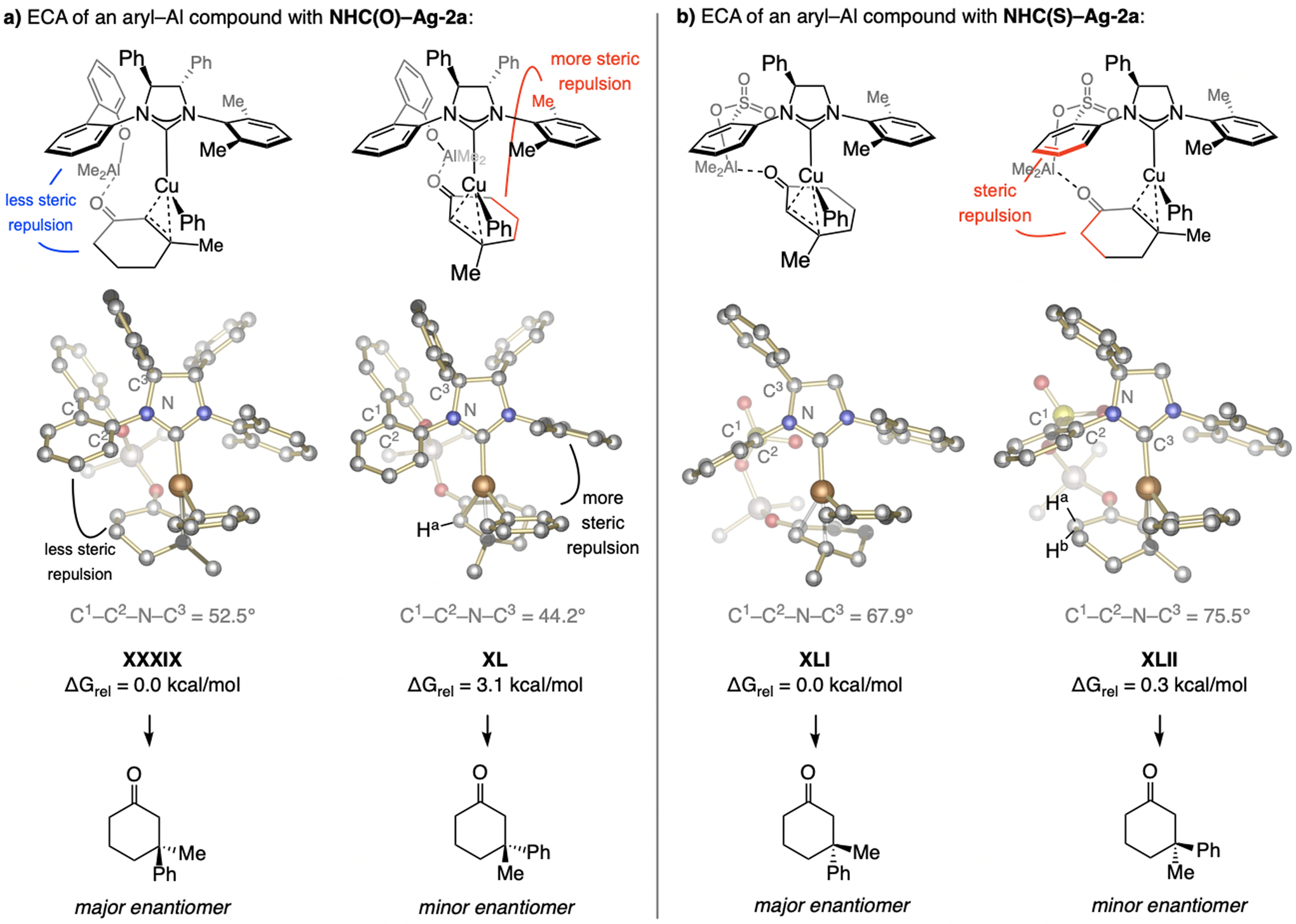
Scheme 60.
Scheme 60.
Rationale for high enantioselectivity in ECA with aryl–Al compounds (see Scheme 55 for methodology). DFT at the M06L/Def2-TZVPP//M06L/Def2-SVP level. Previously unpublished analysis; see the Supporting Information for details of the DFT studies.
Scheme 61.
Scheme 61.
Rationale for high e.r. in ECA of β-alkenyl–Al compounds (see Schemes 47 and 53 for methodology). DFT at the M06L/Def2-TZVPP//M06L/Def2-SVP level. See the Supporting Information for details.
Scheme 62.
Scheme 62.
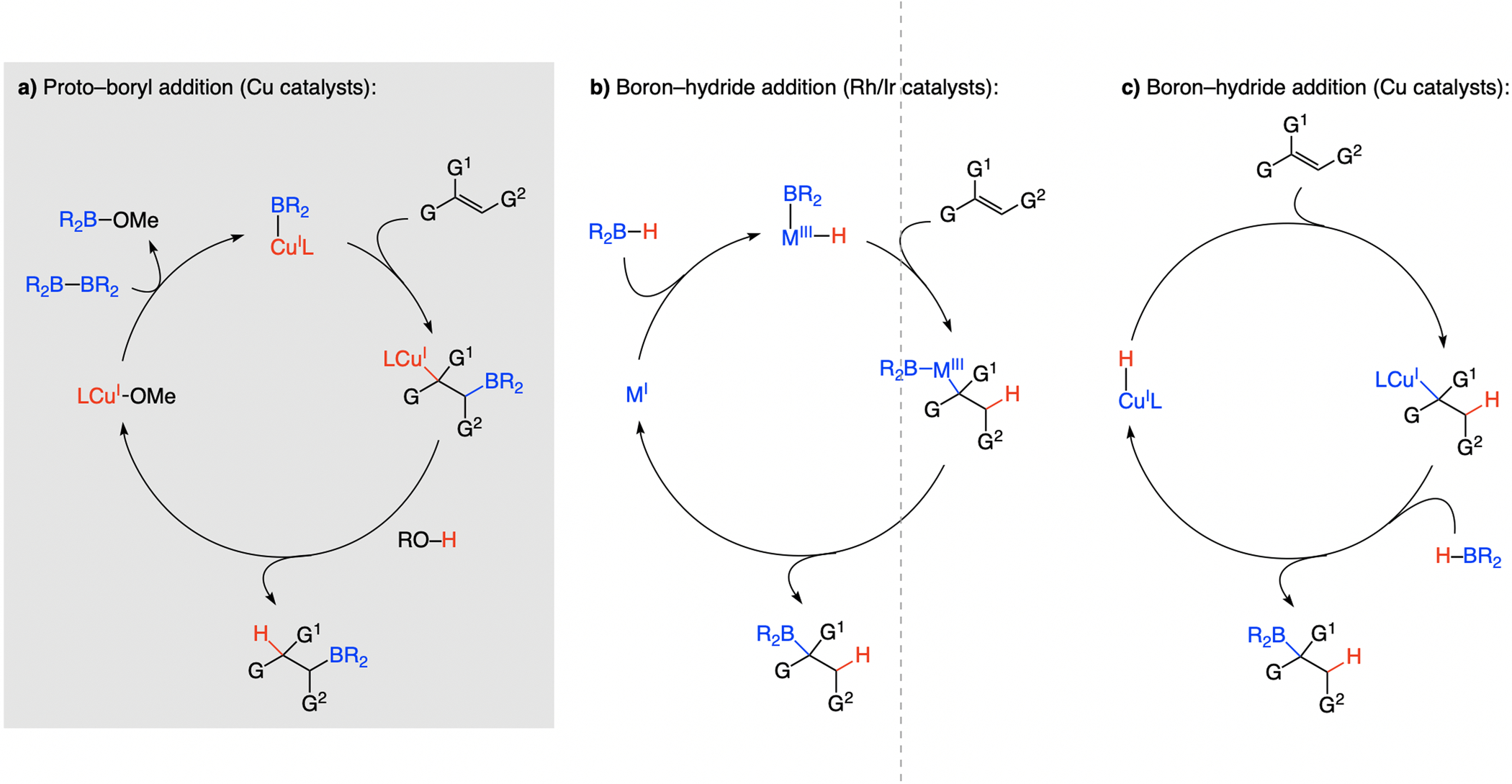
Different pathways by which an H and a B atom can be added to an alkene.
Scheme 63.
Scheme 63.
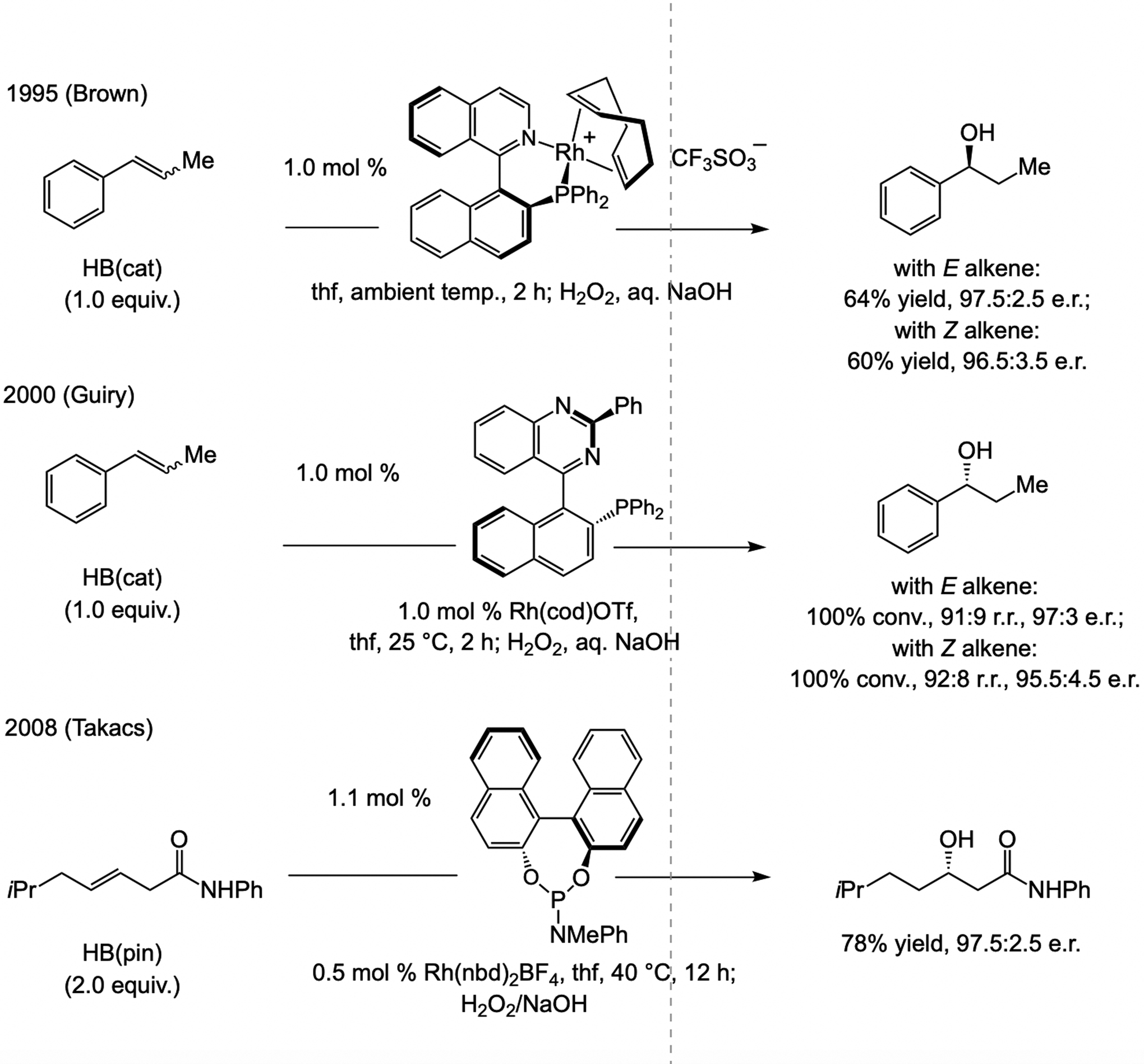
Catalytic enantioselective boron–hydride additions to 1,2-disubsdtituted linear alkenes. cat = catecholate.
Scheme 64.
Scheme 64.
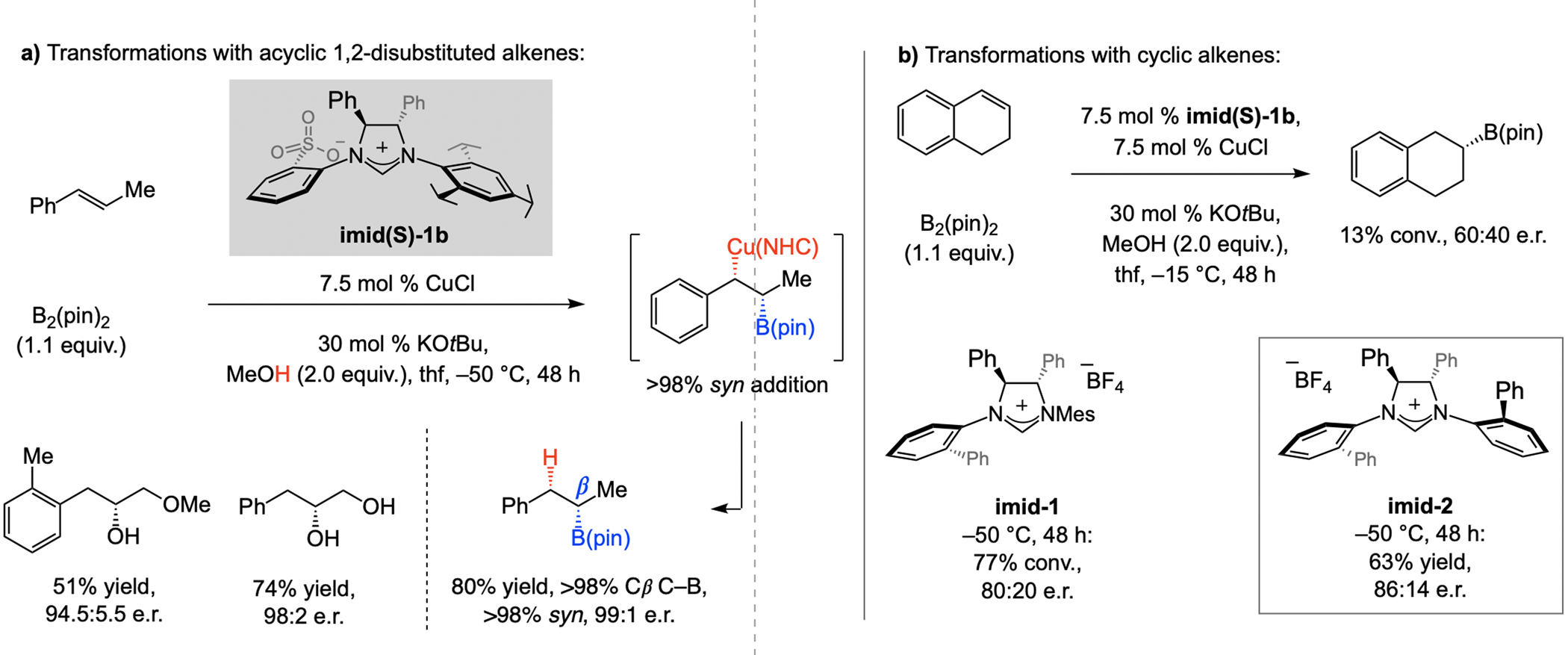
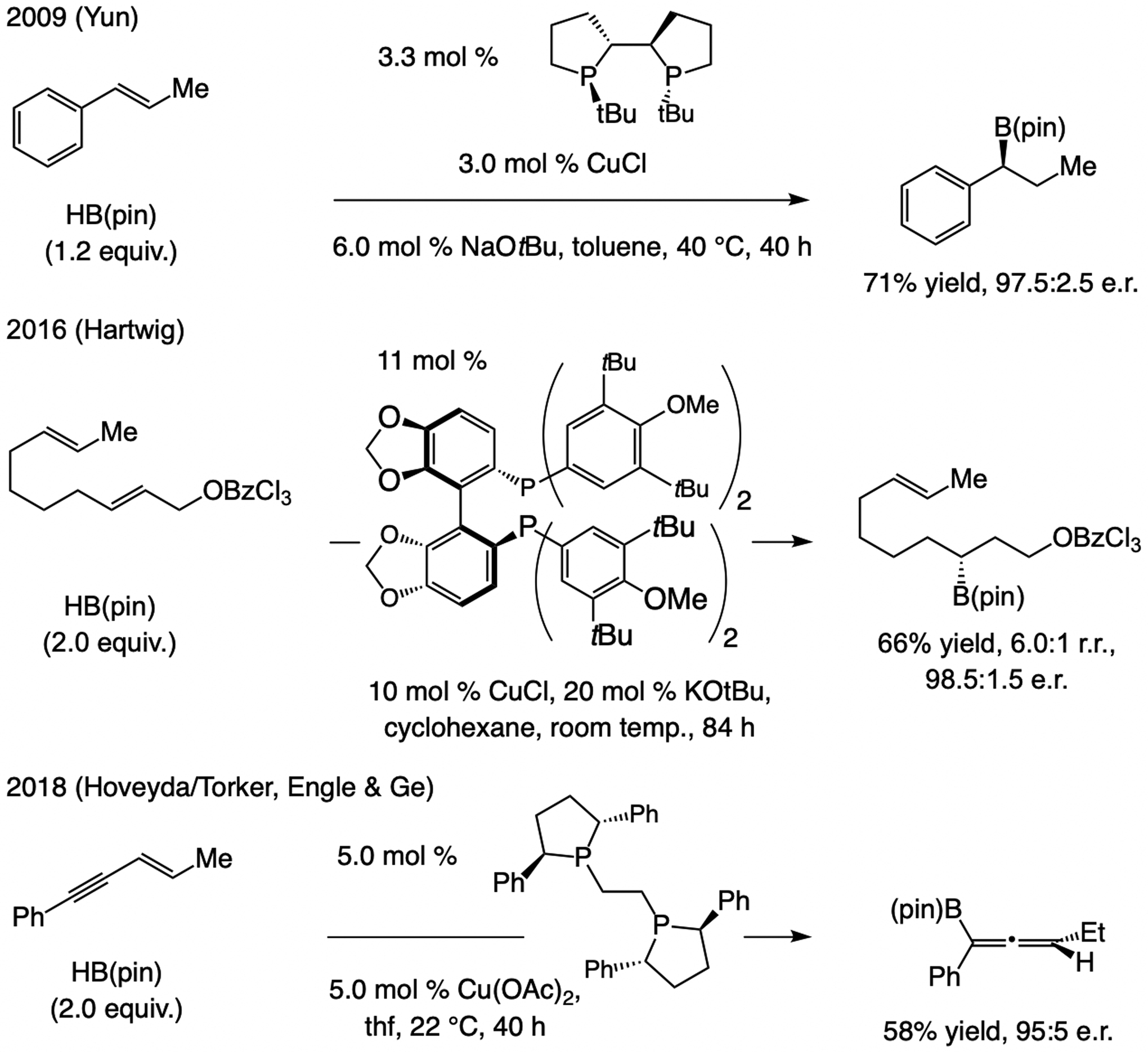
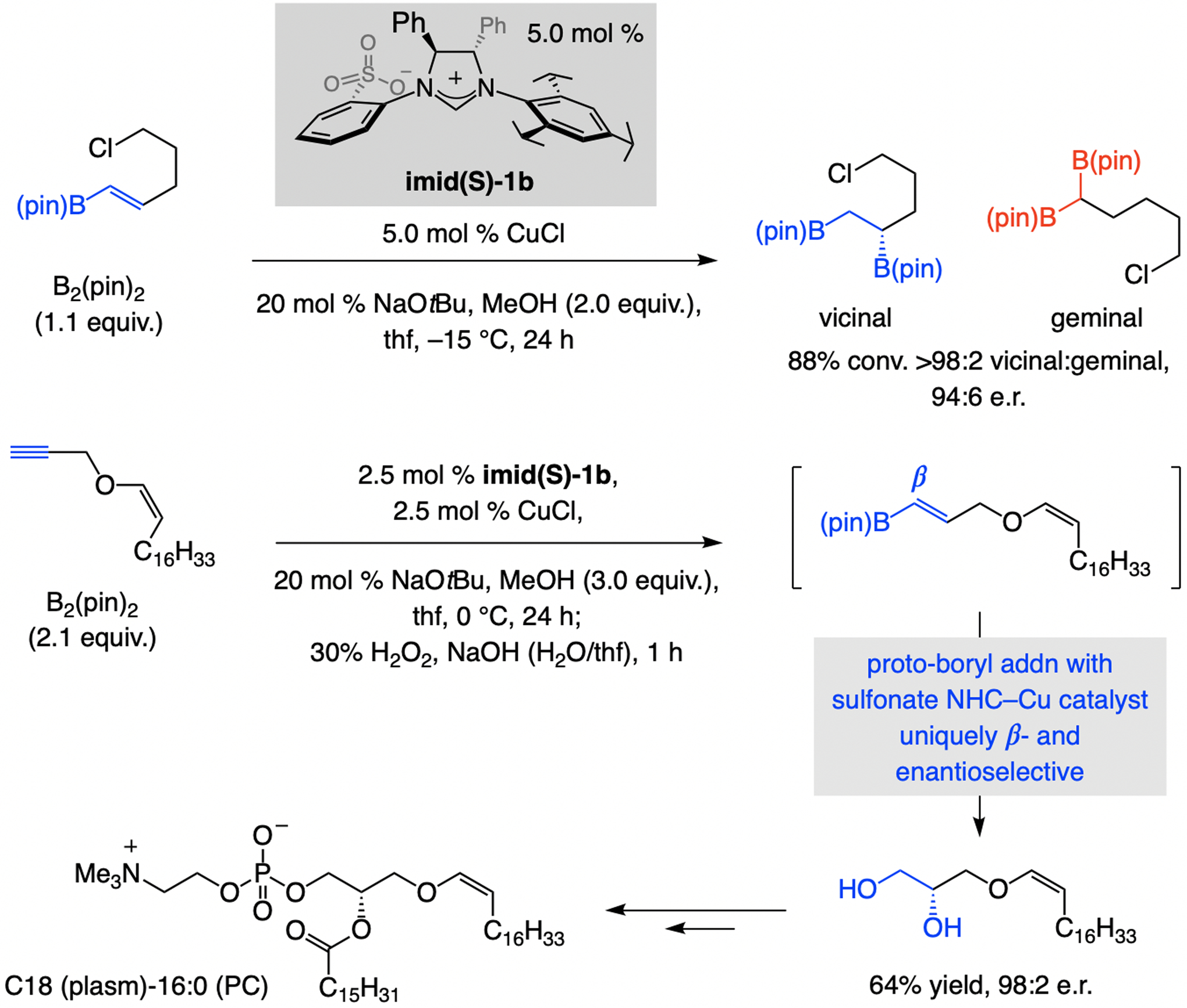
The first examples of enantioselective proto-boryl additions to alkenes.
Scheme 65.
Scheme 65.
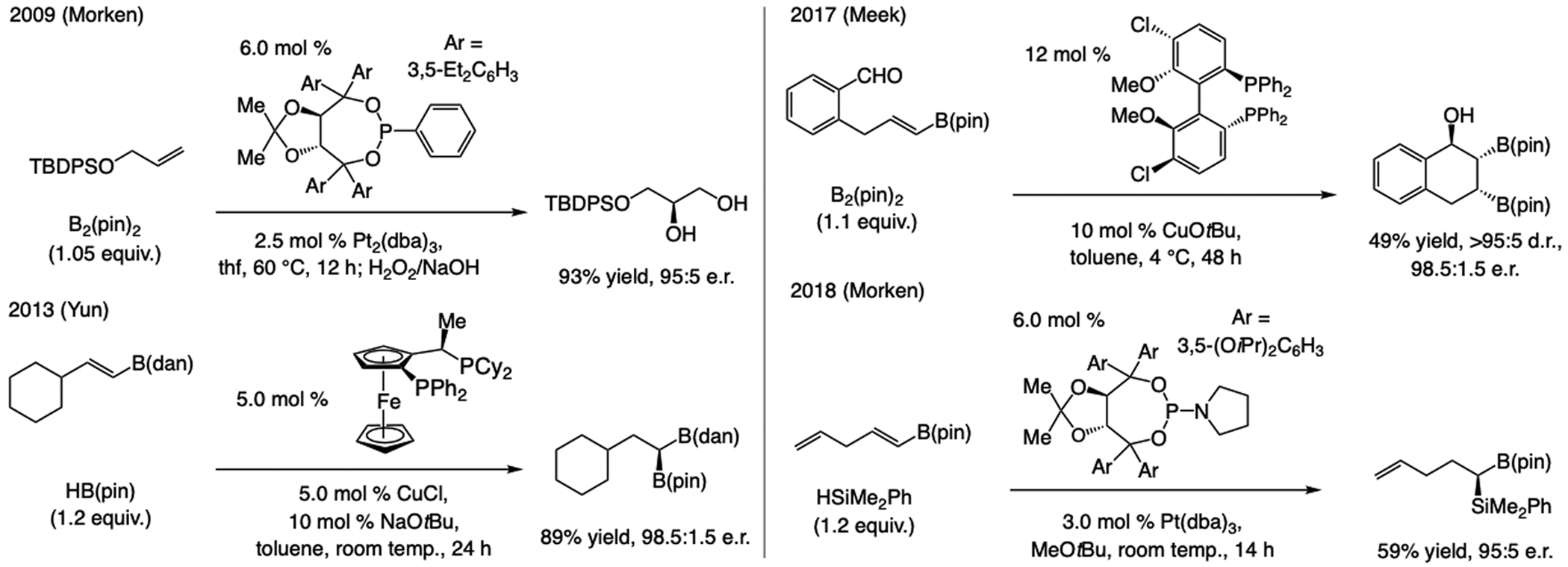
Catalytic enantioselective boron–hydride additions to E-1,2-disubstituted olefins. r.r. = regioisomeric ratio.
Scheme 66.
Scheme 66.
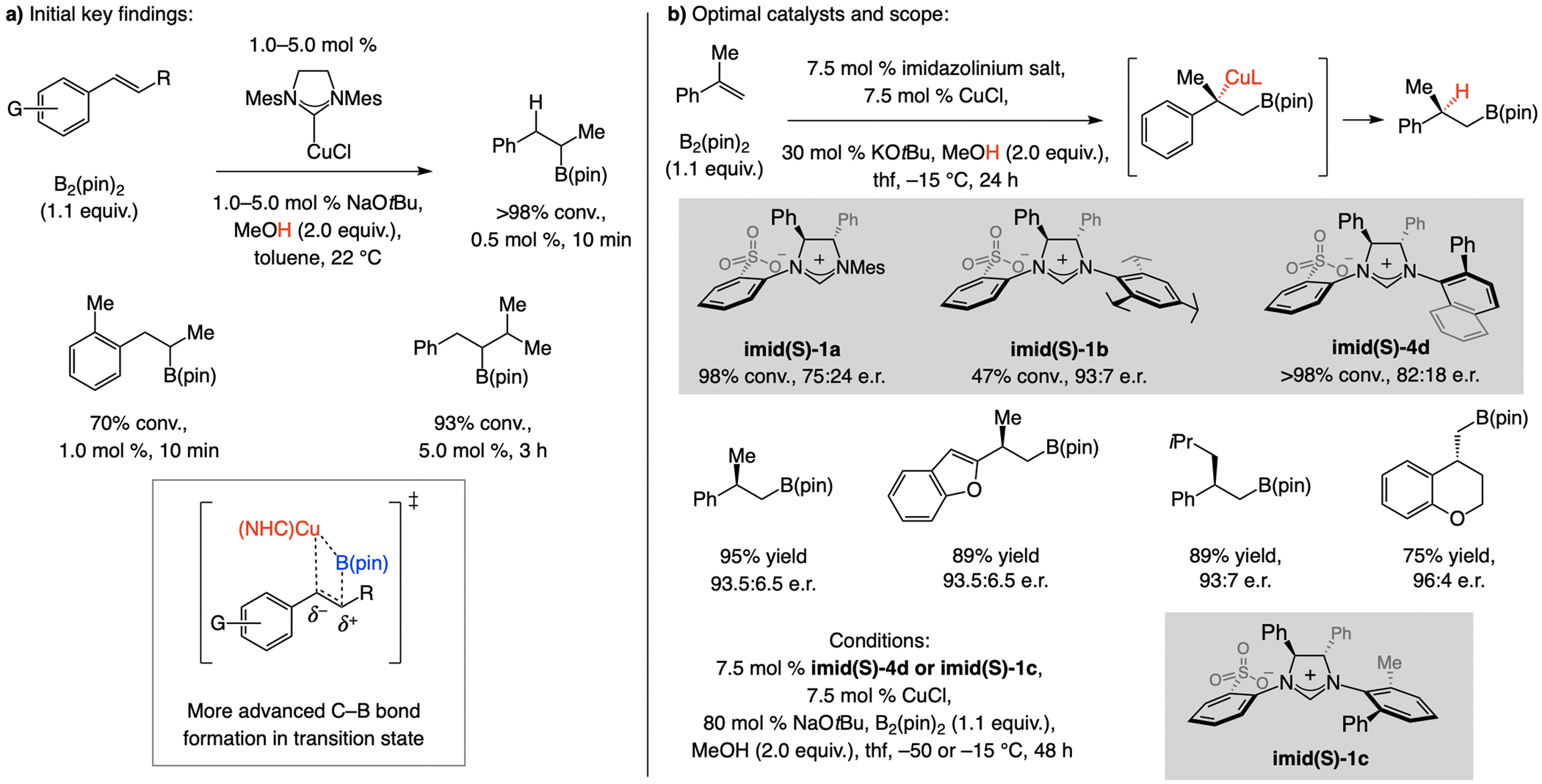
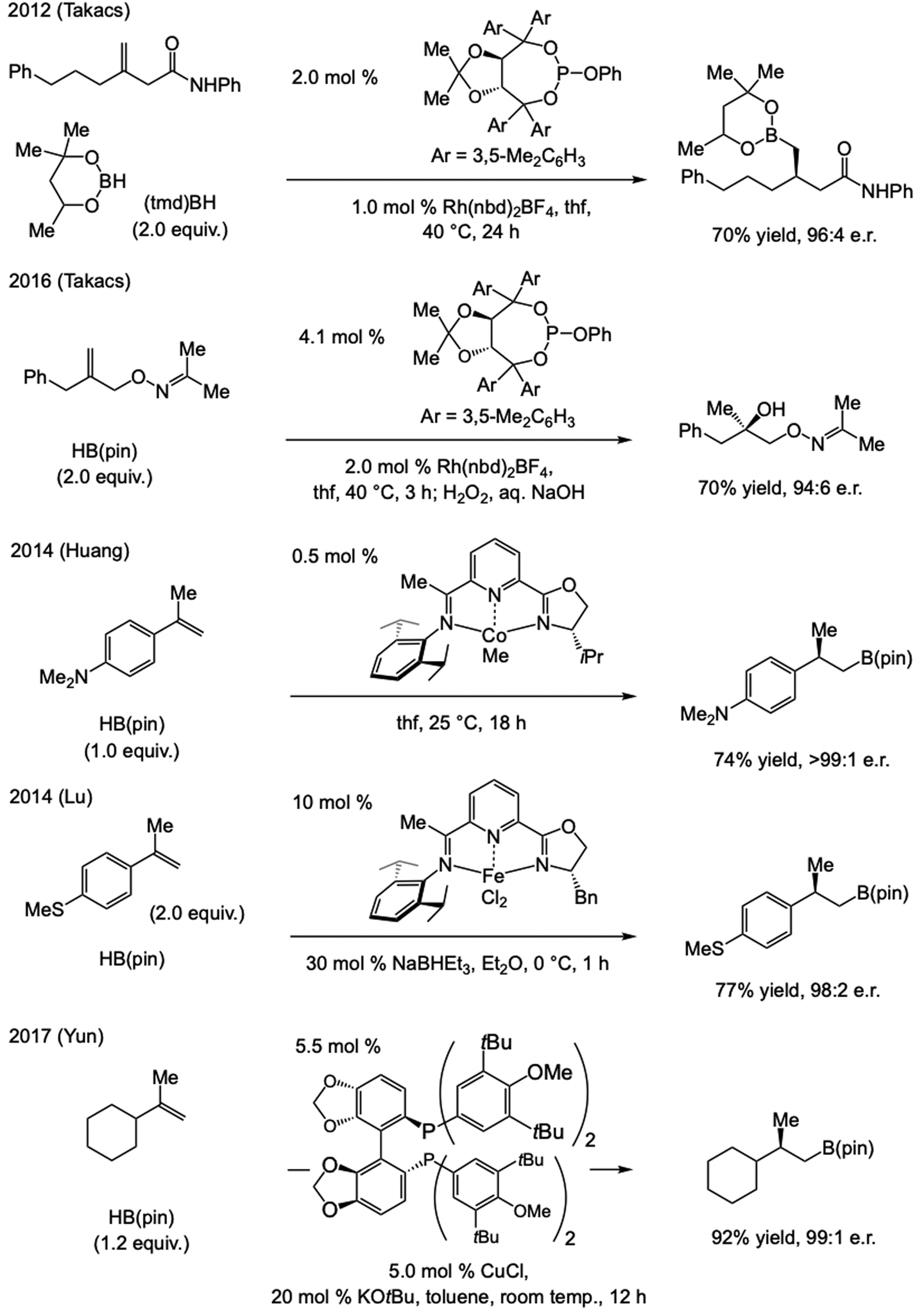
Catalytic enantioselective proto-boryl additions to 1,1-disubstituted alkenes.
Scheme 67.
Scheme 67.
The latest advances in catalytic enantioselective boron–hydride additions to 1,1-disubstituted alkenes.
Scheme 68.
Scheme 68.
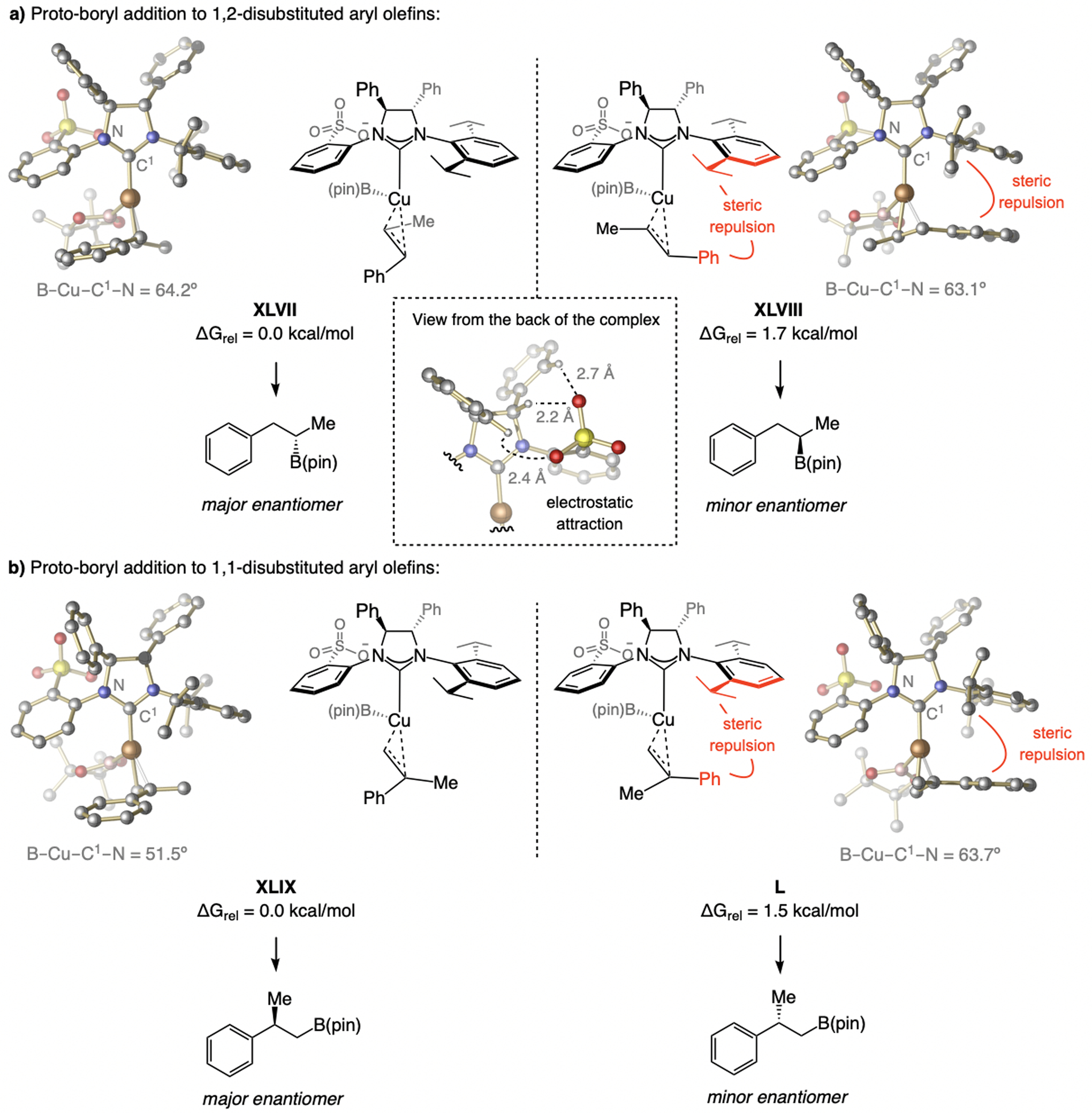
Stereochemical models accounting for the high e.r. in proto-boryl additions to aryl alkenes. DFT with the anionic model at the M06L/Def2-TZVPP//M06L/Def2-SVP level. Previously unpublished analysis; see the Supporting Information for details of the DFT studies.
Scheme 69.
Scheme 69.
Chemo-, regio- and enantioselective sequential catalytic proto-boryl additions to alkynes.
Scheme 70.
Scheme 70.
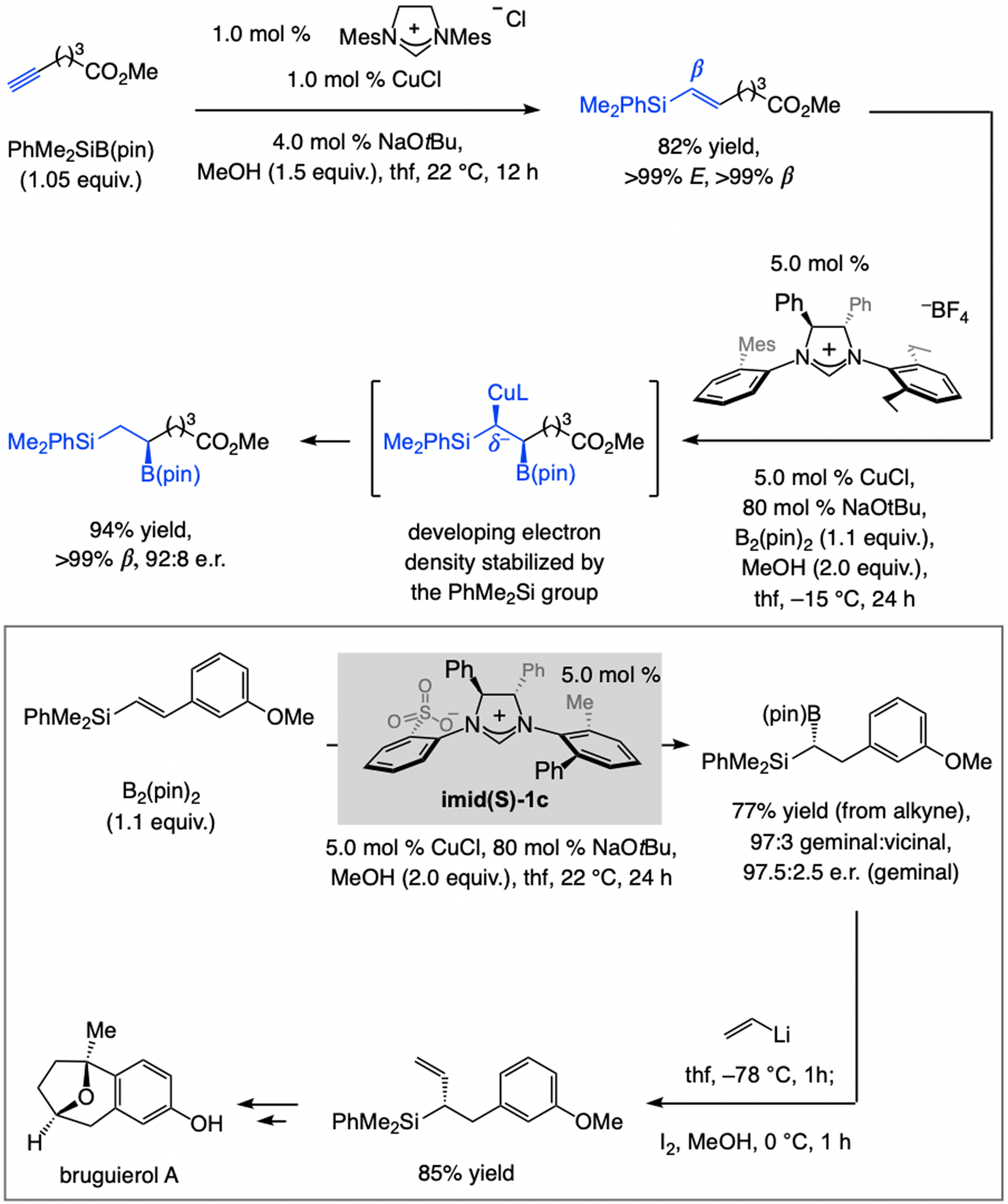
Catalytic regio- and enantioselective proto-boryl addition to an alkenylsilanes.
Scheme 71.
Scheme 71.
Catalytic enantioselective diboryl additions to alkenes, and boron–hydride and silyl–hydride additions to alkenyl boronates. dan = naphthalene-1,8-diaminato.
Scheme 72.
Scheme 72.
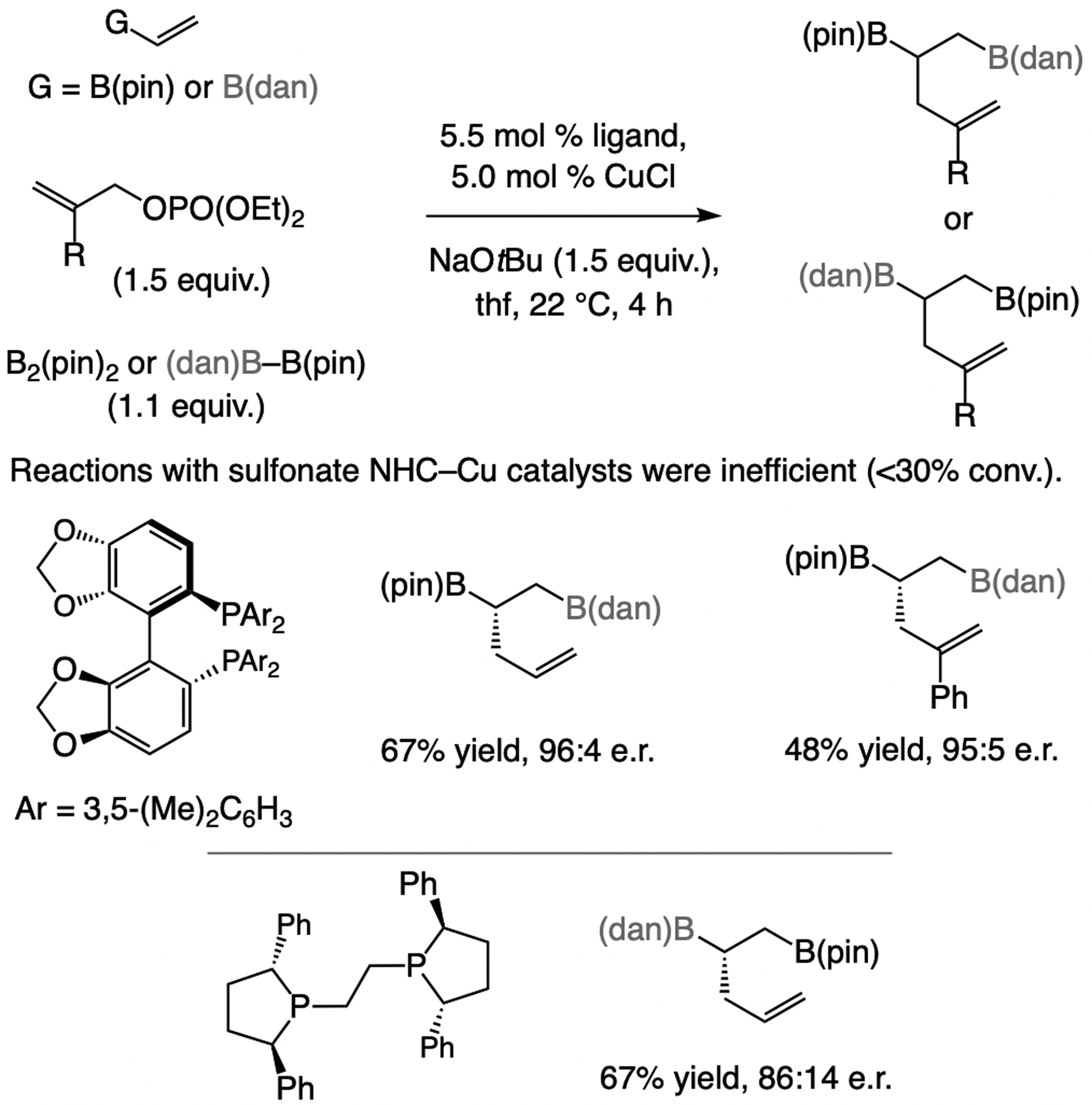
Cu–boryl addition to alkenyl boronates followed by allylic substitution. dan = naphthalene-1,8-diaminato.
Scheme 73.
Scheme 73.
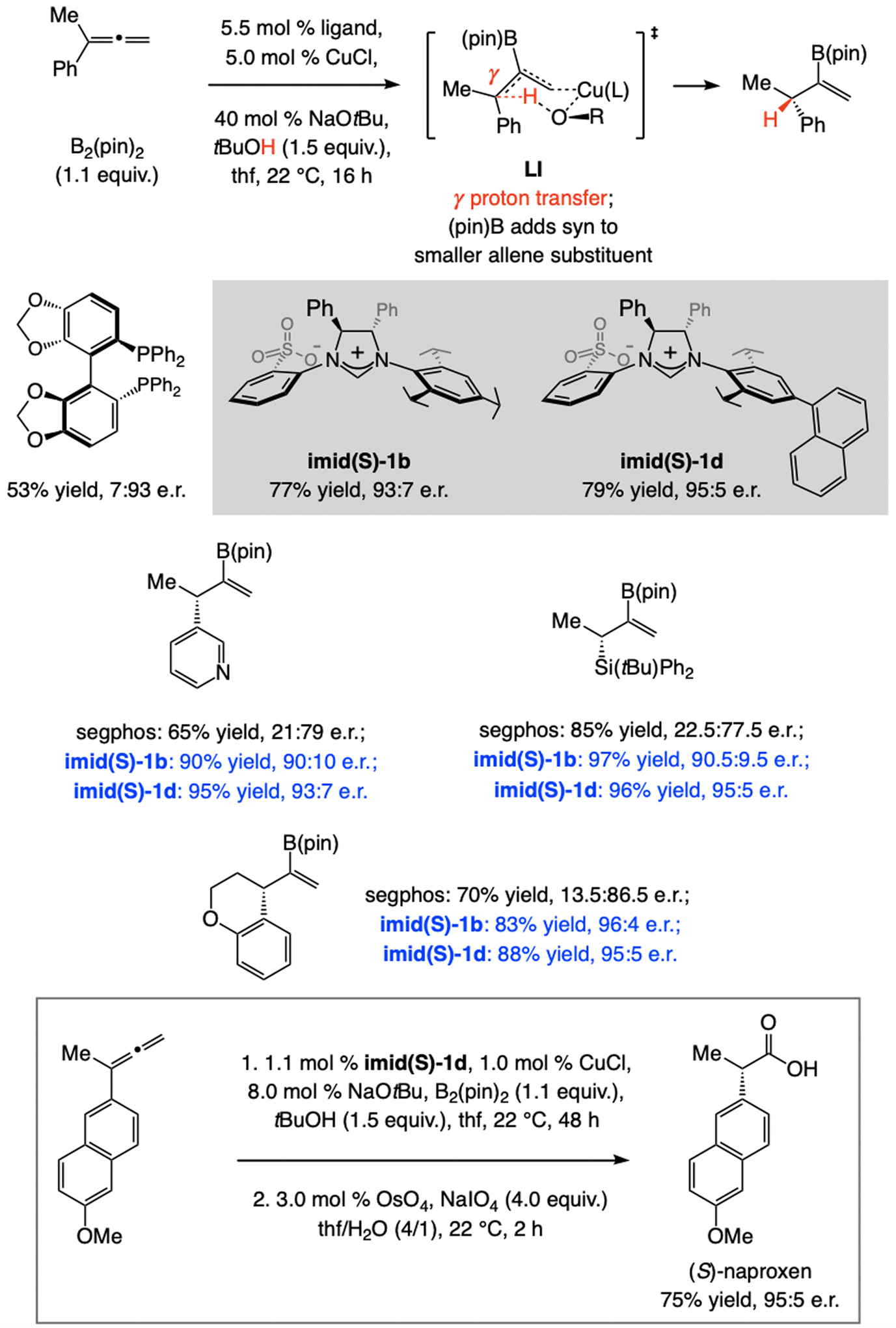
Regio- and enantioselective proto-boryl additions to 1,1-disubstituted allenes.
Scheme 74.
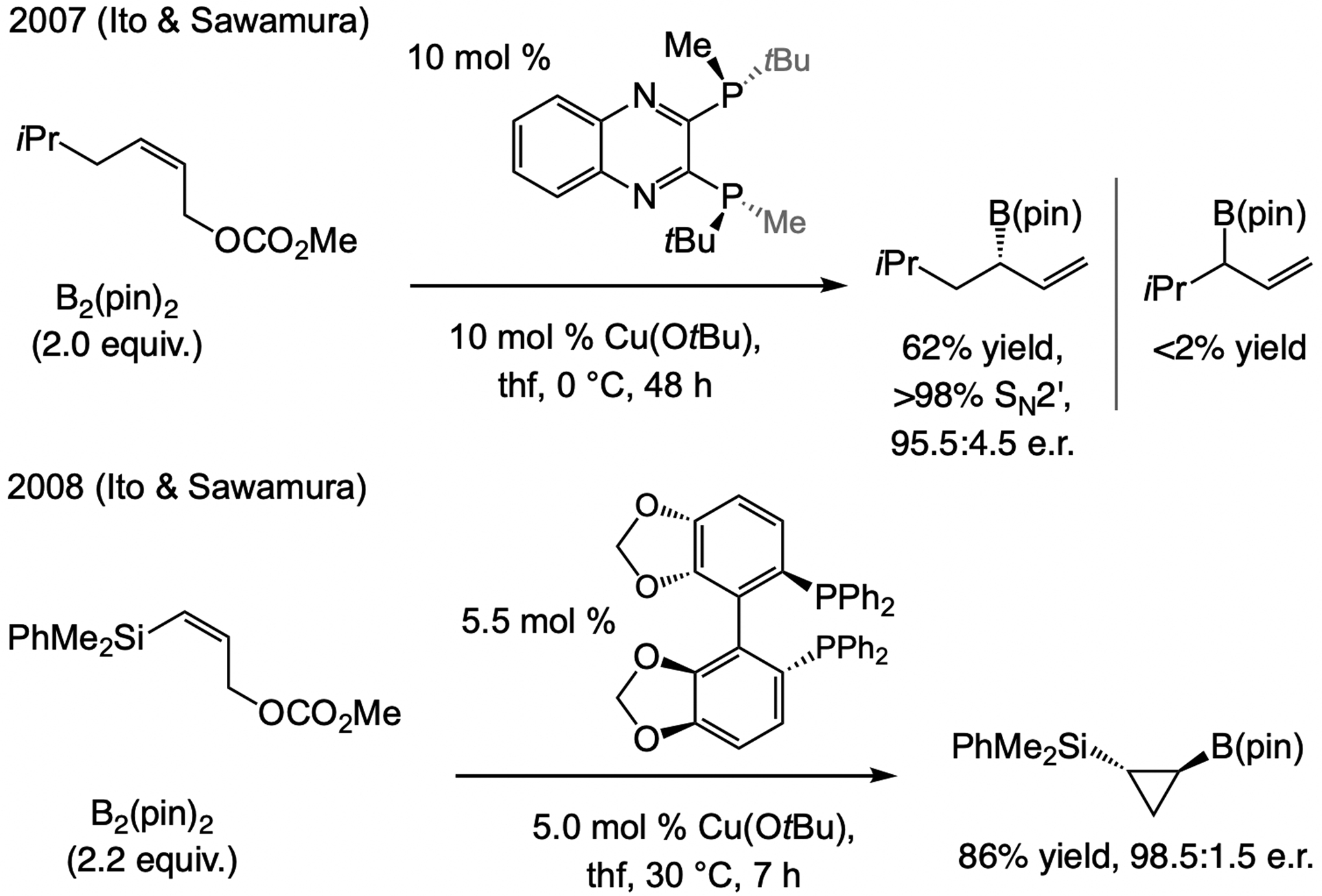
Scheme 74.
The first examples of catalytic enantioselective boryl substitution, and an approach leading to cyclopropyl products.
Scheme 75.
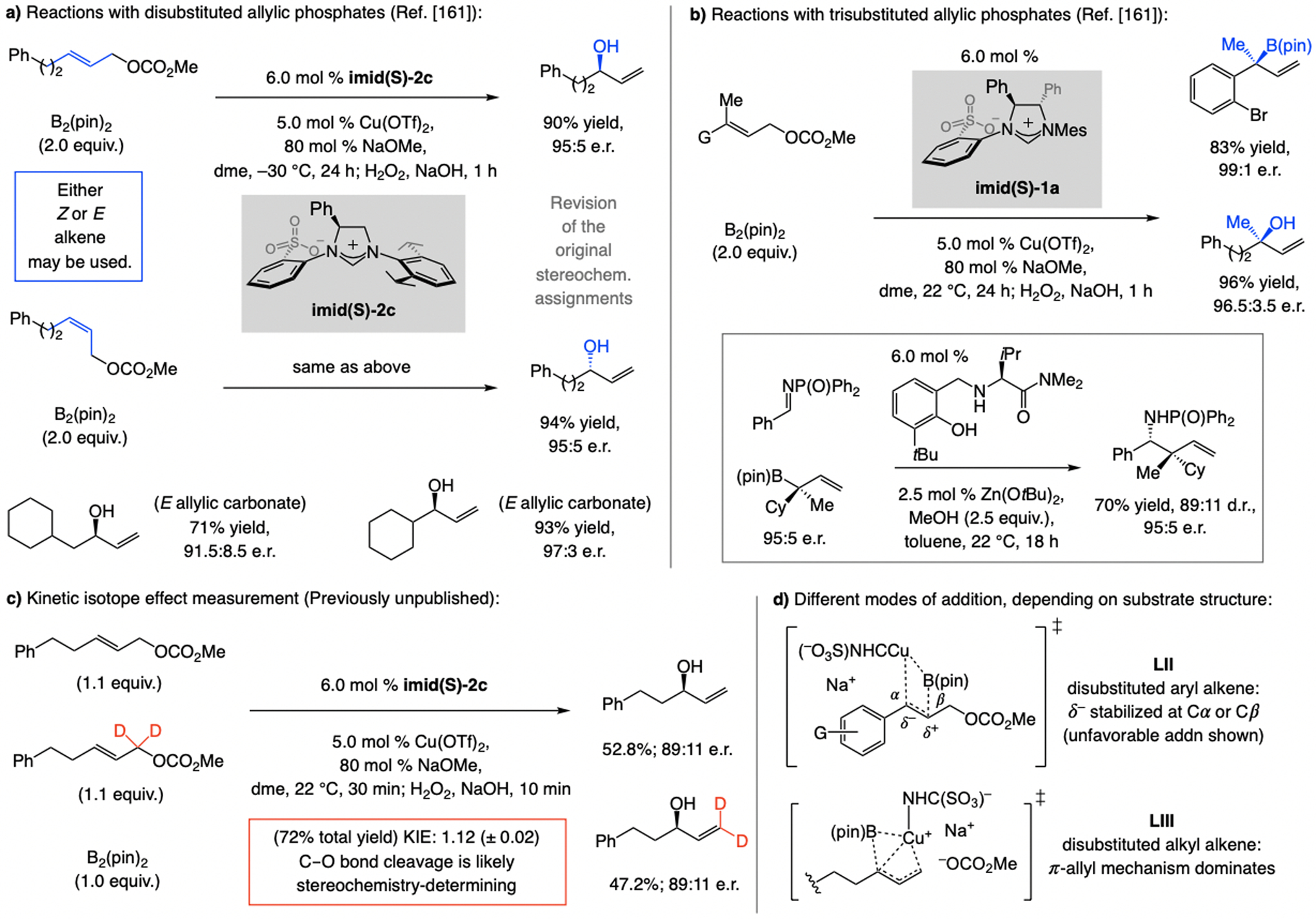
Scheme 75.
Sulfonate NHC–Cu-catalyzed boryl substitution with a di- or a trisubstituted alkene to generate allylic boronates in high e.r., and related KIE data regarding substitution (previously unpublished). Reactions performed under N2 atm.; conv. (±2%) determined by analysis of the 1H NMR spectra of the unpurified mixtures; yields (±5%) of purified products. See the Supporting Information for details.
Scheme 76.
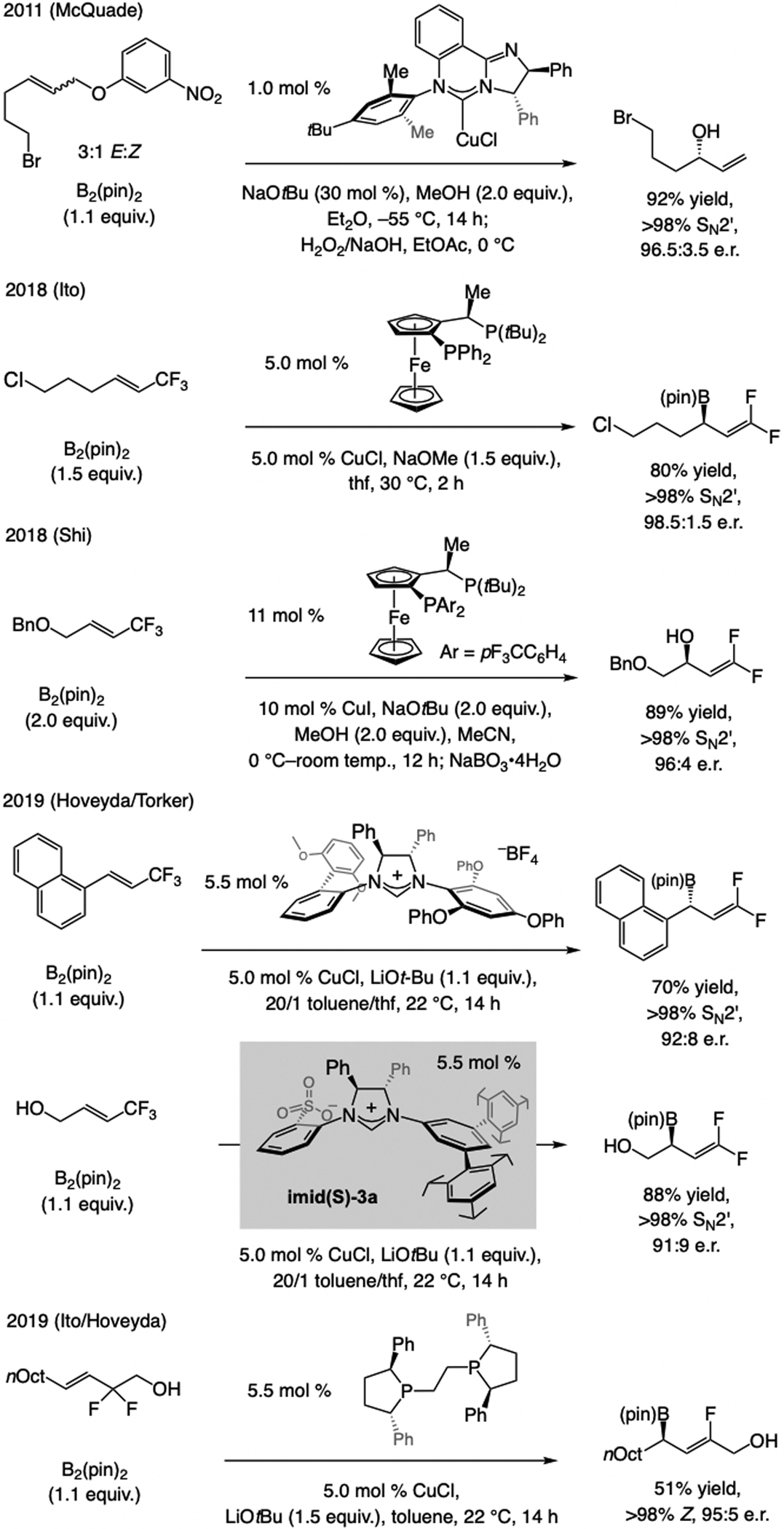
Scheme 76.
Advances in catalytic enantioselective boryl substitution include those that generate F-substituted alkenes.
Scheme 77.
Scheme 77.
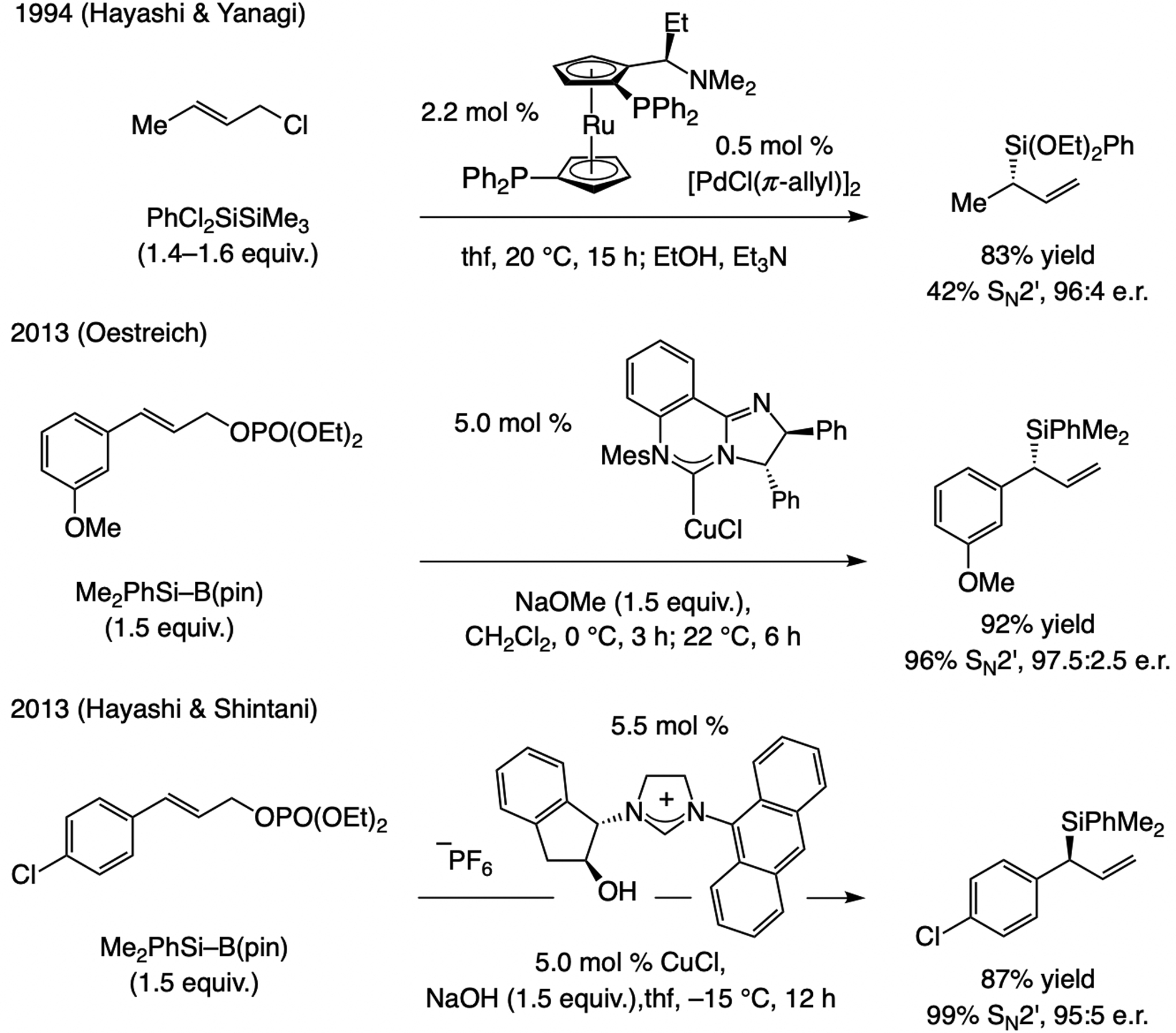
Enantioselective silyl substitution with Pd- and Cu-based catalysts.
Scheme 78.
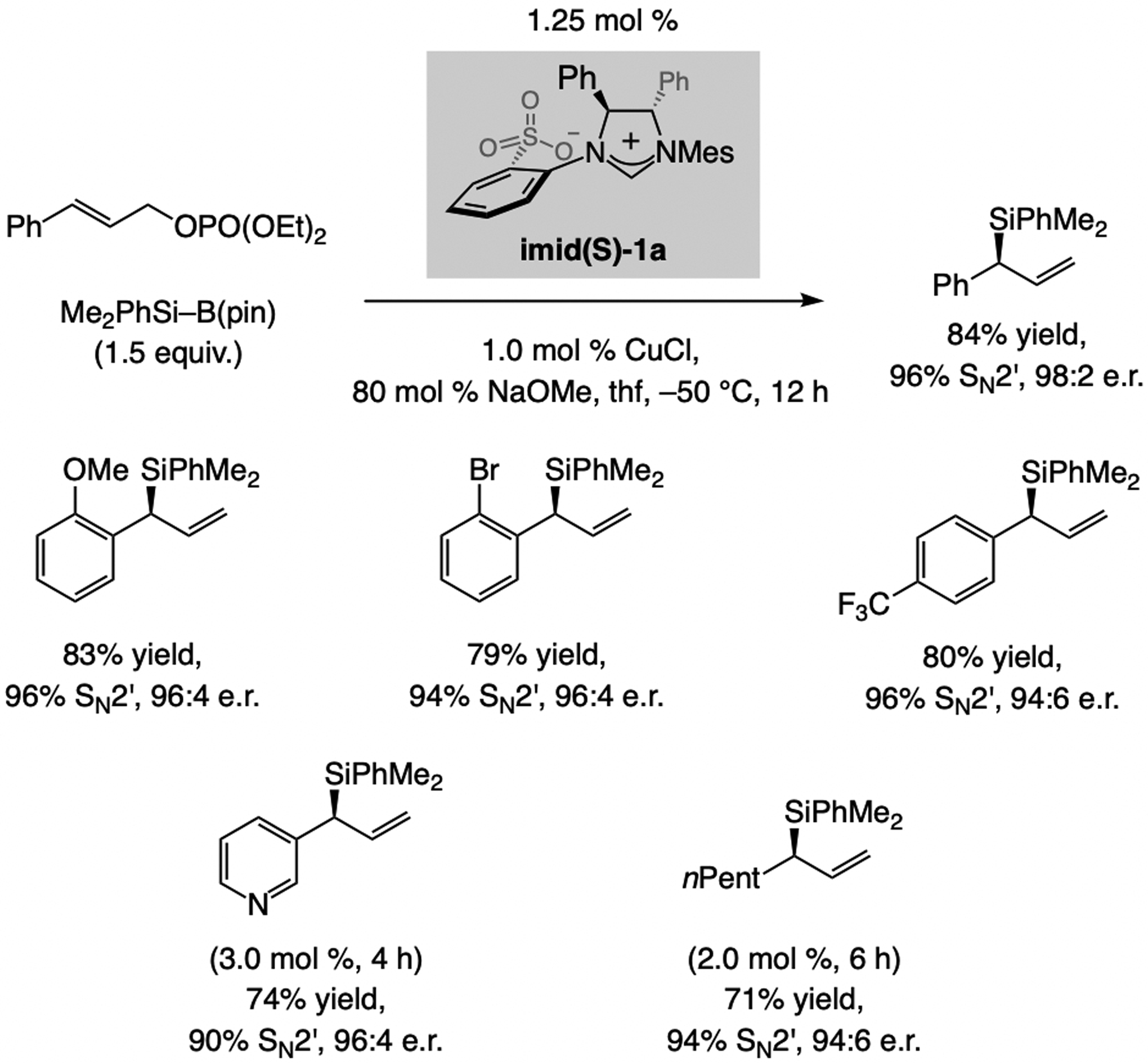
Scheme 78.
Enantioselective silyl substitution with a sulfonate NHC–Cu catalyst. Reactions performed under N2 atm.; conv. and SN2’ selectivity (±2%) determined by analysis of the 1H NMR spectra of the unpurified product mixtures; yields (±5%) of the purified products; enantioselectivity determined by HPLC analysis. Previously unpublished results; see the Supporting Information for details.
Scheme 79.
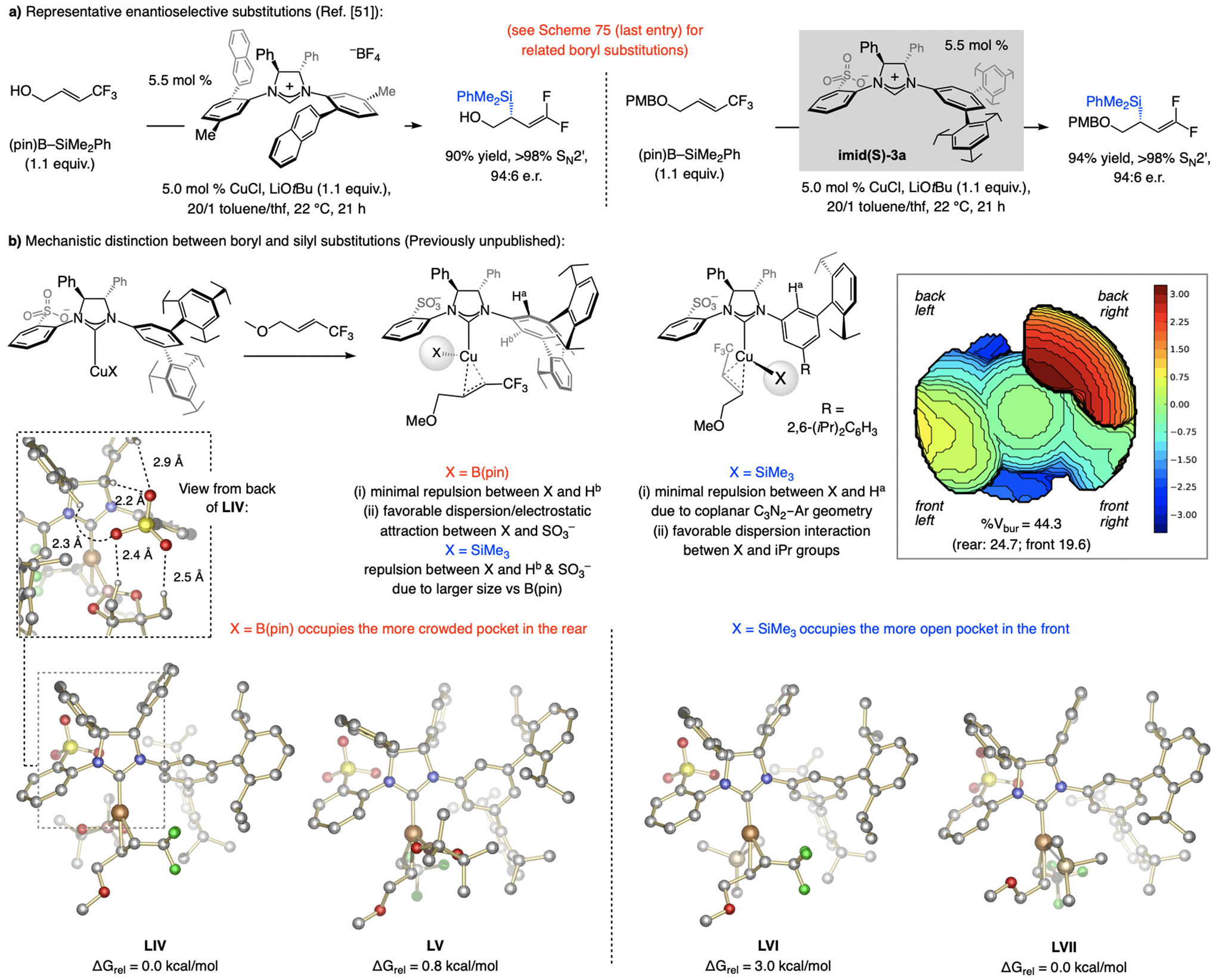
Scheme 79.
A sulfonate NHC–Cu complex can promote highly regio- and enantioselective silyl substitution to generates γ,γ-gem-difluoroallylsilanes, underscoring mechanistic differences with the related boryl substitutions. Previously unpublished analysis; see the Supporting Information for details of the DFT studies.
Scheme 80.
Scheme 80.
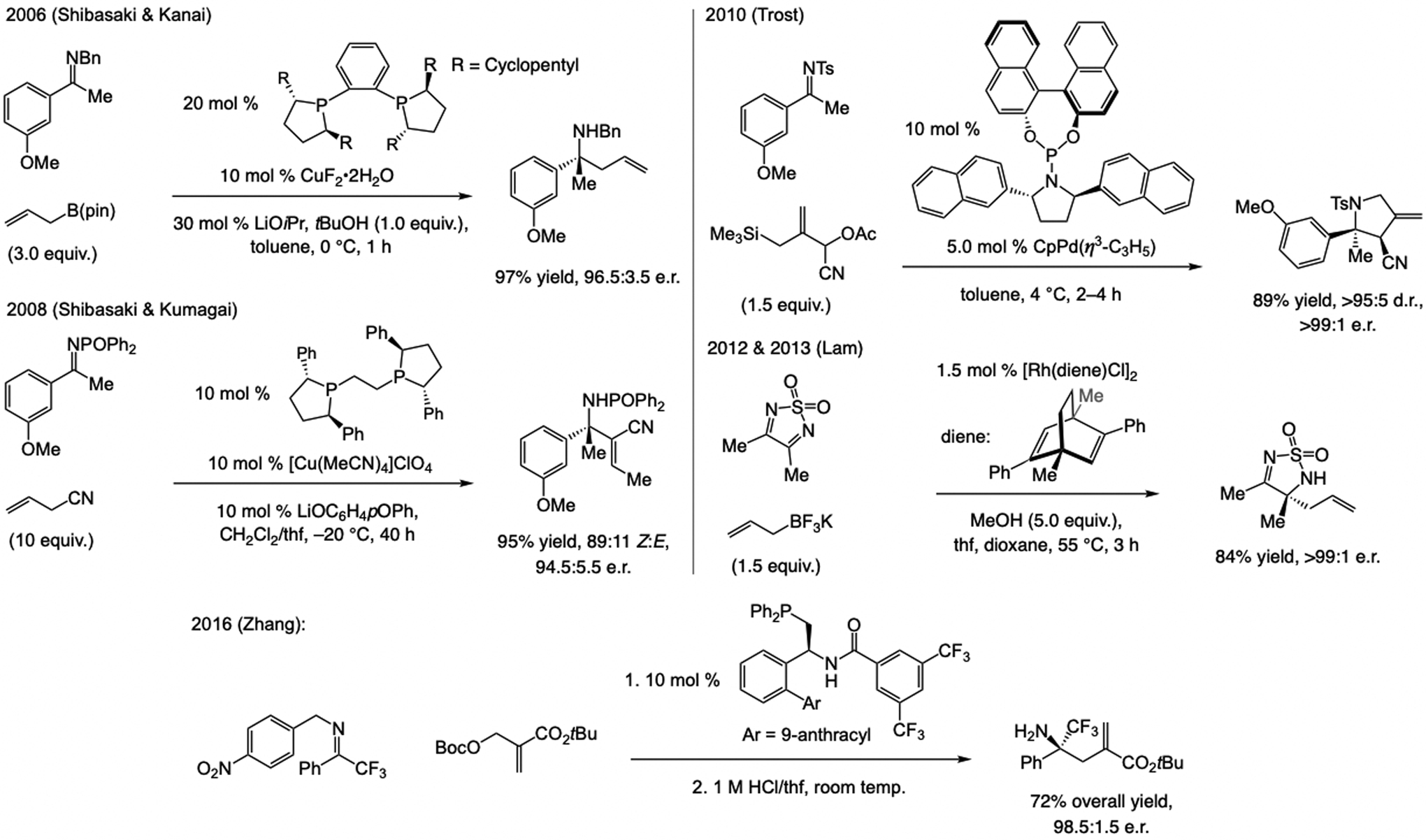
Catalytic enantioselective additions of allylic moieties to N-protected ketimines.
Scheme 81.
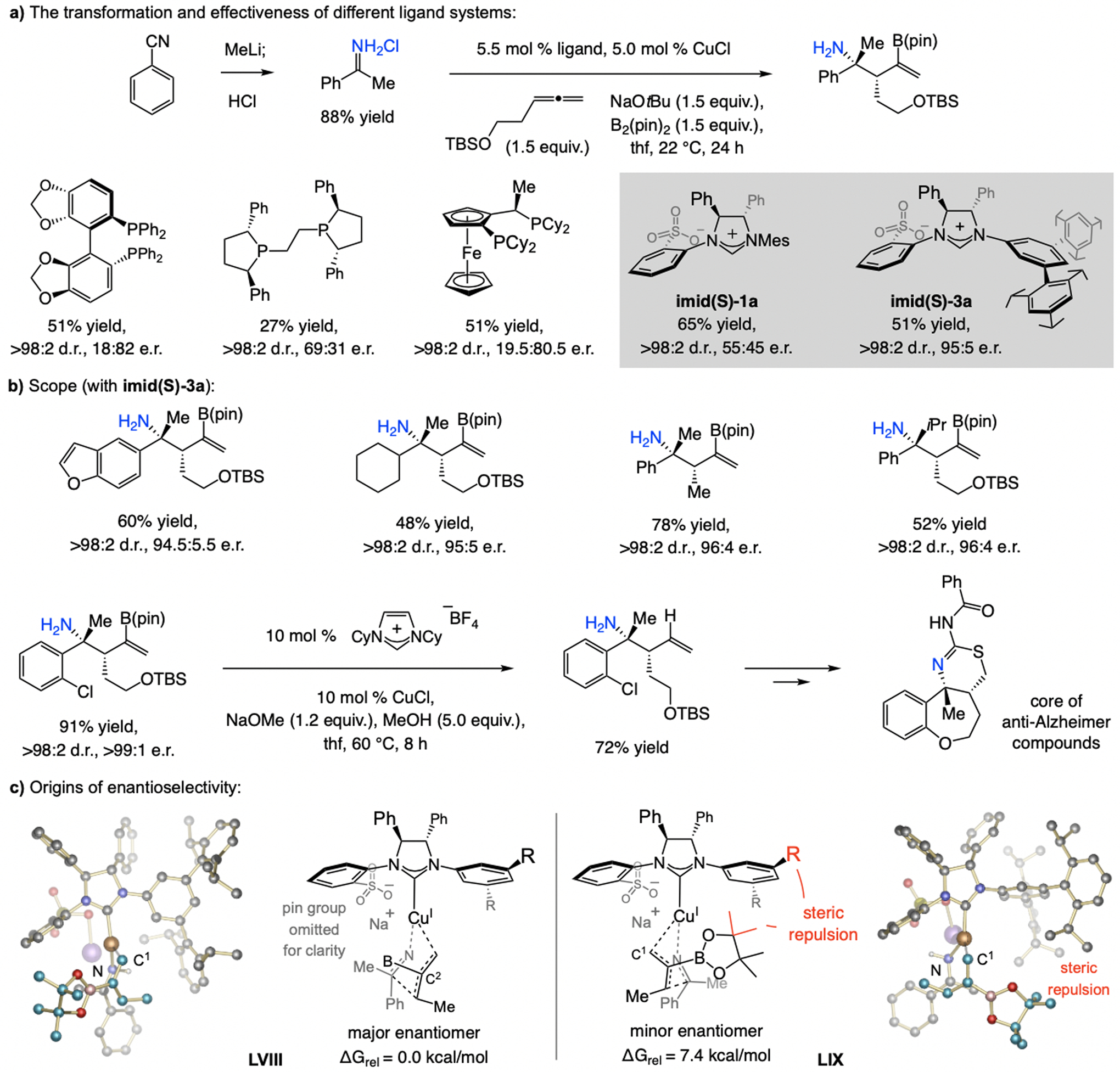
Scheme 81.
Catalytic diastereo- and enantioselective multicomponent additions of boryl-substituted allyl moieties to N-H ketimines.
Scheme 82.
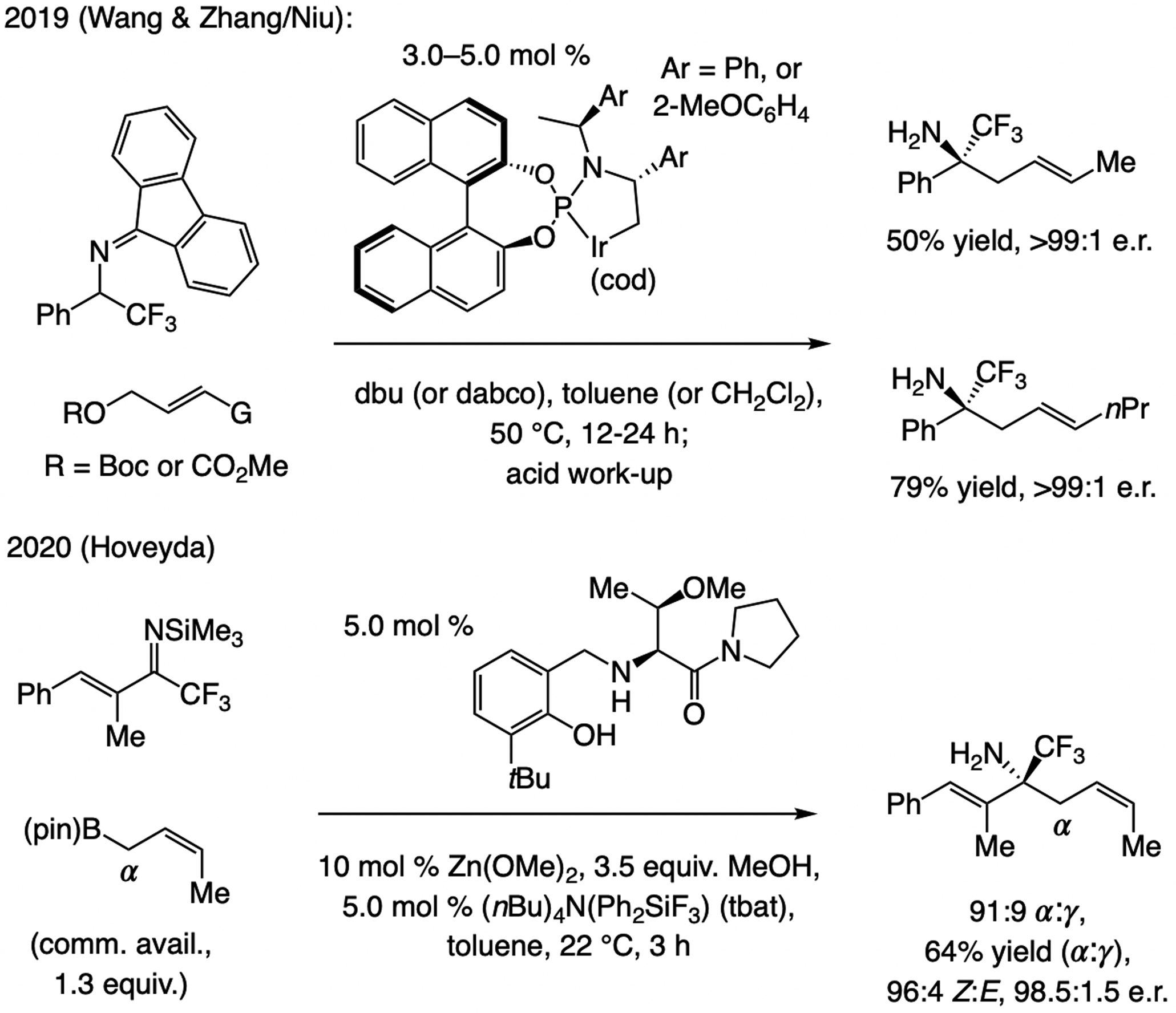
Scheme 82.
Catalytic diastereo- and enantioselective strategies for synthesis of trifluoromethyl-substituted α-tertiary NH2-amines.
Scheme 83.
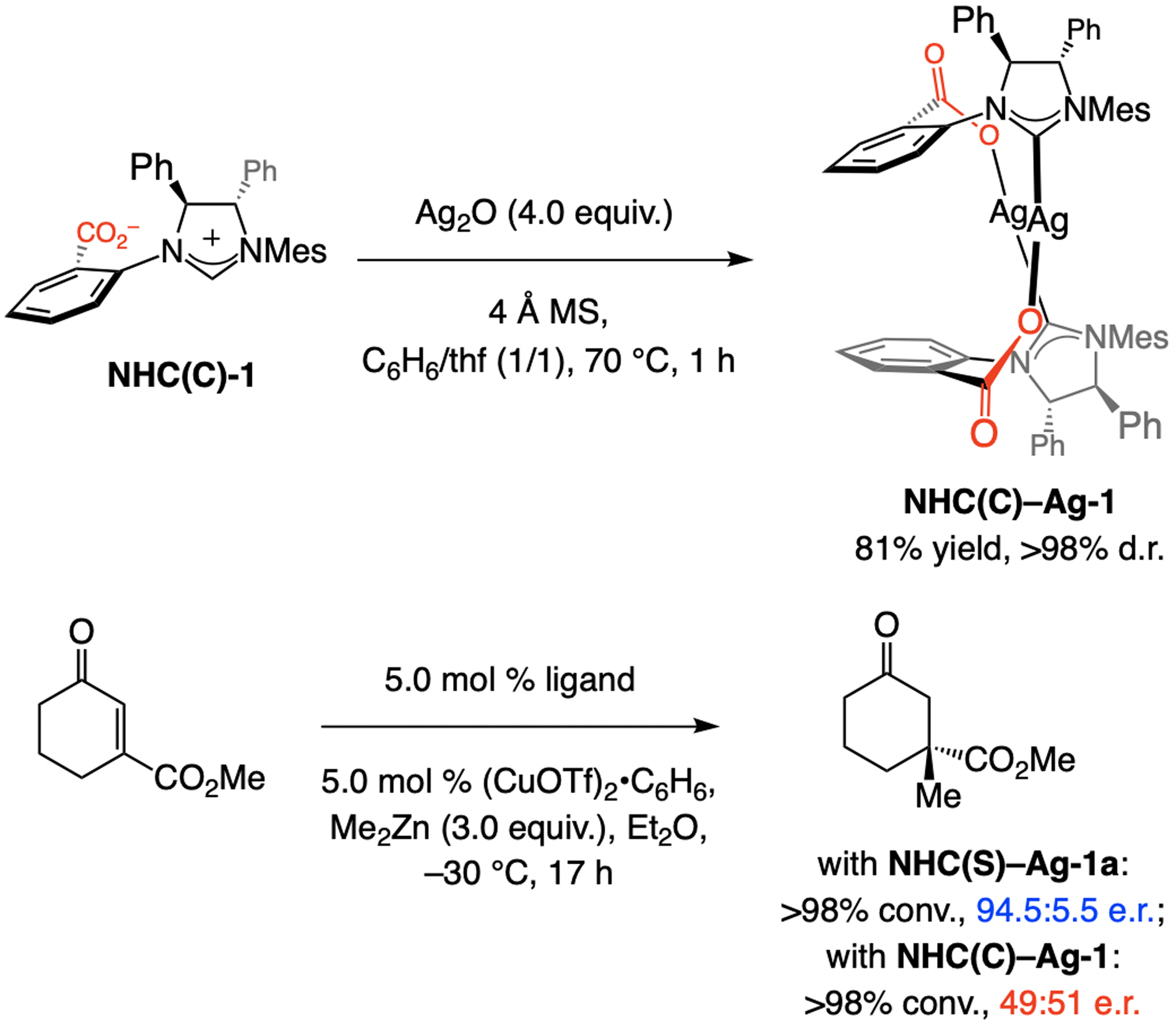
Scheme 83.
A carboxylate NHC–Cu complex is less effective (vs. sulfonate variants). See the Supporting Information for details.

References

    1. van Veldhuizen JJ, Garber SB, Kingsbury JS, Hoveyda AH, J. Am. Chem. Soc 2002, 124, 4954–4955; - PubMed
    2. van Veldhuizen JJ, Gillingham DG, Garber SB, Kataoka O, Hoveyda AH, J. Am. Chem. Soc 2003, 125, 12502–12508; - PubMed
    3. Gillingham DG, Kataoka O, Garber SB, Hoveyda AH, J. Am. Chem. Soc 2004, 126, 12288–12290. - PubMed
    1. Larsen AO, Leu W, Oberhuber C. Nieto, Campbell JE, Hoveyda AH, J. Am. Chem. Soc 2004, 126, 11130–11131; - PubMed
    2. Van Veldhuizen JJ, Campbell JE, Guidici RE, Hoveyda AH, J. Am. Chem. Soc 2005, 127, 6877–6882; - PubMed
    3. Lee Y, Hoveyda AH, J. Am. Chem. Soc 2006, 128, 15604–15605; - PubMed
    4. Kacprzynski MA, May TL, Kazane SA, Hoveyda AH, Angew. Chem. Int. Ed 2007, 46, 4554–4558. - PubMed
    1. Lee K.-s., Brown MK, Hird AW, Hoveyda AH, J. Am. Chem. Soc 2006, 128, 7182–7184. - PubMed
    1. Vedernikov AN, Fettinger JC, Mohr F, J. Am. Chem. Soc 2004, 126, 11160–11161. - PubMed
    2. For related review articles, see:

    3. Vedernikov AN, Chem. Commun 2009, 4781–4790; - PubMed
    4. Vedernikov AN, Acc. Chem. Res 2012, 45, 803–813. - PubMed
    1. Brown KM, May TL, Baxter CA, Hoveyda AH, Angew. Chem. Int. Ed 2007, 46, 1097–1100. - PubMed

Publication types

LinkOut - more resources