. 2020 Jul;201(1):76-84.
doi: 10.1111/cei.13450. Epub 2020 May 15.

Using IL-2R/lymphocytes for predicting the clinical progression of patients with COVID-19

Affiliations

Using IL-2R/lymphocytes for predicting the clinical progression of patients with COVID-19

H Hou et al. Clin Exp Immunol. 2020 Jul.

Abstract

Effective laboratory markers for the estimation of disease severity and predicting the clinical progression of coronavirus disease-2019 (COVID-19) is urgently needed. Laboratory tests, including blood routine, cytokine profiles and infection markers, were collected from 389 confirmed COVID-19 patients. The included patients were classified into mild (n = 168), severe (n = 169) and critical groups (n = 52). The leukocytes, neutrophils, infection biomarkers [such as C-reactive protein (CRP), procalcitonin (PCT) and ferritin] and the concentrations of cytokines [interleukin (IL)-2R, IL-6, IL-8, IL-10 and tumor necrosis factor (TNF)-α] were significantly increased, while lymphocytes were significantly decreased with increased severity of illness. The amount of IL-2R was positively correlated with the other cytokines and negatively correlated with lymphocyte number. The ratio of IL-2R to lymphocytes was found to be remarkably increased in severe and critical patients. IL-2R/lymphocytes were superior compared with other markers for the identification of COVID-19 with critical illness, not only from mild but also from severe illness. Moreover, the cytokine profiles and IL-2R/lymphocytes were significantly decreased in recovered patients, but further increased in disease-deteriorated patients, which might be correlated with the outcome of COVID-19. Lymphopenia and increased levels of cytokines were closely associated with disease severity. The IL-2R/lymphocyte was a prominent biomarker for early identification of severe COVID-19 and predicting the clinical progression of the disease.

Keywords: COVID-19; IL-2R/lymphocyte ratio; SARS-CoV-2; clinical progression; cytokine.


Conflict of interest statement

We declare no competing interests.

Figures
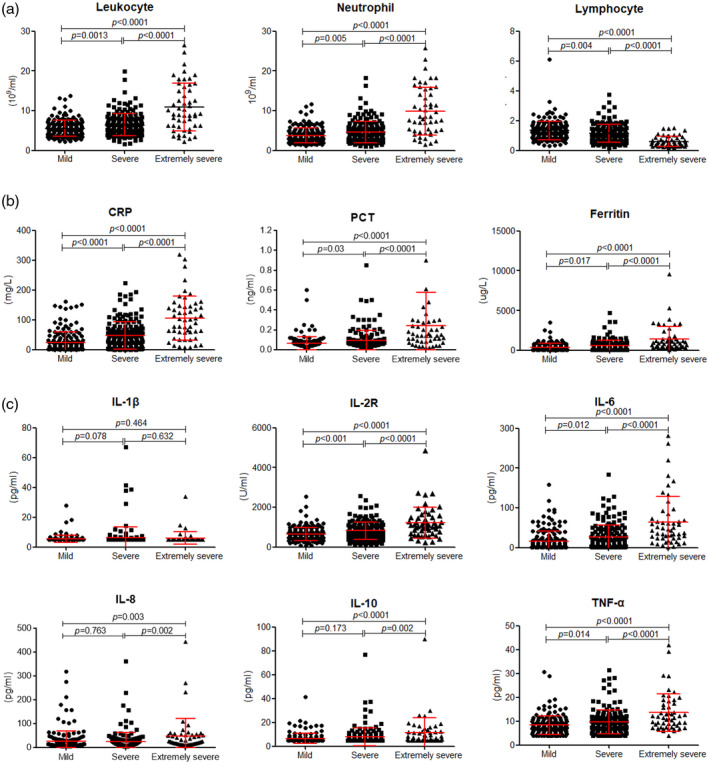
Fig. 1
Fig. 1
Blood cell counts, infectious biomarkers and cytokine profiles in coronavirus disease‐2019 (COVID‐19) patients. (a) The absolute counts of leukocytes, neutrophils and lymphocytes in patients with mild, severe and critical illness. (b) The levels of C‐reactive protein (CRP), procalcitonin (PCT) and ferritin in different groups. (c) The levels of interleukin (IL)‐1β, IL‐2R, IL‐6, IL‐8, IL‐10 and tumor necrosis factor (TNF)‐α in patients with mild, severe and critical illness. The normal reference ranges of IL‐1β, IL‐6, IL‐8, IL‐10 and TNF‐α were 5, 1·5, 5, 5 and 4 pg/ml, respectively. If the concentrations of the corresponding cytokines were lower than the normal range, we recorded the minimum values. Differences of markers among the three groups were compared by analysis of variance (ANOVA). Results of the test were significant with P < 0·05.
Fig. 2
Fig. 2
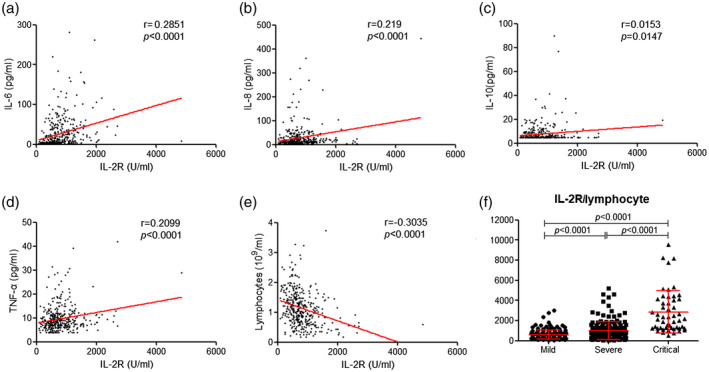
The relationship between the amounts of interleukin (IL)‐2R and other cytokines or lymphocytes. Correlation between the levels of IL‐2R and IL‐6 (a), IL‐8 (b), IL‐10 (c) and tumor necrosis factor (TNF)‐α (d). (e) Correlation between lymphocytes and IL‐2R level. (f) The value of IL‐2R/lymphocytes in mild, severe and critical patients. Spearman’s rank correlation test for non‐parametric data was employed to analyze the relationship between two factors. The differences of IL‐2R/lymphocytes among the three groups were compared by analysis of variance (ANOVA). Results of the test were significant with P < 0·05.
Fig. 3
Fig. 3
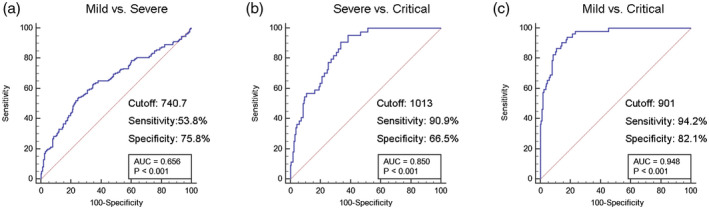
Receiver operating characteristic (ROC) analysis showing the performance of the interleukin (IL)‐2R/lymphocyte among coronavirus disease‐2019 (COVID‐19) patients with different severity of illness.
Fig. 4
Fig. 4
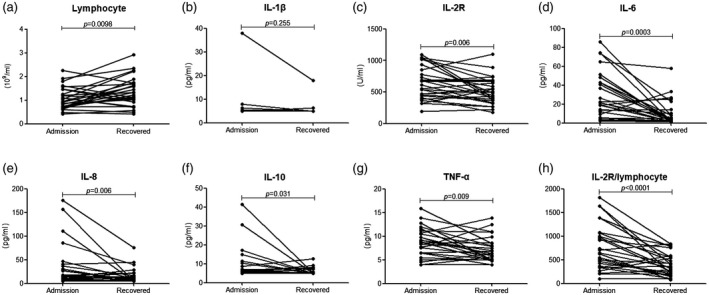
The change of various markers in recovered coronavirus disease‐2019 (COVID‐19) patients. The lymphocytes (a), [interleukin (IL)‐1β (b), IL‐2R (c), IL‐6 (d), IL‐8 (e), IL‐10 (f), tumor necrosis factor (TNF)‐α (g) and IL‐2R/lymphocytes (h)] were compared between the time of admission and hospital discharge. Differences of markers between different time‐points of the same patients were analyzed using the paired Student’s t‐test. Results of the test were significant with P < 0·05.
Fig. 5
Fig. 5
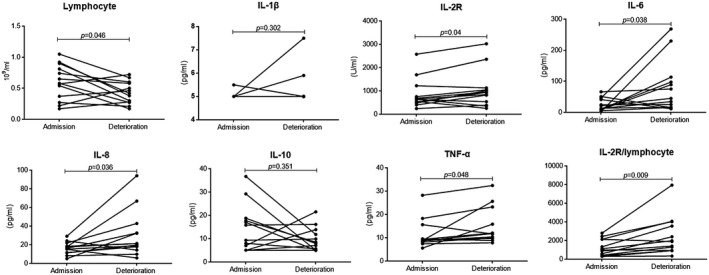
The change of various markers in deteriorated coronavirus disease‐2019 (COVID‐19) patients. The lymphocytes (a), interleukin (IL)‐1β (b), IL‐2R (c), IL‐6 (d), IL‐8 (e), IL‐10 (f), tumor necrosis factor (TNF)‐α and IL‐2R/lymphocytes (h) were compared between the time of admission and deterioration. Differences of markers between different time‐points of the same patients were analyzed using the paired Student’s t‐test. Results of the test were significant with P < 0·05.

References

    1. Zhu N, Zhang D, Wang W et al, China Novel Coronavirus I, Research Team . A novel coronavirus from patients with pneumonia in China, 2019. N Engl J Med 2020; 382:727–33. - PMC - PubMed
    1. Bassetti M, Vena A, Giacobbe DR. The novel Chinese coronavirus (2019‐nCoV) infections: challenges for fighting the storm. Eur J Clin Invest 2020; 50:e13209. - PMC - PubMed
    1. Rothe C, Schunk M, Sothmann P et al Transmission of 2019‐nCoV infection from an asymptomatic contact in Germany. N Engl J Med 2020; 382:970–1. - PMC - PubMed
    1. The L. Emerging understandings of 2019‐nCoV. Lancet 2020; 395:311. - PMC - PubMed
    1. Wu Z, McGoogan JM. Characteristics of and Important lessons from the coronavirus disease 2019 (COVID‐19) outbreak in China: summary of a report of 72314 cases from the Chinese Center for Disease Control and Prevention. JAMA 2020; 323:1239–42. - PubMed

Publication types

MeSH terms