


Type 3 Diabetes and Its Role Implications in Alzheimer's Disease
- PMID: 32365816
- PMCID: PMC7246646
- DOI: 10.3390/ijms21093165
Type 3 Diabetes and Its Role Implications in Alzheimer's Disease
Abstract
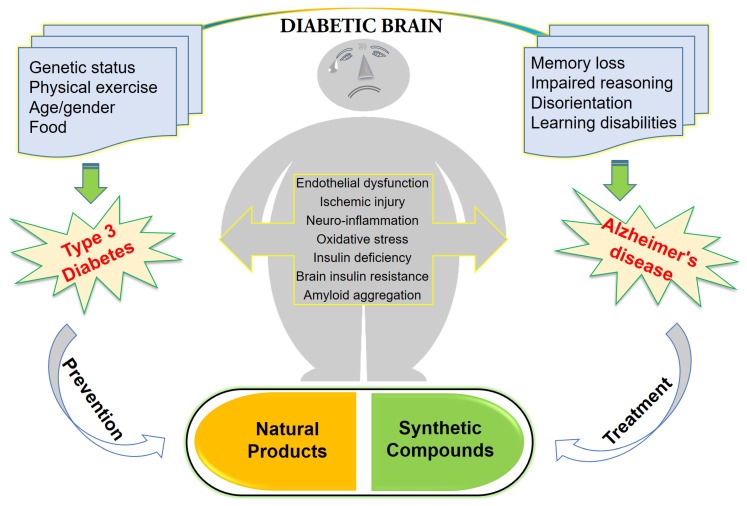
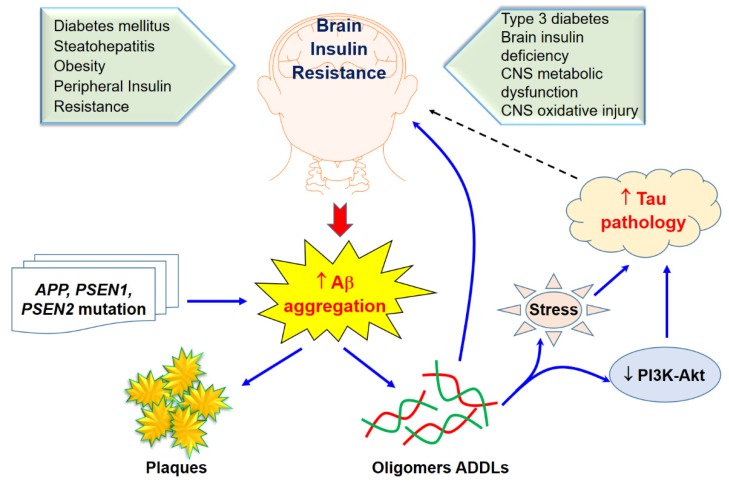
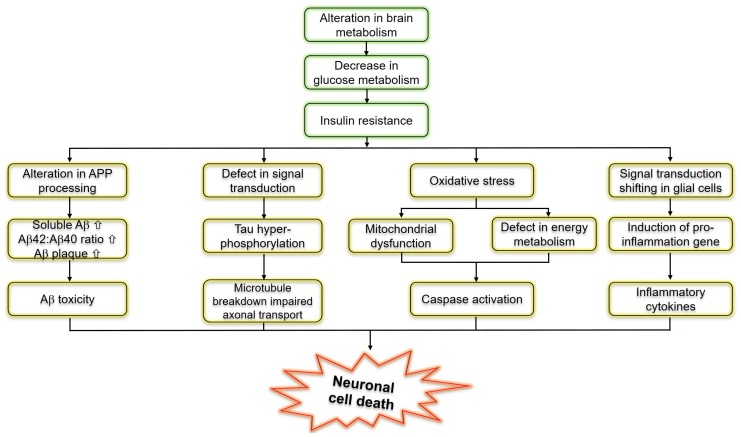
The exact connection between Alzheimer's disease (AD) and type 2 diabetes is still in debate. However, poorly controlled blood sugar may increase the risk of developing Alzheimer's. This relationship is so strong that some have called Alzheimer's "diabetes of the brain" or "type 3 diabetes (T3D)". Given more recent studies continue to indicate evidence linking T3D with AD, this review aims to demonstrate the relationship between T3D and AD based on the fact that both the processing of amyloid-β (Aβ) precursor protein toxicity and the clearance of Aβ are attributed to impaired insulin signaling, and that insulin resistance mediates the dysregulation of bioenergetics and progress to AD. Furthermore, insulin-related therapeutic strategies are suggested to succeed in the development of therapies for AD by slowing down their progressive nature or even halting their future complications.
Keywords: Alzheimer’s disease; hypometabolism; insulin resistance; type 2 diabetes; type 3 diabetes.
Conflict of interest statement
The authors declare no conflict of interest.
Figures
References
-
- Saeedi P., Petersohn I., Salpea P., Malanda B., Karuranga S., Unwin N., Colagiuri S., Guariguata L., Motala A.A., Ogurtsova K., et al. Global and regional diabetes prevalence estimates for 2019 and projections for 2030 and 2045: Results from the International Diabetes Federation Diabetes Atlas, 9th edition. Diabetes Res. Clin. Pract. 2019;157:107843. doi: 10.1016/j.diabres.2019.107843. - DOI - PubMed
Publication types
MeSH terms
Substances
LinkOut - more resources
Full Text Sources
Medical
