Review
. 2020 Apr 30;21(9):3167.
doi: 10.3390/ijms21093167.

Ischemic Heart Disease and Heart Failure: Role of Coronary Ion Channels

Affiliations
Review

Ischemic Heart Disease and Heart Failure: Role of Coronary Ion Channels

Paolo Severino et al. Int J Mol Sci. .

Abstract

Heart failure is a complex syndrome responsible for high rates of death and hospitalization. Ischemic heart disease is one of the most frequent causes of heart failure and it is normally attributed to coronary artery disease, defined by the presence of one or more obstructive plaques, which determine a reduced coronary blood flow, causing myocardial ischemia and consequent heart failure. However, coronary obstruction is only an element of a complex pathophysiological process that leads to myocardial ischemia. In the literature, attention paid to the role of microcirculation, in the pathophysiology of ischemic heart disease and heart failure, is growing. Coronary microvascular dysfunction determines an inability of coronary circulation to satisfy myocardial metabolic demands, due to the imbalance of coronary blood flow regulatory mechanisms, including ion channels, leading to the development of hypoxia, fibrosis and tissue death, which may determine a loss of myocardial function, even beyond the presence of atherosclerotic epicardial plaques. For this reason, ion channels may represent the link among coronary microvascular dysfunction, ischemic heart disease and consequent heart failure.

Keywords: coronary artery disease; coronary microvascular dysfunction; heart failure; ion channel; ischemic heart disease; microcirculation.


Conflict of interest statement

The authors declare no conflict of interest.

Figures
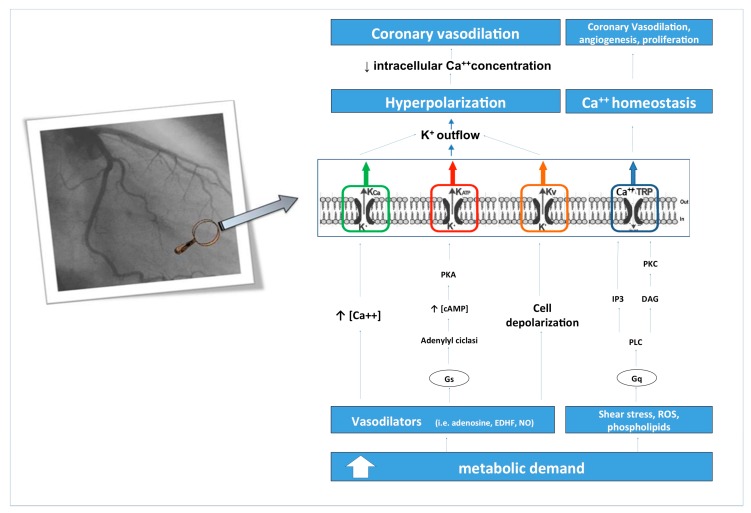
Figure 1
Figure 1
Represents the role of coronary ion channels matching coronary flow to metabolic demands, in coronary microcirculation. An increasing myocardial metabolic request requires an increase in coronary flow, through the action of various regulators in coronary microcirculation. As the metabolic demand increases, the coronary ion channels determine the hyperpolarization of the membrane and the closure of voltage-dependent Ca++ channels. As a consequence, the concentration of intracellular Ca++ decreases, and this leads to a decreasing tone of the coronary smooth muscle cell, resulting in the vasodilatory response. Abnormality function or expression of these ion channels, disturbing the communication between metabolism and coronary microcirculation, can lead to heart disease, ischemia and heart failure. KCa: potassium Ca++-activated channel; KATP: ATP-sensitive potassium channels; Kv: voltage-gated potassium channels; TRP: transient receptor potential; cAMP: cyclic adenosine monophosphate; PKA: protein kinase A; EDHF: endothelial derived hyperpolarizing factor; NO: nitric oxide; ROS: reactive oxygen species; PLC: phospholipase C; IP3: inositol trisphosphate; DAG: diacylglycerol; PKC: protein kinase C.

References

    1. Chaudhry M.A. Heart Failure. Curr. Hypertens Rev. 2019;15:7. doi: 10.2174/157340211501190129144451. - DOI - PubMed
    1. Gould K.L., Lipscomb K. Effects of coronary stenoses on coronary flow reserve and resistance. Am. J. Cardiol. 1974;34:48–55. doi: 10.1016/0002-9149(74)90092-7. - DOI - PubMed
    1. Severino P., D’Amato A., Netti L., Pucci M., De Marchis M., Palmirotta R., Volterrani M., Mancone M., Fedele F. Diabetes Mellitus and Ischemic Heart Disease: The Role of Ion Channels. Int. J. Mol. Sci. 2018;19:802. doi: 10.3390/ijms19030802. - DOI - PMC - PubMed
    1. Fedele F., Severino P., Bruno N., Stio R., Caira C., D’Ambrosi A., Brasolin B., Ohanyan V., Mancone M. Role of ion channels in coronary microcirculation: A review of the literature. Future Cardiol. 2013;9:897–905. doi: 10.2217/fca.13.65. - DOI - PubMed
    1. Ferrari R., Fox K. Heart rate reduction in coronary artery disease and heart failure. Nat. Rev. Cardiol. 2016;13:493–501. doi: 10.1038/nrcardio.2016.84. - DOI - PubMed
