A major genetic determinant of autoimmune diseases is associated with the presence of autoantibodies in hypersensitivity pneumonitis
- PMID: 32366487
- PMCID: PMC7424117
- DOI: 10.1183/13993003.01380-2019
A major genetic determinant of autoimmune diseases is associated with the presence of autoantibodies in hypersensitivity pneumonitis
Abstract
Background: Hypersensitivity pneumonitis is an immune-mediated disease triggered by exposure to organic particles in susceptible individuals. It has been reported that a subgroup of patients with hypersensitivity pneumonitis develops autoantibodies with or without clinical manifestations of autoimmune disease. However, the mechanisms involved in this process and the effect of the autoantibodies on clinical course in hypersensitivity pneumonitis is unknown. We evaluated the association between human leukocyte antigen (HLA) class II alleles and hypersensitivity pneumonitis patients with and without autoantibodies.
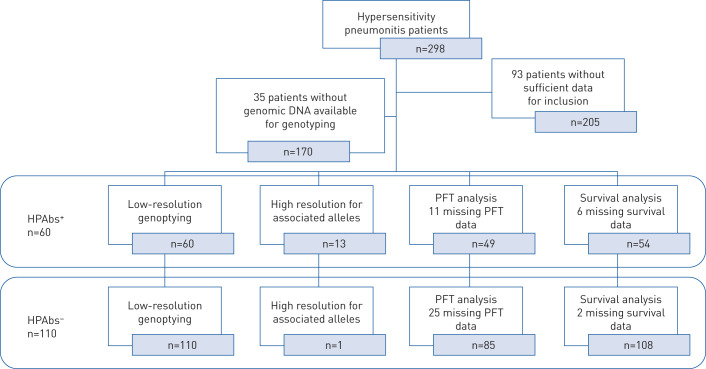
Methods: 170 hypersensitivity pneumonitis patients were included. We analysed the presence of antinuclear antibodies, rheumatoid factor, anti-SSA/Ro, anti-SSB/La and anti-CCP at the time of diagnosis. In addition, in a subset of patients we evaluated anti-Scl-70, anti-neutrophil cytoplasmic antibody, and anti-DNA. HLA typing was performed using PCR sequence-specific primers in a high-resolution modality, including HLA-DRB1 and HLA-DQB1 loci. Statistical analysis was performed employing Epi-Info v7 and SPSS v20.
Results: 60 hypersensitivity pneumonitis patients showed sera autoantibodies (HPAbs+), and 110 hypersensitivity pneumonitis patients did not (HPAbs-). The frequency of the allele HLA-DRB1*03:01 was remarkably increased in the HPAbs+ group (10.8% versus 0.45%; OR 30.14, 95% CI 3.83-237.1; p=1.65×10⁻⁴ after Bonferroni's correction). Likewise, we found that the haplotype DRB1*03:01-DQB1*02:01, which is part of the 8.1 ancestral haplotype, a major genetic determinant of autoimmune diseases, confers significant risk to develop autoantibodies (OR 19.23, 95% CI 2.37-155.9; p=0.0088 after Bonferroni's correction). In addition, the HLA-DRB1*03:01 allele was associated with higher mortality in patients with hypersensitivity pneumonitis (adjusted OR 5.9, 95% CI 1.05-33.05; p=0.043).
Conclusions: A subset of hypersensitivity pneumonitis patients presents circulating autoantibodies and higher mortality that are associated with some alleles of 8.1 ancestral haplotype.
Copyright ©ERS 2020.
Conflict of interest statement
Conflict of interest: I. Buendía-Roldán has nothing to disclose. Conflict of interest: L. Santiago-Ruiz has nothing to disclose. Conflict of interest: G. Pérez-Rubio has nothing to disclose. Conflict of interest: M. Mejía has nothing to disclose. Conflict of interest: J. Rojas-Serrano has nothing to disclose. Conflict of interest: E. Ambrocio-Ortiz has nothing to disclose. Conflict of interest: G. Benítez-Valdez has nothing to disclose. Conflict of interest: M. Selman has nothing to disclose. Conflict of interest: R. Falfán-Valencia has nothing to disclose.
Figures
References
-
- Spagnolo P, Rossi G, Cavazza A, et al. Hypersensitivity pneumonitis: a comprehensive review. J Investig Allergol Clin Immunol 2015; 25: 237–250. - PubMed
MeSH terms
Substances
LinkOut - more resources
Full Text Sources
Other Literature Sources
Medical
Research Materials
Miscellaneous