. 2020 Nov;13(6):908-918.
doi: 10.1038/s41385-020-0290-x. Epub 2020 May 4.

Single cell and tissue-transcriptomic analysis of murine bladders reveals age- and TNFα-dependent but microbiota-independent tertiary lymphoid tissue formation

Affiliations

Single cell and tissue-transcriptomic analysis of murine bladders reveals age- and TNFα-dependent but microbiota-independent tertiary lymphoid tissue formation

Marianne M Ligon et al. Mucosal Immunol. 2020 Nov.

Abstract

Aging has multifaceted effects on the immune system, but how aging affects tissue-specific immunity is not well-defined. Bladder diseases characterized by chronic inflammation are highly prevalent in older women, but mechanisms by which aging promotes these pathologies remain unknown. Tissue transcriptomics of unperturbed, young and aged bladders identified a highly altered immune landscape as a fundamental feature of the aging female bladder. Detailed mapping of immune cells using single cell RNA-sequencing revealed novel subsets of macrophages and dendritic cells and unique changes to the immune repertoire in the aged bladder. B and T cells are highly enriched in aged bladders and spontaneously form organized bladder tertiary lymphoid tissues (bTLTs). Naïve, activated, and germinal center B cells and IgA+ plasma cells are found within bTLT and associated with increased urinary IgA concentrations. bTLTs form with increasing age and their formation is dependent on TNFα. Microbiota are not required to form bTLT, as aged germfree mice also harbor them. Thus, bTLTs require age-dependent TNFα but are independent of the microbiota. Our results indicate that chronic, age-associated inflammation underlies a fundamental alteration to the bladder and establishes a resource for further investigation of the bladder immune system in homeostasis, aging, and disease.


Conflict of interest statement

Competing Interests

The authors have no financial interests to disclose.

Figures
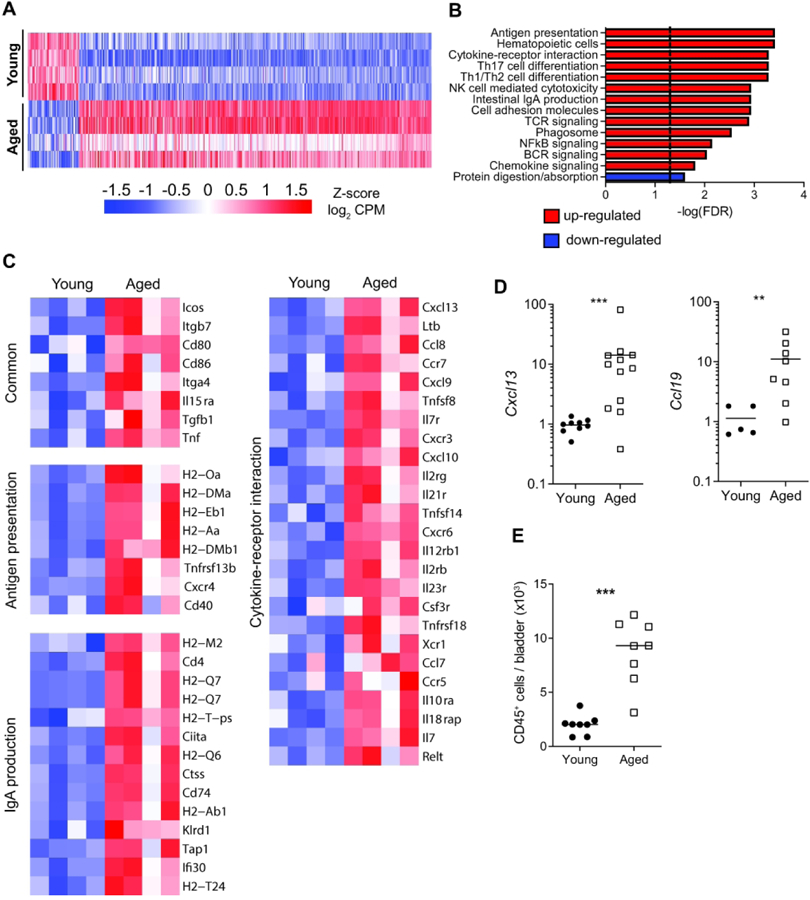
Figure 1.
Figure 1.. Tissue transcriptomic map of young and aged bladders.
(A) Heatmap of the global tissue transcriptome of young and aged bladders with fold change >2 and Benjamini-Hochberg FDR-adjusted P<0.05. n= 4 bladders/group. (B) Significantly enriched KEGG pathways based on fold change of all genes. (C) Heatmaps of significantly different genes from select significant KEGG pathways. (D) Gene expression validation by qRT-PCR in whole bladders (n=5–11/group). (E) Number of CD45+ cells/bladders from young and aged mice (n=8/group) determined by flow cytometry. Line at median. ***p<0.001, **p<0.01, Mann-Whitney U-test.
Figure 2.
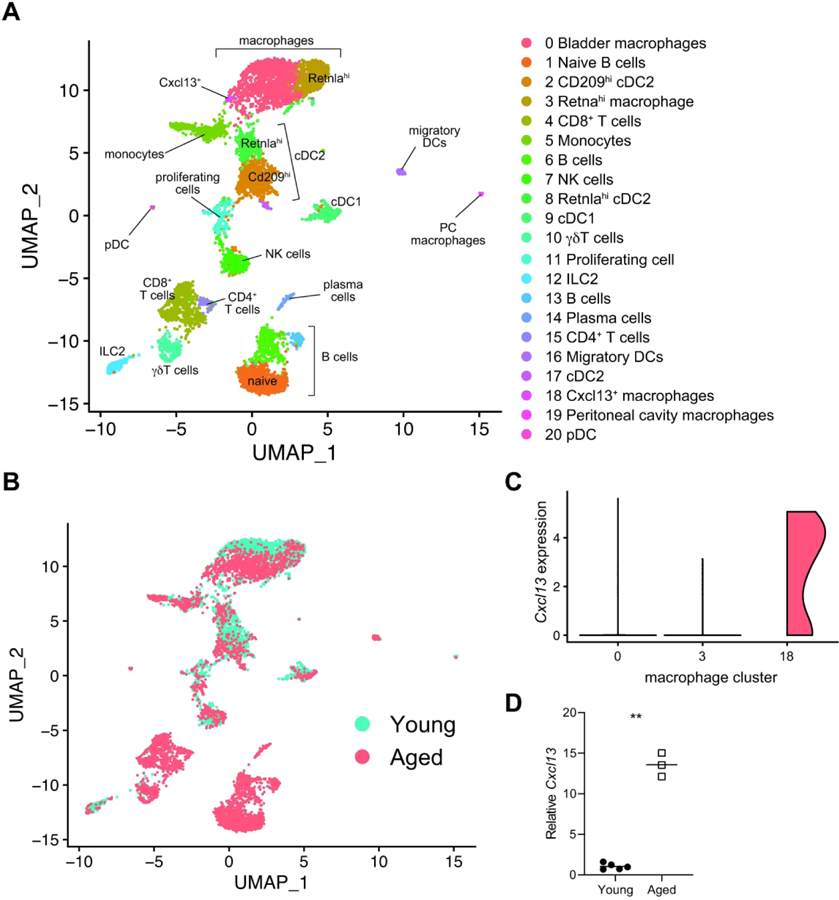
Figure 2.. Single cell transcriptomic map of immune cells from young and aged bladders.
(A) Clustering analysis and cell type identification of CD45+ cells from young (n= 3209) and aged bladders (n=4682). Cluster numbers are ordered by most abundant cell type from the merged data set. (B) Map of cells originating from young or aged bladders. (C) Expression of Cxcl13 in scRNA-seq macrophage clusters (numbered as in A and colored as in B). (D ) RT-qPCR of sorted F4/80+CD64+Ly6C- macrophages from young and aged mice (n=3–5/group). **p<0.01, Unpaired t-test with Welch’s correction. Lines at mean.
Figure 3.
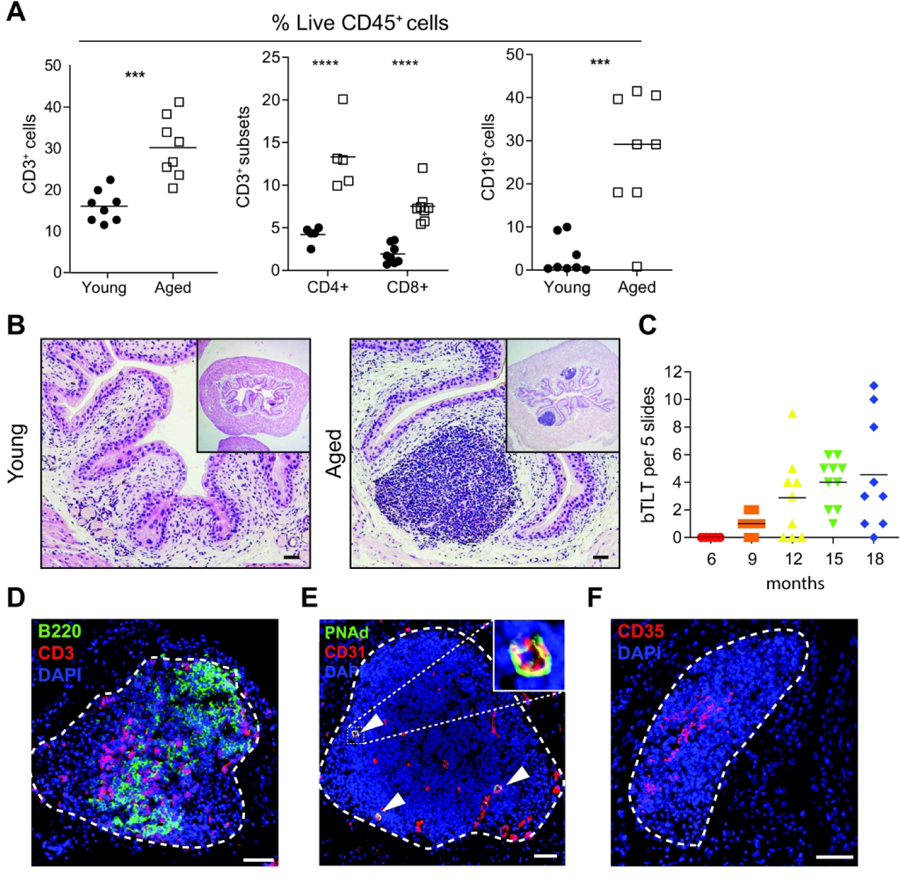
Figure 3.. Lymphoid infiltrates form bladder tertiary lymphoid tissues (bTLT) during aging.
(A) Frequency of B cells, T cells, and T cell subsets among live CD45+ cells in young and aged bladders by flow cytometry. n=5–8 per group. (B) Representative H&E images of young and aged bladders. (C) Number of bTLT over the life course of mice n=5–10/group. (C) Representative image of B cells (B220+, green) and T cells (CD3+, red) in segregated zones within bTLT in aged mice. (D) Representative image of CD31+(red) PNAd+(green) high endothelial venules (white arrowheads) within bTLT in aged mice. (E) Representative image of CD35hi follicular dendritic cell network within bTLT in aged mice. All nuclei stained with DAPI (blue). All scale bars, 50 μm.
Figure 4.
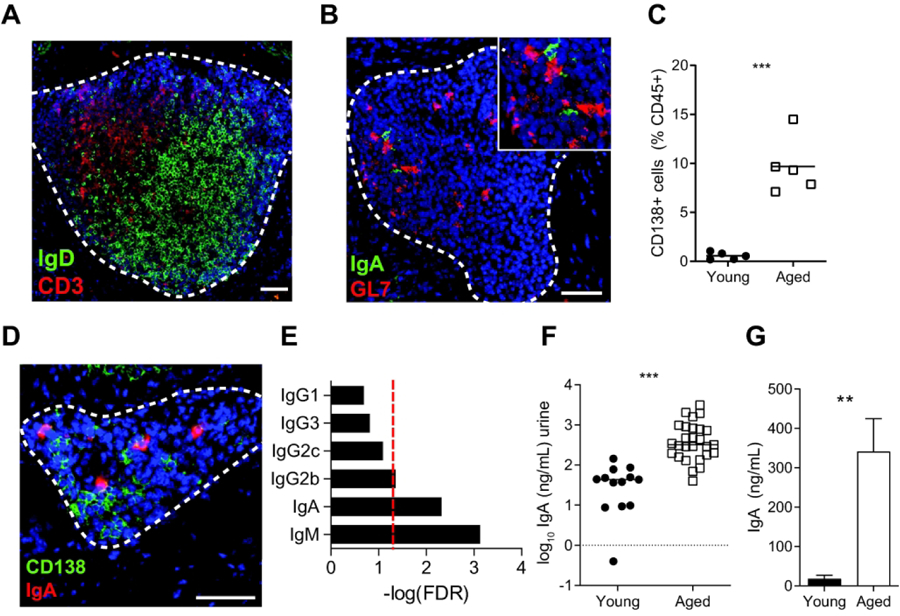
Figure 4.. bTLT are centers for B cell recruitment, activation, germinal center reactions, and plasma cell differentiation.
(A) Representative image of naive B cells (IgD+, green) and T cells (CD3+, red) within bTLT of aged bladders. (B) Representative image of IgA+ cells within a GL7+ (green) germinal center of a bTLT. (C) Frequency of live CD45+CD138+ plasma cells in young and aged bladders by flow cytometry. n=5/group. (D) Representative image of IgA+CD138+ plasma cells within bTLT of aged bladders. (E) FDR -adjusted P values of IgM and class-switched isotypes from tissue RNA-seq of young and aged bladders. Red line, p=0.05. (F) Concentration of IgA in urine of young (n=13) and aged (n=27) mice. (G) Concentration of IgA in supernatants of young and bladders cultured ex vivo for 24 hours. n=5/group. All scale bars, 50 μm. **p<0.01, ***p<0.001. Mann-Whitney U test.
Figure 5.
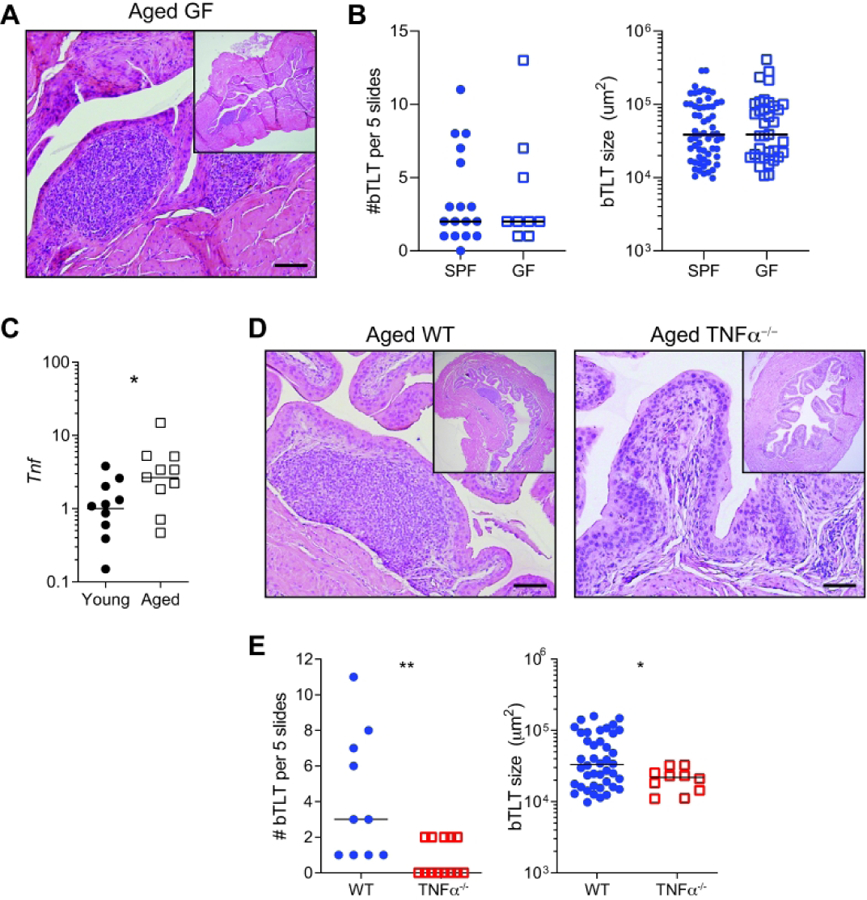
Figure 5.. bTLT size and number are independent of microbial status and dependent on age-associated TNFα.
(A) Representative H&E image of WT aged germ free (GF) bladders. (B) Number and size of bTLT found in WT specific pathogen free (SPF) and GF bladders. n=9–17/group. (B) Relative expression of Tnf and in young and aged bladders by RT-qPCR. n=10/group. (C) Representative H&E images of aged WT and TNFα−/− bladders. (C) Number and size of bTLT in aged WT and TNFα−/− bladders. Lines at median. *p<0.05, **p<0.01, Mann-Whitney U-test. Scale bars, 100 μm

References

    1. Franceschi C, Campisi J. Chronic inflammation (inflammaging) and its potential contribution to age-associated diseases. J Gerontol A Biol Sci Med Sci 2014; 69 Suppl 1: S4–9. - PubMed
    1. Niccoli T, Partridge L. Ageing as a risk factor for disease. Curr Biol 2012; 22(17): R741–752. - PubMed
    1. McHugh D, Gil J. Senescence and aging: Causes, consequences, and therapeutic avenues. J Cell Biol 2018; 217(1): 65–77. - PMC - PubMed
    1. Abraham SN, Miao Y. The nature of immune responses to urinary tract infections. Nature reviews Immunology 2015; 15(10): 655–663. - PMC - PubMed
    1. Wu XR, Kong XP, Pellicer A, Kreibich G, Sun TT. Uroplakins in urothelial biology, function, and disease. Kidney Int 2009; 75(11): 1153–1165. - PMC - PubMed

Publication types

Substances