. 2020 May 4;10(1):127.
doi: 10.1038/s41398-020-0803-0.

A standardized patient-centered characterization of the phenotypic spectrum of PCDH19 girls clustering epilepsy

Affiliations

A standardized patient-centered characterization of the phenotypic spectrum of PCDH19 girls clustering epilepsy

Kristy L Kolc et al. Transl Psychiatry. .

Abstract

Protocadherin-19 (PCDH19) pathogenic variants cause an early-onset seizure disorder called girls clustering epilepsy (GCE). GCE is an X-chromosome disorder that affects heterozygous females and mosaic males, however hemizygous ("transmitting") males are spared. We aimed to define the neuropsychiatric profile associated with PCDH19 pathogenic variants and determine if a clinical profile exists for transmitting males. We also examined genotype- and phenotype-phenotype associations. We developed an online PCDH19 survey comprising the following standardized assessments: The Behavior Rating Inventory of Executive Function; the Social Responsiveness Scale, 2nd edition; the Strengths and Difficulties Questionnaire; and the Dimensional Obsessive-Compulsive Scale. Genetic, seizure, and developmental information were also collected. The survey was completed by patients or by caregivers on behalf of patients. Of the 112 individuals represented (15 males), there were 70 unique variants. Thirty-five variants were novel and included a newly identified recurrent variant Ile781Asnfs*3. There were no significant differences in phenotypic outcomes between published and unpublished cases. Seizures occurred in clusters in 94% of individuals, with seizures resolving in 28% at an average age of 17.5 years. Developmental delay prior to seizure onset occurred in 18% of our cohort. Executive dysfunction and autism spectrum disorder (ASD) occurred in approximately 60% of individuals. The ASD profile included features of attention-deficit hyperactivity disorder. In addition, 21% of individuals met criteria for obsessive-compulsive disorder that appeared to be distinct from ASD. There were no phenotypic differences between heterozygous females and mosaic males. We describe a mosaic male and two hemizygous males with atypical clinical profiles. Earlier seizure onset age and increased number of seizures within a cluster were associated with more severe ASD symptoms (p = 0.001), with seizure onset also predictive of executive dysfunction (p = 4.69 × 10⁻⁴) and prosocial behavior (p = 0.040). No clinical profile was observed for transmitting males. This is the first patient-derived standardized assessment of the neuropsychiatric profile of GCE. These phenotypic insights will inform diagnosis, management, and prognostic and genetic counseling.


Conflict of interest statement

I.E.S serves on the editorial boards of Neurology® and Epileptic Disorders; may accrue future revenue on a pending patent re: Therapeutic compound; has received speaker honoraria from Athena Diagnostics, UCB, GSK, Eisai, and Transgenomics; has received scientific advisory board honoraria from Nutricia, UCB, and GSK; and receives/has received research support from the NHMRC, ARC, NIH, Health Research Council of New Zealand, March of Dimes, CURE, US Department of Defense, and the Perpetual Charitable Trustees. The remaining authors declare no conflict of interest.

Figures

Fig. 1
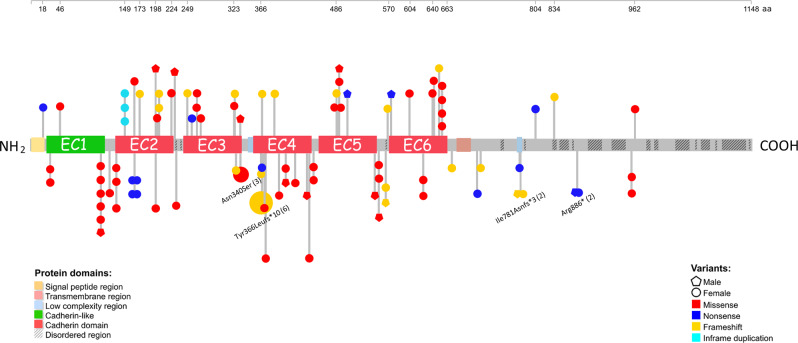
Fig. 1. Lollipop plot illustrating all PCDH19 variants in our cohort (n = 102) excluding whole gene deletions and splicing variants.
Lollipop size is exponentially proportional to the number of times the variant has been observed in unrelated individuals (recurrent). At a given locus, the number of lollipops represents the number of related individuals with that variant, with the exception of Asn340Ser (2 unrelated families and one sporadic case) where this is illustrated in text. Unpublished (novel) variants (n = 34) are located above the protein and published variants (n = 32) are below the protein.
Fig. 2
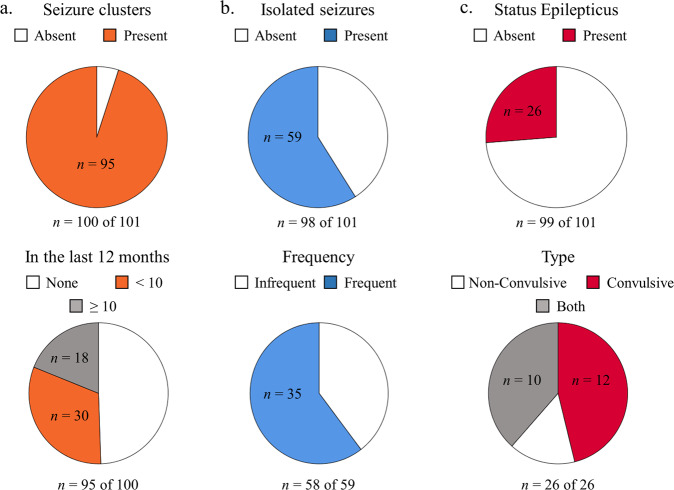
Fig. 2. Seizure characteristics.
Seizure characteristics include: (a) proportion of individuals with seizure clusters and number of clusters in the last 12 months; (b) proportion of individuals with isolated seizures and the frequency of isolated seizures (infrequent refers to less than yearly and frequent to occurrence ranging from daily to yearly); and (c) proportion of individuals with episodes of status epilepticus and type of status epilepticus.
Fig. 3
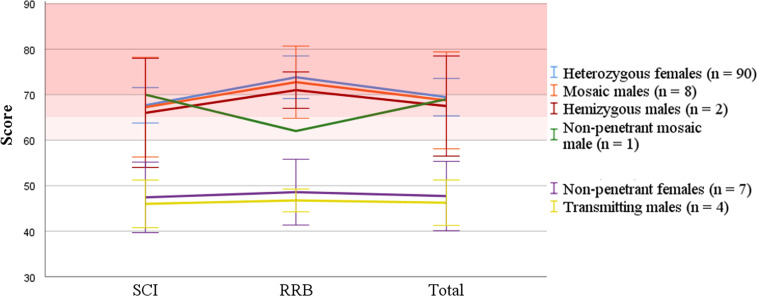
Fig. 3. Average (±2 SEM) SRS-2 total and DSM-5 domain t scores by group.
Darkening shades of red correspond to increasing degrees of severity. SCI, social communication and inhibition; RRB, restricted interests and repetitive behavior.
Fig. 4
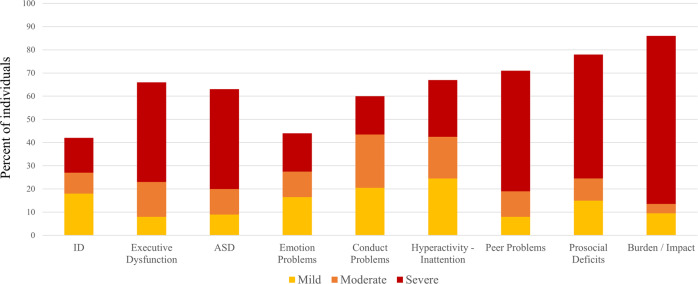
Fig. 4. The percentage of each comorbidity associated with PCDH19 variants.
ID intellectual disability, ASD autism spectrum disorder (severity based on SRS-2 t scores only). Severe ID included two individuals with profound ID. DOCS scores omitted as no cutoff exists for severity.
Fig. 5
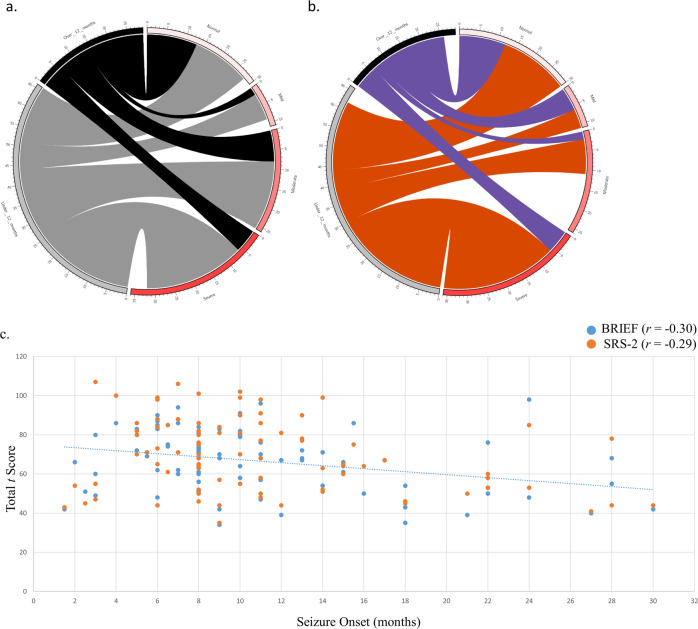
Fig. 5. Circos and scatterplot illustrating phenotype–phenotype association.
a The variable cognitive profile of GCE (n = 95) against age at seizure onset: ≤12 months, represented by grey links (n = 66) and >12 months, represented by black links (n = 29). b The variable ASD profile of GCE (n = 88) against age at seizure onset: ≤12 months, represented by orange links (n = 62) and >12 months, represented by purple links (n = 26). Axes show the number of individuals in each category. c A moderate negative association between age at seizure onset and clinical outcome, as measured by the BRIEF (n = 93) and SRS-2 (n = 86).

References

    1. Marini C, et al. Focal seizures with affective symptoms are a major feature of PCDH19 gene–related epilepsy. Epilepsia. 2012;53:2111–2119. doi: 10.1111/j.1528-1167.2012.03649.x. - DOI - PubMed
    1. Scheffer IE, et al. Epilepsy and mental retardation limited to females: an under-recognized disorder. Brain. 2008;131:918–927. doi: 10.1093/brain/awm338. - DOI - PubMed
    1. Smith L, et al. PCDH 19‐related epilepsy is associated with a broad neurodevelopmental spectrum. Epilepsia. 2018;59:679–689. doi: 10.1111/epi.14003. - DOI - PMC - PubMed
    1. Trivisano M, et al. Defining the electroclinical phenotype and outcome of PCDH19-related epilepsy: a multicenter study. Epilepsia. 2018;59:2260–2271. doi: 10.1111/epi.14600. - DOI - PubMed
    1. Breuillard D, et al. Autism spectrum disorder phenotype and intellectual disability in females with epilepsy and PCDH-19 mutations. Epilepsy Behav. 2016;60:75–80. doi: 10.1016/j.yebeh.2016.04.009. - DOI - PubMed

Publication types