


Hamstring Autograft for Lateral Ligament Stabilization
- PMID: 32367429
- PMCID: PMC7251021
- DOI: 10.1007/s12178-020-09623-1
Hamstring Autograft for Lateral Ligament Stabilization
Abstract
Purpose of review: This paper seeks to review the current literature and trends regarding use of hamstring autograft for lateral ankle instability.
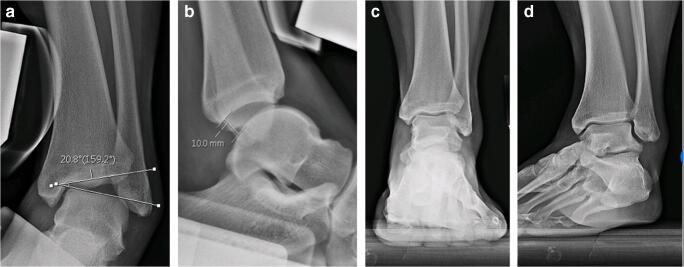
Recent findings: Reconstruction of the lateral ankle ligaments using hamstring autograft has been found to be an effective method to treat ankle instability in terms of patient-reported outcomes and objective measures. Biomechanically, reconstruction has been shown to be stronger (load to failure) when compared with the Broström procedure. Clinical studies have demonstrated non-inferiority when compared with the Broström procedure, with one synthetic reconstruction technique demonstrating superior outcomes. Reconstruction of the lateral ankle ligaments using hamstring autograft is especially useful in patients who are at high risk of failure (insufficient soft tissue available for repair, ligamentous laxity, previous failed ligament repair, ossicle > 1 cm, or in the heavier, high-demand athletes).
Keywords: Broström procedure; Hamstring autograft; Lateral ankle instability.
Conflict of interest statement
Karan A. Patel and Taylor Cabe declare that they have no conflict of interest. Mark C. Drakos declares that he is a paid consultant for Fast Form, Extremity Medical, and Pitusan 360.
Figures


References
-
- Milgrom C, Shlamkovitch N, Finestone A, Eldad A, Laor A, Danon YL, Lavie O, Wosk J, Simkin A. Risk factors for lateral ankle sprain: a prospective study among military recruits. Foot Ankle. 1991;12:26–30. - PubMed
-
- DiGiovanni BF, Partal G, Baumhauer JF. Acute ankle injury and chronic lateral instability in the athlete. Clin Sports Med. 2004;23:1–19, v. - PubMed
-
- Fernandez WG, Yard EE, Comstock RD. Epidemiology of lower extremity injuries among U.S. high school athletes. Acad Emerg Med Off J Soc Acad Emerg Med. 2007;14:641–645. - PubMed
-
- Waterman BR, Owens BD, Davey S, Zacchilli MA, Belmont PJ. The epidemiology of ankle sprains in the United States. J Bone Joint Surg Am. 2010;92:2279–2284. - PubMed
Publication types
LinkOut - more resources
Full Text Sources
Research Materials
