


Airline networks and the international diffusion of severe acute respiratory syndrome (SARS)
- PMID: 32367889
- PMCID: PMC7194177
- DOI: 10.1111/j.1475-4959.2006.00196.x
Airline networks and the international diffusion of severe acute respiratory syndrome (SARS)
Abstract
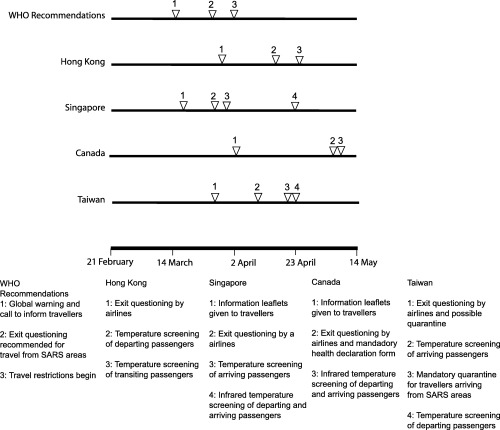
In fewer than four months in 2003, severe acute respiratory syndrome (SARS) spread from China to 25 countries and Taiwan, becoming the first new, easily transmissible infectious disease of the twenty-first century. The role of air transport in the diffusion of the disease became obvious early in the crisis; to assess that role more carefully, this study relates the spatial-temporal pattern of the SARS outbreak to a measure of airline network accessibility. Specifically, the accessibility from those countries that were infected by SARS, beginning with China, to other countries was measured using airline schedules. The country-pair accessibility measure, along with other country-level factors relevant to the disease, were tested as determinants of the speed with which SARS arrived in infected countries as well as its failure to arrive in most countries. The analyses indicate that airline network accessibility was an especially influential variable but also that the importance of this variable diminished in the latter weeks of the outbreak. The latter finding is partly attributable to public health measures, particularly health screening in airports. The timing and geography of those measures are reviewed using data from media reports and interim World Health Organization (WHO) documents during the outbreak. The uneven effort to curtail the international diffusion of SARS suggests further planning is needed to develop a concerted response to contain future epidemics.
Keywords: airline networks; East Asia; disease diffusion; public health; severe acute respiratory syndrome (SARS).
Figures
References
-
- Abraham T 2005. Twenty‐first century plague: the story of SARS The Johns Hopkins University Press, Baltimore - PubMed
-
- Airports Council International 2003. Top 50 ACI airports by passenger traffic ACI World Report 3/4 March/April
-
- Arino J and Van Den Driessche P A multi‐city epidemic model Mathematical Population Studies 10 175–93
-
- Blackwell T and Evenson B 2003. Outbreak closes 2nd hospital: number of possible SARS cases almost doubles, screening at airport questioned National Post 29 March
LinkOut - more resources
Full Text Sources
Miscellaneous