


Short-Term Non-Infectious Outcomes After a Pars Plana Intravitreal Antibiotic-Steroid Injection of Triamcinolone, Moxifloxacin, and Vancomycin During Cataract Surgery versus a Standard Postoperative Topical Regimen
- PMID: 32368007
- PMCID: PMC7185344
- DOI: 10.2147/OPTH.S247739
Short-Term Non-Infectious Outcomes After a Pars Plana Intravitreal Antibiotic-Steroid Injection of Triamcinolone, Moxifloxacin, and Vancomycin During Cataract Surgery versus a Standard Postoperative Topical Regimen
Abstract
Purpose: To compare short-term non-infectious clinical outcomes after cataract surgery with an intraoperative pars plana intravitreal antibiotic-steroid (IVAS) injection of triamcinolone, moxifloxacin, and vancomycin (TMV) versus a standard postoperative topical regimen.
Patients and methods: A retrospective comparative case series of 1058 eyes (control = 487, treatment = 571) undergoing cataract surgery were included. Endpoints included best-corrected visual acuity (BCVA), intraocular pressure (IOP), and the unplanned use of anti-inflammatory topical medication in the postoperative period. The follow-up period ranged from 1 to 6 months.
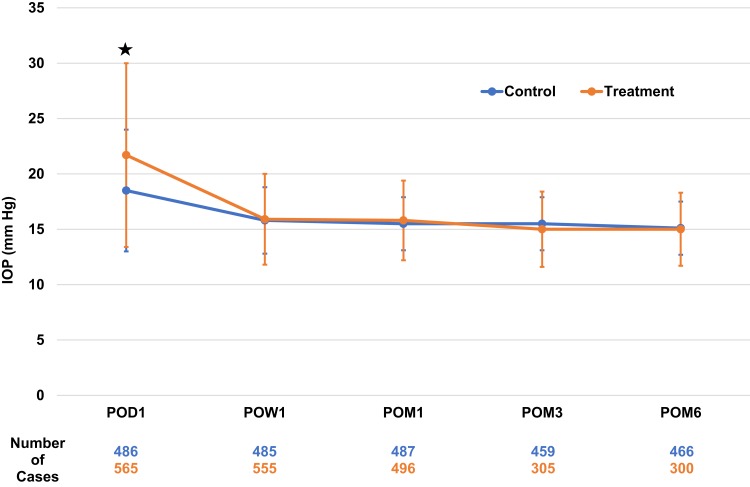
Results: A final monocular BCVA of 20/25 or better was achieved in 78.8% and 87.4% of eyes in the control and treatment groups, respectively (p = 0.001). The overall incidence of an IOP spike (Δ ≥ 10 mm Hg) was not significantly different between the two groups (0.4% versus 1.9%, p = 0.027). The rates of persistent anterior chamber inflammation (PACI), rebound anterior chamber inflammation (RACI), and cystoid macular edema (CME) in the control and treatment groups were 8.0% vs 2.6% (p < 0.001), 6.4% vs 2.6% (p = 0.003), and 3.9% vs 4.7% (p = 0.511), respectively. The use of an IVAS injection of TMV conferred an increased risk of CME (odds ratio [OR] = 3.21, 95% confidence interval [CI] = 1.42 to 7.23) but no significant effect on the risk of PACI (OR = 0.34, 95% CI = 0.10 to 1.14) or RACI (OR = 0.52, 95% CI = 0.18 to 1.54) when compared to a topical regimen.
Conclusion: An intraoperative IVAS injection after uncomplicated cataract surgery may be as safe and effective as a standard topical regimen in terms of postoperative IOP and anterior chamber inflammatory events, respectively. However, the efficacy of a TMV formulation for CME prophylaxis appears to be unsatisfactory. Future studies with prospective and randomized designs are needed to further evaluate this technique.
Keywords: cystoid macular edema; dropless cataract surgery; inflammation prophylaxis; intraocular pressure spike.
© 2020 Haq et al.
Conflict of interest statement
The authors report no conflicts of interest in this work.
Figures

References
LinkOut - more resources
Full Text Sources
Miscellaneous
