Editorial
. 2020 May 5;18(1):185.
doi: 10.1186/s12967-020-02355-3.

SARS-CoV-2 RNA polymerase as target for antiviral therapy

Affiliations
Editorial

SARS-CoV-2 RNA polymerase as target for antiviral therapy

Luigi Buonaguro et al. J Transl Med. .

Abstract

A new human coronavirus named SARS-CoV-2 was identified in several cases of acute respiratory syndrome in Wuhan, China in December 2019. On March 11 2020, WHO declared the SARS-CoV-2 infection to be a pandemic, based on the involvement of 169 nations. Specific drugs for SARS-CoV-2 are obviously not available. Currently, drugs originally developed for other viruses or parasites are currently in clinical trials based on empiric data. In the quest of an effective antiviral drug, the most specific target for an RNA virus is the RNA-dependent RNA-polymerase (RdRp) which shows significant differences between positive-sense and negative-sense RNA viruses. An accurate evaluation of RdRps from different viruses may guide the development of new drugs or the repositioning of already approved antiviral drugs as treatment of SARS-CoV-2. This can accelerate the containment of the SARS-CoV-2 pandemic and, hopefully, of future pandemics due to other emerging zoonotic RNA viruses.


Conflict of interest statement

Authors declare no competing interests.

Figures
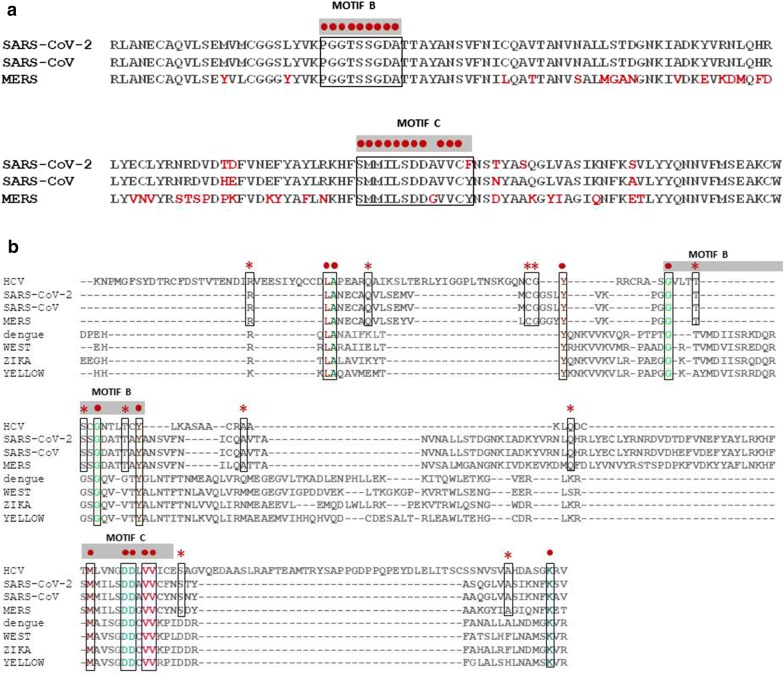
Fig. 1
Fig. 1
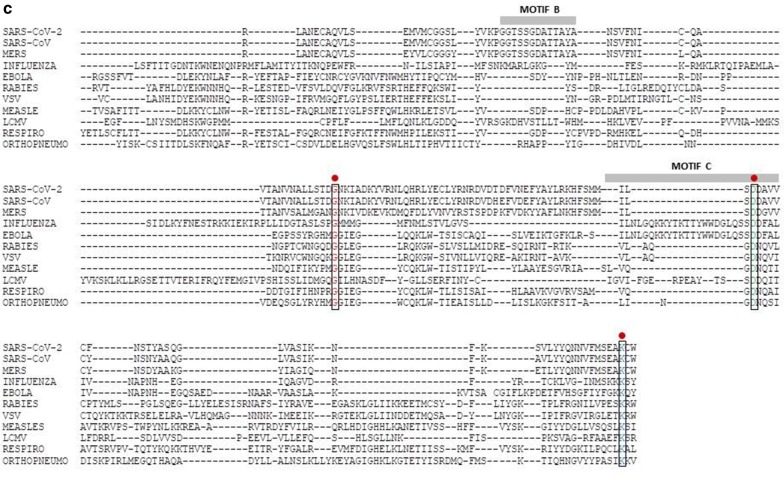
Alignment of amino acid sequences from RdRp of RNA viruses. a Sequences from positive-sense SARS-CoV-2, SARS-CoV and MERS viruses; b Sequences as in (a) with the addition of positive-sense viruses HCV, Dengue, West Nile, Zika and Yellow Fever viruses; c Sequences from positive-sense coronaviruses and negative-sense viruses Influenza, Ebola, Rabies, Vesicular Stomatitis virus, Measle, LCMV, Respirovirus and Orthopneumovirus. Red dots indicate 100% conservation of the indicated aa residues. Red asterisks indicate 100% conservation among HCV and human coronaviruses. Motif B and C of the RdRp are indicated
Fig. 1
Fig. 1
Alignment of amino acid sequences from RdRp of RNA viruses. a Sequences from positive-sense SARS-CoV-2, SARS-CoV and MERS viruses; b Sequences as in (a) with the addition of positive-sense viruses HCV, Dengue, West Nile, Zika and Yellow Fever viruses; c Sequences from positive-sense coronaviruses and negative-sense viruses Influenza, Ebola, Rabies, Vesicular Stomatitis virus, Measle, LCMV, Respirovirus and Orthopneumovirus. Red dots indicate 100% conservation of the indicated aa residues. Red asterisks indicate 100% conservation among HCV and human coronaviruses. Motif B and C of the RdRp are indicated
Fig. 2
Fig. 2
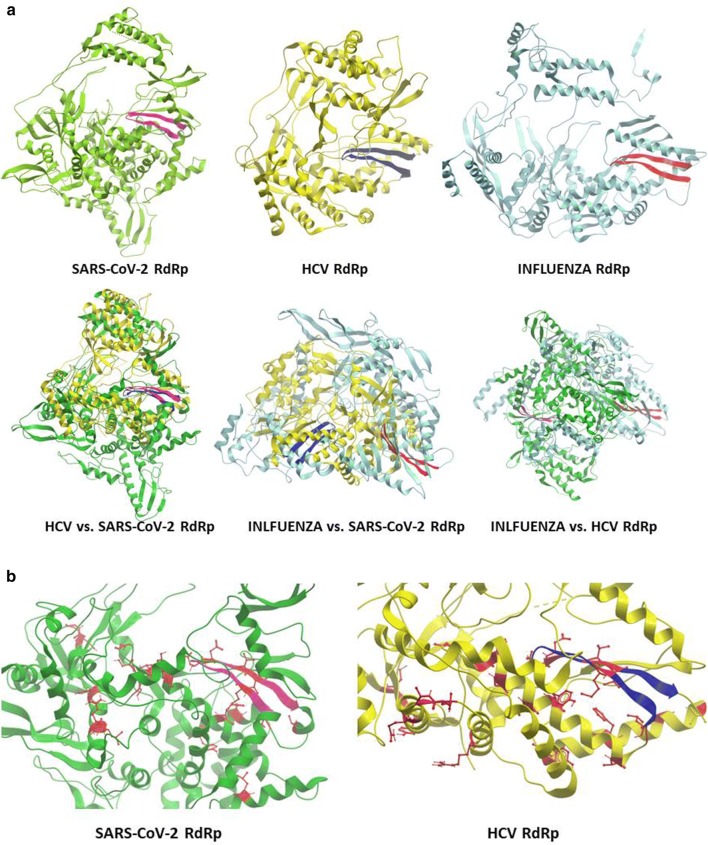
Structure modelling of the RdRps. a RdRp structures were derived from PDB databank: SARS-CoV-2 (6M71), Influenza virus (6QCT); HCV (3MWV). The whole molecules are presented independently or superimposed. b Zoomin of the SARS-CoV-2 and HCV core molecules highlighting in red color the conserved residues. Modelling was performed with Molsoft Browser
Fig. 3
Fig. 3
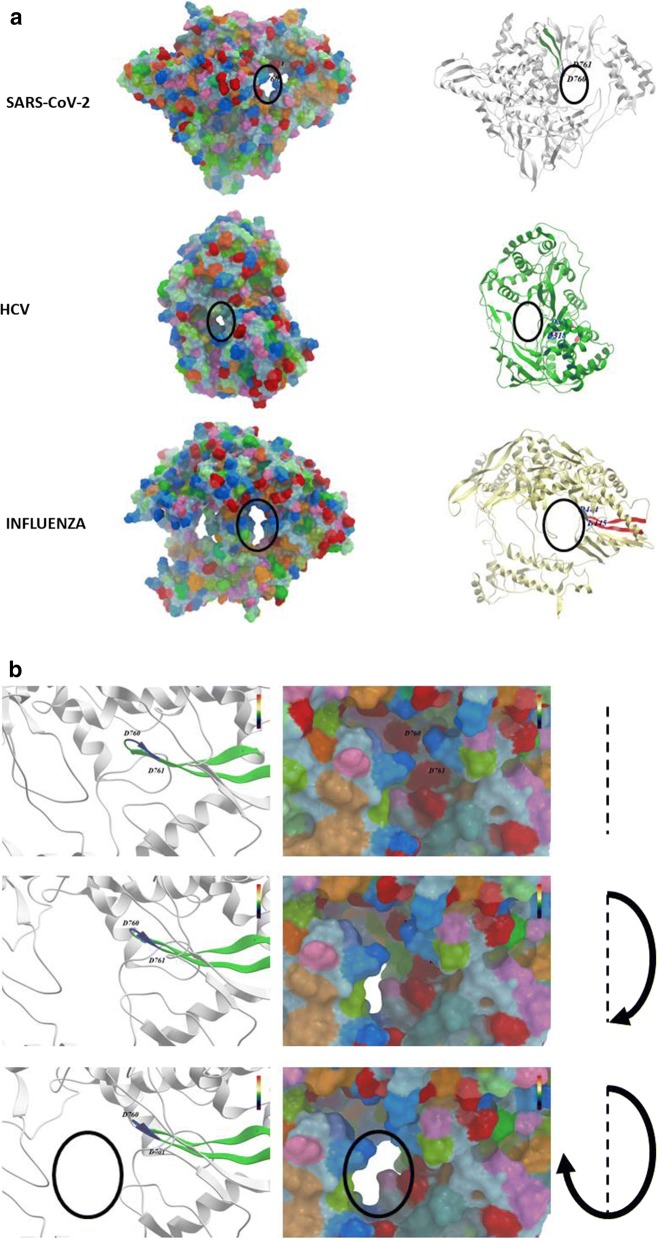
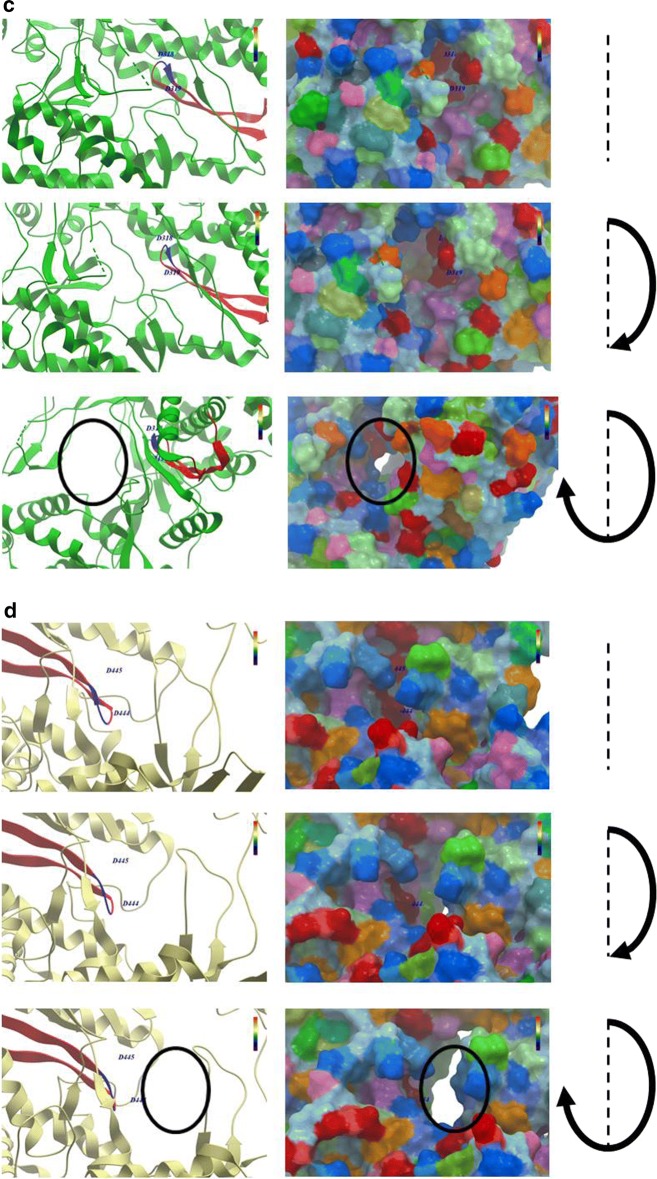
Structure modelling of the RdRps. RdRp structures were derived from PDB databank and modelling was performed as described in Fig. 2. a External surface and internal structures of RdRps were compared. b SARS-CoV-2 RdRp; c HCV RdRp; d Influenza RdRp, zoomingin the channel in which the Motif C protrudes (black empty circle). Each of the latter three panels shows three different snapshots in a clockwise rotation
Fig. 3
Fig. 3
Structure modelling of the RdRps. RdRp structures were derived from PDB databank and modelling was performed as described in Fig. 2. a External surface and internal structures of RdRps were compared. b SARS-CoV-2 RdRp; c HCV RdRp; d Influenza RdRp, zoomingin the channel in which the Motif C protrudes (black empty circle). Each of the latter three panels shows three different snapshots in a clockwise rotation

References

    1. Hui DS, Azhar I, Madani TA, Ntoumi F, Kock R, Dar O, et al. The continuing 2019-nCoV epidemic threat of novel coronaviruses to global health—the latest 2019 novel coronavirus outbreak in Wuhan, China. Int J Infect Dis. 2020;91:264–266. doi: 10.1016/j.ijid.2020.01.009. - DOI - PMC - PubMed
    1. Bogoch II, Watts A, Thomas-Bachli A, Huber C, Kraemer MUG, Khan K. Potential for global spread of a novel coronavirus from China. J Travel Med. 2020;27:taaa011. doi: 10.1093/jtm/taaa011. - DOI - PMC - PubMed
    1. de Wit E, van Doremalen N, Falzarano D, Munster VJ. SARS and MERS: recent insights into emerging coronaviruses. Nat Rev Microbiol. 2016;14:523–534. doi: 10.1038/nrmicro.2016.81. - DOI - PMC - PubMed
    1. Hu B, Ge X, Wang LF, Shi Z. Bat origin of human coronaviruses. Virol J. 2015;12:221. doi: 10.1186/s12985-015-0422-1. - DOI - PMC - PubMed
    1. Menachery VD, Yount BL, Jr, Debbink K, Agnihothram S, Gralinski LE, Plante JA, et al. A SARS-like cluster of circulating bat coronaviruses shows potential for human emergence. Nat Med. 2015;21:1508–1513. doi: 10.1038/nm.3985. - DOI - PMC - PubMed

Publication types

MeSH terms

Substances