. 2020 May 5;8(1):61.
doi: 10.1186/s40168-020-00804-1.

The neovaginal microbiome of transgender women post-gender reassignment surgery

Affiliations

The neovaginal microbiome of transgender women post-gender reassignment surgery

Kenzie D Birse et al. Microbiome. .

Abstract

Background: Gender reassignment surgery is a procedure some transgender women (TW) undergo for gender-affirming purposes. This often includes the construction of a neovagina using existing penile and scrotal tissue and/or a sigmoid colon graft. There are limited data regarding the composition and function of the neovaginal microbiome representing a major gap in knowledge in neovaginal health.

Results: Metaproteomics was performed on secretions collected from the neovaginas (n = 5) and rectums (n = 7) of TW surgically reassigned via penile inversion/scrotal graft with (n = 1) or without (n = 4) a sigmoid colon graft extension and compared with secretions from cis vaginas (n = 32). We identified 541 unique bacterial proteins from 38 taxa. The most abundant taxa in the neovaginas were Porphyromonas (30.2%), Peptostreptococcus (9.2%), Prevotella (9.0%), Mobiluncus (8.0%), and Jonquetella (7.2%), while cis vaginas were primarily Lactobacillus and Gardnerella. Rectal samples were mainly composed of Prevotella and Roseburia. Neovaginas (median Shannon's H index = 1.33) had higher alpha diversity compared to cis vaginas (Shannon's H = 0.35) (p = 7.2E-3, Mann-Whitney U test) and were more similar to the non-Lactobacillus dominant/polymicrobial cis vaginas based on beta diversity (perMANOVA, p = 0.001, r2 = 0.342). In comparison to cis vaginas, toll-like receptor response, amino acid, and short-chain fatty acid metabolic pathways were increased (p < 0.01), while keratinization and cornification proteins were decreased (p < 0.001) in the neovaginal proteome.

Conclusions: Penile skin-lined neovaginas have diverse, polymicrobial communities that show similarities in composition to uncircumcised penises and host responses to cis vaginas with bacterial vaginosis (BV) including increased immune activation pathways and decreased epithelial barrier function. Developing a better understanding of microbiome-associated inflammation in the neovaginal environment will be important for improving our knowledge of neovaginal health. Video Abstract.

Keywords: Gender reassignment surgery; Metaproteomics; Microbiome; Neovagina; Transgender women.


Conflict of interest statement

The authors declare that they have no competing interests.

Figures
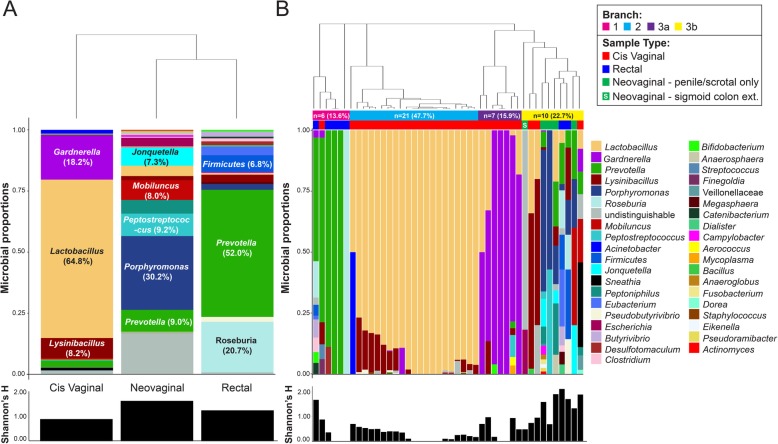
Fig. 1
Fig. 1
Microbial profiles determined by mass spectrometry reveal distinct microbial community structures in the neovaginal, rectal, and vaginal compartments from transgender and cisgender women, respectively. a Unsupervised, hierarchical clustering performed on the averaged proportional abundance of the bacterial taxa detected suggests the polymicrobial, neovaginal profile on average is more similar to the rectal profile compared to the cis vaginal profile which is dominated by Lactobacillus and Gardnerella. b Hierarchical clustering of the individual profiles reveals that neovaginal profiles specifically cluster together as well as with other diverse, species-rich cis vaginal and rectal profiles (branch 3b). All of which are significantly more diverse (Shannon H Index, p = 5.0E−4, Kruskal-Wallis) than cis vaginal and rectal profiles found in branches 1, 2, and 3a
Fig. 2
Fig. 2
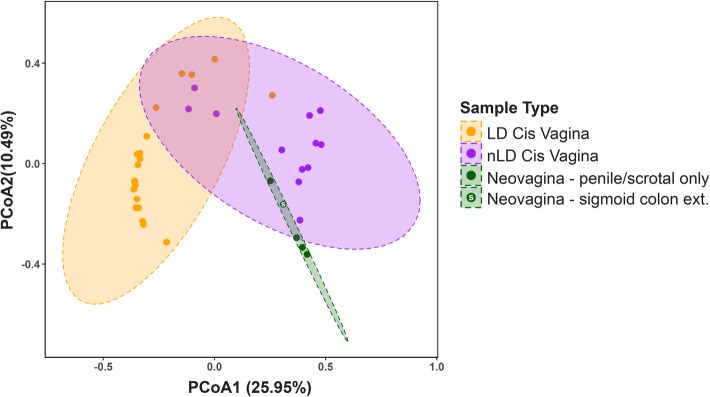
Principal coordinate analysis demonstrates that neovaginal bacterial composition is more similar to that of non-Lactobacillus-dominant (nLD)/polymicrobial than Lactobacillus-dominant (LD) cis vaginas based on Bray-Curtis dissimilarity distances
Fig. 3
Fig. 3
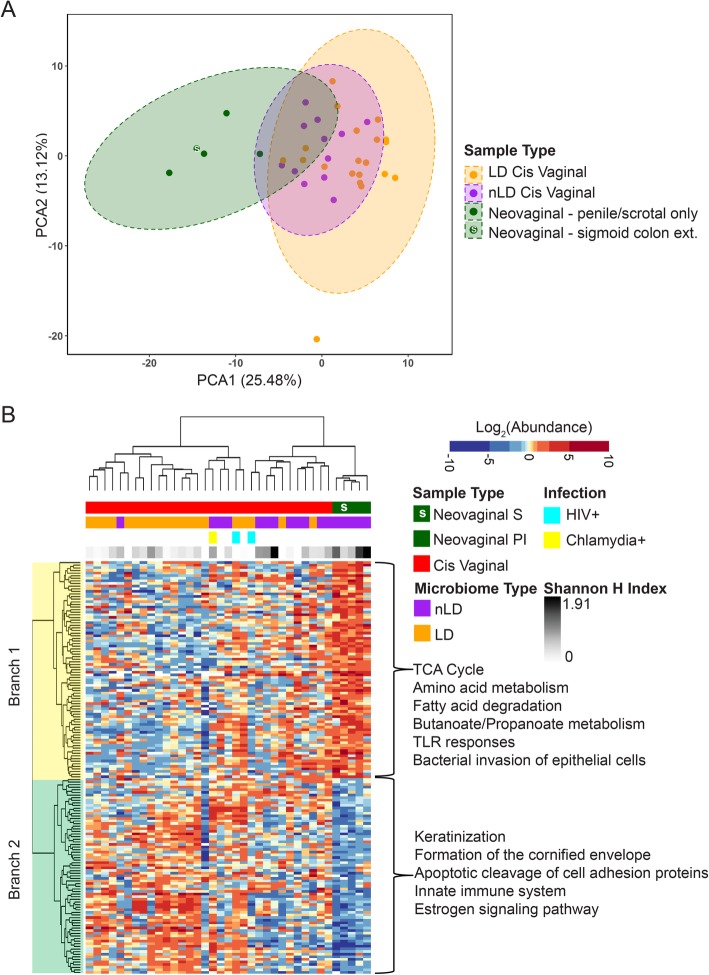
Increased immune activation and decreased keratinization and barrier pathways are associated with the neovagina. a Neovaginal samples have an overall unique host proteome signature compared to cis vaginal samples based on variation decomposition via principal coordinate analysis. b Hierarchical clustering of human proteins differentially abundant between neovaginas and cis vaginas (p < 0.05, Mann-Whitney U test). Neovaginas had increased signatures of immune activation and bacterial invasion and decreased barrier function and estrogen signaling pathways (q < 0.05, ConsensusPathDB). (LD = Lactobacillus dominant, nLD = non-Lactobacillus dominant, neovaginal S = sigmoid colon graft extension, neovaginal PI = penile inversion/scrotal graft only)

References

    1. Baral SD, Poteat T, Stromdahl S, Wirtz AL, Guadamuz TE, Beyrer C. Worldwide burden of HIV in transgender women: a systematic review and meta-analysis. Lancet Infect Dis. 2013;13:214–222. doi: 10.1016/S1473-3099(12)70315-8. - DOI - PubMed
    1. Weinforth G, Fakin R, Giovanoli P, Nunez DG. Quality of life following male-to-female sex reassignment surgery. Dtsch Arztebl Int. 2019;116:253–260. - PMC - PubMed
    1. Dreher PC, Edwards D, Hager S, Dennis M, Belkoff A, Mora J, et al. Complications of the neovagina in male-to-female transgender surgery: a systematic review and meta-analysis with discussion of management. Clin Anat. 2018;31:191–199. doi: 10.1002/ca.23001. - DOI - PubMed
    1. Gosmann C, Anahtar MN, Handley SA, Farcasanu M, Abu-Ali G, Bowman BA, et al. Lactobacillus-deficient cervicovaginal bacterial communities are associated with increased HIV acquisition in young South African women. Immunity. 2017;46:29–37. doi: 10.1016/j.immuni.2016.12.013. - DOI - PMC - PubMed
    1. Anahtar MN, Byrne EH, Doherty KE, Bowman BA, Yamamoto HS, Soumillon M, et al. Cervicovaginal bacteria are a major modulator of host inflammatory responses in the female genital tract. Immunity. 2015;42:965–976. doi: 10.1016/j.immuni.2015.04.019. - DOI - PMC - PubMed

Publication types