One in five patients with rapidly and persistently controlled early rheumatoid arthritis report poor well-being after 1 year of treatment
- PMID: 32371432
- PMCID: PMC7299515
- DOI: 10.1136/rmdopen-2019-001146
One in five patients with rapidly and persistently controlled early rheumatoid arthritis report poor well-being after 1 year of treatment
Abstract
Objectives: To identify and characterise a subgroup of patients with early rheumatoid arthritis (RA) reporting not feeling well 1 year after treatment initiation despite achieving optimal disease control according to current treatment standards.
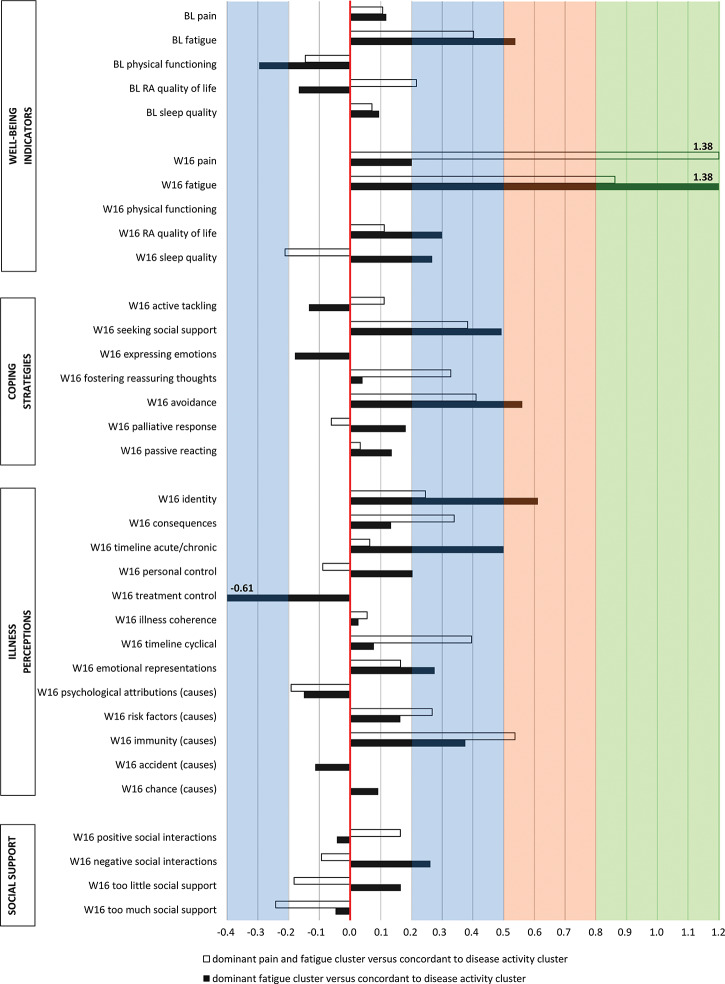
Methods: This observational study included participants of the Care in early RA trial with a rapid and sustained response (DAS28CRP<2.6) from week 16 until year 1 after starting the first RA treatment. Feeling well was assessed at year 1, using five patient-reported outcomes (PROs): pain, fatigue, physical functioning, RA-related quality of life and sleep quality. K-means clustering assigned patients to a cluster based on these PROs. Cohen's d effect size estimated cluster differences at treatment initiation and week 16, for the five clustering PROs, coping behaviour, illness perceptions and social support.
Results: Analyses revealed three clusters. Of 140 patients, 77.9% were assigned to the 'concordant to disease activity' cluster, 9.3% to the 'dominant fatigue' cluster and 12.9% to the 'dominant pain and fatigue' cluster. Large differences in pain and fatigue reporting were found at week 16 when comparing the 'concordant' with the 'dominant pain and fatigue' or the 'dominant fatigue' cluster. Small differences in reporting were found for the other PROs. Illness perceptions and coping style also differed in the 'concordant' cluster.
Conclusions: Although most patients reported PRO scores in concordance with their well-controlled disease activity, one in five persistent treatment responders reported not feeling well at year 1. These patients reported higher pain and fatigue, and different illness perceptions and coping strategies early in the disease course.
Keywords: cluster analysis; fatigue; pain; patient-reported outcomes; rheumatoid arthritis; unmet needs.
© Author(s) (or their employer(s)) 2020. Re-use permitted under CC BY-NC. No commercial re-use. See rights and permissions. Published by BMJ.
Conflict of interest statement
Competing interests: None declared.
Figures
References
-
- Druce KL, Bhattacharya Y, Jones GT, et al. Most patients who reach disease remission following anti-TNF therapy continue to report fatigue: results from the British Society for Rheumatology Biologics Register for Rheumatoid Arthritis. Rheumatology (Oxford) 2016;55:1786–90 10.1093/rheumatology/kew241. - DOI - PubMed
Publication types
MeSH terms
Substances
LinkOut - more resources
Full Text Sources
Medical
Miscellaneous