Diagnostic performance of a point-of-care saliva urea nitrogen dipstick to screen for kidney disease in low-resource settings where serum creatinine is unavailable
- PMID: 32371573
- PMCID: PMC7228485
- DOI: 10.1136/bmjgh-2020-002312
Diagnostic performance of a point-of-care saliva urea nitrogen dipstick to screen for kidney disease in low-resource settings where serum creatinine is unavailable
Abstract
Background: Kidney disease is prevalent in low-resource settings worldwide, but tests for its diagnosis are often unavailable. The saliva urea nitrogen (SUN) dipstick is a laboratory and electricity independent tool, which may be used for the detection of kidney disease. We investigated the feasibility and performance of its use in diagnosing kidney disease in community settings in Africa.
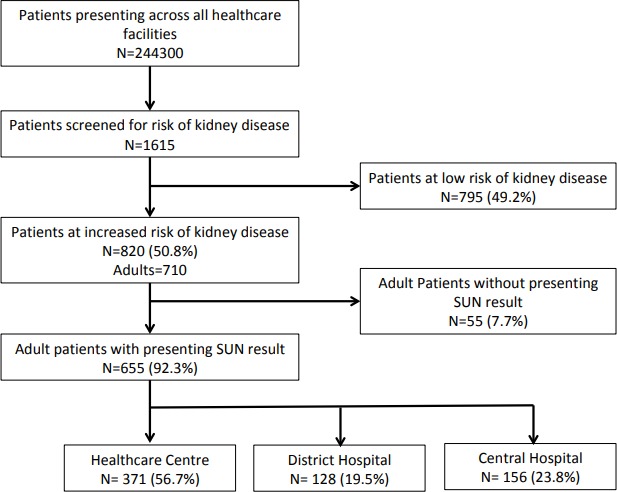
Methods: Adult patients at increased risk of kidney disease presenting to three community health centres, a rural district hospital and a central hospital in Malawi were recruited between October 2016 and September 2017. Patients underwent concurrent SUN and creatinine testing at enrolment, and at 1 week, 1 month, 3 months and 6 months thereafter.
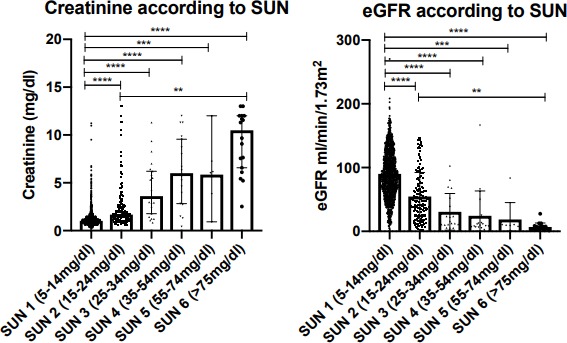
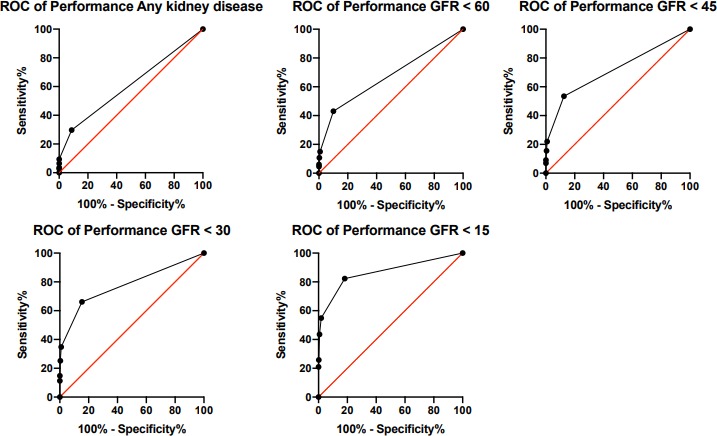
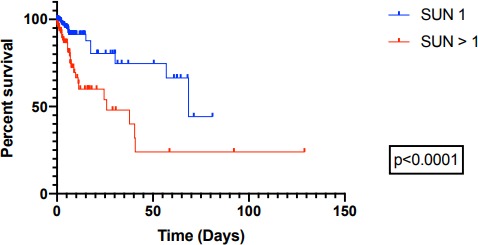
Results: Of 710 patients who presented at increased risk of kidney disease, 655 (92.3%) underwent SUN testing at enrolment, and were included (aged 38 (29-52) years, 367 (56%) female and 333 (50.8%) with HIV). Kidney disease was present in 482 (73.6%) patients and 1479 SUN measurements were made overall. Estimated glomerular filtration rate (eGFR) correlated with SUN (r=-0.39; p<0.0001). The area under the receiver operating characteristics curve was 0.61 for presenting SUN to detect acute or chronic kidney disease, and 0.87 to detect severe (eGFR <15 mL/min/1.73 m2) kidney disease (p<0.0001; sensitivity 82.3%, specificity 81.8%, test accuracy 81.8%). In-hospital mortality was greater if enrolment SUN was elevated (>test pad #1) compared with patients with non-elevated SUN (p<0.0001; HR 3.3 (95% CI 1.7 to 6.1).
Conclusions: SUN, measured by dipstick, is feasible and may be used to screen for kidney disease in low resource settings where creatinine tests are unavailable.
Keywords: HIV; health systems; other diagnostic or tool; prevention strategies; screening.
© Author(s) (or their employer(s)) 2020. Re-use permitted under CC BY-NC. No commercial re-use. See rights and permissions. Published by BMJ.
Conflict of interest statement
Competing interests: None declared.
Figures
References
-
- Acute kidney injury (AKI) – KDIGO. Available: http://kdigo.org/guidelines/acute-kidney-injury/ [Accessed 2017 Aug 17].
-
- Ckd evaluation and management – KDIGO. Available: http://kdigo.org/guidelines/ckd-evaluation-and-management/ [Accessed 2017 Aug 17].
Publication types
MeSH terms
Substances
LinkOut - more resources
Full Text Sources
Medical
Research Materials
Miscellaneous