. 2020 May 5;10(1):7560.
doi: 10.1038/s41598-020-64614-z.

Saliva proteomic patterns in patients with molar incisor hypomineralization

Affiliations

Saliva proteomic patterns in patients with molar incisor hypomineralization

K Bekes et al. Sci Rep. .

Abstract

Molar incisor hypomineralization (MIH) is an endemic pediatric disease with an unclear pathogenesis. Considering that saliva controls enamel remineralization and that MIH is associated with higher saliva flow rate, we hypothesized that the protein composition of saliva is linked to disease. To test this, we enrolled 5 children aged 6-14 years with MIH showing at least one hypersensitive molar and 5 caries-free children without hypomineralization. Saliva samples were subjected to proteomic analysis followed by protein classification in to biological pathways. Among 618 salivary proteins identified with high confidence, 88 proteins were identified exclusively in MIH patients and 16 proteins in healthy controls only. Biological pathway analysis classified these 88 patient-only proteins to neutrophil-mediated adaptive immunity, the activation of the classical pathway of complement activation, extracellular matrix degradation, heme scavenging as well as glutathione -and drug metabolism. The 16 controls-only proteins were associated with adaptive immunity related to platelet degranulation and the lysosome. This report suggests that the proteaneous composition of saliva is affected in MIH patients, reflecting a catabolic environment which is linked to inflammation.


Conflict of interest statement

The authors declare no competing interests.

Figures
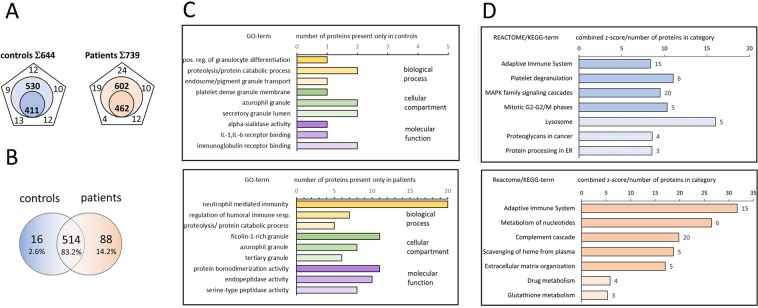
Figure 1
Figure 1
Qualitative comparison of saliva-proteins identified in controls and MIH-patients. (A) Exclusive and common proteins identified by at least two unique peptides in controls and MIH-patients, respectively. Total number of distinct proteins quoted at the top of the pentagon, numbers inscribed in the corners are unique proteins in individual samples. The inscribed smaller circle quotes proteins commonly identified in all samples, numbers in the bigger circle quotes protein-numbers identified in at least 3 out of 5 controls and MIH-patients, respectively. (B) Venn-diagram depicting numbers and percentage of common and exclusive proteins identified in saliva of controls or MIH-patients. (C) Significantly enriched Gene-Ontology (GO) biological process, cellular compartment and molecular function-terms of exclusive (“only”) proteins in controls (upper panel) or MIH-patients (lower panel). Protein-counts for respective terms are shown on the x-axis. (D) Enriched biological pathway-terms (REACTOME, filled bars; KEGG, dashed bars) and respective protein-counts (numbers at the bar-edges) for proteins found only in controls (upper panel) or MIH-patients (lower panel).
Figure 2
Figure 2
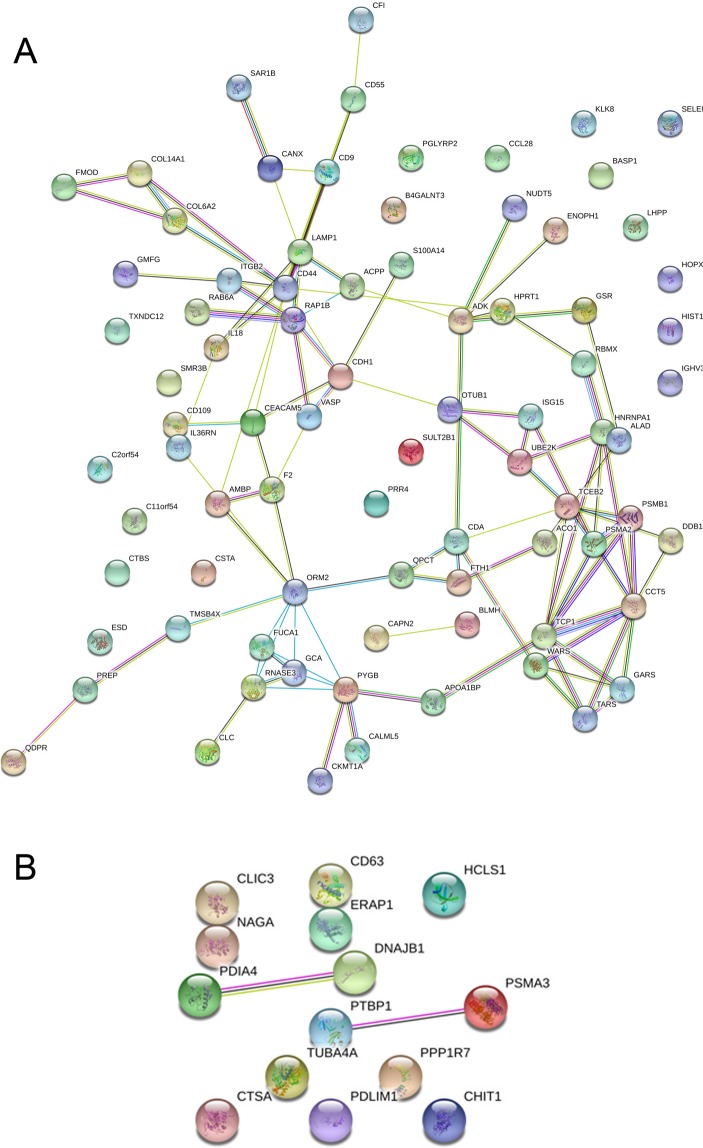
(A) STRING protein-protein interaction networks functional enrichment analysis of exclusive proteins identified by at least two unique peptides in MIH-patients. Number of nodes: 81; number of edges: 105; average node degree: 2.59; avg. local clustering coefficient: 0.36. (B) STRING protein-protein interaction networks functional enrichment analysis of exclusive proteins identified by at least two unique peptides in healthy control patients. Number of nodes: 14; number of edges: 2; average node degree: 0.286; avg. local clustering coefficient: 0.286.

References

    1. Weerheijm KL, Jalevik B, Alaluusua S. Molar-incisor hypomineralisation. Caries Res. 2001;35:390–391. doi: 10.1159/000047479. - DOI - PubMed
    1. Zhao D, Dong B, Yu D, Ren Q, Sun Y. The prevalence of molar incisor hypomineralization: evidence from 70 studies. Int J Paediatr Dent. 2018;28:170–179. doi: 10.1111/ipd.12323. - DOI - PubMed
    1. Manton, D., Crombie, F. A. & Silva, M. J. In Molar Incisor Hypomineralization - A Clinical Guide to Diagnosis and Treatment (ed K. Bekes) Ch. 4, 33–46 (Springer, 2020).
    1. Elhennawy K, et al. Structural, mechanical and chemical evaluation of molar-incisor hypomineralization-affected enamel: A systematic review. Arch Oral Biol. 2017;83:272–281. doi: 10.1016/j.archoralbio.2017.08.008. - DOI - PubMed
    1. Lygidakis NA. Treatment modalities in children with teeth affected by molar-incisor enamel hypomineralisation (MIH): A systematic review. Eur Arch Paediatr Dent. 2010;11:65–74. doi: 10.1007/BF03262715. - DOI - PubMed