. 2021 Jun;26(6):2089-2100.
doi: 10.1038/s41380-020-0723-7. Epub 2020 May 6.

A structural brain network of genetic vulnerability to psychiatric illness

Affiliations

A structural brain network of genetic vulnerability to psychiatric illness

Maxime Taquet et al. Mol Psychiatry. 2021 Jun.

Abstract

Psychiatry is undergoing a paradigm shift from the acceptance of distinct diagnoses to a representation of psychiatric illness that crosses diagnostic boundaries. How this transition is supported by a shared neurobiology remains largely unknown. In this study, we first identify single nucleotide polymorphisms (SNPs) associated with psychiatric disorders based on 136 genome-wide association studies. We then conduct a joint analysis of these SNPs and brain structural connectomes in 678 healthy children in the PING study. We discovered a strong, robust, and transdiagnostic mode of genome-connectome covariation which is positively and specifically correlated with genetic risk for psychiatric illness at the level of individual SNPs. Similarly, this mode is also significantly positively correlated with polygenic risk scores for schizophrenia, alcohol use disorder, major depressive disorder, a combined bipolar disorder-schizophrenia phenotype, and a broader cross-disorder phenotype, and significantly negatively correlated with a polygenic risk score for educational attainment. The resulting "vulnerability network" is shown to mediate the influence of genetic risks onto behaviors related to psychiatric vulnerability (e.g., marijuana, alcohol, and caffeine misuse, perceived stress, and impulsive behavior). Its anatomy overlaps with the default-mode network, with a network of cognitive control, and with the occipital cortex. These findings suggest that the brain vulnerability network represents an endophenotype funneling genetic risks for various psychiatric illnesses through a common neurobiological root. It may form part of the neural underpinning of the well-recognized but poorly explained overlap and comorbidity between psychiatric disorders.


Conflict of interest statement

The authors declare that they have no conflict of interest.

Figures

Fig. 1
Fig. 1. Distribution of SNPs and their correlation with the mode of population covariation.
a Correlation between the top hit for each phenotype and the mode of population covariation showing that positive associations were found for SNPs associated with a range of psychiatric and cognitive-behavioral phenotypes. Error bars indicate 95% confidence intervals. b Genomic position of the 1877 SNPs selected for the analysis on the genome colored by their correlation (r) with the CCA mode. Only SNPs which were reported in the GWAS catalog to be significantly associated with phenotypes of interest (p < 5 × 10−8) were included in the analysis. SNPs significantly correlated with the mode of population covariation were found throughout the genome.
Fig. 2
Fig. 2. Association (positive toward the right and negative toward the left) between polygenic risk scores (PRS) for psychiatric phenotypes and educational attainment, and the connectomic canonical score.
All p values are corrected for multiple comparisons: #p < 0.1, *p < 0.05, **p < 0.01, ***p < 0.005.
Fig. 3
Fig. 3. Network of vulnerability to psychiatric illness.
a Connections with statistically significant canonical strengths form a canonical brain network. Positive (red) and negative (blue) strengths indicate connections whose value respectively increases and decreases with increasing canonical scores. b Positive (red) and negative (blue) connections represented in physical space. c The hubs in the network show overlap with the default-mode network, a network of cognitive control, and the occipital lobes. In blue and red are hubs of hypoconnectivity and hyperconnectivity respectively (i.e., regions whose average connectivity is respectively lower and higher in individuals with higher canonical scores).
Fig. 4
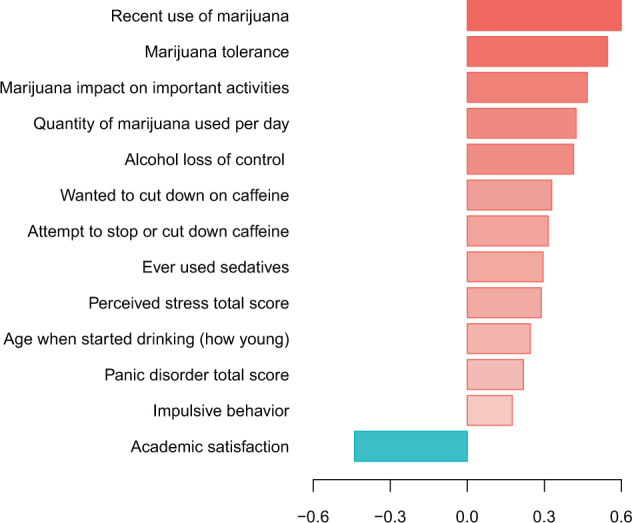
Fig. 4. Significant correlations between measurements of social and emotional function and substance exposure and the mode of population covariation.
The positive correlations with various behaviors indicate that individuals with higher canonical scores tend to exhibit behaviors related to psychiatric vulnerability.

References

    1. Insel T, Cuthbert B, Garvey M, Heinssen R, Pine DS, Quinn K, et al. Research domain criteria (RDoC): toward a new classification framework for research on mental disorders. Am J Psychiatry. 2010;167:748–51. doi: 10.1176/appi.ajp.2010.09091379. - DOI - PubMed
    1. Kessler RC, Chiu WT, Demler O, Merikangas KR, Walters EE. Prevalence, severity, and comorbidity of 12-month DSM-IV disorders in the National Comorbidity Survey Replication. Arch Gen Psychiatry. 2005;62:617–27. doi: 10.1001/archpsyc.62.6.617. - DOI - PMC - PubMed
    1. Plana-Ripoll O, Pedersen CB, Holtz Y, Benros ME, Dalsgaard S, de Jonge P, et al. Exploring comorbidity within mental disorders among a Danish national population. JAMA Psychiatry. 2019. 10.1001/jamapsychiatry.2018.3658. - PMC - PubMed
    1. Caspi A, Houts RM, Belsky DW, Goldman-Mellor SJ, Harrington H, Israel S, et al. The p factor: one general psychopathology factor in the structure of psychiatric disorders? Clin Psychol Sci. 2014;2:119–37. doi: 10.1177/2167702613497473. - DOI - PMC - PubMed
    1. Brainstorm Consortium. Anttila V, Bulik-Sullivan B, Finucane HK, Walters RK, Bras J. Analysis of shared heritability in common disorders of the brain. Science. 2018;360:eaap8757. doi: 10.1126/science.aap8757. - DOI - PMC - PubMed

Publication types

MeSH terms