


A randomized, double-blind, placebo-controlled trial of testosterone for treatment of postmenopausal women with aromatase inhibitor-induced arthralgias: Alliance study A221102
- PMID: 32372176
- PMCID: PMC7644633
- DOI: 10.1007/s00520-020-05473-2
A randomized, double-blind, placebo-controlled trial of testosterone for treatment of postmenopausal women with aromatase inhibitor-induced arthralgias: Alliance study A221102
Abstract
Purpose: To evaluate the efficacy of testosterone supplementation for improving aromatase inhibitor musculoskeletal symptoms (AIMSS).
Methods: Postmenopausal women experiencing moderate-to-severe arthralgias while taking adjuvant aromatase inhibitors for breast cancer were enrolled in this trial. Initially, patients were randomly allocated to receive either a subcutaneous testosterone pellet versus a placebo pellet. Due to slow accrual, the protocol was modified such that additional participants were randomized to receive either a topical testosterone gel or a placebo gel. Changes in patient-reported joint pain were compared between patients receiving testosterone and those receiving placebo using a two-sample t test. Changes in hot flashes and other vasomotor symptoms were also analyzed. Further analyses were conducted to evaluate whether 27 single nucleotide polymorphisms (SNPs) in 14 genes previously associated with AIMSS were associated with testosterone supplementation benefit.
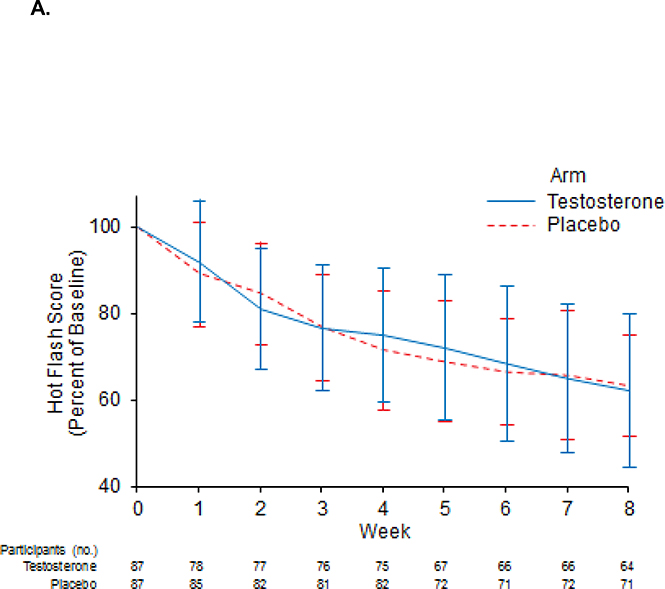
Results: While 64% of patients reported an improvement in joint pain at 3 months, there were no significant differences in average pain or joint stiffness at 3 or 6 months between testosterone and placebo arms. Patients receiving testosterone did report improvements in strength, lack of energy, urinary frequency, and stress incontinence (p < 0.05). The subset of patients receiving subcutaneous testosterone also experienced improvements in hot flashes and mood swings. An inherited variant (rs7984870 CC genotype) in TNFSF11 was more likely to be associated with improvements in hot flashes in patients receiving testosterone.
Conclusion: The doses of testosterone supplementation used in this study did not significantly improve AIMSS.
Trial registration: ClinicalTrials.gov Identifier: NCT01573442.
Keywords: Aromatase inhibitor musculoskeletal symptoms; Hot flashes; Testosterone; Toxicity of endocrine therapy.
Figures



References
-
- Baum M, et al. , Anastrozole alone or in combination with tamoxifen versus tamoxifen alone for adjuvant treatment of postmenopausal women with early breast cancer: first results of the ATAC randomised trial. Lancet, 2002. 359(9324): p. 2131–9. - PubMed
-
- Howell A, et al. , Results of the ATAC (Arimidex, Tamoxifen, Alone or in Combination) trial after completion of 5 years’ adjuvant treatment for breast cancer. Lancet, 2005. 365(9453): p. 60–2. - PubMed
-
- Harris PF, et al. , Prevalence and treatment of menopausal symptoms among breast cancer survivors. J Pain Symptom Manage, 2002. 23(6): p. 501–9. - PubMed
-
- Crew KD, et al. , Prevalence of joint symptoms in postmenopausal women taking aromatase inhibitors for early-stage breast cancer. Journal of Clinical Oncology, 2007. 25(25): p. 3877–3883. - PubMed
Publication types
MeSH terms
Substances
Associated data
Grants and funding
- U10 CA180868/CA/NCI NIH HHS/United States
- KL2 TR002379/TR/NCATS NIH HHS/United States
- UG1CA189861/CA/NCI NIH HHS/United States
- U10CA180820/CA/NCI NIH HHS/United States
- UG1 CA189861/CA/NCI NIH HHS/United States
- UG1 CA189828/CA/NCI NIH HHS/United States
- UG1 CA189823/CA/NCI NIH HHS/United States
- P30 CA015083/CA/NCI NIH HHS/United States
- UG1CA189997/CA/NCI NIH HHS/United States
- U24 CA196171/CA/NCI NIH HHS/United States
- U10 CA180820/CA/NCI NIH HHS/United States
- UG1CA232760/CA/NCI NIH HHS/United States
- UG1 CA233339/CA/NCI NIH HHS/United States
- UG1CA189823/CA/NCI NIH HHS/United States
- UG1 CA189858/CA/NCI NIH HHS/United States
- U24CA196171/CA/NCI NIH HHS/United States
- UG1 CA232760/CA/NCI NIH HHS/United States
- U10CA180868/CA/NCI NIH HHS/United States
- UG1 CA189997/CA/NCI NIH HHS/United States
- UG1CA189858/CA/NCI NIH HHS/United States
LinkOut - more resources
Full Text Sources
Medical
