


Utility of single-item questions to assess physical inactivity in patients with chronic heart failure
- PMID: 32372549
- PMCID: PMC7373918
- DOI: 10.1002/ehf2.12709
Utility of single-item questions to assess physical inactivity in patients with chronic heart failure
Abstract
Aim: The purpose of this study was to explore the utility of two single-item self-report (SR) questions to assess physical inactivity in patients with heart failure (HF).
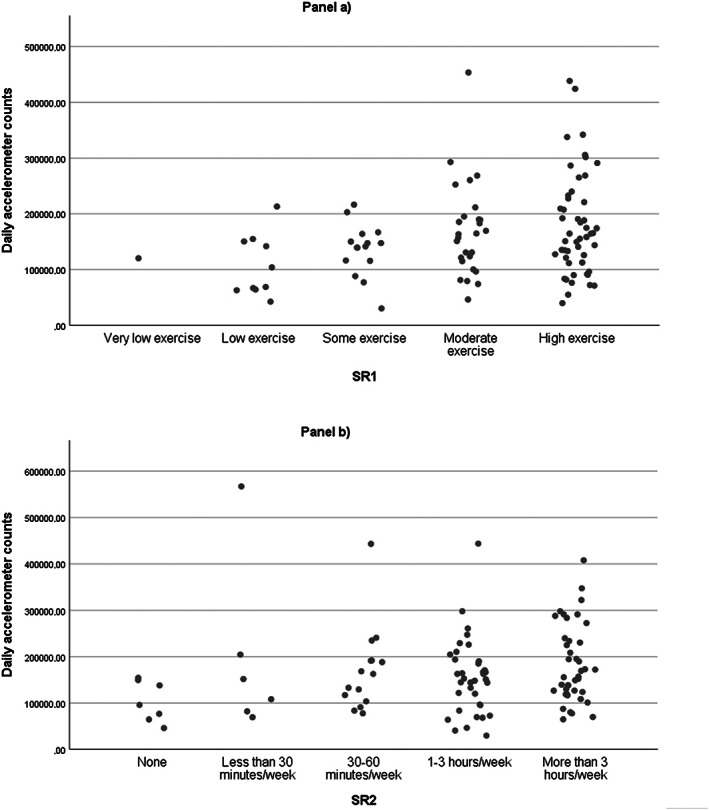
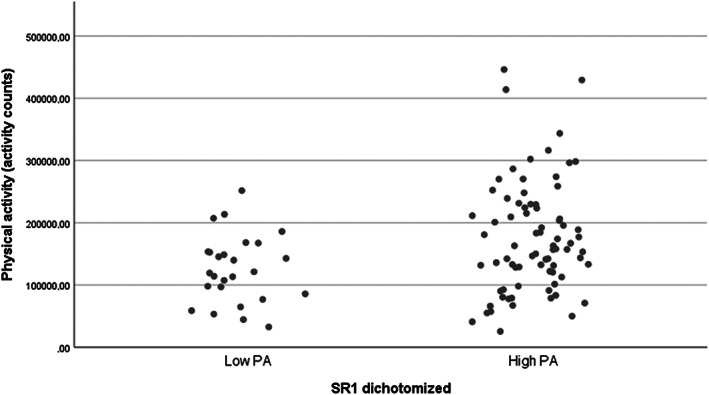
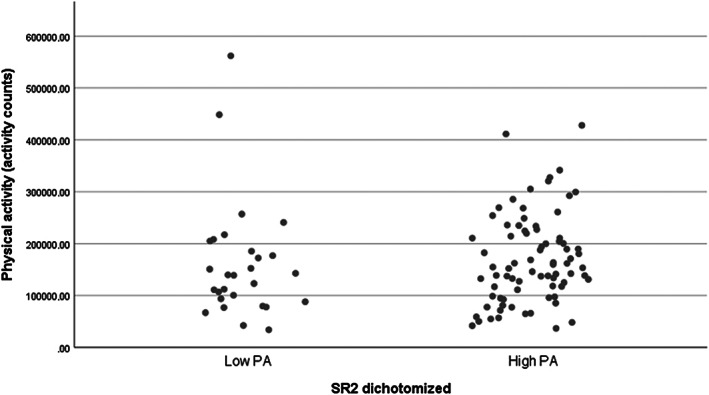
Methods and results: This is a cross-sectional study using data from 106 patients with HF equipped with accelerometers for 1 week each. Two SR items relating to physical activity were also collected. Correlations between accelerometer activity counts and the SR items were analysed. Patients were classified as physically active or inactive on the basis of accelerometer counts, and the SR items were used to try to predict that classification. Finally, patients were classified as having high self-reported physical activity or low self-reported physical activity, on the basis of the SR items, and the resulting groups were analysed for differences in actual physical activity. There were significant but weak correlations between the SR items and accelerometer counts: ρ = 0.24, P = 0.016 for SR1 and ρ = 0.21, P = 0.033 for SR2. Using SR items to predict whether a patient was physically active or inactive produced an area under the curve of 0.62 for SR1, with a specificity of 92% and a sensitivity of 30%. When dividing patients into groups on the basis of SR1, there was a significant difference of 1583 steps per day, or 49% more steps in the high self-reported physical activity group (P < 0.001).
Conclusions: There might be utility in the single SR question for high-specificity screening of large populations to identify physically inactive patients in order to assign therapeutic interventions efficiently where resources are limited.
Keywords: Accelerometer; Heart failure; Physical inactivity; Self-report.
© 2020 The Authors. ESC Heart Failure published by John Wiley & Sons Ltd on behalf of the European Society of Cardiology.
Conflict of interest statement
None to report.
Figures
References
-
- Aggarwal M, Bozkurt B, Panjrath G, Aggarwal B, Ostfeld RJ, Barnard ND, Gaggin H, Freeman AM, Allen K, Madan S, Massera D, Litwin SE, American College of Cardiology's N, Lifestyle Committee of the Prevention of Cardiovascular Disease C. Lifestyle modifications for preventing and treating heart failure. J Am Coll Cardiol 2018;72():2391–2405. - PubMed
-
- Organization WH . Global Recommendations on Physical Activity for Health. WHO Guidelines Approved by the Guidelines Review Committee. Geneva: 2010.
-
- Bauman A, Merom D, Bull FC, Buchner DM, Fiatarone Singh MA. Updating the evidence for physical activity: summative reviews of the epidemiological evidence, prevalence, and interventions to promote “active aging”. Gerontologist 2016; 56: S268–S280. - PubMed
-
- Downing J, Balady GJ. The role of exercise training in heart failure. J Am Coll Cardiol 2011; 58: 561–569. - PubMed
Publication types
MeSH terms
Grants and funding
LinkOut - more resources
Full Text Sources
Medical
Research Materials
Miscellaneous
