. 2020 May;44(3):496-505.
doi: 10.1016/j.jgr.2019.05.003. Epub 2019 May 15.

Korean Red Ginseng extract ameliorates melanogenesis in humans and induces antiphotoaging effects in ultraviolet B-irradiated hairless mice

Affiliations

Korean Red Ginseng extract ameliorates melanogenesis in humans and induces antiphotoaging effects in ultraviolet B-irradiated hairless mice

Evelyn Saba et al. J Ginseng Res. 2020 May.

Erratum in

Abstract

Background: Panax ginseng is a marvelous herbal remedy for all ailments of body. That may be why it is called Panax, which means "cure for all". Melanin is a pigment that gives color to our skin; however, increased melanin production can lead to tumor formation. Human exposure to ultraviolet B radiation has increased extensively owing to the increased sunlight due to global warming. Consequently, a phenomenon called photoaging has been observed for all skin colors and types. As a result of this phenomenon, a set of enzymes called matrix metalloproteinases, which serve as degradation enzymes for extracellular matrix proteins, mainly collagen, is increased, causing depletion of collagen and resulting in early wrinkle formation.

Methods: Therefore, in our study, we used the murine melanoma cell line B16/F10 to study the inhibition of melanogenesis by Korean Red Ginseng (KRG) extract in vitro and HRM-2 hairless mice exposed to artificial ultraviolet B to examine the efficacy of KRG in vivo. We prepared a 3% red ginseng extract cream and evaluated its effects on human skin.

Results: Our results demonstrated that KRG induced potent suppression of tyrosinase activity and melanin production in B16/F10 cells; moreover, it reduced the transcription and translation of components involved in the melanin production pathway. In the in vivo experiments, KRG potently suppressed the expression of matrix metalloproteinases, reduced wrinkle formation, and inhibited collagen degradation. On human skin, ginseng cream increased skin resilience and skin moisture and enhanced skin tone.

Conclusion: Therefore, we conclude that KRG is an excellent skin whitening and antiaging product.

Keywords: Antiaging; Human trials; Korean Red Ginseng extract; Melanogenesis; Wrinkles.


Figures

Fig. 1
Fig. 1
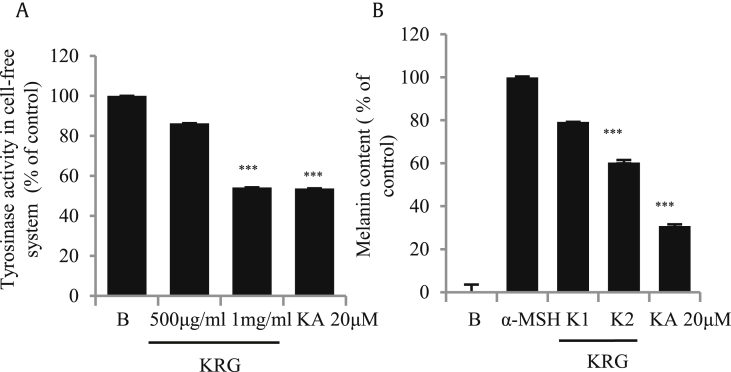
Inhibition of mushroom tyrosinase and melanin production by KRG. (A) KRG inhibited the mushroom tyrosinase activity in a cell-free system. (B) Melanin content in crude lysates was suppressed by KRG when B16/F10 cells were stimulated with α-MSH (K1= KRG 500μg/mL and K2= KRG 1mg/mL). The values in the bar graph are the mean ± SEM of at least four independent experiments. ***p < 0.001 compared with the untreated group. KRG, Korean Red Ginseng; α-MSH, α-melanocyte–stimulating hormone.
Fig. 2
Fig. 2
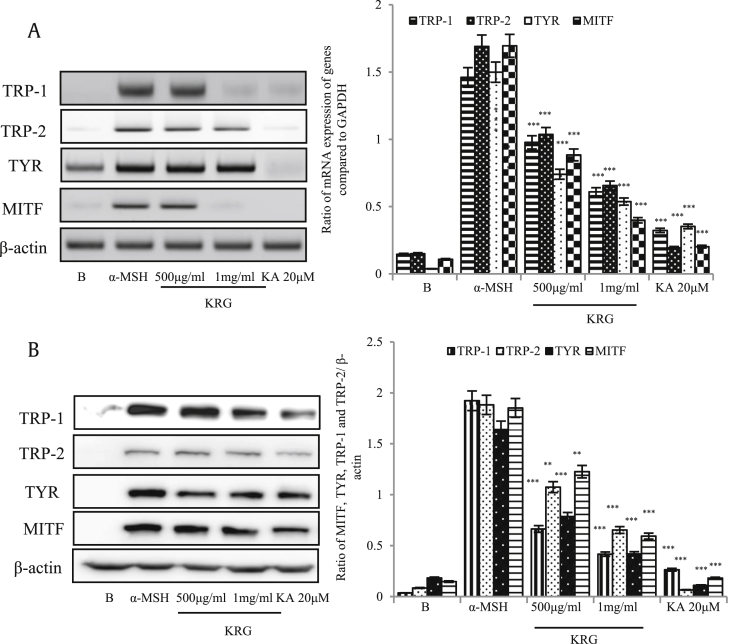
Decreased expression of MITF pathway genes induced by KRG. B16/F10 cells were seeded in 6-well plates, treated with the indicated concentrations of KRG, and then stimulated with α-MSH (10μM). Subsequently, RNA and proteins were extracted and MITF, TYR, TRP-1, and TRP-2 expression was measured by Quantitative Reverse Transcription Polymerase Chain Reaction (qRT-PCR) (A) and western blotting (B). GAPDH was used as the internal control qRT-PCR and β-actin was used as the internal control for western blotting. ***p < 0.001 and **p < 0.05 were considered as statistically significant against the α-MSH-treated group only. KRG, Korean Red Ginseng; α-MSH, α-melanocyte–stimulating hormone; MITF, microphthalmia-associated factor; TYR, tyrosinase; TRP-1, tyrosinase-related protein 1; TRP-2, tyrosinase-related protein 2.
Fig. 3
Fig. 3
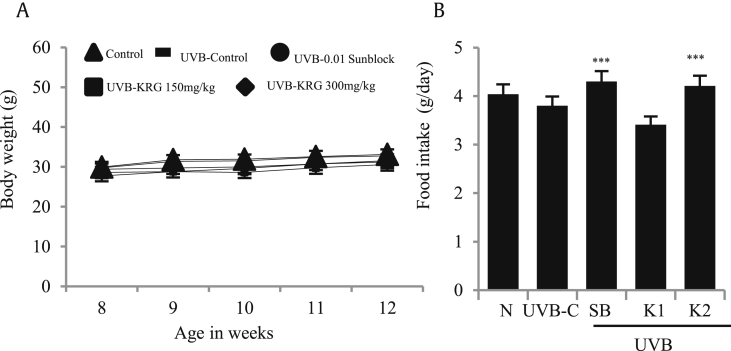
Effects of KRG on body weight and food intake. Food intake and body weight was measured daily for 5 weeks in HRM-2 mice. (A) No significant weight changes were observed in the control and treatment groups. (B) Daily food intake was significantly higher in the positive control and KRG-treated groups (N= HRM-2 control mice, UVB-C = control UVB-irradiated group, SB = 0.01% sunblock, K1= KRG 150mg/kg, and K2= KRG 300mg/kg). The values are expressed as the mean ± SEM from three independent experiments. ***p < 0.001 compared with UVB control. HRM-2 N = normal mice, UVB-C= HRM-2 mice control, exposed to UVB. KRG, Korean Red Ginseng; UVB, ultraviolet B.
Fig. 4
Fig. 4
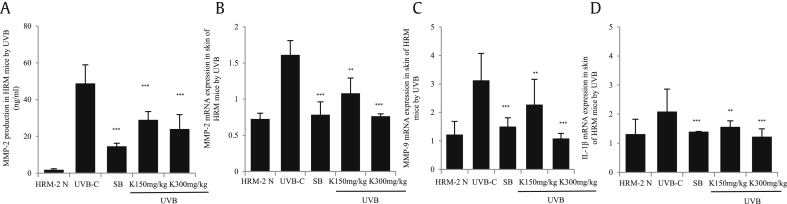
Analysis of wrinkle-related gene expression in UVB-irradiated skin. After 5 weeks, the skin tissues were isolated from HRM-2 mice and MMP-2, MMP-9, and IL-1β gene expression was analyzed. (A) MMP-2 production was significantly reduced by KRG, as determined by ELISA. (B) MMP-2 mRNA expressions was significantly decreased in both KRG-treated groups, as determined by qRT-PCR. (C) MMP-9 mRNA expressions was significantly decreased by KRG, as determined by qRT-PCR. (D) IL-1β expression was significantly decreased by KRG, as determined by qRT-PCR (K= KRG). The values in bar graphs are the mean ± SEM from three independent experiments. ***p < 0.001 and **p < 0.05 compared with the control UVB irradiated mice. KRG, Korean Red Ginseng; MMP, matrix metalloproteinase; IL, interleukin; ELISA, enzyme-linked immunosorbent assay.
Fig. 5
Fig. 5
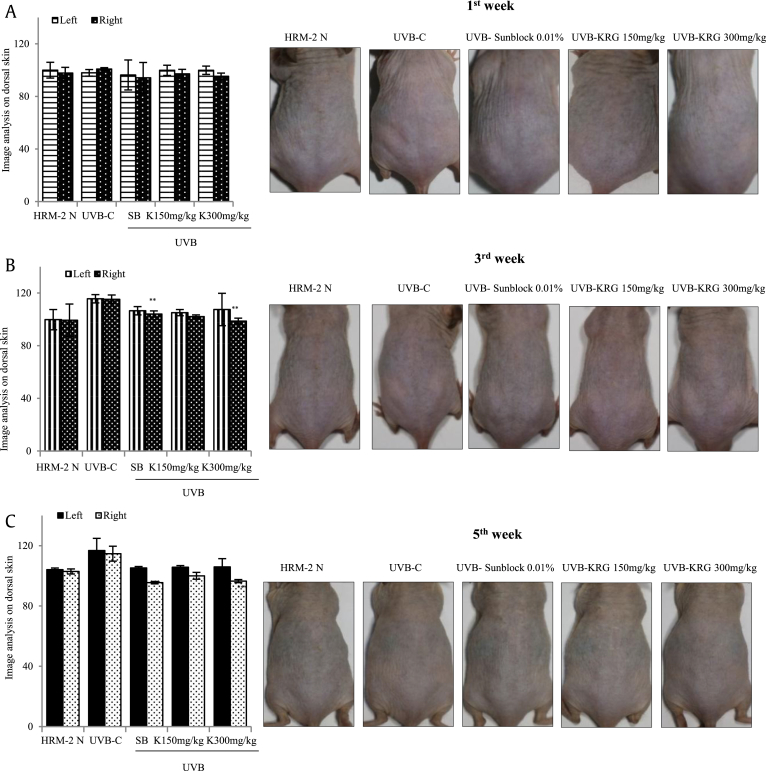
Effects of KRG on melanogenesis in UVB-irradiated skin. (A) No significant reduction was found in melanin production in any groups in Week 1. (B) A minor reduction was found in the melanin production in the KRG-treated group in Week 3. (C) A significant reduction was found in the melanin production in both KRG-treated groups in Week 5. The values in the bar graphs are the mean ± SEM from three independent experiments. ***p < 0.001and **p < 0.05 when compared with the control UVB-irradiated group. [HRM-2 N = normal mice, UVB-C= HRM-2 mice control (exposed to UVB), SB = 0.01% sunblock, and K= KRG]. KRG, Korean Red Ginseng; UVB, ultraviolet B.
Fig. 6
Fig. 6
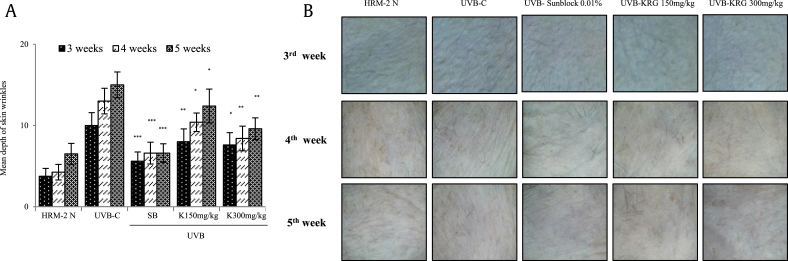
Effects of KRG on wrinkle depth and formation in HRM-2 mice. (A) A significant reduction was found in the depth of wrinkles in Weeks 3, 4, and 5 of KRG treatment. The values in bar graphs are the mean ± SEM from three independent experiments. ***p < 0.001, **p < 0.05, and *p < 0.01 compared with the control UVB-irradiated groups. (B) Wrinkle formation in Week 3, 4, and 5 of KRG treatment. HRM-2 N = normal mice, UVB-C= HRM-2 mice control (exposed to UVB), SB = 0.01% sunblock, and K= KRG. KRG, Korean Red Ginseng; UVB, ultraviolet B.
Fig. 7
Fig. 7
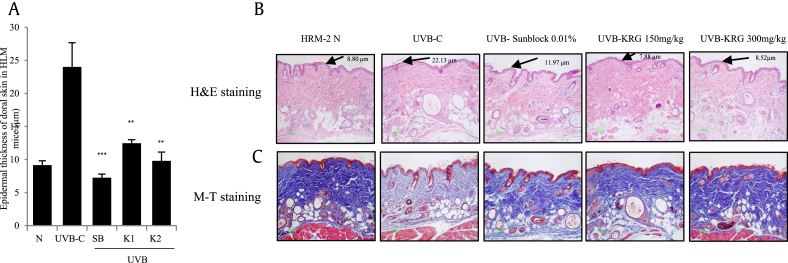
Effects of KRG on epithelial thickness and collagen fiber changes in UVB-irradiated HRM-2 mice. After 5 weeks, the skin tissues were stained with H&E and M-T staining and epithelial thickness was measured (A, B and C). The values in the bar graphs are the mean ± SEM from three independent experiments. ***p < 0.001 and **p < 0.05 compared with the UVB control. (N= HRM-2 control mice, UVB-C= ultraviolet-exposed control, SB = 0.01% sunblock, K1= KRG 150 mg/kg, and K2= KRG 300 mg/kg). KRG, Korean Red Ginseng; M-T, Masson's trichome; H&E, hematoxylin and eosin; UVB, ultraviolet B.

References

    1. Brenner M., Hearing V.J. The protective role of melanin against UV damage in human skin. Photochem Photobiol. 2008;84:539–549. - PMC - PubMed
    1. Kim D.S., Jeong Y.M., Park I.K., Hahn H.G., Lee H.K., Kwon S.B., Jeong J.H., Yang S.J., Sohn U.D., Park K.C. A new 2-imino-1,3-thiazoline derivative, KHG22394, inhibits melanin synthesis in mouse B16 melanoma cells. Biol Pharm Bull. 2007;30:180–183. - PubMed
    1. Kim D.S., Kim S.Y., Park S.H., Choi Y.G., Kwon S.B., Kim M.K., Na J.I., Youn S.W., Park K.C. Inhibitory effects of 4-n-butylresorcinol on tyrosinase activity and melanin synthesis. Biol Pharm Bull. 2005;28:2216–2219. - PubMed
    1. Kim H.R., Kim H., Jung B.J., You G.E., Jang S., Chung D.K. Lipoteichoic acid isolated from Lactobacillus plantarum inhibits melanogenesis in B16F10 mouse melanoma cells. Mol Cells. 2015;38:163–170. - PMC - PubMed
    1. Goldstein B. Ginseng: its history, dispersion, and folk tradition. Am J Chin Med (Gard City N Y) 1975;3:223–234. - PubMed