


Identifying Shared Risk Genes for Asthma, Hay Fever, and Eczema by Multi-Trait and Multiomic Association Analyses
- PMID: 32373153
- PMCID: PMC7176997
- DOI: 10.3389/fgene.2020.00270
Identifying Shared Risk Genes for Asthma, Hay Fever, and Eczema by Multi-Trait and Multiomic Association Analyses
Abstract
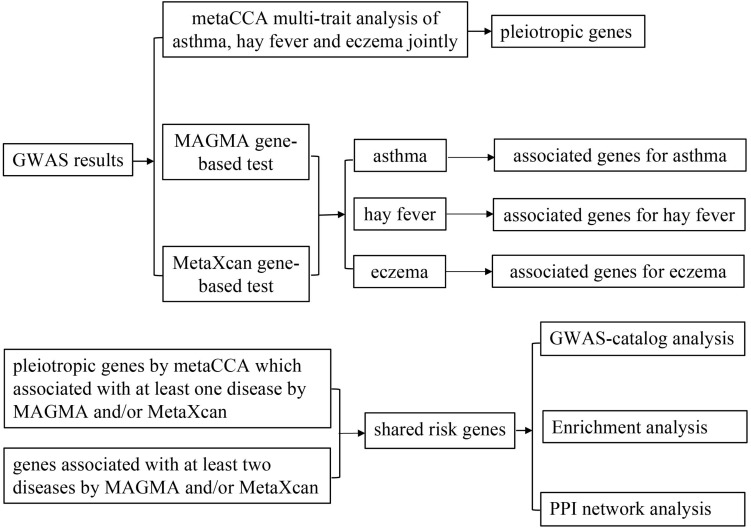
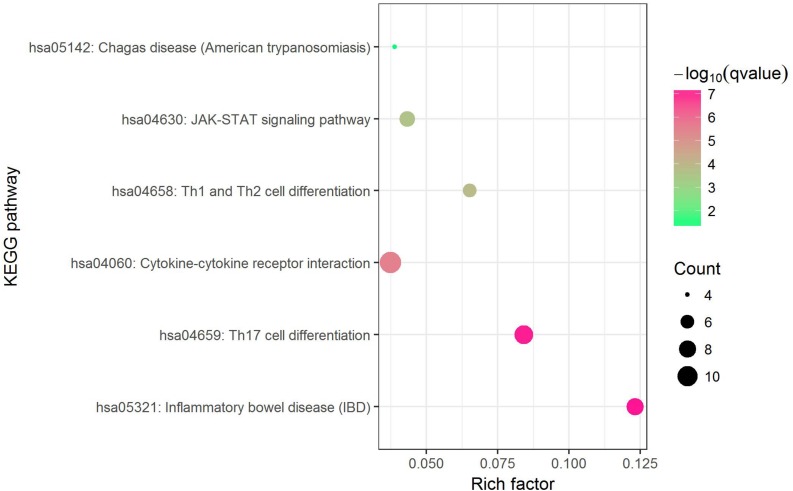
Asthma, hay fever and eczema are three comorbid diseases with high prevalence and heritability. Their common genetic architectures have not been well-elucidated. In this study, we first conducted a linkage disequilibrium score regression analysis to confirm the strong genetic correlations between asthma, hay fever and eczema. We then integrated three distinct association analyses (metaCCA multi-trait association analysis, MAGMA genome-wide and MetaXcan transcriptome-wide gene-based tests) to identify shared risk genes based on the large-scale GWAS results in the GeneATLAS database. MetaCCA can detect pleiotropic genes associated with these three diseases jointly. MAGMA and MetaXcan were performed separately to identify candidate risk genes for each of the three diseases. We finally identified 150 shared risk genes, in which 60 genes are novel. Functional enrichment analysis revealed that the shared risk genes are enriched in inflammatory bowel disease, T cells differentiation and other related biological pathways. Our work may provide help on treatment of asthma, hay fever and eczema in clinical applications.
Keywords: association studies; asthma; eczema; hay fever; multi-trait; multiomic; shared genes.
Copyright © 2020 Guo, An and Yu.
Figures
References
-
- Barbeira A. N., Dickinson S. P., Bonazzola R., Zheng J., Wheeler H. E., Torres J. M., et al. (2018). Exploring the phenotypic consequences of tissue specific gene expression variation inferred from GWAS summary statistics. Nature Communications 9 1825. 10.1038/s41467-018-03621-1 - DOI - PMC - PubMed
-
- Bhattacharjee S., Rajaraman P., Jacobs K. B., Wheeler W. A., Melin B. S., Hartge P., et al. (2012). A subset-based approach improves power and interpretation for the combined analysis of genetic association studies of heterogeneous traits. American Journal of Human Genetics 90 821–835. 10.1016/j.ajhg.2012.03.015 - DOI - PMC - PubMed
-
- Bulik-Sullivan B. K., Loh P.-R., Finucane H. K., Ripke S., Yang J. Schizophrenia Working Group of the Psychiatric Genomics Consortium,et al. (2015). LD score regression distinguishes confounding from polygenicity in genome-wide association studies. Nature Genetics 47 291–295. 10.1038/ng.3211 - DOI - PMC - PubMed
LinkOut - more resources
Full Text Sources
