


Real-World Nonmotor Changes in Patients with Parkinson's Disease and Motor Fluctuations: J-FIRST
- PMID: 32373660
- PMCID: PMC7197319
- DOI: 10.1002/mdc3.12939
Real-World Nonmotor Changes in Patients with Parkinson's Disease and Motor Fluctuations: J-FIRST
Abstract
Background: Nonmotor symptoms (NMSs) of Parkinson's disease (PD) impair health-related quality of life.
Objectives: To identify changes in NMSs during 52 weeks in Japanese PD patients exhibiting motor fluctuations.
Methods: In PD patients with ≥1 NMS and wearing-off, changes in total/subscore of the Movement Disorder Society Unified PD Rating Scale (MDS-UPDRS) Part I and 8-item PD Questionnaire were assessed. Group-based trajectory models were used to characterize longitudinal patterns of MDS-UPDRS Part I.
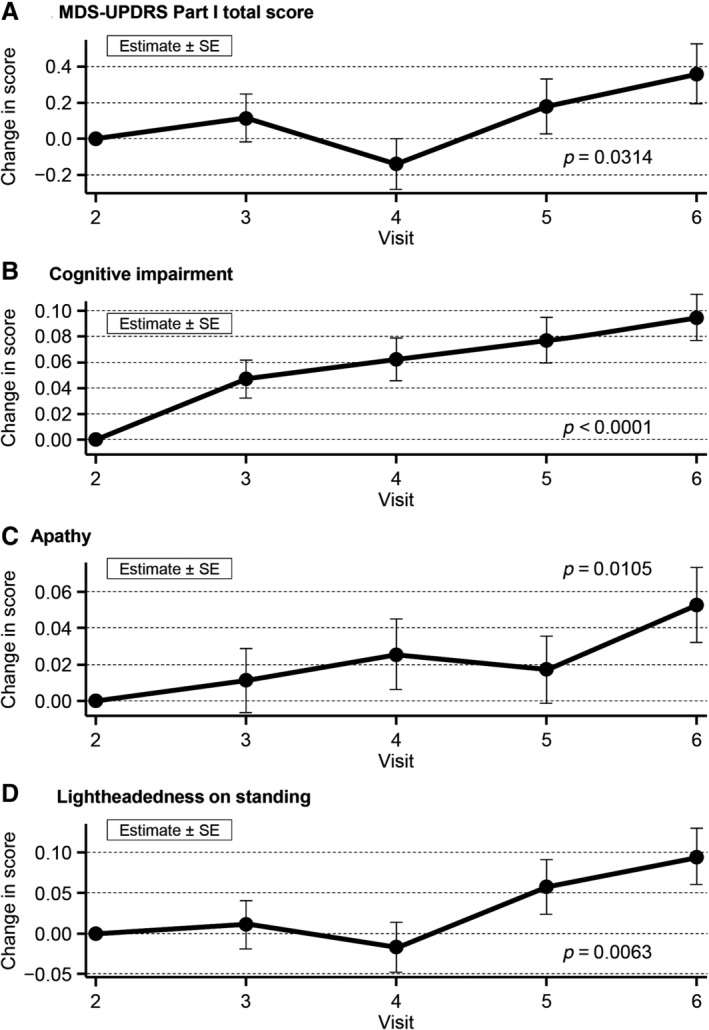
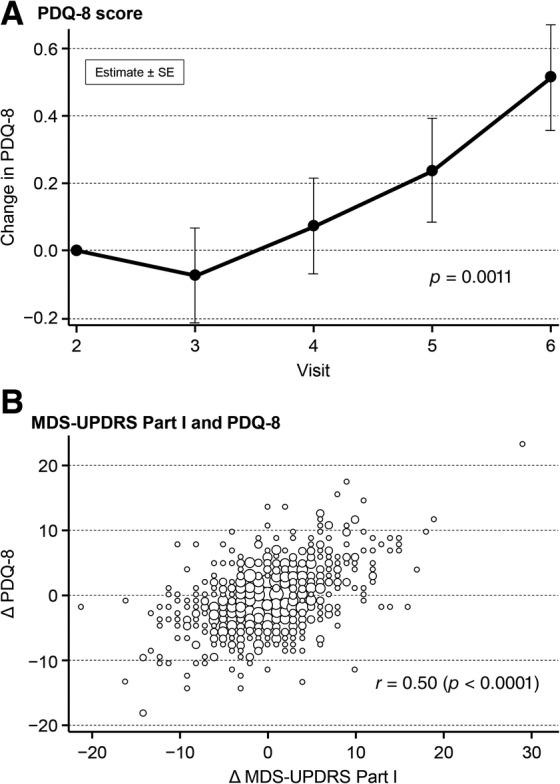
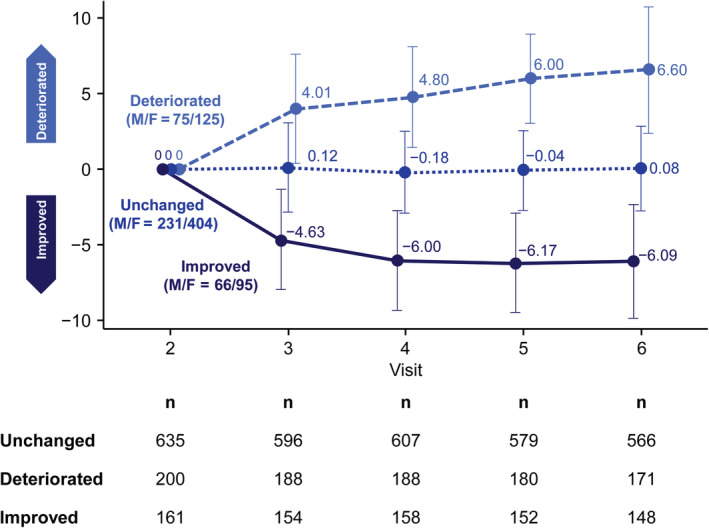
Results: Data from 996 patients were analyzed. MDS-UPDRS Part I subscores for cognitive function decreased linearly over time. Total and subscores for apathy and lightheadedness on standing significantly deteriorated with fluctuations, whereas other subscores fluctuated without significant deterioration. Changes in the MDS-UPDRS Part I total score correlated with changes in the 8-item PD Questionnaire total score. Based on group-based trajectory models, longitudinal pattern analysis of MDS-UPDRS Part I scores yielded the following 3 separate groups: unchanged (63.8%), deteriorated (20.1%), and improved (16.2%). The improved group had significantly more NMSs at baseline, significantly higher MDS-UPDRS Part I/8-item PD Questionnaire total scores, and modified Hoehn and Yahr scores, and had received treatment for NMSs. The multivariate analysis revealed significant associations between severe motor disability and receiving any treatment for NMSs at baseline and improvement of MDS-UPDRS Part I total scores.
Conclusions: Changes in MDS-UPDRS Part I scores were variable and related to changes in health-related quality of life in PD patients with motor fluctuations.
Keywords: Japan; Movement Disorder Society Unified Parkinson's Disease Rating Scale (MDS‐UPDRS); Parkinson's disease; nonmotor symptoms; observational study.
© 2020 The Authors. Movement Disorders Clinical Practice published by Wiley Periodicals, Inc. on behalf of International Parkinson and Movement Disorder Society.
Figures
References
-
- Schapira AHV, Chaudhuri KR, Jenner P. Non‐motor features of Parkinson disease. Nat Rev Neurosci 2017;18:435–450. - PubMed
-
- Poewe W, Seppi K, Tanner CM, et al. Parkinson disease. Nat Rev Dis Primers 2017;3:17013–17021. - PubMed
-
- Antonini A, Barone P, Marconi R, et al. The progression of non‐motor symptoms in Parkinson's disease and their contribution to motor disability and quality of life. J Neurol 2012;259:2621–2631. - PubMed
-
- Berg D, Postuma RB, Adler CH, et al. MDS research criteria for prodromal Parkinson's disease. Mov Disord 2015;30:1600–1611. - PubMed
-
- Marinus J, Zhu K, Marras C, Aarsland D, van Hilten J. Risk factors for non‐motor symptoms in Parkinson's disease. Lancet Neurol 2018;17:559–568. - PubMed
LinkOut - more resources
Full Text Sources
Research Materials
Miscellaneous
