


One in 5 Athletes Sustain Reinjury Upon Return to High-Risk Sports After ACL Reconstruction: A Systematic Review in 1239 Athletes Younger Than 20 Years
- PMID: 32374646
- PMCID: PMC7785893
- DOI: 10.1177/1941738120912846
One in 5 Athletes Sustain Reinjury Upon Return to High-Risk Sports After ACL Reconstruction: A Systematic Review in 1239 Athletes Younger Than 20 Years
Abstract
Context: Anterior cruciate ligament (ACL) reconstruction (ACLR) is frequently performed in patients younger than 20 years whose goal is to return to sport (RTS). Varying reinjury rates have been reported, and the factors responsible are unclear. Studies differ with regard to age, graft type, surgical techniques, postoperative rehabilitation, RTS guidelines, and methods used to determine ACL failures.
Objective: To determine RTS rates; the effect of participation in high-risk sports, sex, and graft type on ACL reinjury rates; and whether objective test criteria before RTS correlate with lower reinjury rates.
Data sources: A systematic review of the literature from inception to May 31, 2019, was conducted using the PubMed and Cochrane databases.
Study selection: Studies on transphyseal ACLR in athletes <20 years old with a minimum mean follow-up of 2 years that reported reinjury rates, the number that RTS, and detailed the type of sport were included.
Study design: Systematic review.
Level of evidence: Level 4.
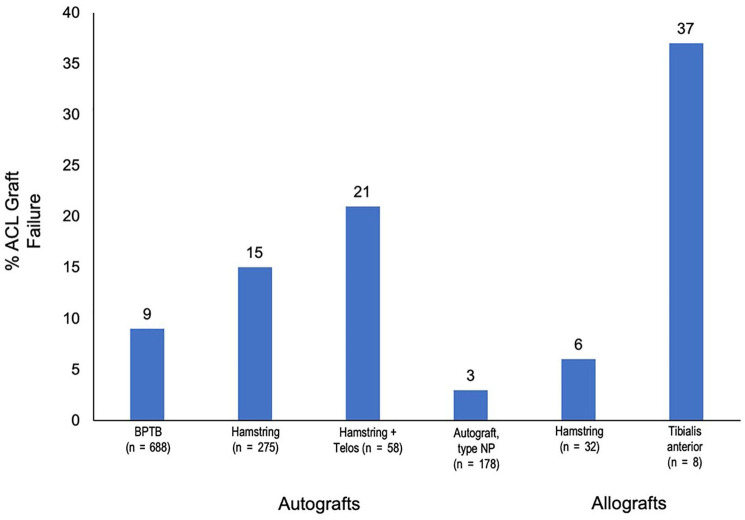
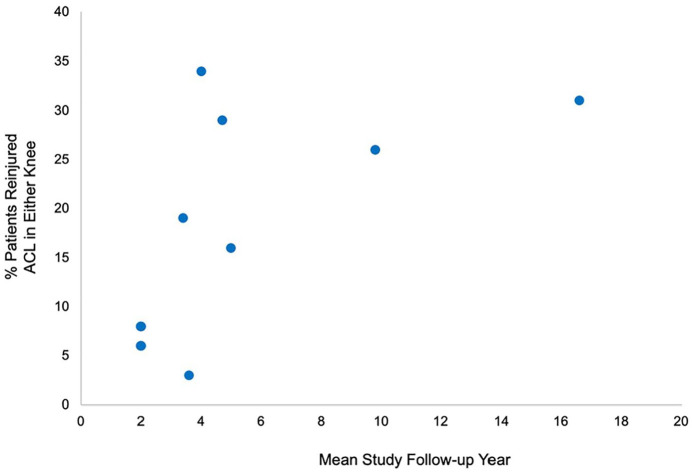
Results: A total of 1239 patients in 8 studies were included; 87% returned to sport and 80% resumed high-risk activities. Of the patients, 18% reinjured the ACL graft and/or the contralateral ACL. Nine percent of patellar tendon autografts and 15% of hamstring autografts failed (odds ratio [OR], 0.52; P = 0.002). Of reinjuries, 90% occurred during high-risk sports. Male patients had a significantly higher rate of ACL graft failure than female patients (OR, 1.64; P = 0.01). There was no sex-based effect on contralateral ACL injuries. Only 1 study cited objective criteria for RTS.
Conclusion: A high percentage of athletes returned to sport, but 1 in 5 suffered reinjuries to either knee. Male patients were more likely to reinjure the ACL graft. Objective criteria for RTS were rarely mentioned or not detailed. The need for testing of knee stability, strength, neuromuscular control, agility, and psychological measures before RTS remains paramount in young athletes.
Keywords: ACL reconstruction; ACL reinjury; return to sport; transphyseal ACL reconstruction.
Conflict of interest statement
The authors report no potential conflicts of interest in the development and publication of this article.
Figures
References
-
- Allen MM, Pareek A, Krych AJ, et al. Are female soccer players at an increased risk of second anterior cruciate ligament injury compared with their athletic peers? Am J Sports Med. 2016;44:2492-2498. - PubMed
-
- Andernord D, Desai N, Bjornsson H, Gillen S, Karlsson J, Samuelsson K. Predictors of contralateral anterior cruciate ligament reconstruction: a cohort study of 9061 patients with 5-year follow-up. Am J Sports Med. 2015;43:295-302. - PubMed
-
- Andernord D, Desai N, Bjornsson H, Ylander M, Karlsson J, Samuelsson K. Patient predictors of early revision surgery after anterior cruciate ligament reconstruction: a cohort study of 16,930 patients with 2-year follow-up. Am J Sports Med. 2015;43:121-127. - PubMed
-
- Anderson AF, Snyder RB, Lipscomb AB., Sr Anterior cruciate ligament reconstruction using the semitendinosus and gracilis tendons augmented by the loose iliotibial band tenodesis. A long-term study. Am J Sports Med. 1994;22:620-626. - PubMed
-
- Ardern CL, Glasgow P, Schneiders A, et al. 2016 Consensus statement on return to sport from the First World Congress in Sports Physical Therapy, Bern. Br J Sports Med. 2016;50:853-864. - PubMed
Publication types
MeSH terms
LinkOut - more resources
Full Text Sources
Medical
