. 2020 Jun 19;48(11):6223-6233.
doi: 10.1093/nar/gkaa336.

eIF4G has intrinsic G-quadruplex binding activity that is required for tiRNA function

Affiliations

eIF4G has intrinsic G-quadruplex binding activity that is required for tiRNA function

Shawn M Lyons et al. Nucleic Acids Res. .

Abstract

As cells encounter adverse environmental conditions, such as hypoxia, oxidative stress or nutrient deprivation, they trigger stress response pathways to protect themselves until transient stresses have passed. Inhibition of translation is a key component of such cellular stress responses and mounting evidence has revealed the importance of a class of tRNA-derived small RNAs called tiRNAs in this process. The most potent of these small RNAs are those with the capability of assembling into tetrameric G-quadruplex (G4) structures. However, the mechanism by which these small RNAs inhibit translation has yet to be elucidated. Here we show that eIF4G, the major scaffolding protein in the translation initiation complex, directly binds G4s and this activity is required for tiRNA-mediated translation repression. Targeting of eIF4G results in an impairment of 40S ribosome scanning on mRNAs leading to the formation of eIF2α-independent stress granules. Our data reveals the mechanism by which tiRNAs inhibit translation and demonstrates novel activity for eIF4G in the regulation of translation.


Figures

Figure 1.
Figure 1.
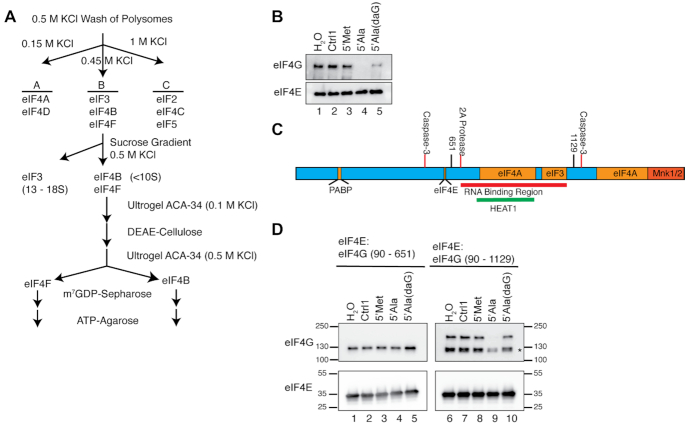
G4-tiRNAs directly target eIF4F. (A) Strategy of purification of eIF4F adapted from (16). (B) Purified human eIF4F is sensitive to TOG containing tiRNAs in a G-quadruplex dependent manner. Purified eIF4F was bound to m7GTP-agarose and challenged with indicated small RNAs. 5′tiRNAAla efficiently disrupted the eIF4F complex, but 5′tiRNAAla(daG), which cannot form a G4 efficiently had reduced activity. (C) Schematic of eIF4G indicating domains required for interaction with other proteins (orange), protease cleavage sites (red lines), sites of truncations (black lines). RNA Binding region (red bar) and HEAT1 repeat (green bar) are indicated. (D) Recombinant eIF4G containing the RNA binding region is sensitive to 5′tiRNAAla. eIF4E and truncation of eIF4G were expressed and purified from E. coli, bound to m7GTP-agarose and challenged with indicated RNAs. 5′tiRNAAla could disrupt eIF4F when eIF4G retained the RNA binding regions (90–1129). This disruption was dependent upon G4 formation as 5′tiRNAAla(daG) is incapable of disrupting eIF4F.
Figure 2.
Figure 2.
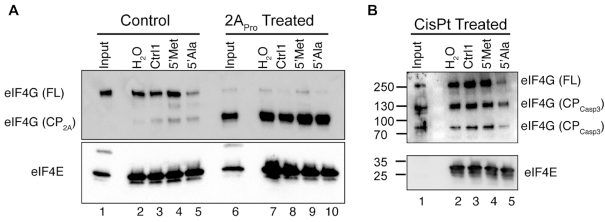
Endogenously expressed eIF4G requires the RNA binding region for G4-tiRNA activity. (A) eIF4G was cleaved with poliovirus 2A protease which separated the eIF4E binding site from the RNA binding region. This fragment was purified on m7GTP-agarose based on its ability to interact with eIF4E. Full length (FL) eIF4G is sensitive to 5′tiRNAAla but the 2A protease cleavage product (cp2A), which lacks the RNA binding region, is insensitive. (B) eIF4G was cleaved by activated caspase3 after induction of apoptosis by cisplatin. The cleavage product containing the eIF4E binding site retains the RNA binding region but lacks the N- and C-termini. This cleavage product (cpcasp3) was purified on m7GTP-agarose and challenged with different small RNAs. It remained sensitive to 5′tiRNAAla.
Figure 3.
Figure 3.
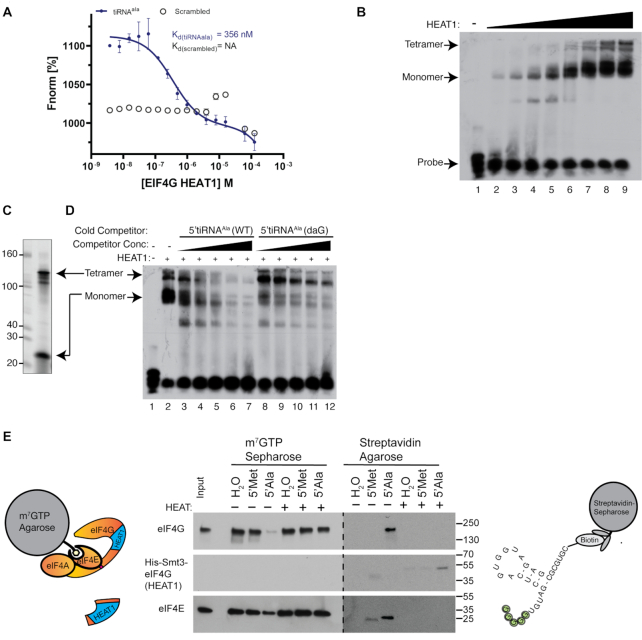
The HEAT1 repeat of eIF4G interacts with 5′tiRNAAla and is required for activity. (A) eIF4G(HEAT1) was expressed and purified from E. coli. Microscale thermophoresis demonstrate that this domain interacted with 5′tiRNAAla (closed circles), but not a scrambled G-rich control (open circles). (B) RNA electrophoresis mobility shift assays (rEMSAs) confirm the interaction between eIF4G(HEAT1) and 5′tiRNAAla and also show that two different complexes are shifted. Lanes 1–9 were shifted with 0, 1.5, 3, 6, 12.5, 25, 50, 100 and 125 pmol of protein. (C) 5′tiRNAAla in the absence of proteins exists as two conformers as previously shown (9). (D) In a cold competition assay, the upper tetrameric complex is efficiently competed by unmodified 5′tiRNAAla. However, the upper band is less sensitive to 5′tiRNAAla(daG), which cannot assemble into G-quadruplex structures. Lanes 3 & 8, 4 & 9, 5 & 10, 6 & 11, 7 & 12 were competed with 6.25, 12.5, 25, 50 and 100 pmol of cold competitors, respectively. (E) 5′tiRNAAla’s interaction with the eIF4G(HEAT1) domain is required for tiRNA activity. m7GTP binding assays were performed with or without supplementation with recombinant eIF4G(HEAT1). Supplementation with this recombinant protein blocked 5′tiRNAAla activity against eIF4F. Upon recovery of tiRNA bound proteins by streptavidin-sepharose, eIF4G was purified without supplementation and eIF4G(HEAT1) was purified with supplementation.
Figure 4.
Figure 4.
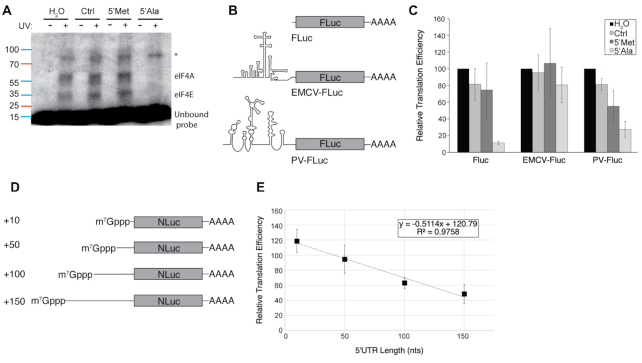
5′tiRNAAla blocks the scanning step of translation initiation. (A) 5′tiRNAAla abolishes eIF4E and eIF4A crosslinks to a synthetic 5′UTR. A capped radiolabelled RNA was in incubated in rabbit reticulocyte lysate with indicated unlabelled RNAs. Lystates were crosslinked, run on an SDS-PAGE gel and visualized by autoradiography. Results indicate that eIF4A is efficiently displaced from the RNA along with eIF4E. An unidentified protein (*) is unaffected by 5′tiRNAAla. (B) Firefly luciferase reporter constructs were generated without an IRES, with the EMCV IRES or with the poliovirus IRES. (C) 5′tiRNAAla blocks uncapped RNA translation but EMCV IRES is refractory to 5′tiRNAAla activity as monitored by luciferase activity. However, poliovirus IRES driven translation is sensitive to 5′tiRNAAla suggesting that scanning is the sensitive step. (D) Capped NanoLuc reporters were generated with differing 5′ UTR lengths to increase the requirement for scanning (E) As 5′ UTR length and requirement for scanning increases, so does the translation inhibitory activity of 5′tiRNAAla as measured by luciferase activity. The effect on each individual 5′UTR reporter was normalized to an in vitro translation assay completed without treatment with 5′tiRNAAla.

References

    1. Holcik M., Sonenberg N.. Translational control in stress and apoptosis. Nat. Rev. Mol. Cell Biol. 2005; 6:318–327. - PubMed
    1. Yamasaki S., Ivanov P., Hu G.F., Anderson P.. Angiogenin cleaves tRNA and promotes stress-induced translational repression. J. Cell Biol. 2009; 185:35–42. - PMC - PubMed
    1. Akiyama Y., Lyons S.M., Fay M.M., Abe T., Anderson P., Ivanov P.. Multiple ribonuclease A family members cleave transfer RNAs in response to stress. 2019; bioRxiv doi:21 October 2019, preprint: not peer reviewed 10.1101/811174. - DOI
    1. Ivanov P., Emara M.M., Villen J., Gygi S.P., Anderson P.. Angiogenin-induced tRNA fragments inhibit translation initiation. Mol. Cell. 2011; 43:613–623. - PMC - PubMed
    1. Donovan J., Rath S., Kolet-Mandrikov D., Korennykh A.. Rapid RNase L-driven arrest of protein synthesis in the dsRNA response without degradation of translation machinery. RNA. 2017; 23:1660–1671. - PMC - PubMed

Publication types

MeSH terms