


Contasure-needleless single incision slings versus transobturator slings (TOT/TVT-O) for female patients with stress urinary incontinence: a systematic review and meta-analysis
- PMID: 32375733
- PMCID: PMC7204064
- DOI: 10.1186/s12894-020-00622-5
Contasure-needleless single incision slings versus transobturator slings (TOT/TVT-O) for female patients with stress urinary incontinence: a systematic review and meta-analysis
Abstract
Background: To assess the current evidence on the effectiveness and safety of Contasure-Needleless (C-NDL) versus transobturator slings (TOT/TVT-O) in the management of female stress urinary incontinence (SUI).
Methods: A comprehensive literature review of articles that investigated the efficacy and safety of C-NDL and TOT/TVT-O was performed based on studies published before June 2019 and retrieved from PubMed, Embase, CNKI and the Cochrane Library. Two reviewers searched the literature, independently extracted the data and evaluated the quality of the data according to the inclusion and exclusion criteria. A meta-analysis was performed by using Review Manager 5.3 software.
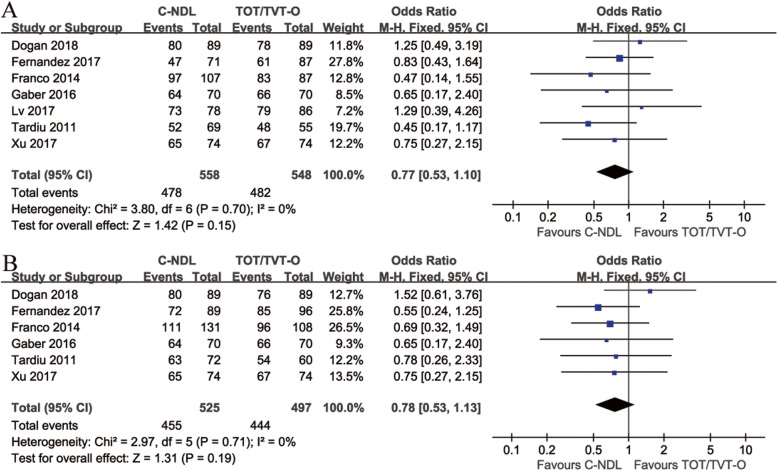
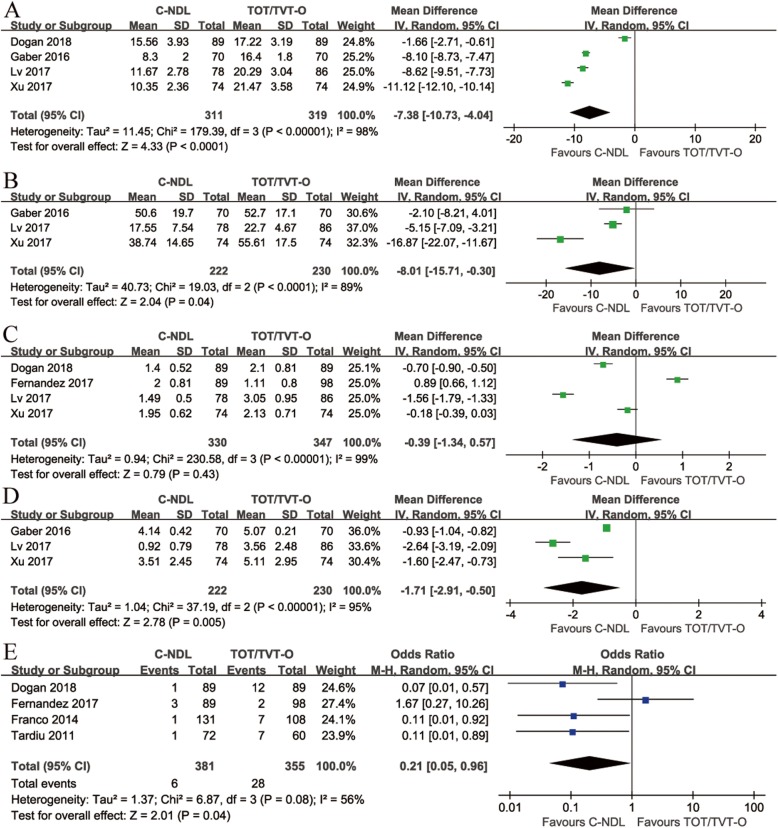
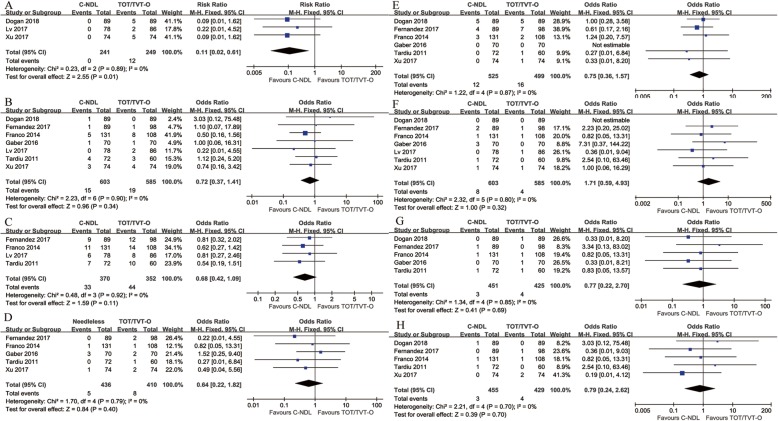
Results: Seven studies with 1188 SUI female patients without intrinsic sphincter deficiency (ISD) or mixed urinary incontinence were included. Our meta-analysis showed that the clinical efficacy of C-NDL is statistically non-inferior to that of TOT / TVT-O in terms of subjective cure rate [OR = 0.77, 95% confidence interval (CI) (0.53 to 1.10), p = 0.15] and objective cure rate [OR = 0.78, 95% CI (0.53 to 1.13), p = 0.19]. In addition, operating times were statistically shorter with C-NDL compared to TOT / TVT-O [mean difference (MD) = - 7.38, 95% CI (- 10.73 to - 4.04), p < 0.0001]. In terms of the postoperative visual analogue scale (VAS) and the incidence of postoperative pain, C-NDL has a greater advantage [MD = - 1.71, 95% CI (- 2.91 to - 0.50), p = 0.005]; [OR = 0.21, 95% CI (0.05 to 0.96), p = 0.04]. Complication rates were statistically similar between the groups, except for groin pain which was higher in TOT / TVT-O.
Conclusion: Our data suggest that C-NDL slings have similar short-term efficacy as TOT/TVT-O in curing SUI patients. Compared with TOT/TVT-O, C-NDL is associated with a shorter operative time, and the incidence of postoperative pain is decreased. Nevertheless, these findings should be further confirmed through large-volume, well-designed prospective randomized controlled trials (RCTs) with long-term follow-up.
Keywords: Female stress urinary incontinence; Mini-slings; Needleless; Transobturator sling; Zhenkai Luo and Binbin Jiao are co-first authors..
Conflict of interest statement
The authors declare that they have no competing interests.
Figures

References
-
- Donkelaar CST, Rosier PFWM, Kort LMOD. 990 international continence society definition of detrusor underactivity; analysis of clinical parameters and comparison with contractility grading methods. J Urol. 2016;195(4):e975.
-
- Hay-Smith J, Herderschee R, Dumoulin C, Herbison P. Comparisons of approaches to pelvic floor muscle training for urinary incontinence in women: an abridged Cochrane systematic review. Eur J Phys Rehabil Med. 2012;48(4):689–705. - PubMed
Publication types
MeSH terms
LinkOut - more resources
Full Text Sources
Medical
