


Post-transplant cyclophosphamide after matched sibling, unrelated and haploidentical donor transplants in patients with acute myeloid leukemia: a comparative study of the ALWP EBMT
- PMID: 32375860
- PMCID: PMC7201995
- DOI: 10.1186/s13045-020-00882-6
Post-transplant cyclophosphamide after matched sibling, unrelated and haploidentical donor transplants in patients with acute myeloid leukemia: a comparative study of the ALWP EBMT
Abstract
Background: The use of post-transplant cyclophosphamide (PTCy) is highly effective in preventing graft-versus-host disease (GVHD) in the haploidentical (Haplo) transplant setting and is being increasingly used in matched sibling (MSD) and matched unrelated (MUD) transplants. There is no information on the impact of donor types using homogeneous prophylaxis with PTCy.
Methods: We retrospectively compared outcomes of adult patients with acute myeloid leukemia (AML) in first complete remission (CR1) who received a first allogeneic stem cell transplantation (SCT) with PTCy as GVHD prophylaxis from MSD (n = 215), MUD (n = 235), and Haplo (n = 789) donors registered in the EBMT database between 2010 and 2017.
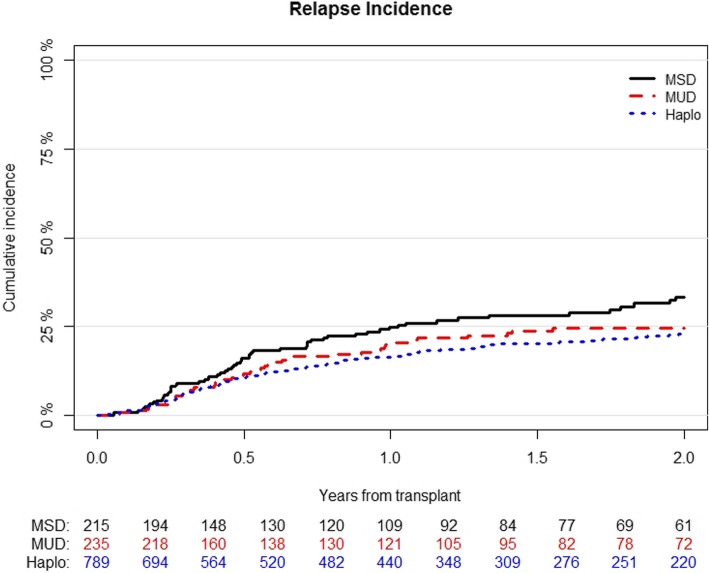
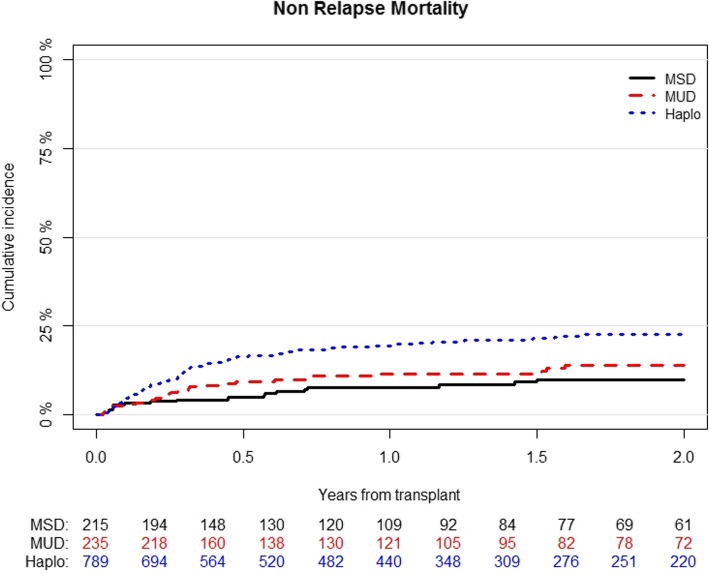
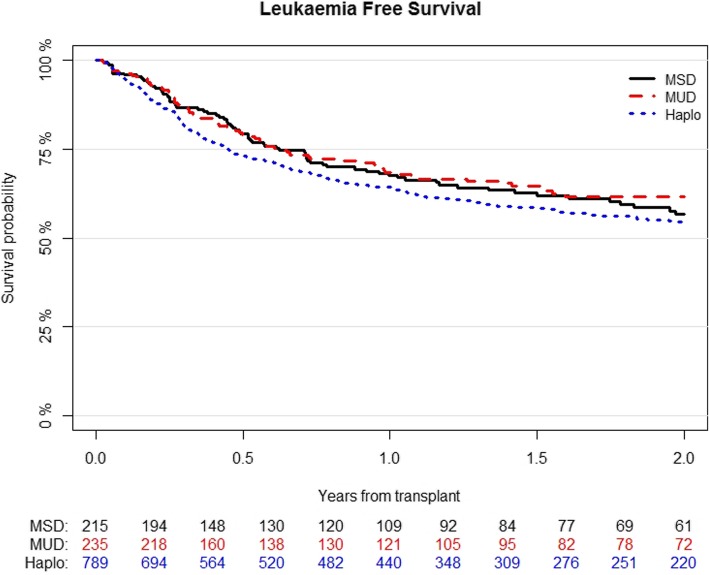
Results: The median follow-up was 2 years. Haplo-SCT carried a significantly increased risk of acute grade II-IV GVHD (HR 1.6; 95% CI 1.1-2.4) and NRM (HR 2.6; 95% CI 1.5-4.5) but a lower risk of relapse (HR 0.7; 95% CI 0.5-0.9) that translated to no differences in LFS (HR 1.1; 95% CI 0.8-1.4) or GVHD/relapse-free survival (HR 1; 95% CI 0.8-1.3). Interestingly, the use of peripheral blood was associated with an increased risk of acute (HR 1.9; 95% CI 1.4-2.6) and chronic GVHD (HR 1.7; 95% CI 1.2-2.4) but a lower risk of relapse (HR 0.7; 95% CI 0.5-0.9).
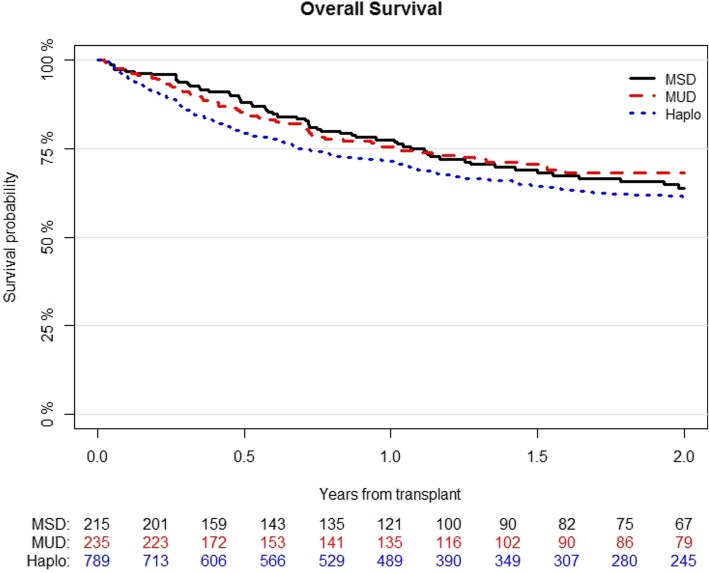
Conclusions: The use of PTCy in patients with AML in CR1 receiving SCT from MSD, MUD, and Haplo is safe and effective. Haplo-SCT had increased risk of acute GVHD and NRM and lower relapse incidence but no significant difference in survival.
Keywords: Acute leukemia; Allogeneic stem cell transplant; Alternative donor transplants; Haploidentical transplant; Post-transplant cyclophosphamide.
Conflict of interest statement
The authors declare no competing interests.
Figures
References
-
- Luznik L, O’Donnell PV, Symons HJ, et al. HLA-haploidentical bone marrow transplantation for hematologic malignancies using nonmyeloablative conditioning and high-dose, posttransplantation cyclophosphamide. Biol Blood Marrow Tr. 2008;14(6):641–650. doi: 10.1016/j.bbmt.2008.03.005. - DOI - PMC - PubMed
-
- Kanakry CG, O’Donnell PV, Furlong T, et al. Multi-institutional study of post-transplantation cyclophosphamide as single-agent graft-versus-host disease prophylaxis after allogeneic bone marrow transplantation using myeloablative busulfan and fludarabine conditioning. J Clin Oncol. 2014;32(31):3497–3505. doi: 10.1200/JCO.2013.54.0625. - DOI - PMC - PubMed
Publication types
MeSH terms
Substances
LinkOut - more resources
Full Text Sources
Medical
